

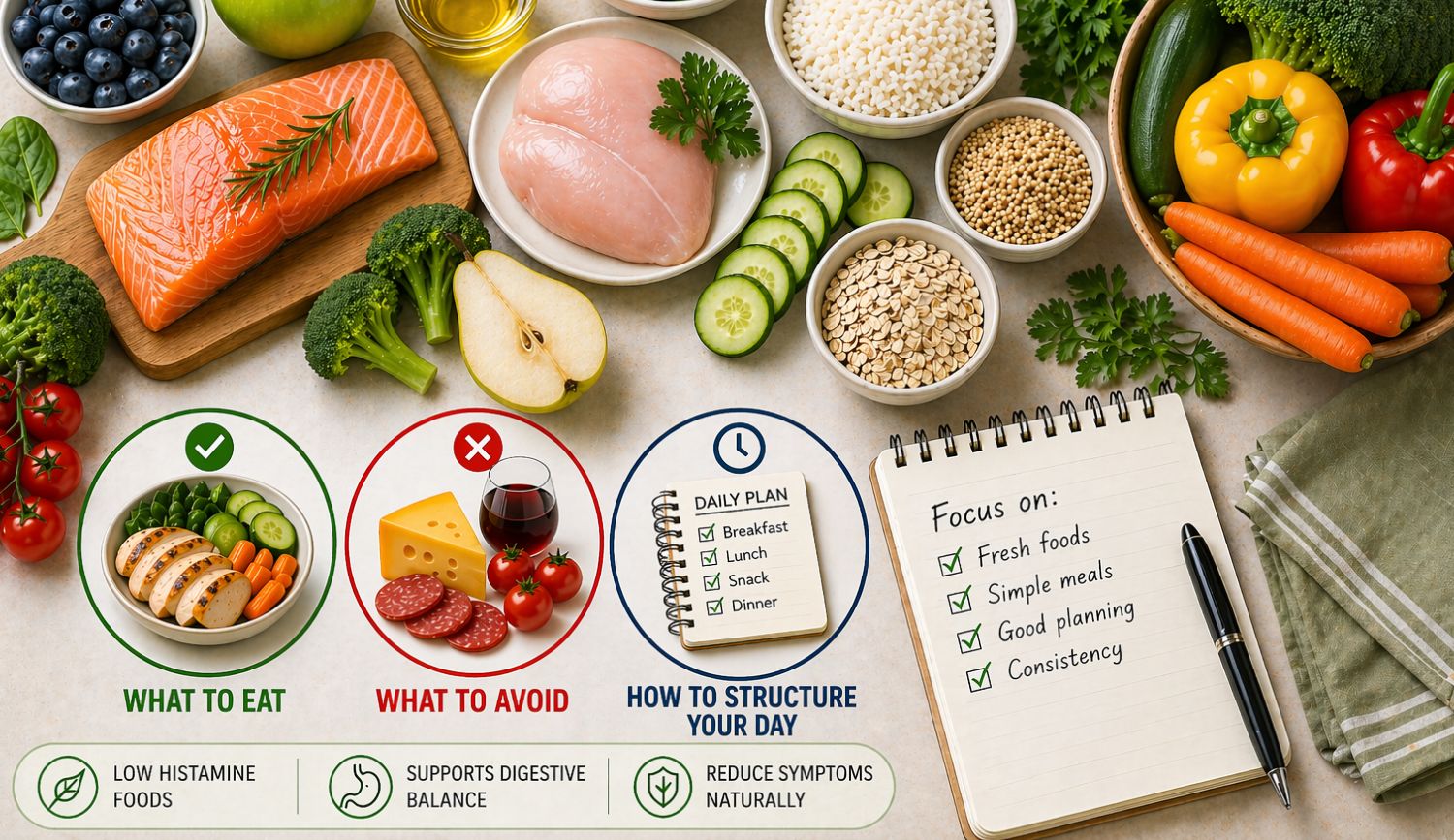
A low histamine diet plan reduces how much histamine you take in through food. People try it after noticing a pattern between certain meals and symptoms like flushing, headaches, or digestive discomfort.
It isn’t a single, standardized medical diet with one official food list. Published low-histamine diets used in research and practice actually disagree with each other quite a bit.
Because of that, the most useful way to approach this is as a structured, individualized trial rather than a permanent list of forbidden foods. In practice, food histamine content can vary with fermentation, processing, handling, storage conditions, and the individual food itself, while personal tolerance may also differ considerably.
This guide walks through what a low histamine diet actually involves, how to start one sensibly, what a practical day looks like, and how to move toward reintroduction rather than indefinite restriction.
What is a low histamine diet?
A low histamine diet reduces the amount of histamine you eat. It doesn’t remove histamine already in your body, and it isn’t a treatment that resolves an underlying cause on its own.
There’s no single, universally agreed food list. Different published versions of this diet — used in different studies and clinics — exclude different foods, sometimes for different reasons.
That’s why it’s most useful as a structured, individualized trial: a temporary, deliberate reduction, followed by careful reintroduction, rather than permanent maximal restriction.
How does a low histamine diet work?
The basic idea is that less dietary histamine may mean less for your body to process, which may reduce symptoms for some people.
Diamine oxidase (DAO) is involved in metabolizing extracellular histamine and is commonly discussed in relation to dietary histamine in the intestinal environment. Reduced intestinal DAO activity has been proposed as one mechanism that could contribute to reactions after histamine-containing foods, but it does not provide a complete or universally established explanation for suspected histamine intolerance.
A low histamine diet doesn’t “heal” or restore DAO function, and it doesn’t work by emptying some kind of measurable internal reservoir. If you’ve seen the “histamine bucket” analogy used to explain this, it’s a teaching tool, not literal physiology.
Response to the diet also varies a lot between individuals, which is one reason a single good or bad week doesn’t tell you as much as it might seem to.
Who might consider trying a low histamine diet?
People who notice a repeated pattern between certain meals and symptoms — flushing, hives, headaches, digestive upset, nasal congestion — sometimes try a low histamine diet as part of figuring out what’s going on.
It’s worth being clear about what this can and can’t tell you. These symptoms are nonspecific, meaning they show up in plenty of conditions beyond suspected histamine intolerance. Feeling better on the diet doesn’t confirm a histamine-related cause by itself — many things change when someone alters their diet, not just histamine intake.
This diet also isn’t a way to diagnose mast cell activation syndrome (MCAS). MCAS has its own separate diagnostic criteria, and a response to a low-histamine diet doesn’t establish it.
Anyone with a history of severe or systemic allergic reactions should get a proper medical evaluation before starting any self-directed elimination approach.
What foods are usually limited on a low histamine diet?
Rather than a giant avoidance directory, it helps to think in categories. Foods commonly limited during an initial trial tend to be fermented, aged, cured, or otherwise shaped by microbial activity during processing or storage.
| Category | Commonly limited initially | Important nuance |
|---|---|---|
| Aged and fermented dairy | Aged cheeses and some cultured dairy products | Histamine content can vary with aging time, microorganisms, processing, and storage |
| Cured and fermented proteins | Cured meats, fermented meats, and some processed fish products | Food type, microbial activity, handling, and storage conditions all matter |
| Fermented vegetables and condiments | Sauerkraut, kimchi, some fermented soy sauces, and vinegar-based products | Fermentation can increase biogenic amines, but levels vary substantially by product |
| Alcoholic beverages | Wine, beer, and some other fermented drinks | Histamine content varies by beverage and production method; alcohol may also affect histamine handling |
| Processed and stored foods | Selected canned, smoked, aged, or heavily processed products | Histamine levels vary by food and can be influenced by processing, microbial activity, handling, time, and temperature |
If you want to examine individual foods more closely, our high histamine foods guide explains which categories tend to contain more histamine, why levels vary, and where the evidence is less certain.
You’ll also see fresh foods like citrus, tomatoes, and some fruits on avoidance lists despite containing relatively little measured histamine themselves. These are sometimes called “histamine liberators,” based on the idea that they trigger the body’s own histamine release. The evidence behind many specific liberator classifications is limited and inconsistent, so it’s worth treating categorical liberator lists with some skepticism.
If you want to dig deeper into this debate, our guide to histamine liberators looks at the evidence behind these claims and why many food lists disagree.
What can you eat on a low histamine diet?
Despite the restrictions above, this diet can still include real variety. Freshly prepared foods across most categories are commonly used as starting options.
| Category | Often used as starting options | Important nuance |
|---|---|---|
| Freshly prepared proteins | Freshly cooked poultry, eggs, and appropriately handled fish or other tolerated proteins | Histamine content can vary with species, handling, storage conditions, and freshness; fish requires particular attention to temperature control |
| Grains and starches | Rice, oats, quinoa, potatoes, and other tolerated grains or starches | These are commonly used as meal bases, but individual tolerance and other dietary needs still matter |
| Vegetables | A variety of fresh, non-fermented vegetables commonly included on lower-histamine food lists | Published lists disagree on some vegetables, so individual tolerance remains important |
| Fruit | Selected fresh fruits commonly included on lower-histamine food lists | Published lists disagree on several fruits, and individual tolerance varies |
| Fats | Olive oil, butter if tolerated, and other simple fats | Histamine content is generally not the main issue, but additives, freshness, and individual tolerance can still matter |
For a more detailed starting point, our low histamine food list organizes commonly used options by category and explains where individual tolerance matters.
Why low histamine food lists disagree
This is worth understanding clearly, because it changes how you should use any food list — including this one.
A 2021 review compared multiple published low-histamine diets and found substantial disagreement about which foods should be excluded.¹ Fermentation was one of the more consistent concerns across lists. But many other exclusions varied widely from one published diet to another, and a meaningful share of commonly excluded foods weren’t clearly justified by their measured histamine content.
Part of the explanation is that histamine and related biogenic amines in food aren’t fixed values. They vary with microbial activity, fermentation method, raw material, processing, handling, and storage time and temperature.² The same food, produced or stored differently, can end up with meaningfully different histamine levels.
Freshness can influence histamine formation in some foods, but “fresh” should not be treated as a synonym for “histamine-free.” The food itself, processing method, microbial activity, handling, and storage conditions can all matter.
This is why personalization matters more than any single master list. No food list, including a well-researched one, can predict every person’s individual response.
Do freshness, leftovers, and storage matter?
Freshness genuinely matters, mainly because microbial activity contributes to histamine and biogenic amine formation in food over time. That’s a real, evidence-supported concern, particularly for fish and other proteins.²
Some common claims go further than the evidence supports, though. Refrigeration itself doesn’t create histamine — it slows microbial activity, which is why it’s a normal food-safety practice, not something to avoid. Histamine doesn’t reliably “double” on any fixed schedule. Freezing doesn’t remove histamine that has already formed, and reheating a meal doesn’t create histamine by itself. No single food-safety cutoff makes every leftover automatically unsafe.
Reasonable, practical habits include:
- Buying appropriately fresh ingredients, especially fish and other proteins
- Maintaining normal cold-chain practices — refrigerating promptly rather than leaving perishables out
- Avoiding unnecessarily long storage of perishable leftovers
- Portioning and freezing food when that’s practical for your routine
- Thawing food safely, using standard food-safety guidance
These are sensible defaults, not guarantees of low histamine content.
A simple low histamine diet plan to get started
A useful starting plan doesn’t need to be complicated. Building meals around simple formulas makes it easier to stay varied while keeping the trial structured.
Breakfast formula: protein or a tolerated alternative + a carbohydrate + a fruit or vegetable + a fat
Lunch formula: freshly prepared protein + a grain or starch + vegetables + a tolerated dressing or fat
Dinner formula: fresh protein + a starch + vegetables + simple seasoning
Snack formula: one simple tolerated carbohydrate or fruit + protein or fat where appropriate
One sample day:
- Breakfast: scrambled eggs cooked in butter with sautéed vegetables, white rice or plain toast, and fresh apple
- Snack: pear, or a small handful of pumpkin seeds
- Lunch: freshly cooked chicken with cucumber, carrot, leafy greens, olive oil, and quinoa or rice
- Snack: rice crackers with butter, or a small portion of tolerated fruit
- Dinner: freshly cooked chicken or turkey with olive oil and herbs, steamed vegetables, and roasted sweet potato
This is meant as a framework, not a comprehensive plan. If you want to see how the structure works across a full day, our simple low histamine meal plan gives practical breakfast, lunch, dinner, and snack examples.
How to start a low histamine diet without over-restricting
A structured approach helps you get useful information without unnecessary restriction.
- Establish a reasonable baseline. Note what you currently eat and any symptom patterns you’ve already noticed.
- Remove the most plausible higher-histamine exposures first, rather than eliminating every food that appears on any list you find online.
- Keep meals simple enough to interpret. Complex dishes with many ingredients make it harder to identify what, if anything, is actually related to symptoms.
- Track patterns, not just single meals. Timing, amount, and context matter as much as the food itself.
- Maintain nutritional adequacy throughout. Restriction shouldn’t come at the cost of calories, protein, or key nutrients.
- Reassess after the initial period. A commonly referenced clinical guideline describes an initial restriction phase of roughly 10 to 14 days as part of one structured approach — not a universal prescription every reader must follow exactly.³
- Begin systematic reintroduction rather than staying in strict elimination indefinitely.
How long should you follow a low histamine diet?
Generally, this isn’t meant to become a permanent, maximally restrictive way of eating.
The guideline referenced above describes a structured initial restriction period followed by testing and reintroduction, moving toward a personalized long-term diet based on individual tolerance.³ That’s one evidence-based approach, not a fixed rule for everyone.
Individual circumstances vary. What matters more than hitting an exact day count is having a plan to reassess and expand the diet, rather than settling into indefinite restriction by default.
How to reintroduce foods
Reintroduction exists to learn your actual tolerance, expand your food variety, and avoid restricting more than necessary.
A simple conceptual framework:
- Simplify first, with a short, structured initial reduction.
- Observe symptoms and context without assuming every change is food-related.
- Reintroduce systematically, testing individual foods or categories one at a time rather than several at once.
- Personalize, building toward the broadest diet you can comfortably tolerate.
Keep this conceptual rather than prescriptive. If you have a history of anaphylaxis or other severe systemic reactions, don’t attempt unsupervised food challenges. That kind of reintroduction needs medical supervision.
A simple food-and-symptom diary can help you track this process: what you ate, roughly how much, timing, symptoms, and other context like alcohol or illness. Obsessive minute-by-minute tracking usually isn’t necessary, and a pattern showing up together doesn’t automatically prove one thing caused the other.
Common low histamine diet mistakes
A few patterns come up often enough to be worth naming directly.
- Following several different internet food lists at once, which usually means eliminating far more than necessary
- Removing too many foods simultaneously, making it hard to tell what’s actually related to symptoms
- Treating every symptom as proof that histamine is the cause
- Focusing entirely on avoidance while neglecting overall nutrition
- Staying in strict elimination indefinitely without reassessing
- Assuming “histamine liberator” claims are settled science rather than an inconsistent, evolving area
- Fearing all leftovers rather than following reasonable freshness and storage practices
- Assuming that feeling better on the diet confirms a diagnosis
- Stacking a low-histamine diet with low-FODMAP, gluten-free, dairy-free, or other restrictions without a clear individual reason for each one
Many of these problems arise because published and online low-histamine food lists differ substantially, making unnecessary restriction easy to fall into.
When to work with a dietitian or clinician
Professional support is particularly valuable when:
- Symptoms persist despite following the diet carefully
- Weight loss is happening unintentionally
- The diet has narrowed to the point of nutritional concern
- You’re pregnant, breastfeeding, or feeding a child or adolescent
- You have a history of disordered eating patterns
- You’re managing several overlapping dietary restrictions at once
- You have a complex underlying gastrointestinal condition
A registered dietitian’s role here is usually about expanding and balancing the diet safely, not simply removing more foods. Early dietitian involvement can be particularly useful when the diet is becoming increasingly restrictive or nutritional adequacy is difficult to maintain.
Professional guidance is especially important for children, during pregnancy or breastfeeding, or alongside serious chronic illness, where a self-directed restrictive diet may not be appropriate.
When symptoms need urgent medical attention
Certain symptoms should never be assumed to be ordinary diet-related histamine reactions.
Seek urgent medical care for difficulty breathing, swelling of the throat or tongue, severe wheezing, fainting or collapse, or any rapidly progressing, whole-body allergic reaction. These can indicate anaphylaxis, which requires emergency treatment.
Dietary changes, supplements, DAO products, or oral antihistamines are not substitutes for emergency care in these situations. If you have a prescribed emergency action plan or an epinephrine auto-injector, use it and seek emergency help.
The bottom line
A low histamine diet can be a genuinely useful, structured tool for some people navigating suspected food-related symptoms. It isn’t a standardized medical protocol, and there’s no single food list that applies to everyone.
Published exclusion lists disagree for real, documented reasons: food histamine content varies, and individual tolerance varies even more. Excessive, indefinite restriction isn’t the goal, and it isn’t necessary for most people who try this approach.
The most useful version of this diet is individualized: a structured trial, careful observation, systematic reintroduction, and a long-term plan built around the broadest diet you can tolerate while staying nutritionally well.
Frequently asked questions
A few questions come up often when people first consider this approach. Short answers are below, with more detail available in the sections above.
What is a low histamine diet?
An approach that reduces dietary histamine exposure, usually structured as a temporary trial rather than a fixed permanent food list.
What foods are highest in histamine?
Fermented, aged, and cured foods tend to have higher and more variable histamine content, although levels differ by product and preparation. Our high histamine foods guide explains these categories in more detail.
What can I eat on a low histamine diet?
Most fresh, freshly prepared foods across all major categories — proteins, grains, vegetables, fruits, and fats — are commonly used as starting options, though individual tolerance varies.
How long should I follow a low histamine diet?
Generally not indefinitely. A commonly referenced structured approach uses an initial restriction period followed by reintroduction and personalization.
Are leftovers high in histamine?
Not automatically. Storage time and temperature can matter, particularly for certain proteins, but there’s no fixed universal cutoff after which food becomes “high histamine.”
Does cooking destroy histamine?
There isn’t strong evidence that standard cooking reliably eliminates histamine already present in food. Cooking method isn’t the same thing as histamine content.
Can you eat eggs on a low histamine diet?
Eggs appear on some low-histamine food lists and not others. Their histamine content is generally not the main concern, but individual tolerance can vary. If eggs consistently seem associated with symptoms, evaluate that pattern individually rather than assuming they are universally unsuitable.
Does a low histamine diet diagnose histamine intolerance?
No. Improving on the diet doesn’t confirm a diagnosis by itself, since many factors can influence symptoms during any dietary change.
Is a low histamine diet permanent?
Usually not by design. The intended path is restriction, reassessment, and reintroduction toward the broadest tolerable long-term diet.
References
- Sánchez-Pérez S, Comas-Basté O, Veciana-Nogués MT, Latorre-Moratalla ML, Vidal-Carou MC. Low-Histamine Diets: Is the Exclusion of Foods Justified by Their Histamine Content? Nutrients. 2021;13(5):1395. doi:10.3390/nu13051395.
- Sánchez-Pérez S, Comas-Basté O, Rabell-González J, Veciana-Nogués MT, Latorre-Moratalla ML, Vidal-Carou MC. Biogenic Amines in Plant-Origin Foods: Are They Frequently Underestimated in Low-Histamine Diets? Foods. 2018;7(12):205. doi:10.3390/foods7120205.
- Reese I, Ballmer-Weber B, Beyer K, et al. Guideline on management of suspected adverse reactions to ingested histamine. Allergologie Select. 2021;5:305–314. doi:10.5414/ALX02269E.