

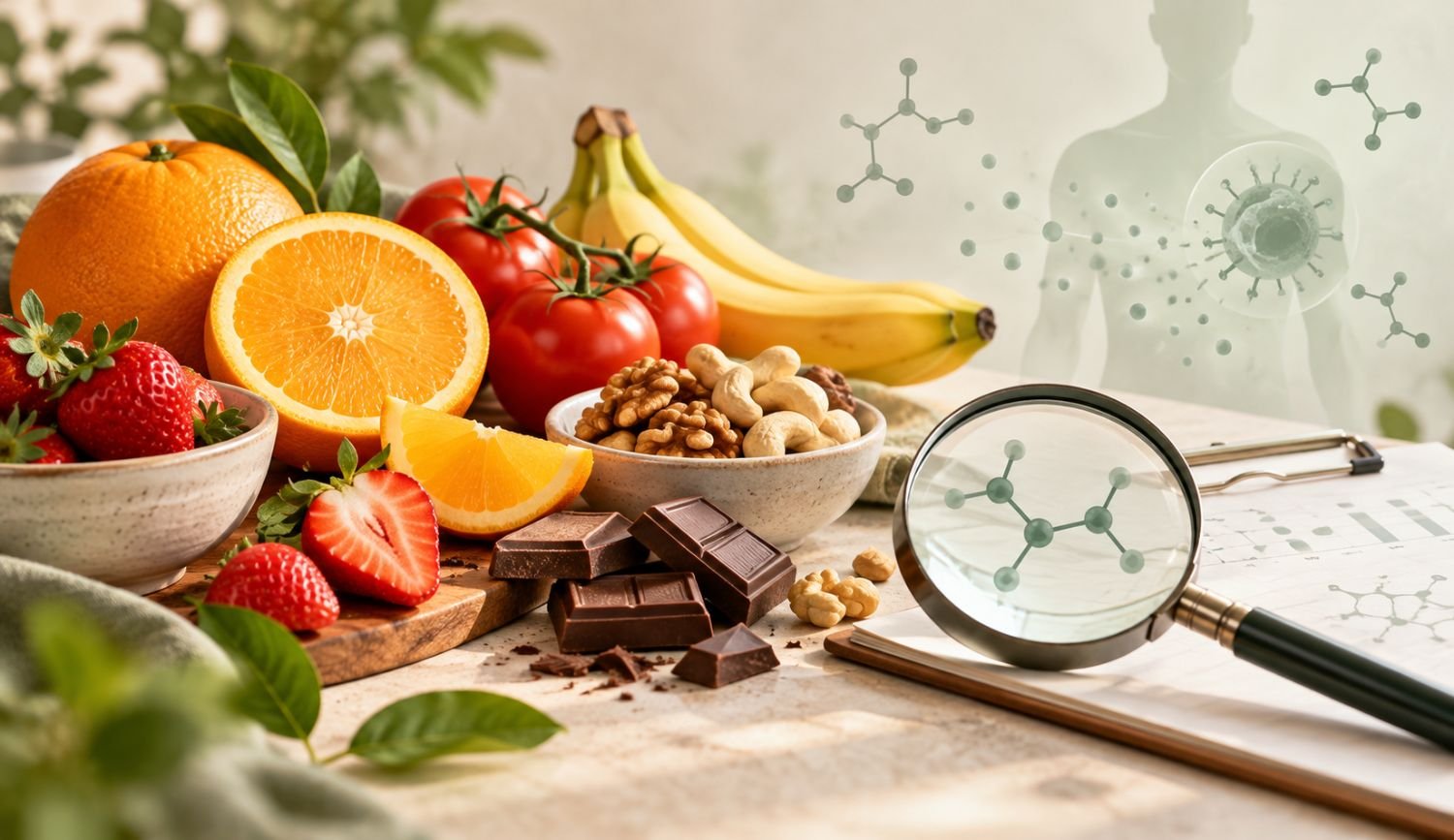
Histamine liberator foods are commonly described as foods thought to trigger the body’s own histamine release, separate from the histamine a food actually contains. Major allergy guidance concludes that reliable evidence establishing these foods — or their clinical significance — is lacking, and dietary reviews describe the proposed mechanism as largely unelucidated.
A reaction to a liberator food can still be real without proving histamine release caused it. On its own, a reaction doesn’t confirm histamine intolerance, high food histamine, mast-cell degranulation, or a liberator mechanism specifically.
What are histamine liberator foods?
The term describes a proposed idea: that certain foods could prompt the body to release its own stored histamine, independent of how much histamine the food itself contains.
It’s a concept used across many wellness and diet resources, but it isn’t a formally defined biological food category. Foods get added to liberator lists inconsistently, often based on reported reactions rather than measured biology.
Are histamine liberators real?
Reliable evidence establishing histamine liberators as a defined food category is lacking. A 2021 multi-society clinical guideline on suspected reactions to ingested histamine concluded that evidence for this mechanism and its clinical relevance remains insufficient.
That doesn’t mean the idea is disproven or impossible — it means the direct human research hasn’t established it. The concept remains a hypothesis, not a confirmed physiological pathway.
Why do histamine liberator lists disagree?
A 2021 review comparing published low-histamine diets found they vary substantially in which foods they exclude.
Some exclusions are explained by measured histamine content. Others may involve different biogenic amines rather than histamine itself. And some foods are excluded despite little or no measured amine content — these are often the ones later labeled “liberators” instead.
Notably, fermented foods were the only category unanimously excluded across the diets reviewed, which lines up with the stronger evidence behind fermentation and histamine formation.
Which foods are commonly called histamine liberators?
Certain foods appear repeatedly across online liberator lists, though the framing below reflects how they’re commonly labeled — not a confirmed mechanism.
| Category | Commonly listed examples | Evidence note |
|---|---|---|
| Citrus fruits | Lemon, orange, grapefruit | Often labeled a liberator; reliable human evidence for the mechanism is lacking. |
| Berries | Strawberries | Frequently listed despite limited evidence that a histamine-release mechanism explains reactions. |
| Nightshades | Tomato | Commonly excluded on diet lists; evidence for a liberator mechanism specifically is limited. |
| Cacao-based | Chocolate, cocoa | Often labeled a liberator; direct clinical evidence is limited. |
| Tropical fruits | Banana, pineapple, papaya | Commonly listed; proposed triggers such as ripeness are not established as liberator mechanisms. |
| Nuts and peanuts | Walnuts, peanuts, cashews | Sometimes listed as liberators; allergy is a distinct and more established differential. |
| Egg components | Egg white | Sometimes labeled a liberator; reliable human clinical evidence for this specific mechanism is lacking. |
Histamine liberators vs high-histamine foods
These are two different concepts, and mixing them up causes a lot of the confusion in online lists.
High-histamine foods contain measurable histamine, though concentrations vary widely by product, processing, storage, and handling — see the high histamine foods overview for specifics. “Liberator” instead refers to a proposed mechanism where a food might trigger the body to release its own histamine, regardless of how much histamine the food contains. That mechanism hasn’t been reliably established as a food category.
Could other biogenic amines explain some reactions?
A 2022 laboratory study found that putrescine and cadaverine — two other biogenic amines — slowed histamine’s breakdown by the DAO enzyme in vitro. The effect depended on which amine was tested and at what concentration.
This is mechanistic, in-vitro evidence, not a human clinical finding. It doesn’t establish that specific everyday foods create clinically meaningful DAO competition in real people, and it doesn’t prove this explains every reaction attributed to a “liberator” food.
Why might someone react to a food that is not high in histamine?
Several other explanations are possible beyond a proposed liberator mechanism, and more than one factor can apply to the same reaction.
- The food’s actual histamine content may have been higher than assumed
- Other biogenic amines or constituents could be involved
- An IgE-mediated food allergy or another immune reaction
- A non-histamine food intolerance or general gastrointestinal sensitivity
- Additives or how the food was prepared, in some contexts
- The dose eaten, the overall food matrix, or other co-exposures
- Coincidence or an unrelated cause entirely
For a closer look at how allergy and suspected histamine reactions differ, see Histamine Intolerance vs Food Allergies.
What does a reaction actually prove?
A reaction shows that symptoms followed an exposure; it does not identify the mechanism on its own.
Symptom tracking over time can reveal useful patterns — which foods, doses, or combinations tend to precede symptoms. But a pattern isn’t a diagnosis. It can’t distinguish a liberator mechanism from histamine content, another amine, an allergy, or an unrelated cause without further evaluation.
How should you test personal tolerance without over-restricting?
A few practical habits can help without turning into indefinite restriction.
- Keep a simple food and symptom record rather than relying on memory
- Avoid changing many variables at once, so patterns are easier to see
- Use structured reintroduction when it’s appropriate, rather than permanent avoidance
- Seek clinician or registered-dietitian guidance if restriction becomes broad, nutrition is affected, or reactions are significant
If a food has previously caused a severe or allergic-type reaction, reintroduction should be discussed with an appropriate clinician rather than attempted casually at home.
The goal is a workable, personalized pattern, not staying on an unnecessarily narrow diet indefinitely. The low histamine food list and what to eat with histamine intolerance guides can help with practical starting points.
When to seek medical evaluation
Chronic or nonspecific food reactions are different from a possible allergic emergency, and it’s worth knowing the difference.
If symptoms include difficulty breathing, throat or tongue swelling, fainting, or a rapidly progressing reaction affecting multiple body systems, treat this as a possible emergency and seek urgent medical care.
Flushing, hives, or palpitations alone do not establish mast cell activation syndrome. These symptoms are nonspecific and can occur for many reasons. Persistent or significant symptoms are still worth discussing with a clinician, even when they aren’t an emergency.
References
This article draws on current allergy guidance, food-histamine reviews, and DAO-biochemistry research.
- Reese I, et al. Guideline on management of suspected adverse reactions to ingested histamine. Allergol Select. 2021;5:305-314. DOI: 10.5414/ALX02269E
- Sánchez-Pérez S, et al. Low-Histamine Diets: Is the Exclusion of Foods Justified by Their Histamine Content?. Nutrients. 2021;13(5):1395. DOI: 10.3390/nu13051395
- Sánchez-Pérez S, et al. The Rate of Histamine Degradation by Diamine Oxidase Is Compromised by Other Biogenic Amines. Front Nutr. 2022;9:897028. DOI: 10.3389/fnut.2022.897028
- Jackson K, et al. Evidence for Dietary Management of Histamine Intolerance. Int J Mol Sci. 2025;26(18):9198. DOI: 10.3390/ijms26189198