

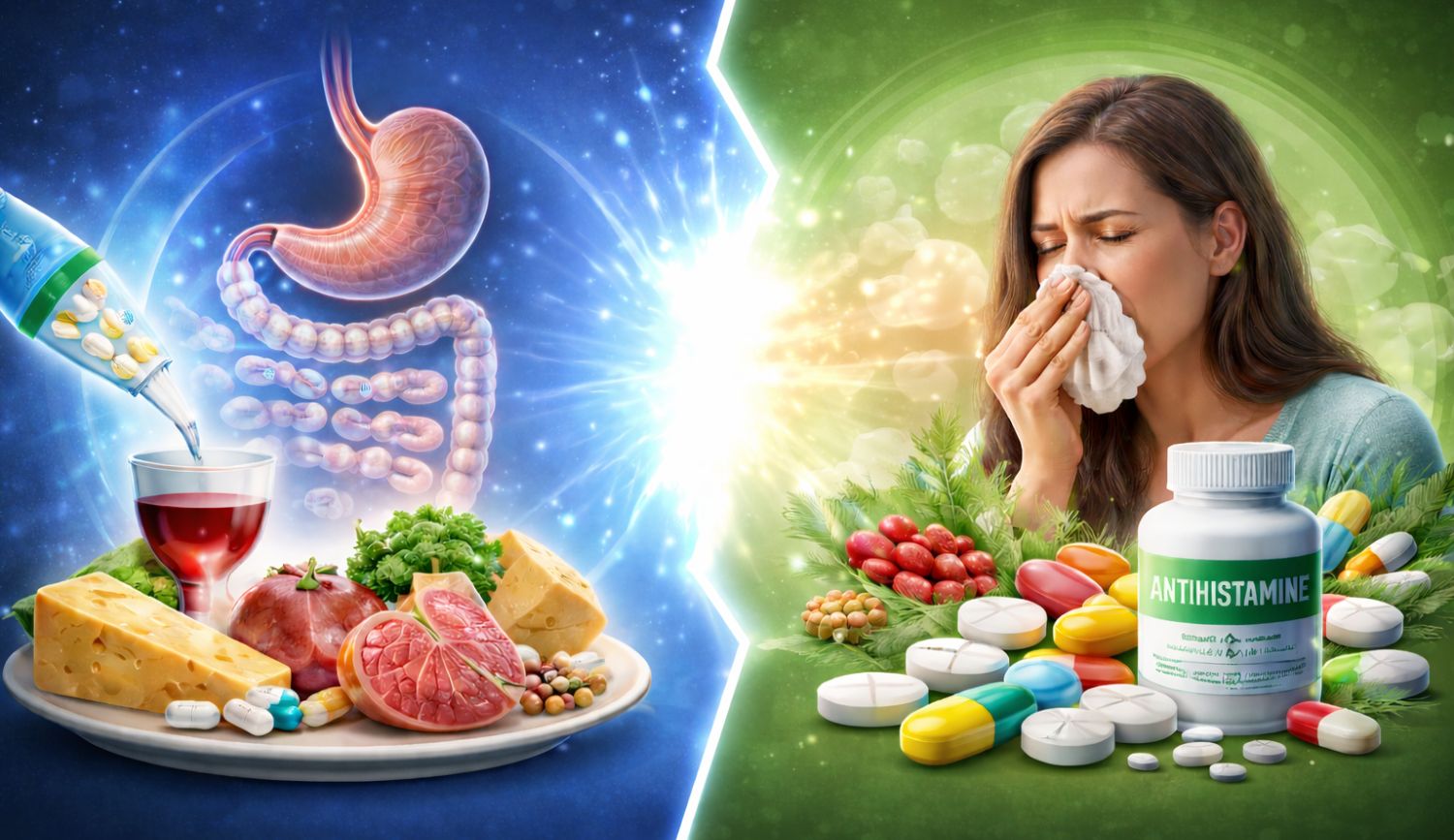
DAO vs antihistamines is often presented as a simple choice, but in reality, these two approaches work in completely different ways.
People dealing with histamine-related symptoms are often presented with two options that appear interchangeable: antihistamines or DAO enzyme support. In practice, they are not interchangeable at all.
These two approaches operate at entirely different points in the histamine pathway. One attempts to block the effects of histamine after it is already circulating. The other reduces how much histamine enters circulation in the first place. Understanding this difference is what determines whether symptoms are being managed temporarily or addressed at their source.
This is not a choice between two similar tools. It is a choice between two fundamentally different strategies.
Understanding DAO vs antihistamines requires looking at where each acts in the histamine pathway rather than treating them as interchangeable solutions.
How antihistamines work
Antihistamines are receptor antagonists. They work by occupying histamine receptors throughout the body before histamine can bind to them, reducing or preventing the downstream signalling that produces symptoms.
H1 blockers act on receptors in the skin, airways, blood vessels, and brain. First-generation options such as diphenhydramine cross the blood-brain barrier and cause sedation. Second-generation options such as loratadine, cetirizine, and fexofenadine are less sedating.
H2 blockers such as famotidine and cimetidine act primarily in the stomach and are sometimes used alongside H1 blockers to broaden coverage.
The key limitation is structural. Antihistamines do not remove histamine from the body. They reduce the body’s ability to respond to it. Once the medication wears off, any remaining histamine can resume its effects.
How DAO works
Diamine oxidase is an enzyme produced in the small intestine that breaks down histamine before it is absorbed.
It converts histamine into an inactive compound, preventing it from entering circulation and triggering receptors.
When DAO activity is sufficient, dietary histamine is neutralized before it becomes a problem. When DAO is insufficient, histamine enters the bloodstream and symptoms appear.
This pattern is explained in more detail in the low DAO levels guide, which outlines why enzyme capacity becomes the limiting factor.
DAO supplements provide the enzyme externally and are taken before meals. This allows histamine to be degraded during digestion rather than after absorption.
The mechanism is upstream, direct, and dependent on timing.
This is where the difference between DAO supplements vs antihistamines becomes clinically important, as one reduces histamine before absorption while the other only blocks its effects afterward.
DAO vs antihistamines: prevention versus suppression
This is the most important concept in this comparison.
DAO supplementation reduces the amount of histamine entering the system. Antihistamines reduce the body’s response to histamine that is already present.
One reduces exposure. The other reduces perception.
DAO works before the problem occurs. Antihistamines work after it has already occurred.
This difference determines when each approach is useful.
When antihistamines are the more appropriate choice
Antihistamines are essential in acute and systemic situations.
They are appropriate for:
- sudden or severe reactions
- environmental triggers such as pollen or mold
- stress-driven mast cell activation
- situations where histamine exposure is unpredictable
In these cases, histamine is already circulating or being released internally. DAO cannot address this because it only acts on dietary histamine in the gut.
Antihistamines provide rapid symptom control and are often necessary in these scenarios.
Short-term use during periods of high reactivity can also be helpful while underlying causes are being addressed.
When DAO support is more appropriate
DAO support is most effective when symptoms are clearly linked to meals.
If reactions occur consistently after eating, particularly after:
- leftovers
- fermented foods
- alcohol
- aged proteins
then dietary histamine is likely the primary driver.
DAO supplementation taken before meals can reduce the incoming histamine load and prevent symptoms before they begin.
Long-term improvement depends on restoring enzyme function, as outlined in the how to increase DAO naturally article.
DAO is not a general antihistamine substitute. It is a targeted tool for food-related histamine exposure.
Using both together
Because these mechanisms do not overlap, they are not mutually exclusive.
For many individuals, the question is not whether antihistamines or DAO enzyme support works better, but how each can be used in the right context.
DAO reduces dietary histamine exposure. Antihistamines manage systemic or breakthrough symptoms.
A combined approach may involve:
- DAO before meals
- antihistamines when needed
This is especially relevant in mixed cases where both dietary and non-dietary triggers are present.
Limitations of both approaches
DAO has clear boundaries. It works only in the gut and only during digestion. It has no effect on histamine already in circulation or released internally.
Its effectiveness depends on timing and does not replace addressing root causes such as gut health or nutrient deficiencies.
Substances that interfere with DAO activity are covered in the foods that block DAO article.
Antihistamines also have limitations.
They do not reduce histamine levels or improve DAO function. Long-term use can lead to tolerance, and some H2 blockers such as cimetidine can inhibit DAO activity.
This creates a paradox where symptoms may appear controlled while the underlying capacity to process histamine continues to decline.
Practical decision framework
Choosing the right approach depends on identifying the primary trigger.
Food-triggered symptoms point toward DAO support.
Systemic or unpredictable reactions point toward antihistamines.
Mixed cases require both.
For those using DAO support, consistency and timing are critical. The DAO supplements guide explains how to apply this effectively.
In practice, identifying whether symptoms are primarily food-driven or systemically triggered determines which approach should lead.
Frequently Asked Questions
These are the most common questions people ask when comparing DAO vs antihistamines and deciding which approach is right for their symptoms.
Is DAO better than antihistamines?
Neither is universally better. DAO is more effective for food-related histamine issues. Antihistamines are more effective for systemic reactions.
Can I take DAO with antihistamines?
Yes. They act on different parts of the histamine pathway and can be used together.
Do antihistamines fix histamine intolerance?
No. They suppress symptoms but do not address underlying causes such as DAO deficiency or gut health.
When should I take DAO?
15 to 20 minutes before meals to ensure it is active during digestion.
Are DAO supplements enough on their own?
DAO supplements reduce dietary histamine exposure but do not address non-food triggers or root causes. A broader strategy is often needed.
Final thoughts
DAO and antihistamines are not competing solutions. They are tools designed for different problems.
Understanding where each fits allows for a more targeted approach, reducing unnecessary medication use while improving symptom control.
Understanding how DAO enzyme vs antihistamine approaches differ allows for a more targeted strategy instead of relying on symptom suppression alone.
The goal is not to choose one over the other, but to use each where it is most effective.
Peer-reviewed research on histamine metabolism supports the role of DAO in regulating dietary histamine.
View research on histamine metabolism.
This article is for informational purposes only and does not constitute medical advice.