
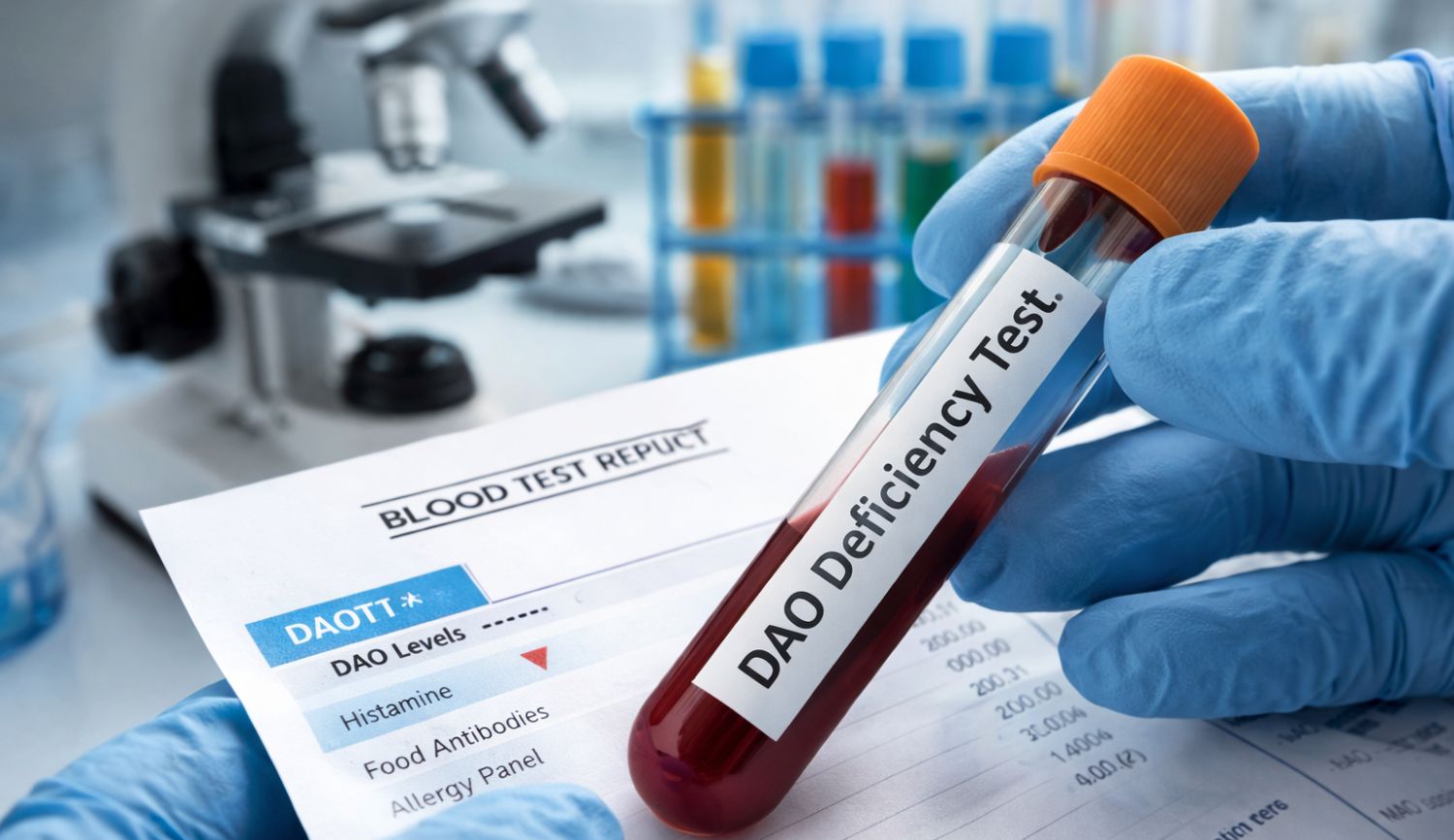
Maybe a practitioner offered you a DAO blood test. Maybe you found a home testing kit online and wondered if it could finally explain your reactions. Maybe you already have a result and don’t know what to make of it.
A DAO test can produce a real number. What that number can and cannot tell you clinically is a genuinely different, more complicated question, and different tests aren’t necessarily measuring the same thing.
What is a DAO deficiency test?
There is no single standardized test called “the DAO deficiency test.” In practice, the phrase usually refers to measuring DAO in a blood specimen, most commonly serum.
Before looking at the tests themselves, it can help to understand how DAO works and why the enzyme matters for breaking down histamine, particularly at the intestinal barrier.
Even within blood testing, methods vary. Some assays attempt to measure DAO’s actual enzyme activity, meaning how effectively it breaks down a substrate in a lab setting. Others use an immunoassay approach, quantifying the amount of DAO-related protein present rather than its functional activity directly. These aren’t the same measurement, and a result from one method shouldn’t be compared as though it’s interchangeable with the other.
How is DAO measured in blood?
A DAO blood test typically involves a venous blood draw, with the sample sent to a lab that runs one of several possible assay types.
Why does the specific method matter so much? Units, calibrators, and reference ranges differ between assays, so a “10” on one lab’s report might not mean the same thing as a “10” from a different manufacturer’s test.
| Feature | DAO activity assay | Immunoassay-based DAO measurement |
|---|---|---|
| What it attempts to assess | Functional enzyme activity in the sample | Quantity of DAO-related protein present |
| Typical specimen | Depends on the specific assay; serum is common | Depends on the specific assay; some immunoassays may also accept dried blood spot specimens |
| How results may be reported | Assay-specific activity units | Assay-specific calibrated units; the unit does not by itself tell you what analytical method was used |
| Main limitation | Activity readings can vary by assay design and substrate | Protein quantity doesn’t always equal functional activity |
Always interpret the specific assay, unit, and reference range your result came from, rather than assuming numbers from different tests can be lined up side by side.
Is serum DAO the same as intestinal DAO?
No.
A joint clinical guideline from several European allergy and immunology societies states plainly that measurement of DAO activity in serum has no established diagnostic value and does not permit conclusions about DAO activity in the small intestine [1].
A blood DAO result reflects what’s circulating in that sample at that moment; it does not directly measure what’s happening at the intestinal lining, which is where DAO’s role in handling dietary histamine actually plays out.
This is a meaningful gap, not a technicality. If your blood test has already come back low, our guide to what a low DAO result means explains how to interpret that finding without assuming it directly reflects intestinal DAO activity.
What do the 3 U/mL and 10 U/mL cutoffs mean?
Some commercial and research assays use reference bands like below 3 U/mL, between 3 and 10 U/mL, and above 10 U/mL as a suggested “normal” range. These are proposed, manufacturer-based, or historically used categories, not universally validated diagnostic thresholds confirmed against a clear biological gold standard.
A 2023 population-based survey of 1,051 randomly sampled adults puts this in perspective. In that cohort, 44% fell below the suggested 10 U/mL cutoff, and fewer than 5% were below 3 U/mL [2].
A very large proportion of this population-based group landed below the commonly used threshold despite no association between DAO levels and reported reactions to histamine-rich foods. That single finding is a strong caution against treating either cutoff as a definitive line between “normal” and “abnormal.”
How accurate is a DAO blood test?
The honest answer is that the evidence genuinely conflicts, depending on which studies you’re looking at.
Several studies suggest serum DAO may carry real, if limited, diagnostic value in selected clinical populations. A 2013 study involving 316 people with suspected histamine intolerance and 55 healthy controls found lower serum DAO in the symptomatic group.
In a follow-up subgroup of 20 patients with highly reduced DAO, DAO activity increased alongside symptom improvement after 6–12 months of a histamine-restricted diet [3].
A 2022 retrospective study of 192 symptomatic outpatients reported associations between DAO ranges and both symptom severity and treatment response [4].
A 2023 diagnostic performance study found that serum DAO could meaningfully distinguish patients with a high clinical probability of histamine intolerance from healthy controls, though its ability to separate that same high-probability group from other symptomatic patients was far more limited [5].
Other, more recent evidence pulls in a different direction. The population survey already discussed found no link between DAO and symptoms across a general population [2].
A 2023 placebo-controlled challenge study, evaluating 59 people with suspected histamine intolerance, excluded the diagnosis in 50 of them and found that 37 of the 59 participants reported symptoms during the placebo challenge; DAO in that study proved too variable and nonspecific to diagnose the condition on its own [6].
A 2024 crossover study tracking 18 patients through low-histamine and mixed-diet phases found that symptoms improved on the low-histamine diet, but changes in serum DAO didn’t reliably track which phase participants were in [7].
And the 2021 professional guideline concludes that DAO activity in blood cannot be considered conclusive for diagnosis [1].
The disagreement partly comes down to differences in study design: some compare symptomatic groups against healthy people, others compare symptomatic subgroups against each other, and clinical criteria for who counts as a “case” vary across studies.
| Study | Population/design | What DAO showed | Main limitation |
|---|---|---|---|
| Mušič 2013 | Suspected HIT vs. healthy controls | Lower DAO in suspected HIT; DAO rose with diet-related symptom improvement | No placebo control; older methodology |
| Cucca 2022 | 192 symptomatic outpatients, retrospective | Associations between DAO range and symptom severity/treatment response | Retrospective; no diagnostic challenge confirmation |
| Arih 2023 | Clinically classified HIT probability groups vs. controls | Distinguished high-probability HIT from healthy controls well; weaker at separating probability subgroups | Classification based on clinical criteria, not challenge-confirmed disease |
| van Odijk 2023 | 1,051 general population adults | No association between DAO and reported food reactions | Not a clinically defined HIT population |
| Bent 2023 | 59 suspected HIT patients, placebo-controlled | HIT excluded in most; DAO too variable to diagnose | Small sample for the confirmed-HIT subgroup |
| Rentzos 2024 | 18 patients, diet crossover | Symptoms improved on low-histamine diet; DAO didn’t track diet phase | Small sample size |
What do sensitivity and specificity studies show?
The 2023 diagnostic performance study is worth walking through carefully, since it’s one of the few papers to report these numbers directly [5].
Using the manufacturer’s proposed cutoff of below 10 U/mL, the test showed 71% sensitivity for identifying patients with a high clinical probability of histamine intolerance. Specificity, though, depended heavily on the comparison group: 92% when comparing high-probability patients against healthy controls, but only 61% when comparing that same group against other symptomatic patients considered low-probability.
The below-3 U/mL cutoff told a different story entirely: very high specificity (100% against healthy controls, 97% against low-probability patients) but extremely poor sensitivity, at just 2%. In this study, the <3 U/mL threshold identified very few participants in the high-probability group: sensitivity was only 2%. At the same time, specificity was very high against both healthy controls and symptomatic low-probability patients [5].
That does not make <3 U/mL a validated diagnostic threshold, because the study classified cases using clinical probability criteria rather than placebo-controlled challenge confirmation.
Can a DAO test diagnose DAO deficiency?
Not conclusively.
This is where a distinction worth holding onto becomes genuinely important. Measuring DAO, obtaining a result below a lab’s reference range, diagnosing a biological state called DAO deficiency, and diagnosing histamine intolerance are four different things, and treating them as interchangeable is where a lot of confusion starts.
| Finding | What it means | What it does not prove |
|---|---|---|
| Blood DAO measurement | A number from a specific assay, at a specific time | Your true DAO activity everywhere in the body |
| Low assay result | The value fell below that lab’s reference range | A confirmed diagnosis of DAO deficiency |
| AOC1 variant | A genetic marker studied for possible relevance | That deficiency or intolerance is present |
| Histamine-related symptoms | A pattern worth tracking | The mechanism behind those symptoms |
| Diet response | Symptoms changed with dietary adjustment | That DAO specifically caused the original symptoms |
Can a DAO test diagnose histamine intolerance?
No, not on its own.
The 2021 guideline is direct about this limitation [1], and the placebo-controlled challenge data reinforces it: DAO was too variable among people without confirmed histamine intolerance to serve as a reliable stand-alone marker [6].
A normal serum DAO result does not reliably rule histamine intolerance out either. Serum DAO has not been validated as a sufficiently reliable standalone diagnostic marker, and the 2021 guideline states that serum DAO does not permit conclusions about DAO activity in the small intestine [1]. A low result doesn’t confirm it either.
DAO is only one proposed piece of the diagnostic picture. Our guide to how histamine intolerance is actually diagnosed covers the broader evaluation process, including why no single laboratory result can confirm the condition on its own.
What about AOC1 genetic testing?
AOC1 is the gene that encodes DAO, and researchers have studied certain variants for their relationship to DAO activity and symptoms.
A 2024 study compared 100 symptomatic adults with 100 healthy controls and found that risk-associated variants were common in both groups, with no statistically significant difference in how often any individual variant appeared between them, though certain homozygous and cumulative risk patterns were somewhat more frequent among symptomatic participants [8].
That pattern points toward possible susceptibility, not a diagnosis. Genetic testing does not diagnose DAO deficiency, and it does not diagnose histamine intolerance on its own. Our comparison of DAO deficiency vs histamine intolerance explains why reduced DAO activity and the broader clinical syndrome are related concepts but should not be treated as the same diagnosis.
Are home DAO tests reliable?
Some commercial laboratory assays are designed to accept dried blood spot specimens, so DAO measurement from this type of sample does exist. That analytical capability should not be confused with clinical validation of DAO testing as a diagnosis of DAO deficiency or histamine intolerance.
The main clinical limitation does not change with home collection: a blood DAO measurement, regardless of specimen collection method, has not been validated as a standalone diagnosis of DAO deficiency or histamine intolerance.
Can DAO be tested in stool?
There is no established, guideline-endorsed stool test that can diagnose intestinal DAO deficiency.
If you come across a commercial stool test marketed for this purpose, it’s worth distinguishing stool histamine or microbiome analysis from an actual, validated measurement of human intestinal DAO activity. Those are different things being marketed under overlapping language.
What is post-heparin DAO testing?
Some older research measured circulating DAO after administering heparin, which increases the amount of measurable DAO in circulation. This post-heparin approach is methodologically different from a routine basal serum DAO assay [9].
Post-heparin DAO testing is not part of routine contemporary DAO assessment, and values from older post-heparin studies should not be interpreted as equivalent to modern basal serum DAO measurements.
When might DAO testing still add useful context?
The 2021 joint professional guideline takes a strong position, stating that serum DAO measurement has no diagnostic value for confirming adverse reactions to ingested histamine [1]. Other clinical studies, however, have reported group-level associations between DAO measurements and clinical probability or symptom patterns [3–5].
These findings are not necessarily contradictory: an assay may show statistical differences between groups without being reliable enough to diagnose an individual patient. A DAO result may still provide contextual information when interpreted alongside medical history and other findings, but it should not replace differential diagnosis or clinical judgment.
What should you do if your DAO result is low?
This page has focused on what DAO testing can and cannot establish. If you already have a low laboratory result, our guide to what low DAO levels mean explains what that finding may suggest, what it cannot prove, and how to put the result into clinical context.
What a DAO deficiency test can and cannot tell you
A DAO test can provide a real laboratory measurement, but the result has limits. The table below separates what the test can reasonably show from conclusions it cannot establish on its own.
| A DAO test can | A DAO test cannot |
|---|---|
| Measure a DAO-related value using a specific assay | Directly measure intestinal mucosal DAO |
| Show whether a result falls inside that assay’s reference range | Establish a universal DAO-deficiency diagnosis |
| Provide supportive data in some clinical contexts | Diagnose histamine intolerance on its own |
| Identify a low measurement that may deserve context | Prove symptoms are caused by DAO |
| Be repeated according to a laboratory method | Guarantee changes will track symptoms or diet |
| Be combined with clinical evaluation | Replace differential diagnosis |
Bottom line
A DAO blood test can produce a real laboratory measurement. The genuine scientific controversy is about what that number actually means clinically, not about whether DAO can be measured at all.
Some clinical studies have found meaningful associations between lower DAO and suspected histamine intolerance, while population-based and controlled studies have shown substantial limitations in using DAO to classify individual patients.
That tension does not make the test worthless, but it also does not make the result diagnostic. Where DAO testing adds value, that value is contextual: one piece of information to interpret alongside clinical history and other findings rather than a definitive answer on its own.
Frequently asked questions
Direct answers to the questions people ask most often about DAO testing.
What is a DAO deficiency test?
There’s no single standardized test by that name. In practice, it usually refers to measuring DAO in a blood sample, using either an activity-based assay or an immunoassay method.
Can a blood test diagnose DAO deficiency?
Not conclusively. A blood test can produce a measurement, but no professional guideline currently treats a single serum DAO result as sufficient to diagnose DAO deficiency on its own.
What is a normal DAO level?
There is no universally accepted DAO level that diagnoses deficiency. Some assays use a suggested cutoff around 10 U/mL, but a population-based study found that 44% of 1,051 adults fell below this threshold, while DAO levels were not associated with reported reactions to histamine-rich foods [2].
Does DAO below 10 U/mL mean histamine intolerance?
Not by itself. This cutoff is an assay-based reference category, not a validated diagnostic line, and population data show many people without reported reactions to histamine-rich foods fall below it.
How accurate is a DAO blood test?
Accuracy findings vary by study and by which groups are being compared. One diagnostic study found reasonable ability to distinguish high-probability cases from healthy people, but much weaker ability to distinguish them from other symptomatic patients.
Is serum DAO the same as intestinal DAO?
No. A blood sample measures circulating DAO, while intestinal DAO refers to enzyme activity at the gut lining specifically; professional guidance states that serum results don’t permit conclusions about intestinal activity.
Can I test DAO at home?
Some laboratory assays accept dried blood spot specimens collected outside a clinic. Home collection doesn’t resolve the underlying limitation that blood DAO alone isn’t a validated standalone diagnostic test.
Can AOC1 genetic testing diagnose DAO deficiency?
No. Genetic variants may relate to susceptibility, but research has found similar rates of individual variants in both symptomatic people and healthy controls, so a variant alone doesn’t establish a diagnosis.
Is there a stool test for DAO deficiency?
No guideline-endorsed stool test currently exists for diagnosing intestinal DAO deficiency. Stool histamine or microbiome testing measures something different from human intestinal DAO activity.
Is DAO testing worth it?
That depends on your situation and is worth discussing with a clinician. A result can add context alongside your history and symptoms, but it shouldn’t be treated as a definitive answer by itself.
References
- Reese I, Ballmer-Weber B, Beyer K, et al. Guideline on management of suspected adverse reactions to ingested histamine. Allergol Select. 2021;5:305-314. doi:10.5414/ALX02269E
- van Odijk J, Weisheit A, Arvidsson M, Miron N, Nwaru B, Ekerljung L. The Use of DAO as a Marker for Histamine Intolerance: Measurements and Determinants in a Large Random Population-Based Survey. Nutrients. 2023;15(13):2887. doi:10.3390/nu15132887
- Mušič E, Korošec P, Šilar M, Adamič K, Košnik M, Rijavec M. Serum diamine oxidase activity as a diagnostic test for histamine intolerance. Wien Klin Wochenschr. 2013;125(9-10):239-243. doi:10.1007/s00508-013-0354-y
- Cucca V, Ramirez GA, Pignatti P, et al. Basal Serum Diamine Oxidase Levels as a Biomarker of Histamine Intolerance: A Retrospective Cohort Study. Nutrients. 2022;14(7):1513. doi:10.3390/nu14071513
- Arih K, Đorđević N, Košnik M, Rijavec M. Evaluation of Serum Diamine Oxidase as a Diagnostic Test for Histamine Intolerance. Nutrients. 2023;15(19):4246. doi:10.3390/nu15194246
- Bent RK, Kugler C, Faihs V, Darsow U, Biedermann T, Brockow K. Placebo-Controlled Histamine Challenge Disproves Suspicion of Histamine Intolerance. J Allergy Clin Immunol Pract. 2023;11(12):3724-3731.e11. doi:10.1016/j.jaip.2023.08.030
- Rentzos G, Weisheit A, Ekerljung L, van Odijk J. Measurement of diamine oxidase (DAO) during low-histamine or ordinary diet in patients with histamine intolerance. Eur J Clin Nutr. 2024;78(8):726-731. doi:10.1038/s41430-024-01448-2
- Duelo A, Comas-Basté O, Sánchez-Pérez S, et al. Pilot Study on the Prevalence of Diamine Oxidase Gene Variants in Patients with Symptoms of Histamine Intolerance. Nutrients. 2024;16(8):1142. doi:10.3390/nu16081142
- D’Agostino L, Daniele B, Pignata S, et al. Postheparin plasma diamine oxidase increases in patients with coeliac disease during gluten free diet. Gut. 1987;28(Suppl):131-134. doi:10.1136/gut.28.suppl.131