DAO is an enzyme involved in breaking down histamine, particularly in the gut. Low measured DAO activity and suspected histamine intolerance are related ideas that often come up together, but they aren’t the same diagnosis, and one doesn’t confirm the other on its own.
No single DAO test — blood or otherwise — proves that someone has histamine intolerance, and a normal result doesn’t rule it out either. Understanding how these two concepts actually relate helps make sense of what a DAO result can and can’t tell you.
DAO deficiency vs histamine intolerance: the short answer
The table below lays out how these two concepts differ across a few practical dimensions.
| Comparison point | DAO / DAO deficiency | Suspected histamine intolerance |
|---|---|---|
| What it refers to | DAO is an enzyme involved in histamine metabolism; DAO deficiency is a non-standardized label often used when measured or suspected activity is low. | A suspected clinical pattern of adverse reactions associated with ingested histamine. |
| What can be measured | Serum DAO activity can be measured, though imperfectly. | No single validated biomarker; evaluation relies on clinical history and exclusion of other explanations. |
| What symptoms tell you | Symptoms alone cannot confirm reduced DAO activity. | Symptoms are nonspecific and do not confirm the diagnosis alone. |
| Does one confirm the other? | A low DAO result does not by itself prove histamine intolerance. | Suspected histamine intolerance is not confirmed or excluded by a specific DAO result. |
| Testing limitations | Serum DAO does not reliably reflect intestinal DAO activity. | No standalone confirmatory test exists. |
What DAO actually does
DAO (diamine oxidase) is an enzyme expressed prominently in the intestinal lining, where it participates in breaking down extracellular histamine — including histamine encountered from food.
This makes DAO biologically relevant to how the body handles ingested histamine. It isn’t accurate, though, to describe DAO as the single, primary enzyme responsible for clearing histamine throughout the whole body.
Histamine metabolism involves more than one pathway — a separate enzyme, HNMT, works inside cells — and DAO’s role is specifically tied to extracellular and intestinal histamine.
Understanding this distinction matters because it’s easy to see the word “enzyme” and assume a simple, mechanical story: low enzyme, high histamine, predictable symptoms. The relationship is more complex than that.
DAO activity is one variable among several that could plausibly influence how someone handles a histamine-containing meal, not a single dial that determines the outcome.
What does DAO deficiency mean?
The term DAO deficiency is used inconsistently, so it helps to separate a low measured DAO result from a formal diagnosis.
A blood test can measure serum DAO activity. However, serum DAO does not reliably reflect DAO activity in the small intestine, where dietary histamine is encountered.
There is also no universally accepted threshold that turns a low serum DAO result into a formal DAO deficiency diagnosis.
Alcohol and certain medications are sometimes discussed in relation to histamine metabolism. However, the evidence varies by factor, so they should not be presented as a fixed list of things that reliably “lower DAO.”
For this reason, terms such as reduced DAO activity or low measured serum DAO are more precise than using DAO deficiency as a standalone diagnosis.
What does histamine intolerance mean?
Suspected histamine intolerance describes a pattern of reactions that may occur after eating histamine-containing foods.
It is best understood as a working clinical hypothesis that still requires evaluation.
It should not be described as a measured state where “total body histamine” has exceeded a known clearance capacity. No validated clinical test measures that kind of whole-body histamine overload.
There’s currently no single validated biomarker that confirms the condition. Evaluation typically relies on history, ruling out other explanations, and sometimes a structured, supervised dietary approach — not one definitive test.
With those definitions separated, the key question is how closely reduced DAO activity is actually linked to the broader symptom pattern.
Does low DAO cause histamine intolerance?
Reduced DAO activity may be one proposed contributor to how well someone handles dietary histamine, but reduced DAO activity alone does not establish histamine intolerance.
The relationship isn’t a simple one-way “DAO deficiency causes histamine intolerance” model. Suspected histamine intolerance is a broader clinical pattern that can’t be reduced to a single enzyme pathway, and real uncertainty remains about how directly DAO activity and reported symptoms connect in any individual.
Other factors, including mast-cell activity, hormonal changes, stress, and gut microbiome differences, are also discussed alongside histamine intolerance.
These may represent separate or overlapping conditions or mechanisms in some people. They should not be treated as interchangeable causes of one validated syndrome or used as default explanations without proper evaluation.
Can you have symptoms with normal DAO?
Yes. Reported symptoms are nonspecific, and serum DAO isn’t a definitive marker — so a normal DAO result doesn’t rule out suspected histamine intolerance or other causes of similar symptoms.
This is why DAO testing should be interpreted as one piece of clinical context rather than as a decisive result.
Can you have low DAO without histamine intolerance?
A low serum DAO result can occur without establishing clinically relevant histamine intolerance.
Measured DAO activity is one piece of information. A low serum result does not, by itself, establish that a person’s symptoms are caused by ingested histamine, so it should be interpreted alongside the clinical history and other possible explanations.
Why symptoms cannot tell the two apart
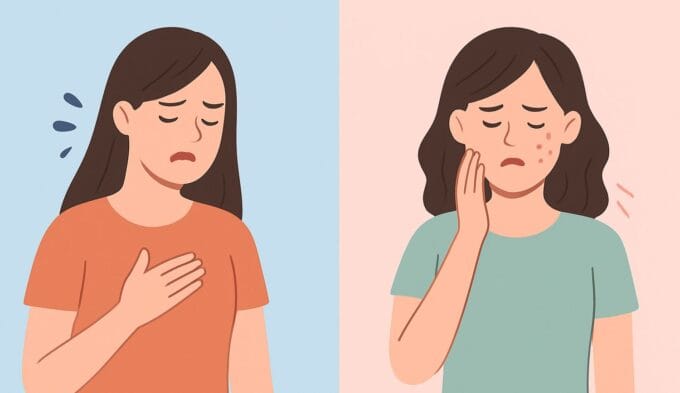
Symptoms sometimes attributed to reduced DAO activity overlap with those reported in suspected histamine intolerance, including flushing, headache, digestive upset, palpitations, and nasal symptoms.
Because these symptoms overlap so heavily with each other, and with unrelated conditions entirely, symptom pattern alone can’t distinguish reduced DAO activity from suspected histamine intolerance, let alone from other possibilities such as:
- Food allergy
- Gastrointestinal disease
- Chronic urticaria or a mast-cell disorder
- Medication effects
- Migraine
Mast cell activation syndrome (MCAS) is often discussed alongside DAO and histamine intolerance, but it is a separate condition.
MCAS is not simply “histamine intolerance with a normal DAO result.” It requires its own clinical criteria and objective evidence, and it should not be inferred from a DAO test or symptom list alone.
A 2023 placebo-controlled study also highlights why symptoms need careful interpretation. Among 59 people referred for suspected histamine intolerance, the diagnosis was excluded in 50 after controlled testing.
Thirty-seven participants also reported symptoms after placebo. These findings do not show how common histamine intolerance is, but they reinforce why symptoms alone are not enough for diagnosis.
What DAO blood testing can and cannot tell you
A DAO blood test may provide limited contextual information in some settings, but it isn’t a standalone diagnostic confirmation of histamine intolerance.
An important limitation is that serum DAO does not permit reliable conclusions about DAO activity specifically in the small intestine — where much of its relevant work with ingested histamine occurs. A low result may prompt further evaluation, but it isn’t proof on its own, and a normal result doesn’t rule the condition out.
For a closer look at how DAO testing is used in practice, see the DAO deficiency test guide.
What about AOC1 genetic testing?
AOC1 is the gene that encodes DAO, and certain variants have been studied for their association with DAO activity.
Genetic variants can indicate susceptibility or a statistical association — they don’t independently diagnose DAO deficiency or histamine intolerance. Having a studied variant doesn’t mean someone will experience symptoms, and not having one doesn’t rule them out.
Does response to DAO supplements prove DAO deficiency?
No. Feeling better after taking a DAO supplement might be clinically interesting to note, but it isn’t a diagnostic test.
Symptom improvement can have several explanations beyond confirming a specific enzyme deficiency, so response to supplementation shouldn’t be used as proof that reduced DAO activity was the underlying cause.
Limited research has explored DAO supplementation as a symptom-management option, but that’s a separate question from whether it confirms what was causing the symptoms in the first place.
Does improvement on a low-histamine diet prove histamine intolerance?
No. Improvement on a low-histamine diet doesn’t, by itself, confirm histamine intolerance.
A stricter diet often changes several things at once, not just histamine content, so symptom improvement needs to be interpreted alongside a fuller clinical picture rather than treated as a standalone confirmation.
When should you get medical evaluation?
It’s worth seeking medical evaluation for:
- Significant or recurrent symptoms affecting daily life
- A diet that has become substantially restricted
- Suspected food allergy
- Severe or worsening reactions
- Unexplained, persistent gastrointestinal symptoms
- Fainting, chest pain, or other cardiovascular symptoms
Breathing difficulty, throat or tongue swelling, fainting, or a rapidly progressing reaction affecting multiple body systems need urgent medical care. These should never be self-managed as low DAO or histamine intolerance — they need emergency evaluation regardless of what a prior DAO result showed.
A clinician can help evaluate a confusing or inconsistent symptom pattern in context. Bringing a brief history of symptoms, food timing, medications, prior testing, and any severe reactions can make that assessment more useful.
Key takeaway
DAO and suspected histamine intolerance are related but distinct concepts. Reduced DAO activity may be one contributing factor for some people, but it isn’t the single explanation for histamine intolerance, and neither a DAO blood test nor a genetic variant can confirm or rule out the diagnosis on its own.
Persistent or significant symptoms are worth discussing with a clinician who can consider the full picture.
Frequently asked questions
A few specific questions come up often enough to answer directly.
Is DAO deficiency the same as histamine intolerance?
No. They’re related concepts, but DAO deficiency refers to a specific enzyme measurement, while suspected histamine intolerance is a broader clinical pattern that isn’t reducible to one enzyme result.
Does low DAO cause histamine intolerance?
Reduced DAO activity may be one proposed contributor, but low DAO alone does not show that histamine intolerance is present — the relationship isn’t a simple one-way model.
Can you have suspected histamine intolerance with normal DAO?
A normal serum DAO result does not rule out suspected histamine intolerance because serum DAO is not a definitive diagnostic marker.
Can a blood test diagnose DAO deficiency?
Not on its own. Serum DAO doesn’t reliably reflect intestinal DAO activity, and there’s no universally accepted threshold that turns a low result into a standalone diagnosis.
Does DAO supplementation confirm the diagnosis?
No. Feeling better after supplementation isn’t a diagnostic test, since symptom improvement can have more than one explanation.
Can AOC1 testing diagnose DAO deficiency?
No. AOC1 variants indicate susceptibility or association, not a confirmed diagnosis.
What else can mimic histamine intolerance?
Food allergy, gastrointestinal disease, chronic urticaria or mast-cell disorders, medication effects, and migraine can all produce similar symptoms. For more on one common differential, see histamine intolerance vs food allergies.
References
- Reese I, Ballmer-Weber B, Beyer K, et al. Guideline on management of suspected adverse reactions to ingested histamine. Allergol Select. 2021;5:305-314.
- Bent RK, Kugler C, Faihs V, et al. Placebo-Controlled Histamine Challenge Disproves Suspicion of Histamine Intolerance. J Allergy Clin Immunol Pract. 2023;11(12):3724-3731.e11.
- Comas-Basté O, Sánchez-Pérez S, Veciana-Nogués MT, Latorre-Moratalla M, Vidal-Carou MC. Histamine Intolerance: The Current State of the Art. Biomolecules. 2020;10(8):1181.
- Schnedl WJ, Schenk M, Lackner S, Enko D, Mangge H, Forster F. Diamine oxidase supplementation improves symptoms in patients with histamine intolerance. Food Sci Biotechnol. 2019;28(6):1779-1784.