
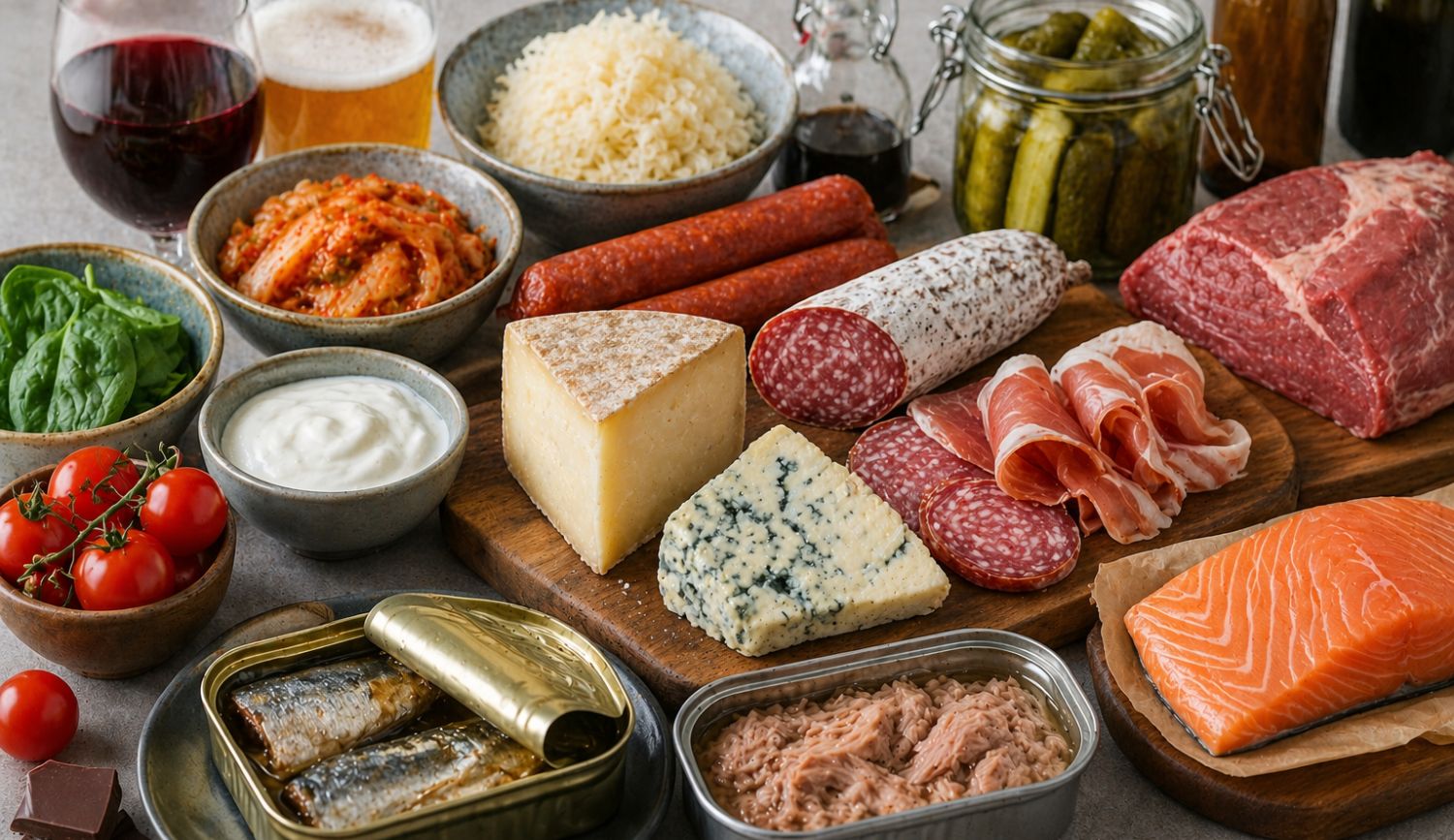
A practical guide to understanding why histamine levels vary between foods, which categories deserve the most attention, and how to use that information without unnecessary restriction.
One list says spinach is high histamine. Another calls it moderate. One source says avoid avocado entirely; another marks it as generally fine. Chocolate shows up on nearly every list, while strawberries appear on some under a completely different explanation.
Most people researching high histamine foods end up more confused than when they started.
The problem isn’t that the lists are wrong exactly. It’s that most of them treat histamine content as a fixed property of foods, without explaining how it actually forms, or why some foods are linked to reactions without containing much measurable histamine at all.
Understanding the underlying patterns is what lets you make real decisions instead of anxiously cross-referencing conflicting charts.
If you’re looking for the other side of the picture, our low histamine food list provides a practical reference for foods that are generally considered lower-risk, while still accounting for freshness and individual tolerance.
Quick answer: what foods are most commonly high in histamine?
The high histamine foods with the strongest and most consistent evidence tend to fall into a few categories: aged and ripened cheeses, cured or fermented meats, fermented vegetables and condiments, certain fish and fish products where handling or storage allowed bacterial activity, and alcoholic or fermented beverages.
Even within these categories, concentrations vary a lot between specific products. A young cheese and a heavily aged one aren’t the same, and neither are two bottles of wine from different producers. Treat this as a starting map, not a precise measurement.
Why histamine levels in food vary
Histamine in food usually forms through a specific biological process rather than being a fixed trait of any ingredient. Certain bacteria produce an enzyme, histidine decarboxylase, that converts histidine — an amino acid naturally present in many protein-rich foods — into histamine.¹
That process depends on several things happening together: enough histidine being available, the right kind of microorganisms being present, and conditions like temperature, time, and storage allowing them to act. Not every bacterium produces histamine, and not every protein-rich food develops meaningful levels.
This is why fermentation, ageing, and inadequate temperature control come up so often in high-histamine discussions. They’re conditions where histamine-producing bacteria have time and opportunity to work, not a guarantee that every product made this way ends up equally high.¹ ⁴
High histamine foods vs. commonly reported trigger foods
A lot of the confusion around food lists comes from treating every “problem food” as if it works the same way. It helps to separate a few different ideas.
Foods with preformed histamine. These already contain measurable histamine before you eat them, built up through fermentation, ageing, or storage. Aged cheeses, cured meats, and fermented vegetables are common examples.
Foods with variable biogenic-amine profiles. These can contain meaningful histamine or related compounds, but levels swing widely depending on the specific product, production method, and handling. Fish and some plant foods fall here.
Foods commonly called “histamine liberators.” These are foods that appear on many restrictive lists despite containing little measured histamine themselves, based on the idea that they prompt the body to release its own histamine. The proposed mechanism has limited direct evidence, and this category deserves real skepticism rather than blanket acceptance.²
If you want to explore this disputed category in more detail, our guide to the evidence behind histamine liberators explains why certain foods appear on these lists and where the science remains uncertain.
Substances that may affect tolerance without adding much histamine. Alcohol is the clearest example here — it may influence how the body handles histamine from other sources, separate from its own histamine content. This is different from simply eating a high-histamine food; our guide to foods that block DAO looks more closely at factors that may interfere with histamine breakdown.
These four categories aren’t interchangeable, and lumping them together is a major reason food lists feel contradictory.
High histamine foods by category
The sections below cover the categories most often flagged, along with what actually drives the concern in each one.
Aged and fermented dairy
Fresh dairy — milk, butter, cream — is generally distinguished from long-aged or fermented dairy in most low-histamine approaches, though individual tolerance and specific product processing still matter.
Aged and ripened cheeses, particularly harder or longer-matured varieties, are consistently flagged because extended fermentation and enzymatic activity give bacteria more time to work. Fermented dairy products like yogurt and kefir also involve bacterial cultures, including ones marketed as probiotic, which is a separate quality from histamine content.
Cured, aged, and fermented meats
Fresh cuts of meat, cooked and eaten promptly, are typically lower in histamine than the same meat cured, fermented, or stored for extended periods. Products like salami, prosciutto, and similar cured meats develop histamine gradually during production, and levels can differ meaningfully between brands and processes.
Fresh meat isn’t automatically “safe” in every case, either — handling and freshness at the point of purchase still matter.
Fish and seafood
This category deserves a more precise safety note than most.
Certain histamine-forming fish species can develop substantial histamine when chilling and time-temperature control are inadequate. Bacterial enzymes convert naturally occurring histidine in the fish muscle into histamine, and once significant histamine has formed, cooking or freezing cannot reliably remove it.³ ⁷
Severe reactions after eating contaminated fish can represent scombroid poisoning, also called histamine fish poisoning — a distinct, well-documented food-safety event rather than the everyday experience of suspected histamine sensitivity.³ It’s worth knowing this exists as a separate category, and separate again from IgE-mediated fish allergy, which involves a different immune mechanism entirely.
The U.S. Food and Drug Administration’s guidance on scombrotoxin poisoning explains why proper chilling is critical for histamine-forming fish and why this type of food poisoning is distinct from ordinary food sensitivity.
Fermented vegetables, soy products, and condiments
Sauerkraut, kimchi, miso, soy sauce, and other fermented foods are relevant because fermentation can create conditions in which biogenic amines form. This depends on suitable amino-acid substrates being present alongside microorganisms capable of producing the enzymes involved, so fermentation itself does not guarantee that every product will contain a high histamine level.⁴
The amount can vary substantially with the raw ingredients, microbial cultures, production conditions, fermentation time, temperature, and storage. Some fermented condiments and sauces may therefore contribute more histamine or other biogenic amines than others, even when the products appear similar.
Fermented foods are a recognized area of concern for biogenic amines, although concentrations can vary substantially according to microorganisms, ingredients, processing conditions, and storage, as outlined in the European Food Safety Authority’s review of biogenic amines in fermented foods.
Alcohol and fermented beverages
Alcohol is worth treating separately because it may affect histamine handling through more than one route: some alcoholic drinks contain measurable histamine themselves, and alcohol more broadly may influence how efficiently the body processes histamine from other sources.
Wine, beer, and other fermented drinks vary in both histamine content and how strongly people report reacting to them. If alcohol is one of your triggers, our guide to low histamine alcoholic drinks looks more closely at wine, beer, spirits, fermentation, and why lower-histamine choices can still cause symptoms in some people.
Fruits and vegetables: where lists disagree most
This is where some of the biggest inconsistencies appear, and it is worth slowing down rather than treating every food the same way.
Published analyses have detected meaningful histamine in some samples of spinach, tomato, eggplant, and avocado, but the concentrations varied substantially between samples.⁵ Foods such as citrus, strawberries, and pineapple are also frequently placed in the separate “histamine liberator” category, although that proposed mechanism has limited direct evidence.² Avocado is especially difficult to reduce to a simple yes-or-no classification because measured biogenic-amine content and individual tolerance can both vary.
None of this means these foods are automatically safe or automatically problematic. It means the evidence for each one is different, and treating them as one uniform group isn’t accurate.
Processed and packaged foods
Processing itself doesn’t automatically mean higher histamine. What matters more is whether a product contains fermented or aged ingredients, cured proteins, or components with a longer storage history before packaging.
Some packaged foods also contain additives that some people report sensitivity to through mechanisms unrelated to histamine content specifically. That’s a separate topic from whether a product is genuinely histamine-rich, and it’s worth not conflating the two.
Collagen supplements are also sometimes placed on high-histamine food lists, but that classification can be too simplistic. Reactions may involve the protein source, processing, formulation, added ingredients, or individual sensitivity rather than proving that every finished collagen powder is inherently high in histamine.
If collagen powder is one of your concerns, our guide answering is collagen high in histamine looks specifically at what collagen contains, why reactions can happen, and why collagen shouldn’t automatically be treated like fermented or aged food.
A quick reference table
This high histamine foods table is best used as a starting point rather than a universal avoid list, because measured histamine and other biogenic amines can vary substantially between products.
| Category | Commonly limited initially | Important nuance |
|---|---|---|
| Aged and fermented dairy | Aged cheeses and some cultured dairy products | Histamine content can vary with aging time, microorganisms, processing, and storage |
| Cured and fermented proteins | Cured meats, fermented meats, and some processed fish products | Food type, microbial activity, handling, and storage conditions all matter |
| Fish and seafood | Histamine-forming species when freshness or temperature control is uncertain | Proper handling is critical; histamine already formed cannot reliably be removed by cooking or freezing |
| Fermented vegetables and condiments | Sauerkraut, kimchi, miso, soy sauce, and other fermented products | Fermentation can support biogenic-amine formation, but concentrations vary substantially by product |
| Alcoholic and fermented beverages | Wine, beer, and some other fermented drinks | Histamine content varies, and alcohol may also affect histamine handling |
| Selected plant foods | Spinach, tomato, eggplant, avocado, and foods commonly called “histamine liberators” | Measured levels and evidence differ considerably between individual foods |
| Processed and stored foods | Products containing aged, fermented, cured, or extensively stored ingredients | Processing alone does not automatically make a food high in histamine |
Why freshness and storage still matter
Bacterial activity can increase biogenic amines in susceptible foods over time, which is why freshness genuinely matters — particularly for fish and other proteins.¹ ⁴
Refrigeration slows microbial activity but does not guarantee that histamine or other biogenic-amine levels will remain unchanged indefinitely. Rapid cooling and appropriate freezing can greatly suppress the microbial activity that drives additional formation, but freezing does not remove histamine that was already present before the food was frozen.⁷
For people who are particularly sensitive, prioritizing freshness and cooling food promptly are reasonable, evidence-aligned habits. They’re not a guarantee, and there’s no universal cutoff — 30 minutes, 24 hours, or otherwise — at which every food becomes unsafe.
Freshness decisions often begin before cooking. Our low histamine grocery list turns these principles into practical shopping choices around fresh proteins, packaged foods, storage, and ingredient labels.
Why high-histamine food lists disagree
This deserves its own explanation, because it’s the single biggest source of frustration people run into with this topic.
Measured histamine content depends on the specific product tested, its production method, the microbial cultures involved, and how it was stored before analysis — which means two samples of the “same” food can genuinely differ.¹ ² Published food lists also mix sources: some draw on laboratory measurements, others on clinical experience with patients, and others on informal patient reports passed down through dietary literature. These aren’t equivalent forms of evidence, even though they end up on the same list.
Histamine and other biogenic amines also aren’t always distinguished clearly in popular lists, even though they’re not the same thing. And the “histamine liberator” category — responsible for a lot of list disagreement around fruits specifically — rests on a mechanism that remains poorly validated.²
None of this means food lists are useless. It means they’re tools built from mixed-quality evidence, and treating any single one as a definitive rulebook sets people up for unnecessary restriction.
How to use a high-histamine food list without over-restricting
A list of high histamine foods works best as a starting framework, not a permanent rulebook.
- Begin with the categories that have the most consistent evidence — aged, cured, and fermented foods — rather than every food that appears on any list you’ve seen.
- Prioritize freshness where it’s practical, especially for fish and other proteins.
- Keep meals reasonably simple while you’re observing patterns, so it’s easier to tell what’s actually connected to symptoms.
- Track what you eat and how you feel, without assuming every symptom has to be histamine-related.
- Avoid expanding restrictions further than necessary just because a food appears on someone else’s list.
- Reintroduce foods over time where appropriate, rather than staying on an extreme elimination approach indefinitely.
- Involve a qualified clinician or dietitian if symptoms are severe, nutrition is becoming limited, or the underlying cause isn’t clear.
If you need help turning these food decisions into an everyday eating structure, the low histamine diet plan shows how to build meals around lower-histamine choices without treating every questionable food as permanently off-limits.
When a food reaction may be something else
Not every reaction to food is histamine-related, and it’s worth keeping other possibilities in mind. IgE-mediated food allergy, general gastrointestinal intolerance, mast cell disorders, and scombroid (histamine) fish poisoning can all produce overlapping symptoms through different mechanisms.³
Severe or rapidly progressing symptoms — difficulty breathing, throat swelling, fainting, or significant cardiovascular symptoms — need medical evaluation. These aren’t situations for dietary self-experimentation, regardless of what food was eaten beforehand.
Frequently asked questions
A few questions come up repeatedly when people first start working through this topic.
What foods are highest in histamine?
Aged and ripened cheeses, cured or fermented meats, certain fish and fish products, fermented vegetables and condiments, and alcoholic or fermented beverages tend to have the strongest, most consistent evidence for higher histamine content.
Why do high-histamine food lists disagree?
Because measured histamine varies by specific product and production method, because lists mix laboratory data with clinical and patient-reported experience, and because the “histamine liberator” category rests on a mechanism that isn’t well established.
Are fermented foods always high in histamine?
Not identically. Fermentation creates conditions where histamine-producing bacteria can act, but levels differ substantially by product, culture, and duration — not every fermented food is equally high.
Does cooking destroy histamine?
Not reliably. Histamine is relatively heat-stable, so ordinary cooking should not be treated as a dependable way to make a high-histamine food low histamine. Studies have found that measured concentrations can change with cooking method: boiling may reduce levels in some foods, while grilling or frying may increase measured concentrations in others.⁶ What matters practically is that cooking cannot be relied upon to eliminate histamine that has already formed.
Do leftovers contain more histamine?
They can, particularly protein-rich foods stored for longer periods, but there’s no fixed universal timeline. Storage conditions, food type, and handling all influence how much change actually occurs.
Does freezing lower histamine?
Freezing slows further bacterial activity and helps prevent additional formation, but it doesn’t remove histamine that had already formed before freezing.
Are tomatoes, strawberries, citrus, and avocado really histamine liberators?
Some people report reacting to these foods, but the proposed liberator mechanism has limited direct evidence. A reaction is possible without that reaction proving histamine liberation specifically.
Can high-histamine foods ever be reintroduced?
Potentially. A low-histamine diet is generally better treated as an individualized management approach than a permanent blanket ban. Whether a particular food can be reintroduced depends on the person, the food, symptom patterns, nutritional needs, and the underlying reason for the reaction. Reintroduction may be easier to interpret with professional guidance when reactions are severe or the diet has become highly restricted.
Using this information going forward
Understanding high histamine foods takes more than memorizing a list, because histamine content varies between products and individual reactions can have different causes.
Understanding the underlying patterns — what drives formation, which categories have the strongest evidence, and where genuine uncertainty remains — makes it possible to use this information as a practical tool rather than a source of ongoing anxiety.
The goal isn’t eliminating as many foods as possible. It’s identifying, with reasonable confidence, what actually affects you, and adjusting from there.
References
- Comas-Basté O, Sánchez-Pérez S, Veciana-Nogués MT, Latorre-Moratalla M, Vidal-Carou MC. Histamine Intolerance: The Current State of the Art. Biomolecules. 2020;10(8):1181. doi:10.3390/biom10081181.
- Sánchez-Pérez S, Comas-Basté O, Veciana-Nogués MT, Latorre-Moratalla ML, Vidal-Carou MC. Low-Histamine Diets: Is the Exclusion of Foods Justified by Their Histamine Content? Nutrients. 2021;13(5):1395. doi:10.3390/nu13051395.
- Hungerford JM. Scombroid poisoning: a review. Toxicon. 2010;56(2):231–243. doi:10.1016/j.toxicon.2010.02.006.
- EFSA Panel on Biological Hazards (BIOHAZ). Scientific Opinion on risk based control of biogenic amine formation in fermented foods. EFSA Journal. 2011;9(10):2393. doi:10.2903/j.efsa.2011.2393.
- Sánchez-Pérez S, Comas-Basté O, Rabell-González J, et al. Biogenic Amines in Plant-Origin Foods: Are They Frequently Underestimated in Low-Histamine Diets? Foods. 2018;7(12):205. doi:10.3390/foods7120205.
- Chung BY, Park SY, Byun YS, et al. Effect of Different Cooking Methods on Histamine Levels in Selected Foods. Ann Dermatol. 2017;29(6):706–714. doi:10.5021/ad.2017.29.6.706.
- U.S. Food and Drug Administration. Scombrotoxin (Histamine)-Forming Fish and Fishery Products—Decomposition and Histamine (CPG 7108.24) Compliance Policy Guide. Silver Spring (MD): U.S. Food and Drug Administration; 2024.