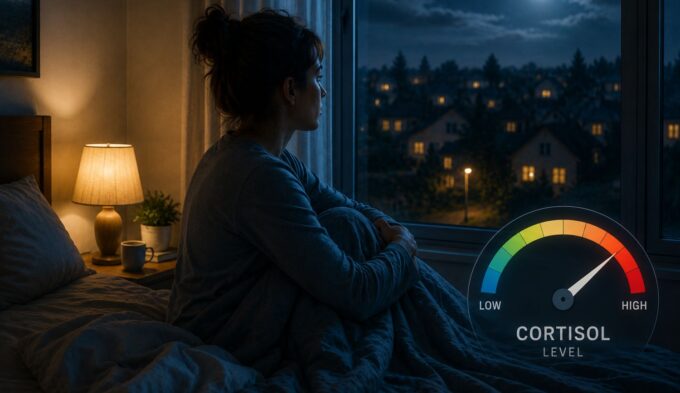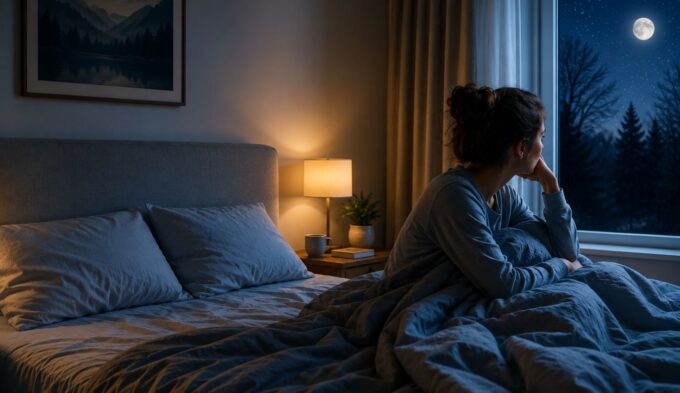

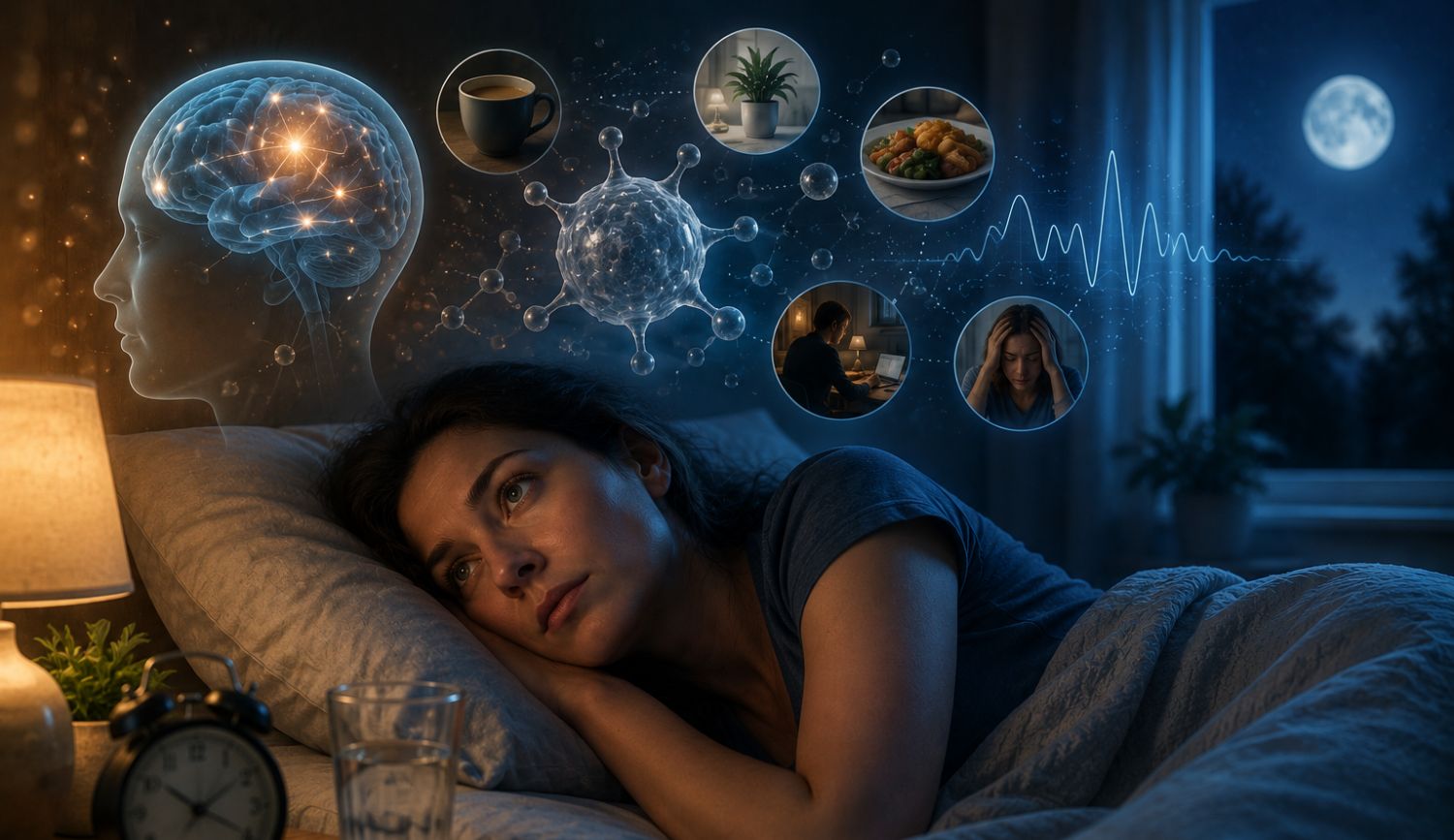
There is something particularly disorienting about symptoms that arrive or intensify after dark.
During the day, discomfort can sometimes fade into the background of work, movement, conversation, errands, and constant stimulation. But once the environment becomes quieter, many people notice that symptoms suddenly feel louder, more physical, and harder to ignore.
For some, this looks like waking abruptly between 2am and 4am feeling alert for no obvious reason.
Others describe:
- restless sleep
- overheating at night
- racing thoughts
- heightened awareness of their heartbeat
- vivid dreams
- lighter sleep patterns
- waking exhausted but strangely activated
Experiences like these can feel unsettling, especially when they repeat inconsistently.
One difficult night turns into several. Sleep becomes less restorative. The nervous system feels less resilient. Eventually, the unpredictability itself can become exhausting.
This is one reason nighttime histamine symptoms often feel emotionally heavier than daytime symptoms.
The body wants rest.
But the system does not fully settle.
Understanding why this happens is rarely as simple as identifying one “bad” food or one isolated trigger. More often, nighttime reactivity reflects several overlapping biological and environmental patterns converging at once.
That broader perspective is important.
Because for many people, symptoms begin to feel less frightening once they become more interpretable.
Histamine and the sleep-wake cycle
Histamine is commonly associated with allergies and food reactions, but it also plays an important role inside the brain.
One of its normal functions is helping regulate wakefulness and alertness.
During the day, histamine activity helps support attention, stimulation, and responsiveness to the environment. During healthy sleep, that activity naturally quiets down.
This relationship is part of why certain antihistamines can cause drowsiness. Blocking histamine signaling in the brain reduces stimulation within systems connected to wakefulness.
For some people during histamine-sensitive periods, however, the body may feel slower to transition fully into a calmer nighttime state.
In practical terms, this can feel like:
- the body being tired while the mind stays alert
- waking suddenly despite exhaustion
- feeling “wired but tired”
- difficulty staying asleep deeply
- lighter, more reactive sleep
This does not necessarily mean histamine alone is causing every difficult night.
Sleep is influenced by many systems simultaneously:
- stress hormones
- nervous system activation
- inflammation
- circadian rhythms
- digestion
- emotional stress
- environmental stimulation
But histamine’s connection to wakefulness helps explain why nighttime symptoms can sometimes feel especially intense or confusing.
For some readers, the broader relationship between histamine and disrupted sleep is explored further in Sleep & Histamine Symptoms: A Calm Guide to Nighttime Reactivity.
Why symptoms often feel stronger after dark
Nighttime changes the body’s environment in several important ways.
Some are psychological.
Others are physiological.
And together, they can create the feeling that symptoms suddenly become amplified once evening arrives.
Reduced distraction changes symptom awareness
During the day, attention is constantly directed outward.
Conversations, movement, work, errands, screens, and environmental stimulation compete for attention. At night, much of that disappears.
Physical sensations that were easier to ignore earlier in the day can suddenly feel far more noticeable.
This does not mean symptoms are imaginary.
It simply means the nervous system has fewer competing inputs pulling attention elsewhere.
For someone already feeling physically reactive, that increased awareness can quickly become emotionally draining.
Stress accumulates across the day
Many people notice that nighttime symptoms feel worse after emotionally intense or overstimulating days.
This pattern makes sense physiologically.
Stress influences:
- inflammation
- nervous system activation
- digestion
- cortisol rhythms
- immune signaling
- sleep quality
By evening, the body may already be carrying a significant amount of accumulated stimulation.
For someone operating near their limit, even smaller stressors can begin to feel amplified at night.
In practical terms, the body may struggle to shift fully into a restorative nighttime state.
Exhaustion is present.
But calmness is not.
The nervous system becomes less buffered
During reactive periods, the nervous system often has less flexibility overall.
This means ordinary stimulation may feel harder to process comfortably.
Noise, screens, emotionally charged conversations, heavy meals, late work, social exhaustion, or overstimulation that once felt manageable may suddenly feel more activating at night.
The body feels less buffered against load.
For some people, this contributes to:
- nighttime alertness
- restless sleep
- overheating
- lighter sleep patterns
- waking around 2–4am
The experience can resemble insomnia, but often feels slightly different.
The body feels tired.
The nervous system simply does not power down fully.
Evening eating patterns can influence reactivity
Food timing and digestive load sometimes become more noticeable at night.
Some people notice stronger nighttime symptoms after:
- large late meals
- leftovers
- restaurant meals
- alcohol
- irregular eating schedules
- heavily processed foods
But food itself is rarely the entire story.
The same meal may feel tolerable one week and much harder another.
That inconsistency often reflects broader accumulated load rather than one isolated food suddenly becoming “toxic.”
For readers looking specifically at evening food patterns, What to Eat Before Bed With Histamine Intolerance explores this topic in more detail.
Poor sleep itself increases vulnerability
One difficult night rarely stays isolated.
Sleep deprivation affects:
- stress tolerance
- inflammation
- nervous system regulation
- emotional resilience
- recovery capacity
For some people, ongoing sleep disruption may also reduce the body’s ability to process histamine efficiently.
This creates a frustrating cycle:
- poor sleep increases reactivity
- increased reactivity worsens sleep
- worsened sleep increases next-day vulnerability
Over time, the body begins operating with progressively less recovery reserve.
That compounding effect is one reason nighttime symptoms can gradually become more overwhelming during reactive periods.
The accumulated load effect
One of the most confusing aspects of histamine-related symptoms is inconsistency.
Some nights feel manageable.
Other nights feel unexpectedly intense despite eating similarly or following roughly the same routine.
This unpredictability often pushes people toward hypervigilance.
Meals become heavily analyzed. Symptoms become monitored constantly. Every difficult night feels like a mystery that must have one specific explanation.
But in reality, nighttime symptoms are often shaped by accumulated load rather than one isolated trigger.
That load can include:
- emotional stress
- poor sleep
- overstimulation
- hormonal shifts
- environmental exposure
- digestive burden
- travel
- social exhaustion
- inconsistent routines
- inflammatory stress
Each factor may seem relatively small on its own.
But together, they reduce the system’s overall flexibility.
This is one reason the same food may feel tolerable one week and difficult the next.
Or why symptoms sometimes appear delayed.
The body is not responding to one variable in isolation. It is responding to the combined pressure of multiple systems carrying more load than they can comfortably regulate.
For many people, understanding this changes the emotional experience significantly.
The goal becomes less about achieving perfect control and more about recognising broader patterns of reactivity, recovery, overstimulation, and nervous system strain.
That perspective often reduces fear — even before symptoms themselves improve.
Waking between 2am and 4am
One of the most commonly discussed nighttime histamine patterns is waking suddenly during the early morning hours.
Often this occurs somewhere between approximately 2am and 4am.
People describe:
- sudden alertness
- racing thoughts
- restlessness
- overheating
- increased heart awareness
- difficulty settling back into sleep
For some, these wakeups feel abrupt and intense.
The body may feel exhausted physically while the nervous system feels unusually awake.
This pattern is explored more deeply in Histamine Dump at Night Symptoms, but it is important to understand that these wakeups are not always caused by one single mechanism.
Histamine, stress hormones, nervous system activation, blood sugar fluctuations, sleep debt, overstimulation, and overall reactivity may all overlap here.
That complexity matters.
Because reducing the experience to one simplistic explanation often creates more confusion later when symptoms shift again.
Nighttime overstimulation and restless sleep
Not all nighttime symptoms are dramatic.
Sometimes sleep simply stops feeling restorative.
People often describe:
- lighter sleep
- vivid dreams
- frequent awakenings
- increased awareness of sound or movement
- feeling partially awake overnight
- waking tired despite sleeping enough hours
For some people, evenings also begin to feel unusually overstimulating.
Screens, bright lights, noise, social interaction, mentally demanding work, or emotional conversations may suddenly feel much harder to recover from than before.
This does not necessarily mean the nervous system is permanently damaged.
More often, it reflects a system operating with reduced buffering capacity during reactive periods.
In practical terms, ordinary stimulation begins feeling disproportionately activating.
And at night, when the body is supposed to be moving toward rest, that mismatch becomes much more noticeable.
Why mornings can feel reactive too
Nighttime disruption rarely stays contained to the night itself.
Poor sleep often changes how the nervous system responds the following morning.
Some people wake feeling:
- exhausted but overstimulated
- mentally foggy
- emotionally reactive
- unusually sensitive to stress
- physically tense
- already overwhelmed before the day begins
For some readers, these experiences overlap strongly with the patterns discussed in Histamine Symptoms in the Morning.
This overlap matters because nighttime symptoms and morning symptoms often reinforce one another.
A restless night increases next-day vulnerability.
And heightened stress during the day may contribute to greater nighttime reactivity later on.
Over time, the cycle can become self-reinforcing.
Which is one reason calmer routines and recovery patterns matter so much during histamine-sensitive periods.
A more supportive way to approach nighttime symptoms
When nighttime symptoms become unpredictable, many people instinctively move toward tighter control.
More rules.
More monitoring.
More food fear.
More symptom tracking.
But excessive hypervigilance often increases nervous system stress rather than reducing it.
A more supportive approach usually focuses less on perfect control and more on reducing overall load where possible.
For some people, that may involve:
- more consistent sleep timing
- reducing evening overstimulation
- simplifying meals during reactive periods
- allowing more recovery time after stressful days
- reducing pressure to identify one perfect explanation for every symptom
Consistency often matters more than perfection.
And calmer routines usually support the nervous system more effectively than constant self-monitoring.
This does not solve everything immediately.
But over time, reducing overall physiological and emotional load can help the body feel less reactive and less overwhelmed.
Patterns become easier to work with
Histamine-sensitive periods rarely follow one simple rule.
More often, nighttime symptoms reflect several overlapping processes converging at once:
- wakefulness signaling
- stress accumulation
- sleep disruption
- nervous system overload
- recovery strain
- overstimulation
- digestive burden
- overall reactivity
That complexity can feel frustrating at first.
But it can also become clarifying.
Because once symptoms are understood as patterns rather than isolated failures, the experience often begins feeling less random and less frightening.
Patterns, once recognised, can be worked with.
And during reactive periods, feeling less confused by the body’s behaviour is often one of the first things that makes the experience feel more manageable.