

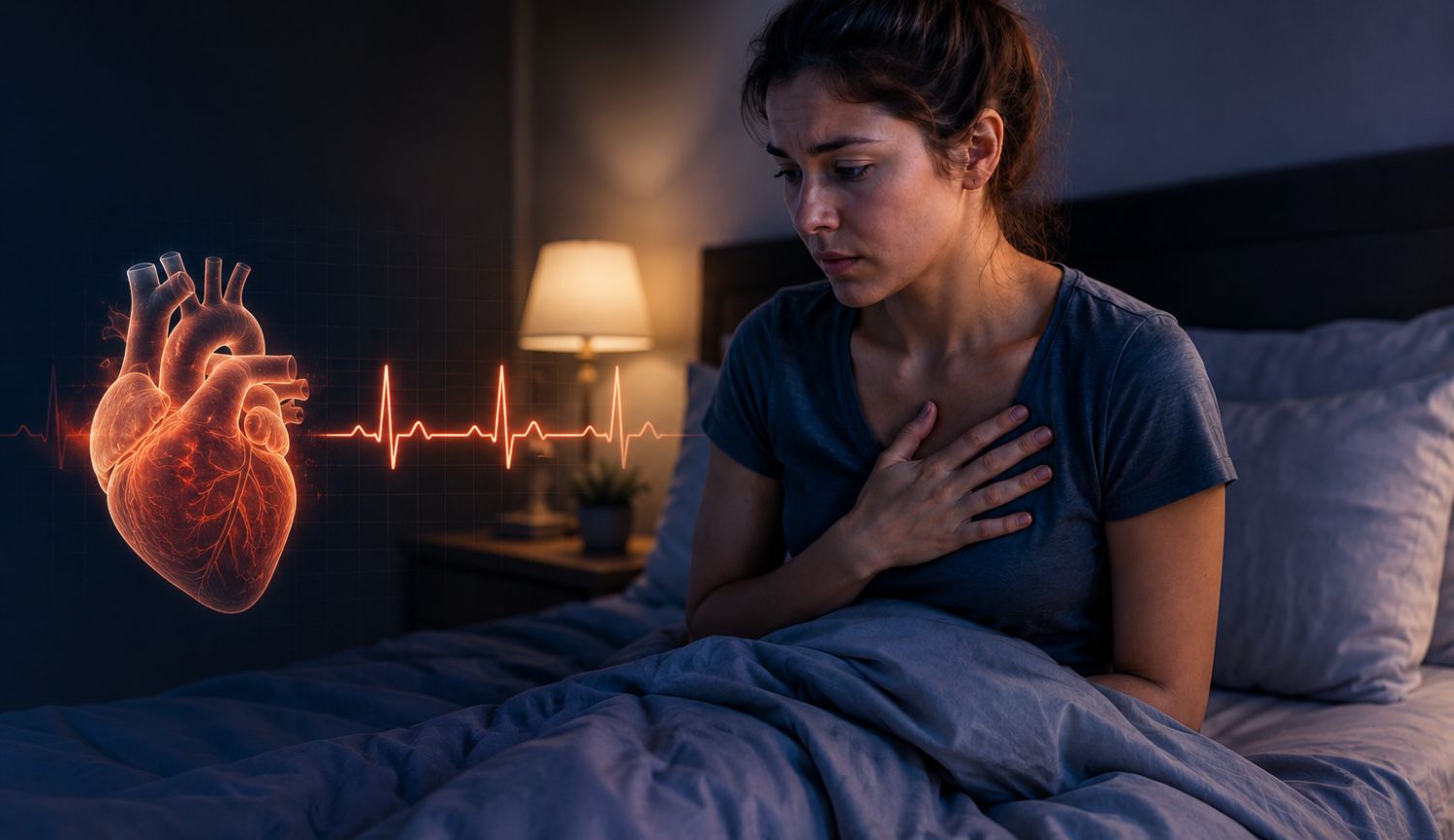
Histamine intolerance heart palpitations are one of the most commonly discussed cardiovascular symptoms in histamine-sensitive individuals.
During the day, the body generates enough movement and noise that the heartbeat stays in the background. At night, lying still, it can become the only thing in the room. A faster rate. A harder thud. A fluttering sensation that was not there an hour ago. And the awareness of it tends to amplify everything.
For people navigating histamine-sensitive periods, the overlap between nighttime heart awareness, wakefulness, nervous system activation, and reactive symptoms can feel especially confusing. This article is an attempt to explore that overlap calmly, clearly, and with the restraint it deserves.
One thing needs to be said at the outset: heart palpitations have many causes.
Caffeine. Dehydration. Thyroid dysfunction. Anaemia. Medication side effects. Anxiety. Sleep deprivation. Cardiac arrhythmia. Hormonal changes. Stress. Exercise. Standing up quickly. And yes, in some people, heightened nervous system activation during reactive periods.
The experience of a racing or pounding heart should not be automatically attributed to histamine. Persistent, severe, worsening, or unexplained cardiac symptoms always warrant proper medical evaluation.
This article is not a diagnostic tool.
It is an interpretive guide for a specific pattern many people experience and struggle to contextualize: nighttime heart awareness during histamine-sensitive periods.
Why histamine intolerance heart palpitations often feel worse at night
The experience of noticing your heartbeat is deeply connected to attention — and attention behaves differently at night.
During the day, sensory input is constant. External noise, movement, conversations, screens, work, and visual stimulation occupy the nervous system’s attention and leave less room for monitoring internal sensations. The heart may be behaving similarly at 3pm and 11pm, but during the day there is usually too much else happening to notice it clearly.
At night, the external environment quiets down.
The nervous system, without its usual outward focus, naturally turns inward. This shift is part of the body’s transition toward rest and sleep regulation. But it also means physical sensations become easier to perceive.
A heartbeat that would feel ordinary during the afternoon can suddenly feel unusually loud or forceful in a dark, silent room.
This does not mean the sensations are imagined or insignificant.
It means the context in which they are perceived changes how intense they feel.
The stillness amplifies awareness. The awareness increases monitoring. And for someone who has already had distressing nighttime experiences, the monitoring itself can become activating.
Histamine, wakefulness, and nervous system activation
Histamine is not only involved in allergic responses and immune signaling. In the brain and nervous system, it also functions as one of the body’s primary wakefulness signals.
During the day, histamine helps maintain alertness and responsiveness. During sleep, those wakefulness circuits are supposed to quiet down.
For some people during histamine-sensitive periods, that transition does not happen as smoothly.
Elevated histamine at night may contribute to a state of physiological alertness that feels difficult to switch off. The body feels tired, but the nervous system remains activated.
That activation is not subtle.
An activated nervous system produces adrenaline. Adrenaline increases heart rate, heightens sensory awareness, and creates the physical sensations associated with alertness: tension, readiness, warmth, internal restlessness, and increased awareness of bodily sensations.
In this context, heart awareness is often part of a broader physiological state rather than an isolated symptom.
The connection between histamine and adrenaline also works in both directions.
Histamine can stimulate adrenaline release. Adrenaline then activates the sympathetic nervous system further, increasing vigilance and bodily awareness. The result is an arousal loop in which the nervous system becomes progressively more sensitive to sensations that might otherwise fade into the background.
For many people, this pattern reflects physiological arousal and nervous system activation rather than a primary cardiac event.
That distinction matters.
But understanding the mechanism does not necessarily make the experience feel pleasant in the moment. And it does not mean symptoms should be dismissed casually.
Stress accumulation and the body’s overall load
Nighttime heart awareness rarely appears in isolation.
More often, it reflects a broader picture of accumulated physiological and emotional load that has been building throughout the day — and sometimes across several difficult days in a row.
Sleep deprivation increases inflammatory stress and reduces the nervous system’s overall regulatory capacity. A run of poor nights leaves the body progressively less resilient to incoming stimulation.
At the same time, chronic stress can disrupt cortisol rhythms that normally help regulate inflammation and mast cell activity across the day.
When those rhythms become less stable, the body may arrive at evening already operating with reduced buffering capacity.
The result is a nervous system that reacts more easily and settles less efficiently.
Emotional stress contributes to this picture as well.
Stress activates corticotropin-releasing hormone (CRH), which can stimulate mast cells directly. Mast cells release histamine. Histamine then contributes to wakefulness signaling and sympathetic nervous system activation.
The overlap becomes self-reinforcing.
A stressful day can therefore become a more reactive night even before food is considered.
By evening, the body may already be carrying:
- accumulated stress
- poor recovery
- nervous system fatigue
- inflammatory load
- overstimulation
- inconsistent sleep
- emotional exhaustion
Dinner may become the final contributor rather than the sole explanation.
This accumulated load framework matters because it shifts the question away from:
“What single thing caused this tonight?”
And toward:
“What has the system been carrying across the day?”
That perspective is often more realistic — and much less psychologically exhausting.
Overstimulation during the evening can add to this load significantly.
Late-night work, emotionally charged conversations, distressing news cycles, excessive screen exposure, and constant mental engagement keep the sympathetic nervous system activated during the exact period when the body is supposed to be winding down.
The result is a body that becomes more reactive precisely when it is trying to rest.
When awareness becomes hypervigilance
This section matters because it affects many people experiencing recurring nighttime symptoms, yet it is rarely discussed carefully.
When heart sensations have previously felt frightening — especially during abrupt nighttime wakeups — the nervous system often develops a learned monitoring pattern afterward.
This is not irrational.
It is a protective response.
The problem is that constant monitoring increases sensitivity to the very sensations the body is trying to avoid.
Lying in bed scanning for the heartbeat makes the heartbeat easier to notice. Noticing it more clearly increases anxiety and physiological alertness. That alertness triggers adrenaline release. Adrenaline raises heart rate and bodily awareness further.
Which then confirms that “something is happening.”
The loop reinforces itself:
- monitoring
- awareness
- anxiety
- adrenaline
- increased heart awareness
- more monitoring
This does not mean the original symptoms were imagined.
They were real.
But the nervous system can continue amplifying the experience long after the initial physiological activation has started settling.
Recognising this distinction is important.
It allows people to understand that two things can be true simultaneously:
- the symptoms themselves are real
- the vigilance surrounding them may also be intensifying the experience
That understanding often reduces fear more effectively than endless symptom analysis.
Nighttime wakeups and racing heart sensations
Waking suddenly with a racing heart or a strong sense of internal alertness — often between roughly 1am and 4am — is one of the most commonly described nighttime patterns during histamine-sensitive periods.
The wakeup often feels abrupt rather than gradual.
People describe:
- elevated heart rate
- sudden alertness
- warmth or flushing
- internal restlessness
- heightened sensory awareness
- difficulty returning to sleep
Several biological processes overlap during this window.
Cortisol reaches its nightly low point around midnight, temporarily reducing one of the body’s natural mast cell-regulating influences. Histamine follows a circadian rhythm and tends to rise during the early morning hours. Overnight fasting also corresponds with lower DAO enzyme activity compared with daytime digestion.
At the same time, the nervous system is operating in an environment with less distraction, more bodily awareness, and reduced emotional buffering.
The overlap of these factors can produce a state of physiological arousal that feels unusually intense in the darkness and quiet of the night.
Understanding this timing does not eliminate the discomfort.
But it often makes the experience feel less random and less frightening.
The body is responding to a convergence of biological and nervous-system factors rather than behaving arbitrarily.
When symptoms need proper medical evaluation
This section is important.
Heart palpitations, racing heart sensations, chest awareness, and nighttime wakefulness can occur for many different reasons. Histamine sensitivity is only one possible contributor among many.
Symptoms should never be automatically self-interpreted as histamine-related without appropriate clinical context.
The following situations warrant proper medical evaluation rather than online interpretation:
- chest pain or chest pressure
- fainting or near-fainting
- significant shortness of breath
- sustained very rapid heart rate
- worsening or changing symptoms
- symptoms occurring alongside known cardiac conditions
- strong family history of heart disease
- symptoms that feel severe, new, or medically concerning
These points are not included to create fear.
They are included because interpretive frameworks are helpful only when they remain within appropriate limits.
Understanding overlap between histamine reactivity, nervous system activation, and nighttime symptoms can be genuinely useful for many people. But it should never replace medical assessment when symptoms require proper evaluation.
If there is uncertainty, the safer direction is always toward professional assessment rather than away from it.
A more supportive way to approach the pattern
There is no perfect protocol here.
What tends to help most is often a gradual reduction in the overall load the system is carrying into the night.
Predictability usually supports the nervous system more effectively than perfection.
For some people, supportive adjustments may include:
- earlier and simpler dinners
- reducing evening overstimulation
- calmer nighttime routines
- more consistent sleep timing
- less symptom monitoring during wakeups
- lower screen exposure late at night
- more recovery time after stressful days
These changes matter less because they are “biohacks” and more because they reduce the amount of activation the body carries into overnight hours.
When nighttime wakeups happen, the response matters too.
Panic, symptom-checking, repeated pulse-monitoring, and frantic online searching often intensify the activation loop already occurring.
Calmer responses tend to help the nervous system settle more efficiently:
- slower breathing
- low-stimulation environments
- avoiding screens
- reducing catastrophic interpretation
- allowing the body time to settle gradually
The goal is not to force perfect sleep.
It is to reduce additional activation layered on top of an already reactive system.
Within the broader sleep & histamine ecosystem
This article sits within a broader cluster of writing on nighttime symptoms, nervous system activation, and histamine-sensitive periods at Mynourishly.
For the foundational overview of why sleep becomes vulnerable during histamine-sensitive periods — including circadian rhythms, wakefulness signaling, food timing, and overnight reactivity — the Sleep & Histamine Symptoms guide covers the broader landscape.
The article Why Histamine Symptoms Feel Worse at Night explores how accumulated stress, cortisol decline, nervous system overload, and reduced distraction combine to make nighttime symptoms feel more intense after dark.
For the specific 1am–4am wakeup pattern, Histamine Dump at Night Symptoms examines the biological overlap that can contribute to sudden nighttime alertness and reactive wakeups.
And for the morning aftermath of disrupted nights, Histamine Symptoms in the Morning explains why waking already reactive, overstimulated, or “wired but tired” often reflects what happened overnight rather than a completely separate issue.
Together, these articles are designed to help readers interpret nighttime patterns more calmly and with less confusion.
Closing
Heart awareness at night can feel genuinely distressing.
The stillness, darkness, and heightened alertness of reactive periods can make ordinary bodily sensations feel unusually intense and emotionally loaded. That experience is real. And the overlap between histamine-sensitive periods, nervous system activation, wakefulness signaling, and accumulated stress is also real.
What this article has attempted to offer is not a simplistic explanation, but a calmer framework for interpreting those experiences.
The timing is not random. The overlap is understandable. And the body’s reactions often make more sense once the broader patterns surrounding stress, wakefulness, nervous system load, and nighttime physiology become visible.
At the same time, interpretive clarity is not the same thing as medical reassurance. Persistent, worsening, severe, or concerning symptoms deserve proper clinical evaluation.
But for many people, understanding these nighttime patterns more clearly is the point where the experience begins feeling less frightening and more manageable.
Understanding the relationship between histamine intolerance and heart palpitations can help explain why symptoms often appear during periods of increased histamine load, stress, or disrupted sleep.
This article is for educational and informational purposes only. It does not constitute medical advice and should not be used for self-diagnosis or treatment decisions. Heart palpitations and related symptoms can have multiple potential causes. If you are experiencing persistent, worsening, or concerning symptoms, consult a qualified healthcare professional promptly.

