
What vitamins increase DAO is often treated as a supplement question. In reality, it determines whether histamine can be processed at all.
Histamine tolerance depends less on intake and more on how efficiently it is broken down at the intestinal level. That process is controlled by diamine oxidase, and DAO activity is constrained by the availability of specific nutrient cofactors.
When those cofactors are insufficient, the enzyme slows regardless of how carefully histamine intake is managed. This is why dietary control alone often reaches a limit. Without adequate cofactor support, DAO cannot operate at full capacity.
This is the point where dietary control stops being enough and biochemical capacity becomes the limiting factor.
If you are unsure whether DAO is the limiting factor, this low DAO levels guide explains the patterns behind reduced enzyme activity.
What vitamins increase DAO and support enzyme activity
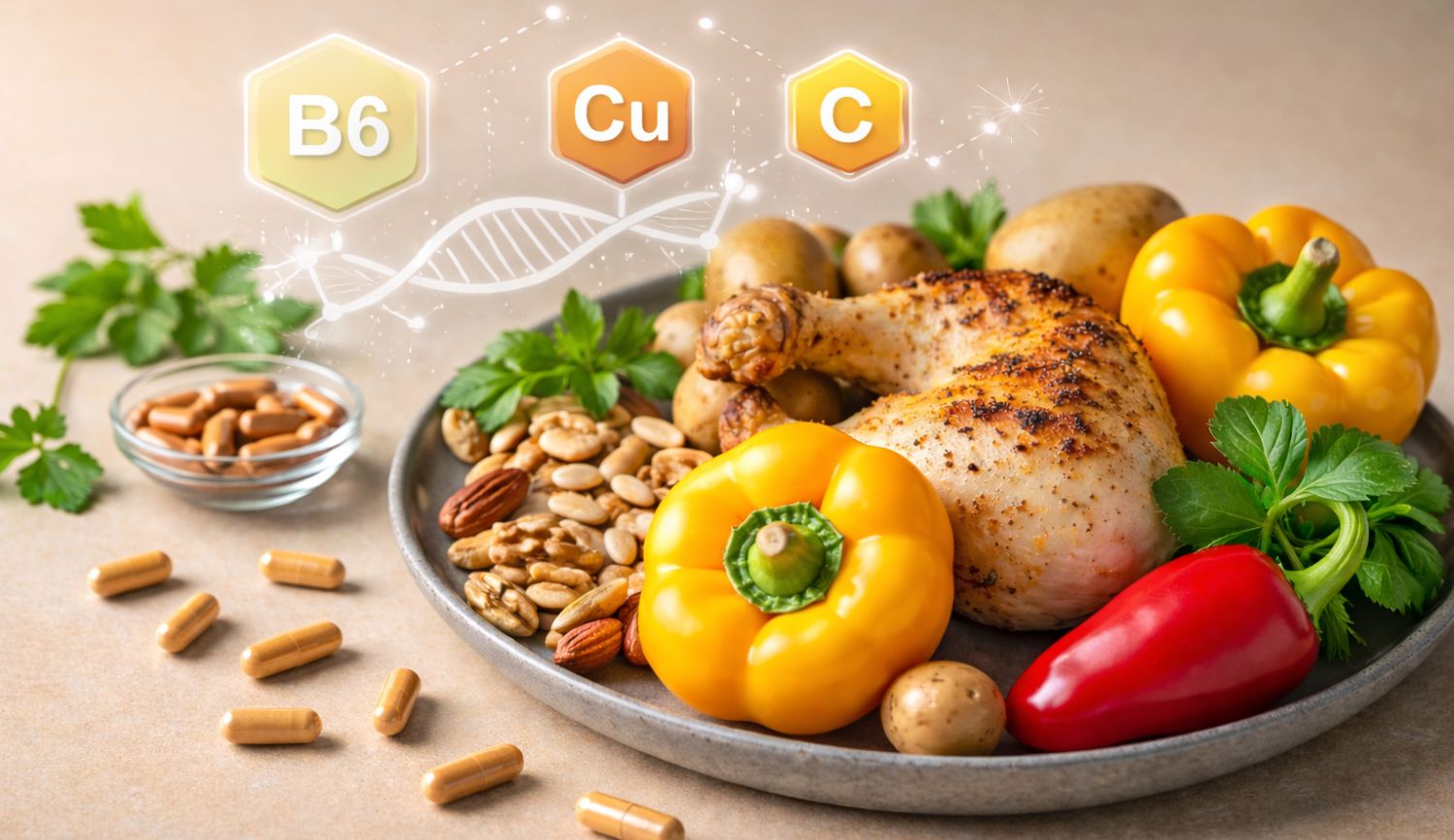
DAO does not function in isolation. Its activity depends on a small group of nutrients that directly influence how efficiently histamine is broken down. Copper has a direct biochemical relationship with DAO, while claims about vitamin B6, vitamin C and other nutrients require more careful interpretation.
Vitamin B6
Vitamin B6, specifically in its active form pyridoxal-5-phosphate (PLP), is the primary cofactor required for DAO enzymatic activity. It binds directly to the enzyme and enables the reaction that breaks histamine down.
When B6 levels are low, DAO cannot perform efficiently regardless of how much of the enzyme is present. This creates a situation where histamine intake appears to be the issue, when the real limitation is enzymatic function.
B6 deficiency is more common than often assumed. Oral contraceptives, low-protein diets, and gut inflammation can all reduce B6 availability. In these situations, improving intake or using the active P-5-P form can restore DAO function more effectively than dietary restriction alone.
This is why B6 often produces the most noticeable improvement when it is genuinely deficient. It directly removes a functional bottleneck rather than indirectly supporting the system.
Dietary sources include poultry, fish, potatoes, and bananas. For individuals with impaired conversion, supplementing with pyridoxal-5-phosphate bypasses this limitation.
Copper
Copper is not simply supportive. It is part of the physical structure of the DAO enzyme. Without adequate copper, DAO is not properly formed, which means enzyme activity is structurally limited rather than just reduced.
This makes copper deficiency fundamentally different from most nutrient issues. It does not just slow the system. It prevents the system from being correctly built.
Copper deficiency often goes unnoticed, particularly in people following restricted diets or supplementing with high doses of zinc. Zinc competes with copper for absorption, and long-term high-dose zinc use can reduce copper levels enough to impair DAO.
This interaction is one of the more practical examples of how well-intentioned supplementation can create unintended consequences.
Copper is found in shellfish, organ meats, nuts, and seeds. Severely restricted diets can reduce intake below functional levels, which contributes to ongoing histamine sensitivity despite dietary control.
Vitamin C
Vitamin C has been studied in relation to histamine physiology, but it is not established as a direct DAO cofactor or a proven way to increase intestinal DAO activity.
Small human studies have reported changes in circulating histamine with vitamin C status or supplementation, but that is different from showing that vitamin C improves histamine intolerance by increasing DAO. Evidence for a specific dose, timing strategy or preferred formulation for histamine intolerance is also lacking.
Vitamin C can still be an important nutrient, but its role should not be described as a proven DAO-boosting mechanism. For the full evidence review, see our guide to vitamin C and histamine intolerance.
Vitamins that influence histamine indirectly
Not all nutrients act directly on DAO. Some influence histamine metabolism by affecting gut health or immune regulation.
Zinc
Zinc supports DAO indirectly by maintaining the integrity of the intestinal lining. Since DAO is produced in the gut, the health of these cells determines how much enzyme is available.
Zinc also stabilizes mast cells, reducing histamine release from internal sources. This lowers the total histamine load the body needs to manage.
However, zinc must be balanced carefully. High intake without copper can reduce copper absorption and indirectly impair DAO.
Vitamin D
Vitamin D regulates immune activity rather than DAO itself. Adequate levels help prevent excessive mast cell activation, which reduces histamine release.
Deficiency is associated with increased inflammatory responses and greater histamine-related symptoms. Correcting vitamin D does not increase DAO directly, but it reduces the burden placed on the system.
Vitamin B12
Vitamin B12 is often misunderstood in the context of histamine.
It does not directly support DAO activity. Instead, it contributes to histamine breakdown through a separate pathway involving the HNMT enzyme, which operates inside cells rather than in the gut.
This distinction is important. DAO handles histamine from food before it enters circulation, while HNMT processes histamine after it has already been absorbed.
Concerns about B12 increasing histamine are usually linked to methylation dynamics and depend on the form used. Methylated forms may affect some individuals differently, while hydroxocobalamin is generally better tolerated.
B12 deficiency does not cause DAO deficiency, but it can reduce the body’s ability to clear histamine once it has entered circulation.
Which vitamin deficiency causes histamine intolerance
Vitamin B6 deficiency is the most direct nutritional cause of reduced DAO activity. Without sufficient PLP, the enzyme cannot perform its core function effectively.
Copper deficiency produces a different type of problem. Instead of slowing the enzyme, it prevents proper enzyme formation. This distinction explains why some individuals do not respond to general nutrient support unless copper status is addressed specifically.
In practice, combined deficiencies are common. Restrictive diets designed to reduce histamine often remove nutrient-dense foods, leading to reduced intake of B6, copper, zinc, and vitamin C.
Over time, this creates a paradox. The diet reduces histamine exposure but also weakens the body’s ability to process it.
Gut-related malabsorption adds another layer. When the intestinal lining is compromised, nutrient absorption declines, and DAO production is reduced at the same time. In these cases, correcting deficiencies requires addressing gut health alongside nutrient intake.
What increases DAO enzyme activity in practice
Understanding deficiency explains the limitation. The next step is understanding how that limitation is actually reversed in practice.
DAO activity improves when enzyme production and nutrient availability are supported together.
This includes maintaining adequate levels of vitamin B6 and copper, supporting gut integrity, and reducing exposure to substances that interfere with DAO.
These mechanisms are also why approaches outlined in how to increase DAO naturally focus on multiple factors rather than isolated interventions.
Improvements tend to be gradual rather than immediate. Consistent dietary patterns, stable nutrient intake, and reduced inhibitory factors produce more reliable changes than isolated interventions.
Why improvements are often partial
Even when key deficiencies are corrected, improvements in histamine tolerance are often incomplete.
This is because DAO activity is only one part of the system. Ongoing exposure to DAO inhibitors, unresolved gut inflammation, or high baseline mast cell activity can continue to drive symptoms.
This is why improvement often feels inconsistent rather than linear.
In practice, this means nutrient correction improves the ceiling of tolerance, but does not eliminate triggers entirely. This distinction is important for setting realistic expectations.
Why fixing vitamins alone does not always work
Correcting deficiencies improves DAO efficiency, but it does not remove factors that actively suppress the enzyme.
Alcohol, certain medications, and synthetic food additives can inhibit DAO regardless of nutrient status. These interactions explain why identifying foods that block DAO is essential when symptoms persist despite improving nutrition.
A detailed breakdown of these interactions is covered in the foods that block DAO article, which explains why nutrient correction alone often fails.
Gut inflammation creates a similar limitation. Even with adequate nutrients, DAO production remains low if the intestinal lining is compromised.
Absorption also matters. Nutrients taken in combinations that compete for absorption, such as high-dose zinc without copper, reduce effectiveness. This is why timing, balance, and form are as important as intake.
Food versus supplements for DAO support
Whole foods provide the most stable and balanced source of nutrients for DAO support. They supply cofactors in combinations that support absorption and long-term metabolic function.
However, dietary restrictions often limit access to these nutrients. Foods rich in copper, zinc, or vitamin C may be avoided due to histamine concerns, which creates a gap that diet alone cannot always fill.
In these situations, targeted supplementation becomes necessary. Using specific forms such as P-5-P for B6, chelated minerals for copper and zinc, and buffered vitamin C improves tolerability and absorption.
Relying exclusively on diet in a structurally restricted eating pattern often prolongs deficiency rather than resolving it.
The practical distinction is not whether food or supplements are better, but whether diet alone can reliably meet the required intake. When dietary patterns are structurally restricted, supplementation becomes less of an option and more of a necessity.
Practical approach to improving DAO through nutrients
Improving DAO function begins with identifying which nutrients are actually limiting enzyme activity.
Testing for B6, copper, and vitamin D provides a useful starting point, while dietary analysis helps identify consistent gaps. Addressing one deficiency at a time allows for clearer evaluation of results.
B6 is typically the most effective starting point due to its direct role in enzyme activity. Copper should be addressed carefully and ideally confirmed through testing, especially in individuals using zinc supplements.
Improvements usually occur over several weeks rather than immediately. This reflects the time required for enzyme systems to recover.
For individuals who have corrected deficiencies and reduced DAO inhibitors but still experience post-meal symptoms, targeted enzyme support before meals becomes a practical next step.
The DAO supplements guide explains how these products work, when they are useful, and how to evaluate their effectiveness.
Frequently Asked Questions
These are the most common questions related to vitamins and DAO function.
What vitamins increase DAO levels?
Copper has established biochemical relevance to DAO, but vitamin C is not a proven DAO booster. Vitamin C has been studied more broadly in histamine physiology, while direct clinical evidence that it raises intestinal DAO or treats histamine intolerance is lacking.
Which vitamin deficiency causes histamine intolerance?
Vitamin B6 deficiency is most directly linked to reduced DAO activity. Copper deficiency also impairs DAO by affecting enzyme structure. Combined deficiencies are common in individuals following long-term restrictive diets.
What vitamins lower histamine levels?
Nutrients can influence histamine-related biology through different pathways, but they should not all be described as DAO boosters. Vitamin C has some human evidence involving circulating histamine, while copper has direct biochemical relevance to DAO. Evidence that supplementation reliably lowers histamine or improves histamine intolerance depends on the specific nutrient and clinical context.
Does B12 increase histamine?
B12 does not directly increase histamine. Its effects depend on form and individual metabolism. It supports histamine breakdown through methylation pathways rather than DAO activity. Hydroxocobalamin is generally better tolerated in histamine-sensitive individuals.
How to increase DAO naturally?
Increasing DAO naturally involves correcting nutrient deficiencies, supporting gut health, and reducing exposure to DAO inhibitors such as alcohol and food additives. These changes improve enzyme function over time rather than producing immediate effects.
Are vitamins enough to fix histamine intolerance?
Vitamins improve DAO function when deficiencies are present, but they do not address all contributing factors. DAO inhibitors, gut health, and immune activity also influence histamine tolerance. For many individuals, nutrient correction is necessary but not sufficient on its own.
Final thoughts
DAO function is not determined by diet alone. It depends on whether the enzyme has the structural and functional support required to operate efficiently.
When key nutrients are missing, histamine tolerance declines even in carefully controlled diets. Addressing these deficiencies provides a more complete framework for improving histamine metabolism.
Understanding how vitamins influence DAO shifts the focus from restriction to restoration. Instead of continuously removing foods, the goal becomes restoring the system responsible for processing them.
That shift is often what determines whether histamine intolerance improves temporarily or resolves more sustainably.
Peer-reviewed research on histamine metabolism and DAO enzymatic activity consistently highlights the role of nutrient cofactors in determining functional enzyme capacity. View research on histamine metabolism.
This article is for informational purposes only and does not constitute medical advice. Consult a qualified healthcare provider before starting supplementation or making significant dietary changes.