

Key takeaways
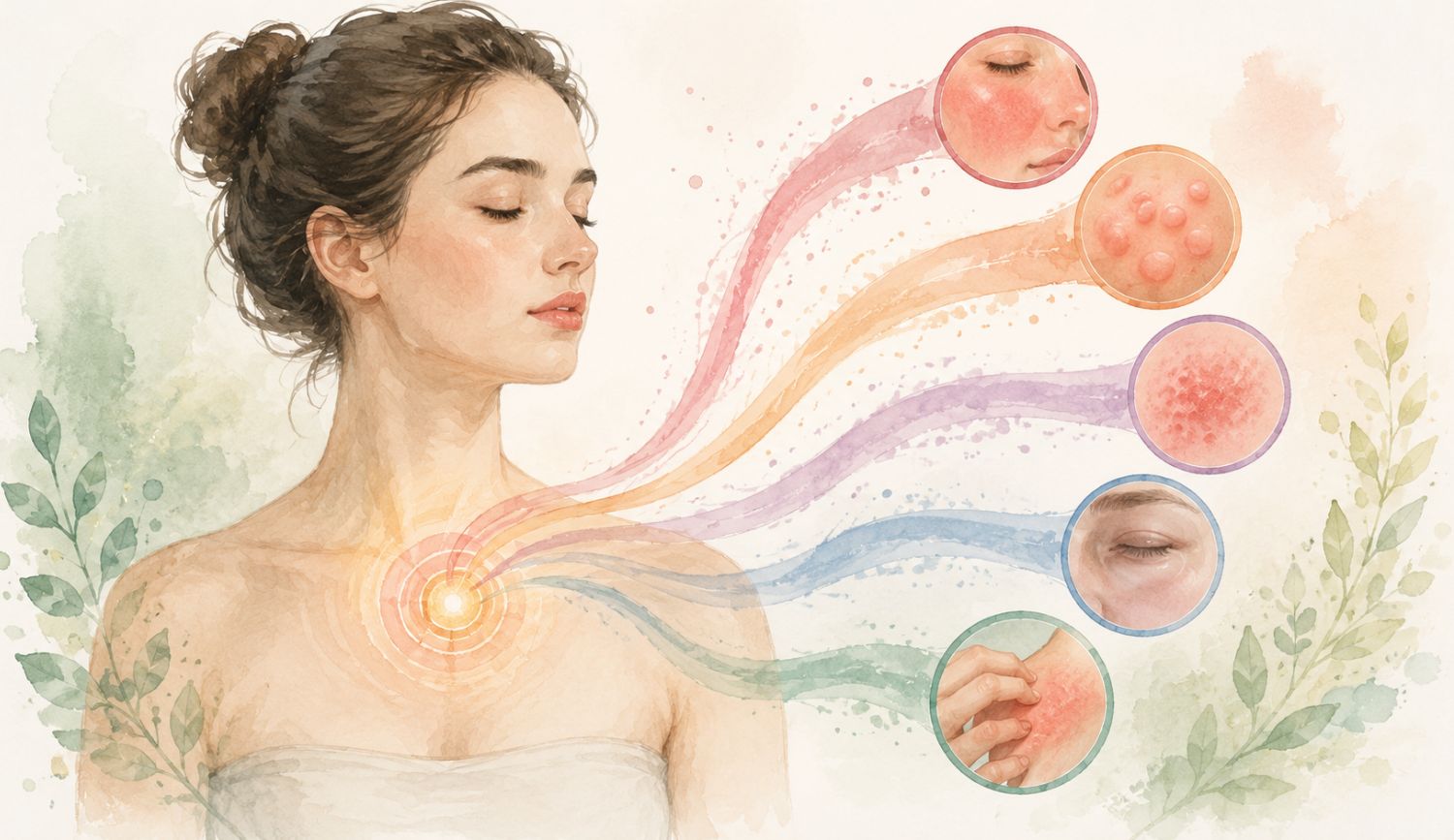
- Histamine skin reactions do not always look the same. One person may experience itching, while another develops hives, flushing, redness, or swelling.
- The important pattern is not the specific symptom but the body’s overall response.
- If skin symptoms seem to appear unpredictably, tracking triggers, symptom patterns, and cumulative histamine load may provide more useful insights than focusing on a single reaction in isolation.
Unexplained skin symptoms are one of the most common reasons people start investigating histamine intolerance.
The rash that appears after certain meals. The itching that starts at night. The face flushing after wine. The hives that come and go without an obvious pattern. These experiences are real, often distressing, and frequently misunderstood.
This article explains the full picture of histamine skin reactions — not just what they look like, but why they happen, why they vary so much between individuals, and why the same person can experience different skin symptoms at different times.
Histamine skin reactions in 30 seconds
Skin symptoms are often one of the earliest and most visible signs of histamine-related reactivity.
Histamine skin reactions occur when elevated histamine activates receptors in skin tissue, triggering localised or widespread responses that can include:
- Flushing — sudden redness, warmth, and visible redness, typically across the face, neck, and chest
- Urticaria (hives) — raised, itchy welts that appear and disappear, sometimes within hours
- Generalised itching — pruritus with or without visible skin change
- Rash — redness, blotches, or papular eruptions, often on the face, trunk, or limbs
- Angioedema — deeper swelling, typically affecting lips, eyelids, or hands
- Dermographism — raised lines that appear when skin is lightly scratched
The exact reaction varies between individuals and can change depending on overall histamine load, trigger exposure, and other contributing factors.
What are histamine skin reactions?
Histamine skin reactions are cutaneous responses driven by histamine acting on receptors within skin tissue.
The skin contains a high density of mast cells — immune cells that store and release histamine. When these mast cells are triggered, they release histamine into the surrounding tissue. Histamine then binds to local H1 receptors, triggering vasodilation, increased vascular permeability, nerve sensitisation, and the immune cascade that produces visible skin changes.
The result depends on the location, intensity, and duration of receptor activation. Superficial vasodilation produces flushing. Fluid leaking into the dermis produces hives. Deep tissue swelling produces angioedema. Nerve sensitisation at the skin surface produces itching.
All of these are the same underlying mechanism — histamine acting on skin receptors — expressed differently depending on which structures are affected.
Why histamine affects the skin differently
This is the question most articles do not answer, and it is the one that matters most for people trying to understand their own pattern.
Two people can eat the same high-histamine meal and experience completely different skin responses. One develops a flushed face. The other gets hives on their arms. A third gets no skin reaction at all but experiences a headache. Why?
Several factors determine which skin response occurs — and whether a skin response occurs at all.
Receptor distribution and density
H1 receptors are not uniformly distributed across skin tissue. They are concentrated in certain areas, and their density varies between individuals. Someone with higher H1 receptor density in facial blood vessels is more likely to experience flushing. Someone with greater mast cell density in the dermis is more likely to develop hives.
This structural variation partly explains why reactions tend to follow personal patterns — why one person’s histamine reaction always starts in the face, while another always notices it on the trunk or limbs.
Total histamine load at the time of exposure
The skin does not react in isolation from the rest of the body’s histamine status. When overall histamine load is high — from accumulated dietary sources, stress, poor sleep, hormonal fluctuations, or environmental triggers — the threshold for skin reactions drops.
A food that produced no skin reaction on a low-load day may produce flushing or hives on a high-load day. The food did not change. The total state of the system did. This cumulative load concept is explained in depth in the histamine bucket theory article.
The type of histamine trigger
Not all histamine triggers act through the same pathway. Some foods contain preformed histamine. Others act as histamine liberators — stimulating mast cell release without contributing histamine directly. Certain medications and alcohol inhibit DAO enzyme activity, reducing the body’s clearance capacity.
Each of these mechanisms can produce different patterns of skin activation, contributing to the variation people observe in their own reactions.
Hormonal state
Experimental evidence suggests oestrogen can influence mast-cell reactivity, and small human studies suggest skin-test responsiveness may vary across the menstrual cycle. However, findings are limited and inconsistent, and current evidence does not establish that oestrogen universally reduces DAO or that skin reactions predictably worsen at ovulation or before a period. See our estrogen and histamine guide for the evidence in context.
One person develops hives after wine.
Another notices flushing after a stressful day.
Someone else experiences itching with no visible rash at all.
These reactions may look completely different, yet histamine can be involved in all of them.
Common histamine skin reactions
Histamine can affect the skin in several different ways. Some reactions are easy to see, such as hives, redness, or swelling. Others may be more subtle, including persistent itching or occasional flushing.
Understanding these common patterns can make it easier to recognize when histamine may be contributing to skin symptoms.
Histamine rash
A histamine rash typically presents as red, blotchy patches, small raised bumps, or diffuse skin redness. It can appear on the face, neck, chest, arms, or trunk.
Unlike a fixed allergic rash, a histamine-related rash is often transient — appearing within 30 to 90 minutes of a trigger and fading within a few hours. It does not necessarily recur in the same location each time.
The rash may be accompanied by warmth or mild itching, or it may appear without any sensation. Some people notice it only when they look in a mirror rather than feeling it first.
Distinguishing a histamine rash from other rash types — contact dermatitis, viral exanthem, or drug reaction — requires clinical assessment, particularly when the pattern is not clearly food-linked.
Histamine itching
Itching, or pruritus, is one of the most common and most distressing histamine skin symptoms. It can occur with or without visible skin change, which often makes people question whether the sensation has a physical cause at all.
The mechanism is direct. Histamine binds to H1 receptors on sensory nerve fibres (C-fibres) in the skin, triggering the itch signal independently of any tissue damage or rash. This is the same pathway that mediates the itch of conventional allergic reactions.
Histamine-related itching tends to be:
- Generalised rather than localised to one area
- Worse in the evening and at night, when histamine levels follow their circadian peak
- Exacerbated by heat, exercise, alcohol, or stress
- Not always accompanied by visible skin changes
The histamine symptoms at night guide covers the nighttime pattern in detail, including why itching often intensifies after dark.
Histamine hives
Urticaria — commonly known as hives — is one of the most recognised histamine skin presentations. It produces raised, red or pale welts (wheals) that vary in size, appear suddenly, and typically resolve within 24 hours.
Hives form when histamine increases vascular permeability in superficial blood vessels, allowing fluid to leak into the dermis and creating the characteristic raised appearance.
Chronic urticaria is defined as hives occurring more than twice a week for six weeks or more. Histamine intolerance is one of several possible contributors to chronic urticaria, but the connection is not straightforward. In a significant proportion of chronic urticaria cases, no single consistent dietary or environmental trigger is identified — because non-dietary histamine sources (stress, hormonal shifts, environmental allergens) contribute simultaneously.
A randomised controlled trial published in the International Archives of Allergy and Immunology found that DAO supplementation reduced symptoms in a subset of chronic spontaneous urticaria patients with confirmed low DAO activity (Yacoub et al., 2018). This supports a histamine-DAO connection in some urticaria cases but does not apply universally.
Histamine flushing and redness
Flushing is the most visually prominent histamine skin reaction and one of the most immediately noticeable after consuming a high-histamine trigger.
It occurs through H1 receptor activation in cutaneous blood vessels, causing rapid vasodilation. This brings increased blood flow to the surface, producing visible redness, warmth, and sometimes a tingling or prickling sensation.
Common areas affected include the face, neck, chest, and upper arms. The face — particularly the cheeks, nose, and forehead — is the most frequently reported location, often described as a “histamine rash on the face” by people searching for an explanation.
Histamine flushing tends to:
- Develop within minutes of a trigger
- Be accompanied by warmth or a burning sensation
- Fade gradually over 30 to 90 minutes
- Be triggered reliably by alcohol, particularly red wine
Distinguishing histamine flushing from rosacea requires clinical assessment, as both can produce persistent or episodic facial redness. Rosacea involves a distinct pathological mechanism and requires different management, though histamine may be a contributing trigger in some individuals with rosacea.
Histamine-related swelling
Swelling associated with histamine is driven by the same vascular permeability mechanism as hives, but involves deeper tissue layers.
Angioedema — deep tissue swelling typically affecting the lips, eyelids, cheeks, hands, or feet — can occur alongside hives or independently. It tends to be less itchy than superficial hives and may feel tight or uncomfortable rather than producing a classic itch sensation.
Histamine-related facial swelling, particularly around the lips or eyelids, is a symptom that warrants medical evaluation rather than self-management. While histamine intolerance can contribute to mild recurrent angioedema, this symptom can also indicate IgE-mediated allergy, ACE inhibitor drug reaction, or hereditary angioedema — each requiring specific clinical assessment and management.
Mild localised swelling or puffiness that resolves within hours and correlates with high-histamine food intake may reflect histamine sensitivity, but any swelling involving the tongue, throat, or airway is a medical emergency requiring immediate attention.
Why skin symptoms can change from day to day
This is the most common source of confusion for people with histamine-related skin symptoms.
The same food tolerated last week triggers a rash this week. The hives that appeared on Tuesday are gone by Thursday. The flushing after wine at home is more pronounced at a restaurant than at home. None of this makes obvious sense if food is the only variable being tracked.
The explanation is that skin symptoms do not reflect just what was eaten. They reflect the total histamine load at the time, which includes:
| Contributor | How it affects skin threshold |
|---|---|
| Poor sleep | Reduces regulatory capacity and increases mast cell reactivity |
| Psychological stress | CRH-driven mast cell activation adds to baseline load |
| Seasonal allergens | Elevates mast cell reactivity before food is considered |
| Hormonal phase | Hormonal phase may influence reactivity, but no fixed cycle-phase pattern is established |
| Alcohol the previous day | DAO inhibition persists for several hours |
| Recent illness | Immune activation increases histamine burden |
On a day when several of these factors are present simultaneously, the threshold drops. Foods and exposures that would normally be tolerated exceed the reduced threshold and produce skin reactions.
This is why tracking food alone rarely provides the full picture. A symptom diary that includes sleep quality, stress level, cycle phase, and environmental conditions alongside food choices is significantly more informative.
Common triggers that may worsen skin reactions
Understanding the triggers that most reliably worsen histamine skin reactions helps clarify why symptoms feel unpredictable.
Dietary triggers are the most recognised. High-histamine foods — aged cheeses, cured meats, fermented products, canned fish, red wine, beer — are the primary dietary contributors. Histamine liberators such as citrus fruits, strawberries, tomatoes, and chocolate can trigger mast cell release without contributing histamine directly.
Alcohol deserves specific mention. It contains histamine, inhibits DAO enzyme activity, and triggers direct mast cell degranulation simultaneously. Even small quantities can produce flushing and urticaria in sensitive individuals.
Heat and exercise directly trigger histamine release from skin mast cells. Hot showers, saunas, vigorous physical activity, and hot ambient temperatures can all produce or worsen skin reactions in histamine-sensitive people, independently of dietary intake.
Medications that inhibit DAO activity — including NSAIDs such as ibuprofen, certain antibiotics, and some antidepressants — can lower the histamine clearance capacity and worsen skin reactivity. This is explored in detail in the DAO deficiency article.
Stress activates corticotropin-releasing hormone (CRH), which directly stimulates mast cell degranulation. Emotional or psychological stress is a genuine histamine trigger, not a secondary factor.
Environmental allergens including pollen, dust mites, mould, and animal dander activate mast cells through IgE pathways. During high-allergen periods, baseline mast cell reactivity is elevated before any dietary trigger is added.
How histamine skin reactions differ from allergies, eczema, rosacea, and MCAS
Accurate identification matters because each condition requires different management.
Histamine reactions vs IgE-mediated allergy
IgE-mediated allergy produces an immune-specific response that occurs even with trace exposures and is not dose-dependent. A true peanut allergy, for example, produces a reaction from the smallest quantity.
Histamine intolerance is dose-dependent — small amounts of a trigger may cause no reaction, while larger amounts or cumulative load produces symptoms. The presence of a reaction threshold is a clinically important distinguishing feature.
Both conditions can produce hives, redness, and itching. Formal allergy testing — skin prick testing or specific IgE blood testing — is required to differentiate them.
Histamine reactions vs eczema (atopic dermatitis)
Eczema involves a distinct immunological mechanism: Th2-mediated immune dysregulation, skin barrier dysfunction, and chronic inflammation. It typically presents as dry, lichenified, intensely itchy plaques, usually in flexural areas such as the inner elbows and behind the knees.
Some research suggests histamine may play a role in maintaining itch and inflammation in atopic dermatitis, and some people with eczema report that dietary histamine worsens their skin. However, this evidence is emerging rather than established, and eczema cannot be attributed to histamine alone.
A low-histamine diet is not a standard treatment for eczema. Anyone managing a skin condition resembling eczema should receive a dermatological assessment before making dietary changes.
Histamine reactions vs rosacea
Rosacea is a chronic inflammatory skin condition characterised by persistent facial redness, flushing, small visible blood vessels, and, in some subtypes, papules and pustules. It differs from histamine flushing in that it is a diagnosed condition with its own pathological mechanism.
That said, high-histamine foods — alcohol, spicy foods, hot beverages — are among the established triggers for rosacea flares. For some individuals with rosacea, reducing dietary histamine load may reduce the frequency or severity of flushing episodes, but this addresses a trigger rather than the underlying condition.
Histamine reactions vs MCAS
Mast cell activation syndrome (MCAS) involves dysregulated mast cell activation that produces symptoms across multiple organ systems, of which skin reactions are one component. Unlike histamine intolerance, MCAS is driven by intrinsic mast cell dysfunction rather than excessive dietary load or reduced clearance capacity alone.
The histamine intolerance symptoms article covers the broader overlap between these conditions, including when specialist assessment is appropriate.
When to seek medical advice
Histamine-related skin reactions are common and often manageable, but some presentations require clinical evaluation rather than self-management.
Seek immediate emergency care if:
- Skin reactions are accompanied by throat tightening, difficulty breathing, tongue swelling, or dizziness — these are signs of anaphylaxis
- Swelling involves the throat, airway, or produces difficulty swallowing
Seek prompt medical assessment if:
- Hives or angioedema are frequent, severe, or persistent without an identifiable pattern
- Skin reactions are worsening over time despite dietary changes
- Symptoms do not correspond to known histamine triggers and do not respond to load reduction
- Skin reactions are accompanied by systemic symptoms such as rapid heart rate, significant blood pressure change, or severe gastrointestinal distress
Consider seeing a dermatologist or allergist if:
- A chronic skin condition such as eczema, rosacea, or urticaria has not been formally assessed
- You are considering eliminating significant food categories based on suspected histamine intolerance — a dietitian can guide this process safely
- You have not had formal allergy testing to exclude IgE-mediated reactions
Self-diagnosis based on online information alone has real risks, particularly where skin conditions overlap. A supervised dietary elimination trial, guided by a dietitian, provides significantly more diagnostic value than unsupervised food removal.
Key takeaway
Histamine skin reactions are varied, unpredictable, and often misunderstood — not because they are random, but because they reflect a dynamic interplay between total histamine load, individual skin receptor sensitivity, and the cumulative state of the system at any given moment.
The same person can experience different skin symptoms on different days. The same food can produce a reaction in one context and not another. This is not inconsistency — it is the system responding accurately to changing conditions.
Understanding which triggers elevate your own threshold, how non-dietary contributors compound dietary load, and when symptoms genuinely require clinical assessment is the foundation of managing histamine-related skin reactions effectively.
Frequently asked questions
Histamine-related skin symptoms can be confusing because they often overlap with allergies, eczema, rosacea, and other skin conditions. These are some of the most common questions people ask when trying to understand whether histamine may be contributing to their symptoms.
What does a histamine skin reaction look like?
Histamine skin reactions can look quite different depending on the individual. Common presentations include red flushing across the face and chest, raised itchy welts (hives), blotchy redness or small raised bumps forming a rash, and in some cases swelling around the eyes, lips, or hands. The appearance varies based on where histamine is activating receptors and how intensely.
Can histamine cause itching without a rash?
Yes. Histamine directly activates itch-signalling nerve fibres (C-fibres) in the skin, producing pruritus independently of any visible tissue change. This explains why some people experience intense itching with no rash to explain it — the sensation is neurological, not dependent on a visible skin response.
Can histamine intolerance cause facial redness?
Yes. Histamine-driven vasodilation in facial blood vessels produces the characteristic flushing that many people notice after high-histamine foods or alcohol. Facial redness or flushing is one of the most consistently reported histamine skin reactions, particularly affecting the cheeks, nose, and forehead.
Can high histamine levels cause hives?
Yes. Urticaria (hives) is a well-recognised histamine-mediated skin reaction, produced when histamine increases vascular permeability in the dermis, allowing fluid to leak and form raised welts. Both acute hives (single episode) and chronic urticaria (recurring hives) can involve histamine intolerance as a contributing factor, though chronic urticaria has multiple possible causes and warrants clinical assessment.
Why do histamine skin symptoms come and go?
Histamine skin symptoms are threshold-dependent. The threshold shifts based on total histamine load — which includes food, stress, sleep quality, hormonal phase, and environmental allergen exposure simultaneously. On high-load days, foods that would normally be tolerated exceed the threshold and produce skin reactions. On low-load days, the same foods do not. This day-to-day variability reflects the system’s changing capacity, not the unpredictability of a single food.
Can stress make histamine skin reactions worse?
Directly, yes. Psychological stress activates corticotropin-releasing hormone (CRH), which binds to receptors on mast cells and stimulates histamine release. Stress is a genuine histamine trigger through a specific biochemical pathway, not simply a background factor. People often notice that skin reactions are worse during difficult life periods even when their diet has not changed.
How long can a histamine rash last?
Most histamine-related skin reactions resolve within a few hours of the triggering exposure, once the histamine is cleared from tissue. Flushing typically fades within 30 to 90 minutes. Hives usually resolve within 24 hours, though they may recur in waves. A rash that persists beyond 48 to 72 hours, or one that is worsening rather than improving, warrants clinical assessment to exclude other causes.
Can histamine cause swelling?
Yes. Angioedema — swelling in the deeper layers of skin tissue — is a recognised histamine-driven response. It typically affects the lips, eyelids, cheeks, or hands and can accompany hives or occur independently. Mild histamine-related swelling that correlates with high-histamine food intake and resolves within hours may reflect histamine sensitivity, but swelling involving the throat or airway is a medical emergency.
References
- Maintz L, Novak N. Histamine and histamine intolerance. Am J Clin Nutr. 2007;85(5):1185–1196. https://doi.org/10.1093/ajcn/85.5.1185
- Yacoub MR, Colombo G, Bruni B, et al. Diamine oxidase supplementation in chronic spontaneous urticaria: a randomized, double-blind, placebo-controlled study. Int Arch Allergy Immunol. 2018;176(3–4):268–271. https://doi.org/10.1159/000488142
- Comas-Basté O, Sánchez-Pérez S, Veciana-Nogués MT, et al. Histamine intolerance: The current state of the art. Biomolecules. 2020;10(8):1181. https://doi.org/10.3390/biom10081181
- Siebenhaar F, Redegeld FA, Magerl M, et al. Mast cells as drivers of disease and therapeutic targets. Trends Immunol. 2018;39(2):151–162. https://doi.org/10.1016/j.it.2017.10.005
This article is for informational purposes only and does not constitute medical advice. Always consult a qualified healthcare provider before making dietary changes, self-diagnosing skin conditions, or beginning any self-management protocol. Individual presentations vary considerably, and many skin conditions require clinical assessment and diagnosis.

