

Have you ever reacted to a food that seemed completely safe a few days earlier?
Perhaps leftovers caused symptoms one week but not the next. Maybe a meal you’ve eaten many times suddenly triggered flushing, headaches, digestive discomfort, or a racing heart. Then, just as confusingly, those symptoms disappeared again.
For many people living with histamine intolerance, the unpredictability can feel more frustrating than the symptoms themselves.
When reactions seem random, it’s natural to start searching for a single culprit. But histamine symptoms often don’t work that way.
The histamine bucket theory is one of the most widely used frameworks for explaining why symptoms can change from day to day. Rather than focusing on a single food or trigger, it helps explain how multiple factors can combine to influence your overall histamine load and symptom threshold.
Importantly, this theory is not a medical diagnosis. It is a practical model that helps people understand why reactions can feel inconsistent, why symptoms sometimes appear unexpectedly, and why reducing overall load is often more effective than chasing individual triggers.
Most explanations stop there.
This article takes a broader view.
You’ll learn how food, sleep, stress, environmental exposures, illness, recovery, and daily habits can all contribute to cumulative histamine load—and why understanding those patterns may be more helpful than trying to achieve perfect avoidance.
The diagram below shows how each trigger contributes to your total histamine load:
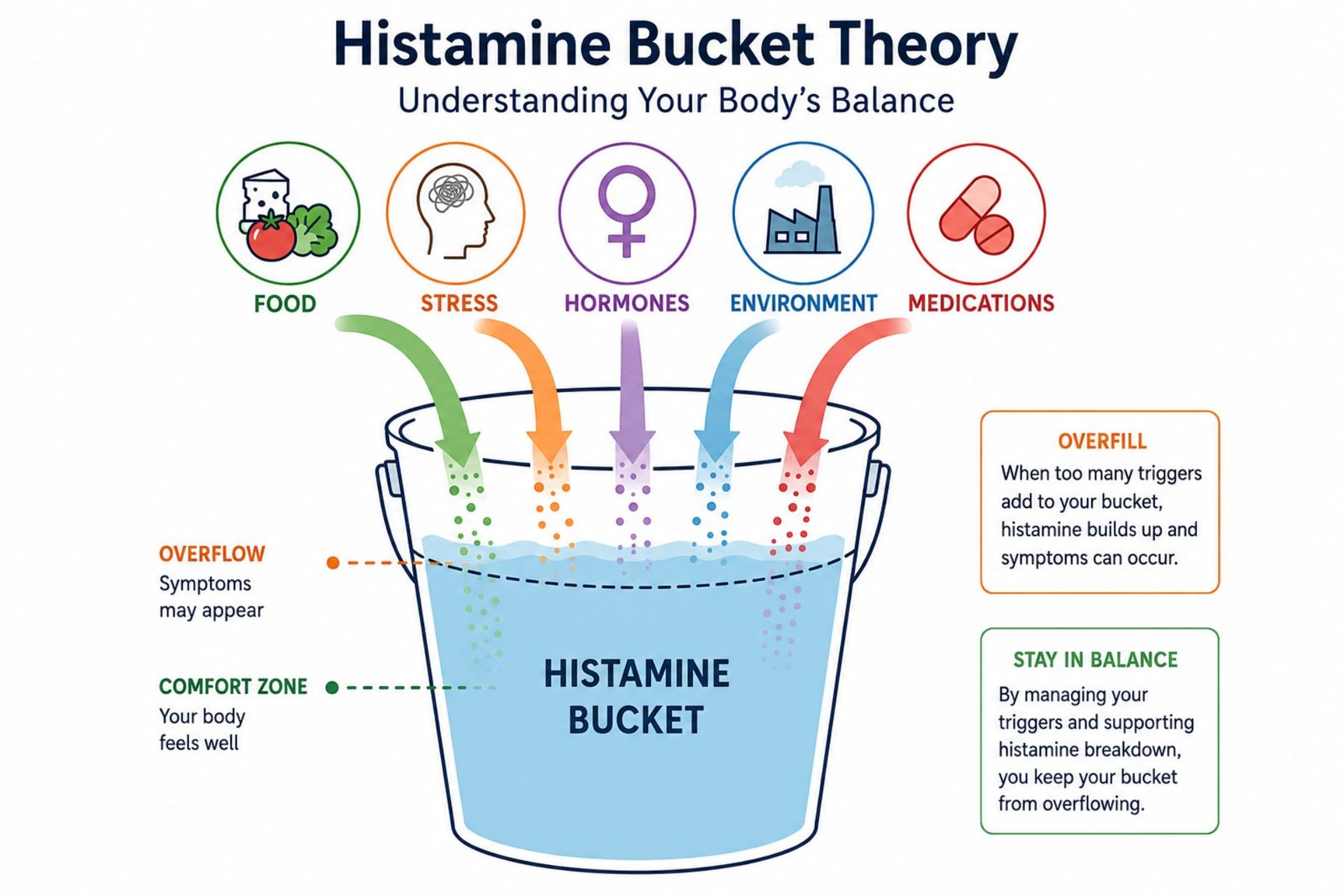
As shown above, no single trigger fills the bucket — it is the combination of food, stress, hormones, environment, and medications that pushes your load over the threshold.
Histamine bucket theory in 30 seconds
- Histamine symptoms are often cumulative rather than caused by a single trigger.
- Food is only one contributor to overall histamine load.
- Sleep disruption, stress, illness, hormones, environmental exposures, and lifestyle factors may also play a role.
- Symptoms often appear when several sources of load accumulate together.
- The goal is not to achieve perfect avoidance.
- The goal is to help the body carry less overall burden.
Understanding that distinction can completely change how you think about symptom management.
So what exactly is the histamine bucket theory—and how accurately does it reflect what we know about histamine intolerance today?
What is the histamine bucket theory?
The histamine bucket theory is a simple way of describing how multiple sources of histamine-related stress may accumulate over time.
The idea is straightforward: every person has a certain capacity to tolerate histamine and related triggers before symptoms begin to appear.
Rather than being caused by one food, one event, or one exposure, symptoms may emerge when several contributing factors occur close together and collectively exceed that person’s current histamine threshold.
This helps explain one of the most confusing aspects of histamine intolerance:
Why can the same food feel perfectly fine one day and trigger symptoms the next?
The bucket theory suggests that the answer may not lie entirely in the food itself. Instead, it may reflect the total load the body is already carrying at that moment.
A meal that feels manageable after a restful weekend may feel very different after several nights of poor sleep, a stressful work week, seasonal allergies, illness, or increased environmental exposures.
A more useful way to think about the bucket
The bucket metaphor is helpful because it illustrates accumulation.
However, it can also be misleading if taken too literally.
Your body is not a static container that gradually fills until it suddenly overflows.
A more accurate way to think about histamine load is as a dynamic balance between:
- Histamine entering or being released in the body
- The body’s ability to process and clear histamine
- Recovery capacity at a given moment
That balance is constantly changing.
Sleep, stress levels, illness, hormones, food choices, activity, environmental exposures, and recovery all influence where that balance sits from one day to the next.
For that reason, many people find it more helpful to think about overall body load rather than a permanently full bucket.
Key takeaway
Histamine symptoms are not always caused by one food or one trigger.
Instead, reactions often occur when multiple sources of load accumulate faster than the body can comfortably process them.
Understanding this shift—from single-trigger thinking to cumulative-load thinking—is often the first step toward making symptoms feel less random and more understandable.
The five sources of histamine load
While every person is different, most contributors to cumulative histamine load tend to fall into five broad categories.
1. Food load
Certain foods naturally contain histamine or may encourage histamine release in susceptible individuals.
Food often matters, but it is rarely the entire story.
2. Sleep load
Poor sleep can reduce resilience, increase physiological stress, and make symptoms feel more intense the following day.
3. Nervous system load
Chronic stress, overstimulation, hypervigilance, and prolonged sympathetic activation may all influence how the body responds to everyday challenges.
4. Environmental load
Fragrances, chemicals, mold exposure, air quality issues, temperature extremes, and seasonal allergens can contribute to the overall burden the body is managing.
5. Lifestyle load
Illness, overtraining, irregular routines, travel, hormonal fluctuations, and recovery deficits can all influence symptom patterns.
None of these categories exist in isolation.
Most histamine reactions occur within the overlap between several of them.
That overlap is what makes symptoms feel unpredictable—and understanding it is what makes the histamine bucket theory genuinely useful.
The next question is where many people get stuck:
If load is cumulative, why do symptoms sometimes seem completely random?
Why histamine symptoms can feel so unpredictable
One of the most frustrating parts of histamine intolerance is that symptoms rarely follow a perfectly predictable pattern.
A food that feels completely safe one week may seem problematic the next. This unpredictability is one reason histamine intolerance symptoms can feel difficult to connect to a single trigger.
A routine that normally works may suddenly stop working.
Some days symptoms feel mild. Other days they appear out of nowhere.
This inconsistency often leaves people searching for a single explanation.
But in many cases, there isn’t one.
The histamine bucket theory helps explain why reactions can seem random even when they aren’t.
When symptoms develop, it is often the result of several small contributors accumulating together rather than one major trigger acting alone.
The same input can enter a different body
Imagine two different days.
On the first day:
- You slept well.
- Stress levels are manageable.
- You’ve been eating regularly.
- Allergy symptoms are quiet.
- You feel relatively recovered.
Now imagine eating a food that is moderately high in histamine.
You may notice little or no reaction.
A week later, the same food appears again.
But this time:
- Sleep has been poor for several nights.
- Work has been unusually stressful.
- Seasonal allergies are active.
- You’ve been skipping meals.
- Recovery has been limited.
Nothing about the food has changed.
What changed is the context in which the food entered the body.
The total burden is different.
The body’s available capacity may be different too.
This is one reason symptoms can feel inconsistent even when eating the same foods.
Example scenario
Poor sleep. Stress. Leftovers. Allergy season. A glass of wine. None of these factors may be enough to trigger symptoms alone. Together, they may exceed your current histamine threshold.
The result can feel sudden.
In reality, the body has been carrying a growing amount of load throughout the day.
Why reactions often seem delayed
Another reason symptoms feel confusing is that they do not always appear immediately after a specific trigger.
People naturally look for the most recent thing they ate or did.
But cumulative load does not always work on a simple cause-and-effect timeline.
The body is constantly responding to multiple influences at once.
As a result, the trigger that appears responsible may simply be the final contributor in a much larger pattern.
This doesn’t mean food is unimportant.
It means food is often only one piece of a bigger picture.
Pattern recognition is more helpful than trigger hunting
When symptoms feel unpredictable, many people fall into a cycle of constantly searching for the one thing that caused a reaction.
Over time, this can lead to increasingly restrictive diets, growing frustration, and even greater uncertainty.
A more productive approach is often to look for patterns instead.
Questions such as:
- How has sleep been recently?
- Has stress been unusually high?
- Are seasonal allergies active?
- Have routines changed?
- Has recovery been limited?
- Were several load factors present at the same time?
often reveal more useful information than focusing on a single food.
This shift—from trigger hunting to pattern recognition—is one of the most valuable insights the histamine bucket theory can offer.
Once you begin looking at symptoms through the lens of cumulative load, the next step is understanding exactly what contributes to that load in the first place.
What can contribute to histamine load?
One of the most common misconceptions about histamine intolerance is that symptoms are caused entirely by food.
Food can certainly play an important role, but it is rarely the only factor influencing how someone feels.
The histamine bucket theory becomes most useful when we recognize that histamine load often comes from multiple sources at the same time.
Some are obvious.
Others are easy to overlook.
Food and histamine exposure
Food is often where people begin their histamine intolerance journey.
Certain foods naturally contain higher amounts of histamine, while others may encourage histamine release or affect histamine metabolism in susceptible individuals.
Food freshness can also matter.
For example, histamine levels may increase in some foods as they age, even when stored properly.
This is one reason many people find that freshly prepared meals feel different from leftovers.
However, focusing exclusively on food can sometimes create an incomplete picture.
Many people discover that symptom patterns do not fully improve even after making significant dietary changes.
That’s often because other contributors to histamine load remain present.
For a practical overview of foods commonly discussed in histamine intolerance, see our Low Histamine Foods List.
Sleep and recovery
Sleep is one of the most overlooked influences on overall resilience.
A single poor night of sleep may not cause noticeable symptoms.
But several nights of disrupted sleep can gradually increase overall physiological stress and reduce the body’s ability to recover.
Many people also notice that symptoms feel more intense after periods of insufficient sleep.
Headaches, flushing, digestive discomfort, fatigue, and increased sensitivity to triggers may all feel more noticeable when recovery has been limited.
This may help explain why symptoms often seem worse after periods of poor sleep—even when food choices have remained unchanged.
If nighttime symptoms are a recurring challenge, our guide to histamine symptoms at night explores this connection in greater detail.
Stress and nervous system load
The body does not separate emotional stress from physical stress as neatly as we often imagine.
Work pressure.
Financial concerns.
Overstimulation.
Constant multitasking.
Lack of downtime.
These experiences all require energy and recovery.
When stress becomes chronic, many people notice that their overall tolerance for everyday challenges appears to decrease.
Foods that once felt manageable may suddenly feel less predictable.
Symptoms may seem stronger.
Recovery may take longer.
This does not mean stress is “all in your head.”
It means the nervous system is part of the larger picture.
We’ll explore this relationship more deeply in the next section because it deserves special attention.
Environmental exposures
Not all sources of histamine load come from what we eat.
For some individuals, the environment itself may contribute to the overall burden the body is managing.
Examples may include:
- Seasonal allergens
- Fragrances and scented products
- Mold exposure
- Poor indoor air quality
- Chemical irritants
- Temperature extremes
- Smoke exposure
Environmental triggers vary significantly between individuals.
The important point is not identifying every possible trigger.
The goal is recognizing that food may not be the only contributor to symptom patterns.
Illness, hormones, and lifestyle factors
Daily life introduces many variables that can influence how resilient we feel.
Travel.
Infections.
Hormonal fluctuations.
Intense exercise.
Major life changes.
Busy schedules.
Interrupted routines.
Each of these can affect recovery and overall physiological load.
Individually, they may seem insignificant.
Combined, they may help explain why symptoms feel different from one week to the next.
Histamine load is rarely one thing
People often ask:
“What is filling my bucket?”
The answer is usually more complex than a single food or trigger.
Overall histamine burden is often shaped by the interaction between multiple influences occurring at the same time.
Food matters.
Sleep matters.
Stress matters.
Recovery matters.
Environment matters.
The value of the histamine bucket theory is not that it helps identify one cause.
Its value is that it encourages a broader view of the patterns influencing how we feel.
Among those contributors, one deserves special attention because it is frequently overlooked yet closely connected to symptom resilience: the nervous system.
How the nervous system may influence histamine reactions
When people think about histamine intolerance, they often focus on food.
Yet many eventually notice something puzzling:
Symptoms seem more intense during stressful periods of life.
A food that felt manageable during a relaxed vacation suddenly feels less predictable during a demanding work week.
A routine that normally works begins to feel inconsistent after weeks of poor sleep, constant multitasking, or emotional strain.
This observation has led researchers and clinicians to explore the relationship between the nervous system, stress physiology, and histamine-related symptoms.
While histamine intolerance is not simply a stress problem, stress and recovery can influence the broader environment in which symptoms occur.
The body is designed for short-term stress
Stress is not inherently harmful.
In fact, the body’s stress response is designed to help us adapt to challenges.
The problem arises when stress becomes chronic and recovery becomes limited.
Modern life often creates a steady stream of demands:
- Constant notifications
- Information overload
- Work pressure
- Financial concerns
- Caregiving responsibilities
- Poor sleep
- Limited downtime
Individually, these challenges may seem manageable.
Over time, however, they can contribute to a state where the body spends less time recovering and more time reacting.
The “wired but exhausted” experience
Many people living with histamine-related symptoms describe feeling both tired and overstimulated at the same time.
They feel exhausted.
Yet relaxing feels difficult.
Sleep may be disrupted.
Minor stressors may feel unusually intense.
Recovery seems slower than expected.
This experience is sometimes described as being “wired but exhausted.”
While the causes can vary significantly from person to person, it highlights an important principle:
The body’s ability to tolerate everyday challenges is influenced not only by what enters the body, but also by its current recovery capacity.
When recovery is limited, the threshold for symptoms may feel lower.
Overstimulation is a form of load
One of the most overlooked contributors to cumulative histamine load is overstimulation.
Crowded environments.
Excessive screen time.
Constant background noise.
A packed schedule with little recovery.
Continuous decision-making.
These experiences require energy and adaptation.
For some individuals, especially during a histamine flare, reducing overstimulation can feel just as meaningful as making dietary adjustments.
This does not mean overstimulation causes histamine intolerance.
Rather, it recognizes that the nervous system is part of the larger load-and-recovery equation.
Why recovery matters
A common mistake is focusing entirely on reducing triggers while neglecting recovery.
Someone may spend enormous effort analyzing foods, reading ingredient labels, and avoiding potential exposures.
Meanwhile, sleep remains poor.
Stress remains high.
Daily life remains overwhelming.
This can create the frustrating feeling of doing everything right while still struggling.
The goal is not simply to remove inputs.
The goal is to improve the body’s overall capacity to recover.
Food choices matter.
But recovery matters too.
Looking beyond food
One of the most empowering aspects of the histamine bucket theory is that it expands the conversation beyond food alone.
Instead of asking:
“What food caused this?”
it encourages a broader question:
“What was my overall load and recovery capacity at the time?”
That shift often reveals patterns that would otherwise remain hidden.
And among all the factors that influence recovery capacity, few are as consistently important as sleep.
Which brings us to another major contributor to cumulative histamine load: recovery during the night.
Sleep, recovery, and histamine load
Among all the factors that can influence histamine load, sleep may be one of the most important—and one of the most overlooked.
Many people notice that symptoms feel more intense after a poor night’s sleep.
Headaches may be stronger.
Food reactions may seem less predictable.
Flushing, itching, digestive discomfort, fatigue, or brain fog may feel more noticeable than usual.
Yet sleep is often treated as a secondary concern compared to diet.
The histamine bucket theory suggests a different perspective.
Rather than viewing sleep as separate from symptom management, it can be helpful to think of sleep as one of the primary ways the body restores its capacity to handle everyday challenges.
Sleep influences recovery capacity
A single poor night of sleep does not automatically trigger symptoms.
The issue is usually cumulative.
Just as histamine load can build gradually, sleep debt can accumulate gradually too.
One late night may have little impact.
Several nights of disrupted or insufficient sleep can leave the body working with fewer resources for recovery.
This is one reason symptoms may seem more unpredictable during periods of poor sleep.
The foods haven’t necessarily changed.
The body’s available resilience may have changed.
Why symptoms often feel worse after poor sleep
Many people with histamine intolerance report a similar experience:
They can often predict how they will feel the next day based on how they slept.
After a restful night:
- Symptoms may feel more manageable.
- Energy may improve.
- Food tolerance may feel more predictable.
After several poor nights:
- Recovery may feel slower.
- Triggers may seem stronger.
- Symptoms may appear more easily.
This pattern doesn’t prove that sleep causes histamine intolerance.
However, it does suggest that sleep plays an important role in the broader load-and-recovery equation.
Nighttime histamine symptoms
Sleep and histamine have a particularly interesting relationship because many people notice symptoms during the evening or overnight hours.
Some experience:
- Difficulty falling asleep
- Frequent waking
- A racing heart at night
- Restlessness
- Night sweats
- Early-morning waking
Others notice that symptoms feel strongest in the early hours of the morning.
These experiences can feel confusing, especially when no obvious food trigger is present.
While individual causes vary, they highlight an important reality:
Histamine symptoms are not only a daytime experience.
For many people, sleep quality and nighttime symptom patterns are closely connected.
If this sounds familiar, our guide on histamine symptoms at night explores these patterns in greater detail.
Recovery is more than sleep duration
When people think about sleep, they often focus exclusively on the number of hours they spend in bed.
Quantity matters.
But recovery involves more than duration alone.
Consistency.
Sleep quality.
Stress levels before bed.
Evening routines.
Exposure to light and stimulation.
All of these can influence how restorative sleep feels.
The goal is not perfect sleep.
Just as with food, perfection is rarely realistic.
Instead, the goal is supporting recovery as consistently as possible over time.
Small improvements can have meaningful effects
One of the reassuring aspects of the histamine bucket theory is that improvement does not require solving everything at once.
Small changes often accumulate just as load does.
An earlier bedtime.
A calmer evening routine.
Reducing overstimulation before bed.
Supporting a more consistent sleep schedule may also complement strategies discussed in our guide to Magnesium Glycinate for Histamine Intolerance.
These changes may seem modest individually.
Together, however, they can help create a stronger foundation for recovery.
And recovery is one of the most important factors influencing how much overall load the body can comfortably carry.
Sleep is only one part of that picture, though.
Many people discover that some of their most significant contributors to histamine load are not found on their plate or in their bedroom at all—but in the environments they move through every day.
Environmental load: The triggers beyond food
When people first learn about histamine intolerance, most of their attention naturally goes to food.
What should I avoid?
What caused today’s reaction?
What can I eat safely?
These questions are understandable.
But over time, many people notice that symptom patterns do not always match what is happening on their plate.
Some days symptoms increase despite eating familiar foods.
Other days they remain stable even when the diet is less than perfect.
This is one reason the histamine bucket theory encourages a broader view of cumulative load.
Food matters.
But it is not the only input the body is responding to.
The environment is constantly providing information
Every day, the body interacts with thousands of environmental signals.
Air quality.
Temperature.
Fragrances.
Seasonal pollen.
Cleaning products.
Indoor spaces.
Outdoor spaces.
Most of these exposures are handled without issue.
However, when overall histamine load is already elevated, some people notice that environmental factors seem to contribute to symptom patterns as well.
This does not mean every exposure is dangerous.
It simply recognizes that the body is responding to more than food alone.
Seasonal allergies and histamine load
One of the clearest examples is seasonal allergy season.
Many people report that foods they normally tolerate feel less predictable when pollen counts are high.
Others notice:
- Increased congestion
- Itchy eyes
- Fatigue
- Headaches
- Greater sensitivity to everyday triggers
This does not necessarily mean food has suddenly become the problem.
It may reflect the fact that the body is already managing additional demands from the environment.
The total load has changed.
Fragrances, chemicals, and indoor air
Some individuals also report increased sensitivity to:
- Strong perfumes
- Scented cleaning products
- Air fresheners
- Smoke exposure
- Newly renovated spaces
- Poorly ventilated environments
Responses vary significantly between individuals.
The goal is not to become fearful of every environmental exposure.
Instead, it is to remain curious about patterns.
If symptoms consistently appear in certain environments, that observation may be worth noting.
Mold and air quality
Indoor air quality is another factor that often receives less attention than diet.
Damp environments.
Poor ventilation.
Water-damaged buildings.
Mold exposure.
These issues can affect people very differently.
For some, they seem irrelevant.
For others, they appear to coincide with worsening symptom patterns.
The important point is not that mold explains every symptom.
The important point is that environmental influences deserve consideration alongside food, sleep, and recovery.
Temperature and physical stressors
Environmental load can also include physical conditions that place additional demands on the body.
Examples may include:
- Extreme heat
- Extreme cold
- Sudden weather changes
- Long periods outdoors
- Travel-related disruptions
These factors may not directly increase histamine.
However, they can influence overall resilience, recovery, and stress levels.
Within the framework of cumulative load, that distinction matters.
Awareness without hypervigilance
Learning about environmental load can be empowering.
It can also become overwhelming if approached from a place of fear.
Not every fragrance is a problem.
Not every pollen season causes symptoms.
Not every environmental exposure needs to be tracked.
The purpose of the histamine bucket theory is not to encourage constant monitoring.
It is to encourage broader pattern recognition.
When food, sleep, stress, recovery, and environment are viewed together, symptoms often begin to make more sense.
And that understanding creates space for a more balanced approach to symptom management.
Unfortunately, many people never reach that point because they become trapped in a different cycle altogether: the pursuit of perfect control.
That is where “empty your bucket” thinking can sometimes become unhelpful.
Why “empty your bucket” thinking can backfire
If you’ve spent any time researching histamine intolerance, you’ve probably encountered the phrase:
“Empty your histamine bucket.”
At first glance, it sounds sensible.
If symptoms occur when the bucket becomes too full, then the solution must be to empty it as quickly as possible.
But over time, this way of thinking can create problems of its own.
Not because reducing histamine load is unhelpful.
But because the pursuit of perfect control can become exhausting.
When symptom management becomes symptom monitoring
Many people begin their histamine journey by trying to identify patterns.
This can be useful.
Over time, however, pattern recognition sometimes turns into constant monitoring.
Every meal is analyzed.
Every symptom is tracked.
Every reaction feels urgent.
Every exposure feels potentially dangerous.
The focus gradually shifts from living life to avoiding mistakes.
Ironically, this often creates more uncertainty rather than less.
The more variables people try to control, the harder it becomes to identify which ones truly matter.
The problem with searching for one perfect trigger
The histamine bucket theory is often misunderstood as a tool for finding the single thing that caused a reaction.
In reality, it teaches the opposite.
Most symptoms emerge from the interaction of multiple factors.
Trying to identify one perfect trigger can create the illusion that every symptom has a simple explanation.
Real life is usually more complicated than that.
And that’s okay.
The goal is understanding patterns, not achieving certainty.
Hypervigilance can become its own source of stress
When symptoms feel unpredictable, vigilance feels reasonable.
People want answers.
They want control.
They want to prevent future reactions.
Yet constant monitoring can become mentally exhausting.
Meals become stressful.
Social events feel risky.
Travel becomes complicated.
The body never fully receives the message that it is safe to relax.
This does not mean symptoms are psychological.
Nor does it mean symptoms are “all in your head.”
It simply recognizes that chronic vigilance requires energy.
And energy is a resource that supports recovery.
More restriction is not always better
Another common response to uncertainty is increasing dietary restriction.
A food causes symptoms.
It is removed.
Another food seems questionable.
It is removed too.
Over time, the list of “safe foods” becomes smaller and smaller.
Sometimes this is necessary for a period of time.
But long-term restriction is not automatically the same as long-term progress.
In some cases, people become trapped in a cycle where quality of life continues to shrink while symptom confidence never improves.
The goal of a low-histamine approach should be creating more stability and understanding—not permanent fear around food.
The pursuit of perfect control
Perhaps the biggest challenge with “empty your bucket” thinking is that it implies there is a finish line.
A point where all triggers are eliminated.
All symptoms disappear.
And the bucket stays empty forever.
Life rarely works that way.
Stress happens.
Travel happens.
Poor sleep happens.
Illness happens.
Unexpected challenges happen.
The objective is not to create a perfectly controlled environment.
The objective is to increase resilience within an imperfect one.
A more sustainable perspective
A calmer interpretation of the histamine bucket theory looks different.
Instead of asking:
“How do I empty my bucket completely?”
it asks:
“How can I help my body carry less overall load?”
That shift may seem subtle.
In practice, it changes everything.
It moves attention away from fear and toward understanding.
Away from perfection and toward consistency.
Away from constant restriction and toward sustainable support.
And for many people, that perspective becomes far more helpful over the long term than the idea of endlessly chasing an empty bucket.
If perfection is not the goal, then what should symptom management actually look like?
The answer begins with a calmer way of thinking about histamine load itself.
A calmer way to think about histamine load
The greatest value of the histamine bucket theory is not that it helps explain symptoms.
It is that it changes how we respond to them.
When symptoms feel unpredictable, it is easy to fall into a cycle of searching for certainty.
People often look for:
- The one food that caused a reaction
- The one supplement that will fix everything
- The one mistake that explains a flare
Unfortunately, symptom patterns are rarely that simple.
Histamine load is influenced by many moving parts.
Food matters.
Sleep matters.
Stress matters.
Recovery matters.
Environment matters.
And those factors are constantly changing.
Progress is not about perfection
One of the most reassuring aspects of cumulative-load thinking is that improvement does not require perfect behavior.
You do not need to:
- Eat perfectly
- Sleep perfectly
- Avoid every trigger
- Eliminate every source of stress
Life is not designed for perfection.
What often matters more is the overall direction of your habits over time.
Small improvements can accumulate.
Just as load can build gradually, recovery can build gradually too.
Patterns matter more than individual moments
A single meal rarely tells the whole story.
A single symptom rarely tells the whole story.
A single difficult day rarely tells the whole story.
When viewed in isolation, these experiences can feel confusing.
When viewed as part of a larger pattern, they often become much easier to understand.
This is why many people find that observing trends over weeks is more helpful than analyzing every reaction in real time.
Capacity is just as important as exposure
Much of the conversation around histamine intolerance focuses on reducing exposure.
That can be useful.
But reducing load is only one side of the equation.
The other side is increasing capacity.
Recovery.
Sleep.
Routine.
Nervous system support.
Managing overstimulation.
Creating space for the body to recover from the demands it is already carrying.
The goal is not simply to avoid more.
The goal is to support more.
A different question
Instead of asking:
“What did I do wrong?”
consider asking:
“What was my overall load at the time?”
That question often leads to more useful answers.
It encourages curiosity instead of fear.
Understanding instead of blame.
Patterns instead of panic.
And that shift is where many people begin to develop a healthier relationship with symptom management.
Understanding histamine load is valuable.
But understanding alone is not enough.
The next step is translating that understanding into practical actions that support everyday life.
Practical ways to reduce histamine load
Understanding the histamine bucket theory can be reassuring.
It helps explain why symptoms often feel unpredictable and why focusing on a single trigger is not always enough.
The next question, naturally, is:
“What can I actually do about it?”
The answer is not to eliminate every possible source of histamine.
Nor is it to create a perfectly controlled lifestyle.
Instead, the goal is to gradually reduce unnecessary load while supporting the body’s ability to recover.
Small, sustainable changes often have a greater long-term impact than aggressive short-term strategies.
For some individuals, understanding histamine breakdown is also important. Learn more in our guides to DAO Deficiency and Best DAO Supplements.
Focus on food freshness before food perfection
Many people begin by searching for the perfect low-histamine diet.
In reality, food freshness is often more important than dietary perfection.
For some individuals, freshly prepared foods feel more predictable than meals that have been stored for several days.
This does not mean leftovers are always problematic.
It simply highlights one of the practical ways cumulative histamine exposure can change over time.
Before eliminating large numbers of foods, it can be helpful to focus on:
- Meal freshness
- Storage practices
- Consistency
- Identifying personal patterns
For a more detailed overview, see our guides on low-histamine foods and low-histamine grocery shopping.
Support sleep as a recovery tool
Sleep is one of the most effective ways to support overall recovery.
While no sleep routine eliminates histamine intolerance, improving sleep quality can help strengthen resilience and recovery capacity over time.
Simple strategies may include:
- Maintaining a consistent bedtime
- Reducing stimulation before sleep
- Creating a calm evening routine
- Prioritizing sufficient sleep opportunities
The goal is not perfect sleep.
The goal is making recovery more likely.
Reduce nervous system overload
Many people focus exclusively on reducing physical triggers while overlooking mental and emotional overload.
Recovery requires more than avoiding certain foods.
It also requires periods of rest.
Moments of quiet.
Opportunities for the nervous system to shift out of constant activation.
Helpful practices may include:
- Spending time outdoors
- Gentle movement
- Relaxation practices
- Reduced screen exposure
- Building recovery time into busy schedules
These approaches are not cures.
They are ways of supporting the body’s overall capacity to adapt.
Pay attention to environmental patterns
You do not need to monitor every environmental exposure.
However, becoming aware of recurring patterns can be valuable.
For example:
- Do symptoms feel different during allergy season?
- Are certain environments consistently more challenging?
- Does travel affect symptom stability?
- Do strong fragrances seem to coincide with reactions?
The purpose is not to create fear around the environment.
The purpose is to identify patterns that may help explain fluctuations in histamine load.
Build stability before chasing perfection
One of the most helpful shifts is moving away from an all-or-nothing mindset.
Instead of constantly searching for the next thing to remove, consider focusing on what creates stability.
Regular meals.
Consistent sleep.
Reasonable routines.
Recovery time.
Managing overstimulation.
These habits may seem less exciting than finding a new supplement or eliminating another food.
Yet they often provide a stronger foundation for long-term progress.
Keep a broad view of symptoms
When symptoms appear, it is tempting to focus on the most recent meal.
Sometimes that meal matters.
Sometimes it doesn’t.
Before assuming a single trigger is responsible, consider the broader context.
How has sleep been?
What has stress been like?
Have allergies been active?
Has recovery been limited?
Were several sources of load present at the same time?
These questions often reveal more useful information than analyzing food alone.
Progress often looks smaller than expected
Many people expect improvement to happen suddenly.
In reality, progress often looks gradual.
Better recovery.
More predictable symptoms.
Fewer severe flares.
Greater confidence around food and a clearer plan during difficult periods, such as those covered in our Histamine Flare Recovery Guide.
A stronger understanding of personal patterns.
These changes may not happen overnight.
But they often represent meaningful movement in the right direction.
The purpose of reducing histamine load is not to create a life free from every challenge.
It is to create a life that feels more manageable, more predictable, and less dominated by symptom uncertainty.
The bucket model can help organize possible contributors, but it is not a treatment protocol. Our histamine intolerance treatment guide separates commonly recommended approaches from options with limited or indirect evidence.
Of course, not every symptom can or should be explained by cumulative load alone.
There are times when medical evaluation is an important part of the picture as well.
When symptoms may need medical evaluation
The histamine bucket theory can be a helpful framework for understanding symptom patterns.
However, it is important to remember that it remains a model—not a diagnosis.
Many symptoms commonly associated with histamine intolerance can also occur in other health conditions.
For that reason, persistent, severe, or worsening symptoms should not automatically be assumed to be caused by histamine alone.
Medical evaluation may be especially important if symptoms are:
- New or rapidly worsening
- Significantly affecting daily life
- Accompanied by unexplained weight loss
- Associated with severe digestive symptoms
- Linked to recurrent fainting, chest pain, or breathing difficulties
- Creating significant nutritional challenges due to food restriction
A healthcare professional can help assess whether additional factors may be contributing to symptoms and determine whether further testing or evaluation is appropriate.
This is particularly important because histamine-related symptoms often overlap with other conditions involving digestion, allergies, hormones, sleep, or immune function.
The goal of understanding histamine load is not to self-diagnose every symptom.
It is to develop a more informed understanding of the patterns that may be influencing how you feel.
When used alongside appropriate medical care, the histamine bucket theory can be a valuable tool for making symptom experiences feel less confusing and more manageable.
Frequently asked questions
What is the histamine bucket theory?
The histamine bucket theory is a practical framework used to explain how multiple sources of histamine-related load may accumulate over time. Rather than being caused by a single food or trigger, symptoms often appear when several contributing factors—such as food, stress, poor sleep, illness, or environmental exposures—combine and exceed a person’s current histamine threshold.
Is the histamine bucket theory scientifically proven?
The histamine bucket theory itself is not a formal scientific model. Instead, it is a teaching tool that helps explain the concept of cumulative load. While researchers recognize that histamine metabolism, stress, sleep, immune activity, and environmental factors can all influence symptoms, the bucket analogy is best viewed as a practical framework rather than a medical diagnosis.
What fills the histamine bucket?
Many factors may contribute to overall histamine load, including:
- Histamine-containing foods
- Histamine-releasing foods
- Poor sleep
- Chronic stress
- Seasonal allergies
- Illness and infection
- Environmental exposures
- Hormonal fluctuations
- Recovery deficits
The specific combination varies from person to person.
Why do histamine symptoms feel different from day to day?
Symptoms often change because overall load changes. A food that feels manageable on a well-rested, low-stress day may feel very different after poor sleep, increased stress, active allergies, or illness. This variability is one of the main reasons the histamine bucket theory resonates with many people living with histamine intolerance.
Can stress increase histamine symptoms?
Stress does not automatically cause histamine intolerance, but many people notice that symptoms become less predictable during stressful periods. Chronic stress can affect recovery, sleep quality, and overall resilience, which may influence how the body responds to other sources of load.
Can poor sleep worsen histamine intolerance symptoms?
Many individuals report stronger symptoms after periods of poor sleep. While sleep alone is rarely the sole explanation for a reaction, insufficient recovery may reduce resilience and make existing symptoms feel more noticeable. This is one reason sleep is considered an important part of overall histamine load management.
Are histamine levels higher at night?
Histamine plays a role in wakefulness and alertness, which helps explain why some people experience nighttime symptoms such as restlessness, difficulty sleeping, or early-morning waking. However, nighttime symptom patterns can vary considerably between individuals and may be influenced by multiple factors beyond histamine alone.
How do You lower histamine load?
The goal is usually not to eliminate every possible trigger. A more sustainable approach focuses on reducing overall load through practical strategies such as improving food freshness, supporting sleep, managing stress, recognizing environmental influences, and developing a better understanding of personal symptom patterns.
How long does it take to reduce histamine load?
There is no universal timeline. Histamine-related symptoms are influenced by many factors, including diet, sleep, stress, environment, health status, and individual physiology. Some people notice improvements relatively quickly, while others require longer periods of observation and adjustment to identify meaningful patterns.
Conclusion: A different way to understand histamine symptoms
Living with histamine-related symptoms can feel unpredictable.
One day, everything seems manageable.
The next, symptoms appear without an obvious explanation.
Over time, that uncertainty can become exhausting.
It is natural to search for a single cause.
A single food.
A single trigger.
A single mistake.
Yet the reality is often more complex.
The histamine bucket theory offers a different perspective.
Rather than viewing symptoms as isolated events, it encourages us to look at the bigger picture.
Each may contribute to the total load the body is carrying at a given moment.
When those factors are viewed together, symptoms often begin to feel less random and more understandable.
That does not mean every reaction will have a clear explanation.
Nor does it mean symptoms can always be prevented.
Life is dynamic.
Load changes.
Recovery changes.
Capacity changes.
The goal is not to achieve perfect control over every variable.
The goal is to better understand the patterns that influence how you feel.
For many people, that shift alone can be powerful.
It moves attention away from fear and toward awareness.
Away from constant trigger hunting and toward broader pattern recognition.
Away from perfection and toward sustainability.
Because ultimately, the value of the histamine bucket theory is not that it teaches us how to avoid life.
It teaches us how to navigate it more thoughtfully.
Understanding your patterns may never provide perfect certainty, but it can make symptoms feel far less mysterious.
And perhaps the most important takeaway is this:
The goal is not to empty a bucket. It is to help the body carry less.
If you’re ready to go beyond theory, continue with the Histamine Load Reduction Series, where we explore food freshness, sleep, nervous system support, environmental load, and recovery one step at a time.