

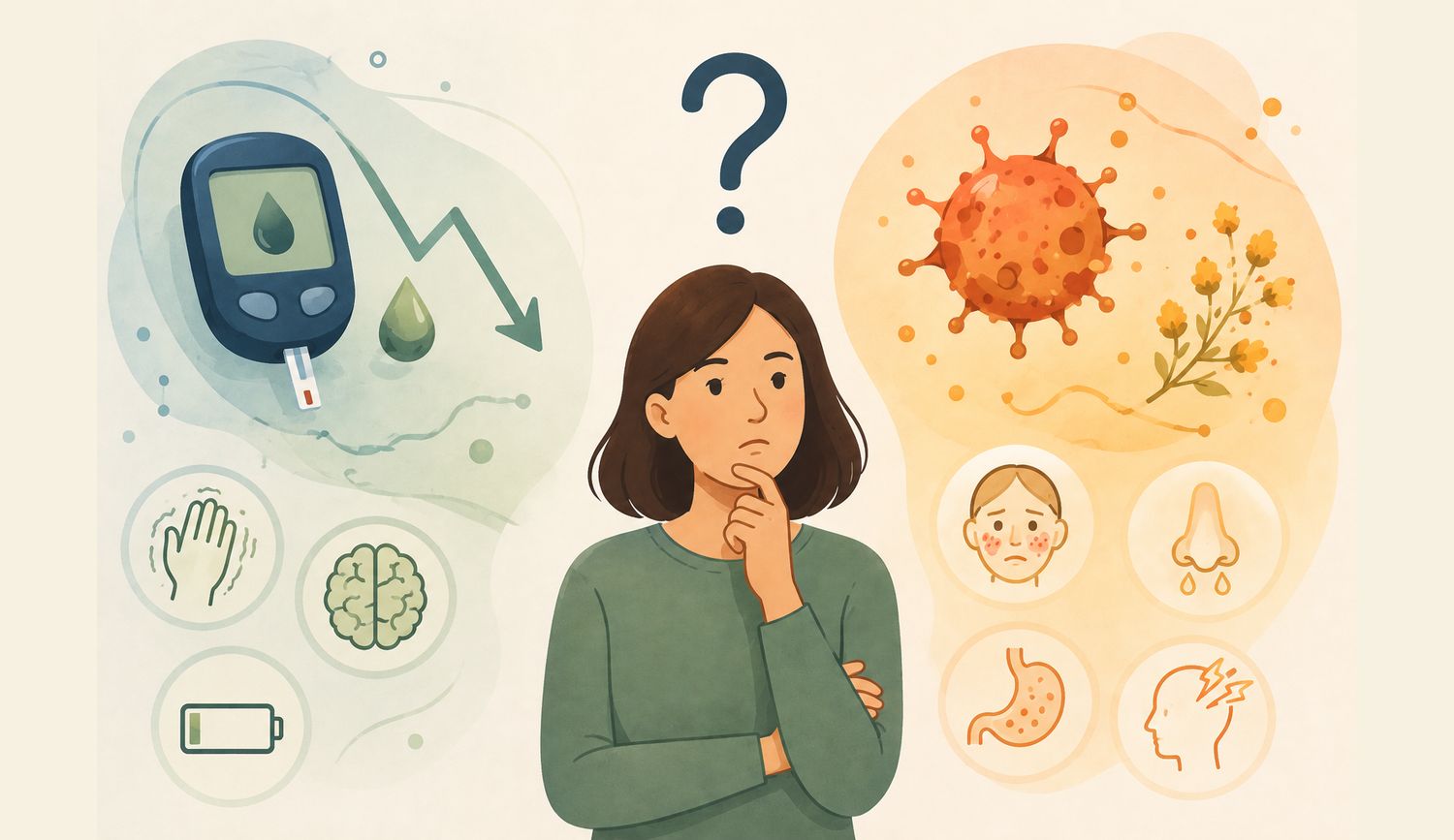
You finish eating.
Thirty minutes later you feel awful. Your heart is doing something strange. Your thoughts won’t land properly. You’re flushed, or shaky, or strangely sleepy, or wired in a way that makes no sense.
Did your blood sugar crash?
Or was it a histamine reaction?
If you’ve ever tried searching online, you’ve probably found convincing arguments for both.
These two experiences can look surprisingly similar. Both happen after meals. Both involve the nervous system. Both produce fatigue, anxiety, and a sense that something in the body just shifted hard.
But the mechanisms driving them are different. The timing is different. The symptoms that distinguish them are different. And so is what you should do next.
This article compares them directly — not to help you self-diagnose, but to help you bring better information to a clinical conversation.
Reactive Hypoglycemia vs Histamine Crash in 30 Seconds
Reactive hypoglycemia is a blood sugar event. After eating — particularly a high-carbohydrate meal — the body releases too much insulin, which drives blood glucose lower than it should go. This typically happens two to four hours after eating. Shakiness, sweating, strong hunger, and confusion are the most recognizable signs [1][2].
A histamine crash is different. It’s an immune and vascular event. A histamine reaction happens when histamine enters or is released faster than the body can break it down and clear it — through dietary load, reduced DAO enzyme activity, or mast cell involvement — and symptoms often begin within fifteen to sixty minutes of eating [3][4]. Flushing, itching, bloating, nasal congestion, and headache are more characteristic here.
The reactive hypoglycemia vs histamine crash distinction matters because treating one with the other’s approach usually doesn’t work. And in some cases, both may be contributing at once.
If you’re trying to work out which pattern sounds more like your own experience, this quick comparison can help. It isn’t meant to diagnose either condition, but it highlights some of the differences that healthcare professionals often consider during an evaluation.
| If… | It may point more toward… |
|---|---|
| Symptoms begin within 15–60 minutes after eating | Histamine reaction |
| Symptoms begin 2–4 hours after eating | Reactive hypoglycemia |
| Flushing, itching, hives, or nasal congestion appear | Histamine reaction |
| Shakiness, cold sweats, and intense hunger develop | Reactive hypoglycemia |
| Symptoms improve quickly after eating carbohydrates | Reactive hypoglycemia |
| Digestive symptoms such as bloating or diarrhea occur alongside fatigue | Histamine reaction |
| Finger-prick glucose is normal during symptoms | A histamine-related reaction becomes more likely, although other conditions are still possible. |
| Reactions happen after specific high-histamine foods | Histamine reaction |
This quick comparison is a useful starting point, but it doesn’t tell the whole story. These two conditions can overlap in surprising ways, which is why understanding what happens inside the body after a meal often provides the clearest answers.
Why These Two Conditions Are Often Confused
Despite having different causes, both can leave your body behaving as though it’s responding to a threat.
Reactive hypoglycemia does it through adrenaline and glucagon — the hormones the body releases when blood glucose drops too low. Histamine does it through its own direct effects on H1 receptors and, in higher concentrations, through stimulation of the HPA axis [3].
The result in both cases can look like anxiety: racing heart, internal restlessness, difficulty concentrating, flushed or cold skin, and a general feeling of physical alarm without a visible cause.
Both happen within a few hours of eating, which makes the meal the obvious focus. But “I reacted to something I ate” is where the paths quickly diverge.
Online advice makes this worse. Search for post-meal fatigue or “sugar crash” and you’ll find carbohydrate restriction as the universal answer. Search for histamine symptoms and you’ll find an enormous food elimination list. Readers end up more confused, not less.
The place to start is symptom timing — which tells you more than any individual symptom on its own.
What Is Reactive Hypoglycemia?
Reactive hypoglycemia happens when blood sugar falls too far after eating because the body releases more insulin than it needs.
Reactive hypoglycemia, also called postprandial hypoglycemia, occurs when blood glucose falls to abnormally low levels after a meal — typically below 70 mg/dL (3.9 mmol/L), though some clinicians use a threshold of 55 mg/dL (3.0 mmol/L) for confirmed diagnosis [1].
The mechanism starts with an exaggerated insulin response. After a high-carbohydrate meal, the pancreas releases insulin to move glucose into cells. In reactive hypoglycemia, that insulin response is disproportionate — glucose drops faster and lower than it should, triggering a counterregulatory hormone surge [1][2].
That surge is what produces most of the recognizable symptoms: adrenaline causes shakiness, sweating, and palpitations. Falling glucose in the brain causes confusion, difficulty concentrating, and irritability. Glucagon rises to bring blood sugar back up [1].
The window is typically two to four hours after eating. Symptoms generally improve when glucose is normalized — through a small amount of food or a glucose source. That improvement is one of the key distinguishing features, and it has a name: Whipple’s triad requires that symptoms occur with low glucose and resolve when glucose rises [1].
Research shows that a significant proportion of people who experience post-meal symptoms that feel like hypoglycemia don’t actually have measurably low blood glucose when tested. This pattern has its own name — idiopathic postprandial syndrome — and it’s discussed later in this article.
What Is a Histamine Crash?
A histamine crash, more precisely called a post-meal histamine reaction, happens when the body’s histamine load exceeds its current clearance capacity.
Histamine is a biogenic amine found in many foods and produced within the body itself. Diamine oxidase (DAO) is the primary enzyme responsible for breaking down histamine in the gut. When DAO activity is reduced, histamine from food is absorbed before it can be adequately degraded [3][4].
The result is a systemic response that involves blood vessels, the skin, the gut, the respiratory system, and the nervous system — because histamine receptors (H1 through H4) are distributed throughout the body [3]. Vasodilation causes flushing and warmth. Smooth muscle stimulation causes gut cramping and bowel changes. Histaminergic neurons in the brain promote wakefulness, which can create a wired but exhausted feeling [4].
The term “crash” is a bit loose. Some people experience profound fatigue — which relates to the overall inflammatory burden and the histamine response. Others experience agitation, flushing, or palpitations. The symptom pattern depends on where histamine’s effects are most concentrated, which varies between individuals [3].
It’s also important not to oversimplify this as “histamine from food enters the bloodstream.” The process involves enzymatic capacity, mast cell sensitivity, histamine load from all sources, and how well the individual’s clearance pathways are functioning on that day. Our histamine bucket theory article explains this cumulative model in more detail.
Symptoms typically begin within fifteen to sixty minutes of eating, sometimes sooner, depending on the food and how much histamine load was already present before the meal.
Reactive Hypoglycemia vs Histamine Crash: Side-by-Side
No single symptom can tell these conditions apart on its own. Looking at the overall pattern—including timing, associated symptoms, and how quickly you recover—usually provides much better clues.
This table is designed to help you identify patterns across multiple symptoms and across multiple meals — not to confirm a diagnosis from a single event.
| Feature | Reactive hypoglycemia | Histamine crash |
|---|---|---|
| Typical onset | 2–4 hours after eating | 15–60 minutes after eating |
| Duration | 30–60 minutes; resolves with glucose | 30 minutes to several hours |
| Primary mechanism | Excess insulin → low blood glucose | Histamine overload → mediator release |
| Key trigger foods | High-carbohydrate, high-glycaemic meals | High-histamine or histamine-releasing foods |
| Shakiness | Common, sometimes prominent | Uncommon |
| Cold sweat | Common | Uncommon |
| Strong hunger | Common — often distinctive | Uncommon |
| Relief with eating | Yes — symptoms typically improve | Partial at best; more food may worsen symptoms |
| Flushing or skin warmth | Uncommon | Common |
| Itching | Not typical | Common |
| Hives | Not typical | Possible |
| Nasal congestion or sneezing | Not typical | Common |
| Bloating | Not typical | Common |
| Diarrhoea | Uncommon | More common |
| Nausea | Possible | More common |
| Headache | Uncommon | Common — often frontal or throbbing |
| Heart racing or palpitations | Yes — adrenaline-driven | Yes — vasodilation and H1 receptor effect |
| Anxiety feeling | Yes — adrenaline response | Yes — histamine stimulates HPA axis |
| Brain fog or difficulty thinking | Yes — reduced glucose to brain | Yes — but typically less severe initially |
| Extreme tiredness | Yes — especially after symptoms resolve | Yes — often prolonged |
| Dizziness | Yes — from low glucose | Yes — from vasodilation and blood pressure shift |
| Skin colour | Pale or cold, due to vasoconstriction | Flushed or red, due to vasodilation |
| Blood glucose during symptoms | Low, below ~70 mg/dL if confirmed | Normal |
| Improvement with glucose | Yes — usually within 15 minutes | No clear improvement |
No single symptom from this table confirms either condition. The pattern across multiple episodes is what starts to tell the story.
Decision Tree: Which Is This?
After finishing a meal, symptoms appear.

Step 1: WHEN did they begin?

├── Within 15–60 minutes
│   └── Step 2: WHAT type of symptoms?
│       ├── Flushing, itching, hives, nasal congestion,
│       │   bloating, headache, nausea?
│       │   └── → Histamine reaction becomes more likely
│       │         → Did eating MORE worsen things?
│       │           YES → Histamine further supported
│       │           NO  → Less clear; consider both
│       │
│       └── Shakiness, cold sweat, strong hunger only?
│           └── → Less typical for 15-min onset
│                 → Rule out rapid dumping syndrome
│                 → Discuss with a clinician
│
└── 2–4 hours after eating
    └── Step 2: WHAT type of symptoms?
        ├── Shaky, cold sweating, strong hunger,
        │   confusion, relief after eating something?
        │   └── → Reactive hypoglycemia becomes more likely
        │         → Check blood glucose if possible
        │         → Below 70 mg/dL? → Confirm with a doctor
        │         → Normal reading?  → Consider IPS or other causes
        │
        └── Flushing, itching, bloating, headache?
            └── → Less typical for 2–4 hour window
                  → Food may have had delayed histamine
                    release (leftover effect, fermented)
                  → Discuss with a clinician

Any severe symptoms (fainting, chest pain, throat tightening)?
→ Seek emergency medical care immediately.

Recurring episodes without a clear pattern?
→ Structured symptom diary + clinical evaluation.
Why Timing Matters More Than Symptoms Alone
One of the most useful diagnostic clues isn’t a symptom at all. It’s the clock.
Reactive hypoglycemia follows a predictable metabolic timeline. Insulin peaks, glucose falls, counterregulatory hormones kick in — this sequence takes time. The two-to-four-hour window after a meal is when blood glucose has had time to respond to an exaggerated insulin secretion [1][2].
A histamine reaction doesn’t need the same delay. Histamine from food can begin entering the bloodstream within fifteen to thirty minutes of ingestion, depending on gastric transit time and enzyme availability [3]. Symptoms follow soon after. Someone who begins flushing and developing a headache within twenty minutes of eating is not experiencing a blood sugar crash — the timeline rules it out physiologically.
A helpful self-experiment is to note the precise time you finish eating, and the precise time symptoms begin. You don’t need to time it to the minute — but knowing whether symptoms started at 20 minutes or 2.5 hours changes the picture considerably.
Timing also explains a common attribution error. A meal high in both carbohydrates and histamine (pasta with tomato sauce and aged cheese, for example) could theoretically trigger both pathways in an individual susceptible to each — with histamine symptoms appearing at twenty minutes and blood sugar effects arriving an hour or two later.
Can Both Happen Together?
This is an honest question, and the evidence is still evolving.
A significant drop in blood glucose is a physical stressor. When the body detects that kind of stress, it activates the HPA axis and releases adrenaline and cortisol to restore balance. There is evidence that the brain’s early stress signal — corticotropin-releasing hormone (CRH), which rises before cortisol — can activate mast cells directly through receptors on the cell surface [5].
In other words: for someone with mast cell sensitivity, a blood sugar crash could plausibly trigger a second wave of histamine-related symptoms. The sequence would be: reactive hypoglycemia → physiological stress response → mast cell activation → histamine release.
This has not been confirmed in controlled trials for this specific pattern. It remains a biologically plausible explanation for why some people seem to experience both sets of symptoms in sequence.
What is confirmed is that both conditions share overlapping nervous system physiology. That’s part of why they’re easily confused — and why treating only one may leave the other unaddressed.
How to Investigate Safely at Home
No home investigation replaces clinical evaluation. But there are structured approaches that can give you and your doctor better information.
A symptom and meal diary is the most accessible starting point. For each episode, record: what you ate, approximately when you finished, what time symptoms began, the symptoms in roughly the order they appeared, and how long they lasted. Three to five episodes documented this way can reveal whether the timing, food types, or symptom patterns consistently point toward one condition or the other.
If you’re investigating the blood sugar angle, a finger-prick glucose test during a symptomatic episode is more informative than testing at random times. A reading within the normal range during active symptoms makes reactive hypoglycemia less likely, but not impossible — glucose may have already begun recovering by the time you test [2]. This is part of why the timing of the test within the episode matters.
Continuous glucose monitors (CGMs) are increasingly accessible without a diabetes diagnosis in many countries. They can track your glucose in real time through a sensor on the arm, capturing the glucose nadir without relying on you to test at exactly the right moment [6]. The limitation is that CGMs measure interstitial fluid glucose, not blood glucose directly — there can be a lag of several minutes, and accuracy at very low glucose levels may be reduced [6]. They are a useful investigative tool, not a diagnostic one.
If symptoms track with high-histamine or histamine-releasing foods and arrive quickly after eating, a structured elimination trial with a clinician’s involvement may be the appropriate next step for the histamine angle. Our histamine intolerance symptoms guide covers what that pattern tends to look like.
If you experience a suspected blood sugar crash, eating a small amount of food and noting whether symptoms resolve within ten to fifteen minutes provides useful information. If they don’t resolve, it weakens the reactive hypoglycemia hypothesis.
Neither reactive hypoglycemia nor a histamine reaction should become a default explanation for every post-meal symptom. Several other conditions can produce a similar pattern, which is why repeated or severe episodes deserve proper medical assessment rather than self-diagnosis.
When It May Not Be Either Condition
Post-meal symptoms have a long list of possible causes. It’s worth knowing the most common alternatives before landing on either of the two conditions above.
Idiopathic postprandial syndrome (IPS) is worth knowing about. It describes people who experience the full symptom pattern of reactive hypoglycemia — shakiness, palpitations, anxiety, confusion — with measurably normal blood glucose at the time of symptoms [1][2]. The mechanism may involve an adrenergic response or heightened sensitivity to normal post-meal glucose fluctuations. It’s more common than true reactive hypoglycemia and is often mislabelled as a “blood sugar problem” even when glucose is normal.
Other causes of post-meal symptoms to consider:
- Dumping syndrome — rapid gastric emptying, common after gastric surgery, causes early carbohydrate flooding and similar symptoms.
- Food allergy — IgE-mediated, typically rapid, may include hives, swelling, or breathing changes. This is distinct from histamine intolerance.
- POTS (postural orthostatic tachycardia syndrome) — blood pressure and heart rate instability can worsen after eating.
- Prediabetes or early type 2 diabetes — alters insulin timing and changes post-meal glucose patterns.
- Anxiety disorders — autonomic activation after eating can produce symptoms very similar to both conditions above.
- Alcohol — even small amounts alter glucose metabolism and can trigger histamine release simultaneously.
- Medication effects — a range of drugs affect insulin sensitivity or histamine metabolism in ways that can produce post-meal symptoms.
If symptoms are recurrent, unexplained after a structured diary approach, or affecting daily function, clinical evaluation is the right next step. Our sudden fatigue after lunch article addresses the afternoon-specific version of this pattern in more detail.
When to Seek Medical Care
Most post-meal symptoms, while unpleasant, resolve on their own. The following warrant prompt medical attention rather than continued self-monitoring:
- Fainting or loss of consciousness after eating.
- Severe confusion that doesn’t clear quickly.
- Chest pain, significant shortness of breath, or palpitations lasting more than 20–30 minutes.
- Widespread hives, throat tightening, or any sign of a systemic allergic reaction.
- A blood glucose reading below 55 mg/dL (3.0 mmol/L) confirmed on a meter.
- Symptoms occurring after every meal, affecting your ability to work or function normally.
- Any new or worsening pattern that has not been evaluated by a clinician.
A doctor can investigate reactive hypoglycemia through a mixed meal test, extended glucose tolerance testing, and fasting glucose evaluation. Histamine intolerance is typically assessed through dietary elimination trials, clinical history, and sometimes DAO enzyme testing. These are two different clinical pathways — which is another reason why narrowing down the more likely condition first saves time and reduces unnecessary dietary restriction.
If you’re currently in recovery from a histamine flare, our histamine flare recovery guide covers the immediate management steps while you work toward a formal evaluation.
This article is for educational purposes only and does not replace individualized medical advice. If you experience severe, worsening, or recurring post-meal symptoms, consult a qualified healthcare provider.
Frequently Asked Questions
These are the questions that come up most often when people try to tell reactive hypoglycemia apart from a histamine crash.
What is the difference between reactive hypoglycemia and a histamine crash?
Reactive hypoglycemia is a blood glucose event. Blood sugar drops too low two to four hours after eating, triggering a counterregulatory hormone response that produces shakiness, sweating, and hunger. A histamine crash is an immune-vascular event. Histamine exceeds the body’s clearance capacity, causing flushing, itching, bloating, and head symptoms, typically within sixty minutes of eating. Both involve the nervous system and can feel like anxiety — but the timing, triggers, and accompanying symptoms are usually different.
Can histamine cause low blood sugar?
This is not established. Histamine activates the HPA axis and triggers adrenaline release, which can cause symptoms that resemble hypoglycemia — including anxiety, heart racing, and shakiness — without any actual drop in blood glucose. A normal blood glucose reading during histamine symptoms would support this interpretation. True causal hypoglycemia from histamine alone has not been confirmed in human clinical evidence.
Can reactive hypoglycemia feel like anxiety?
Yes. When blood glucose falls, the body releases adrenaline to trigger glucose release from the liver. Adrenaline produces exactly the sensations associated with anxiety: racing heart, sweating, trembling, and internal dread. This is one reason post-meal anxiety — particularly in the two-to-four-hour window — sometimes has a metabolic origin rather than a psychological one. A glucose test during the episode helps clarify whether blood sugar is involved.
How quickly does a histamine reaction happen after eating?
Most histamine reactions begin within fifteen to sixty minutes of eating the triggering food. The speed depends on how much histamine the food contained, how much DAO enzyme activity was available to break it down, and how full or empty the stomach was. Very fast reactions — within ten to twenty minutes — may also suggest other mechanisms, including a true IgE-mediated food allergy, which requires different evaluation.
Can a CGM detect reactive hypoglycemia?
A continuous glucose monitor can provide useful data for investigating reactive hypoglycemia, but it has limitations [6]. CGMs measure glucose in interstitial fluid rather than blood, which introduces a lag of several minutes. At very low glucose levels, accuracy can also be reduced. A CGM that shows a glucose dip aligned with your symptoms is suggestive — but a normal CGM reading doesn’t fully exclude reactive hypoglycemia, particularly if the nadir was brief. Formal diagnosis requires a clinical test under observation.
Why do I feel shaky after eating?
Shakiness after eating usually points to one of several possibilities: a reactive blood sugar drop in the two-to-four-hour window, an adrenaline response to histamine or another stimulus, or idiopathic postprandial syndrome where symptoms occur without measurably low glucose. The time between finishing your meal and when the shakiness starts is a useful starting point. Combined with other symptoms — sweating and hunger suggest blood sugar; flushing and itching suggest histamine — it helps narrow the picture.
Can both conditions happen together?
Possibly, particularly in people susceptible to both. A significant blood sugar drop is a physiological stressor that activates the HPA axis, and there is evidence that physiological stress signals — including CRH — can activate mast cells [5]. This creates a plausible mechanism by which reactive hypoglycemia could trigger a secondary histamine response. The evidence for this specific sequence in humans is limited. Clinically, addressing both dietary histamine and blood sugar stability may be reasonable to explore, with clinical guidance.
When should I see a doctor?
See a doctor if post-meal symptoms are recurring and unexplained, if you’ve experienced fainting, severe confusion, chest pain, or any signs of a serious allergic reaction, if a blood glucose reading comes back below 55 mg/dL (3.0 mmol/L), or if symptoms are affecting your daily function. A structured symptom and meal diary prepared before the appointment will make the clinical conversation more productive. Both conditions are investigable — the goal is to stop self-narrowing and get the right test for the right hypothesis.
References
- Cryer PE, Axelrod L, Grossman AB, Heller SR, Montori VM, Seaquist ER, Service FJ; Endocrine Society. Evaluation and management of adult hypoglycemic disorders: an Endocrine Society Clinical Practice Guideline. J Clin Endocrinol Metab. 2009;94(3):709–728. PMID: 19088155. https://academic.oup.com/jcem/article/94/3/709/2596247
- Brun JF, Fedou C, Mercier J. Postprandial reactive hypoglycemia. Diabetes Metab. 2000;26(5):337–351. PMID: 11119013. https://pubmed.ncbi.nlm.nih.gov/11119013/
- Maintz L, Novak N. Histamine and histamine intolerance. Am J Clin Nutr. 2007;85(5):1185–1196. PMID: 17490952. https://academic.oup.com/ajcn/article/85/5/1185/4648998
- Hrubisko M, Danis R, Huorka M, Wawruch M. Histamine Intolerance—The More We Know the Less We Know. A Review. Nutrients. 2021;13(7):2228. PMID: 34209583. https://pmc.ncbi.nlm.nih.gov/articles/PMC8308327/
- Theoharides TC. The impact of psychological stress on mast cells. Ann Allergy Asthma Immunol. 2020;125(4):388–392. PMID: 32687989. https://www.annallergy.org/article/S1081-1206(20)30484-1/fulltext
- Petta CA, Nguyen Q, Pasquale S, Cox BM. Use of continuous glucose monitoring in detecting reactive hypoglycemia in individuals without diabetes. J Diabetes Sci Technol. 2018;12(6):1228–1234. PMID: 29845872. https://pmc.ncbi.nlm.nih.gov/articles/PMC6232734/