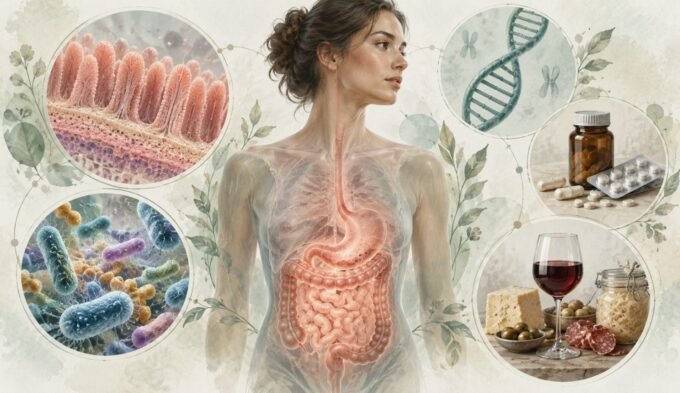
Maybe you ate aged cheese for years without a problem. Wine never bothered you. Leftovers were just leftovers.
Then something changed.
A meal that used to feel completely normal suddenly seems to leave you flushed, headachy, bloated, itchy, dizzy, or rushing to the bathroom.
So, why does sudden histamine intolerance occur?
You can suddenly begin experiencing symptoms that resemble histamine intolerance, but current research does not establish that a distinct histamine intolerance disorder reliably develops overnight. What changes suddenly may be your symptoms, exposures, health circumstances, or tolerance threshold rather than the underlying biology appearing from nowhere [1–4].
That difference matters because several other conditions can cause very similar reactions.
Why histamine intolerance can seem to appear suddenly
The main proposed model of histamine intolerance involves difficulty handling ingested histamine, particularly when intestinal degradation through diamine oxidase (DAO) is insufficient relative to the amount of histamine reaching the gut [2,4].
But the biology is not as simple as having enough DAO one day and suddenly losing it the next.
Histamine tolerance appears to vary between people and may also vary within the same person depending on food exposure and other circumstances [1,2].
One useful way to think about this is a threshold rather than an on/off switch.
Imagine that you have previously tolerated a certain combination of foods and circumstances. If something changes, such as a higher dietary histamine load, alcohol intake, gastrointestinal illness, medication use, or another health problem, the same meal may produce symptoms when it did not before.
This resembles the practical idea behind the histamine bucket concept. The bucket is a useful explanatory metaphor, not a proven measurable biological container.
What can change around the time symptoms begin?
Several factors deserve consideration, but they do not all carry the same level of evidence.
Intestinal health may change histamine-handling capacity
DAO involved in degrading dietary histamine is associated with the intestinal mucosa [2].
Diseases or inflammation that affect intestinal tissue are therefore biologically plausible contributors to reduced local DAO activity. Research has reported reduced intestinal DAO activity in affected Crohn’s disease tissue, and intestinal conditions such as inflammatory bowel disease and untreated celiac disease have been discussed in the histamine-intolerance literature [1,5,6].
That does not mean every case of gastrointestinal illness, IBS, SIBO, or “leaky gut” causes histamine intolerance.
If digestive symptoms appeared around the same time as your food reactions, the gastrointestinal problem may deserve investigation in its own right.
Our guide to the DAO and gut health connection explains that relationship in more detail.
A medication change may be relevant
Medications are frequently blamed for sudden histamine intolerance online, often through long lists of supposed “DAO blockers.”
The evidence is less certain than those lists suggest.
Several drugs have historically been proposed to influence DAO or histamine metabolism, but professional guidance notes that the evidence from older reports is inconsistent and that the relevance of individual drugs requires further validation [1].
A new medication is therefore worth discussing with your clinician if symptoms began around the same time, but it does not automatically explain the reaction.
Do not stop, reduce, or replace a prescribed medication because it appears on an online DAO-blocker list.
Your histamine exposure may have changed
Sometimes the person has not changed as much as the exposure has.
Histamine levels can vary considerably between foods and even between different samples of the same food. Fermentation, processing, microbial activity, storage conditions, and freshness all affect the amount of histamine and other biogenic amines present [2].
Alcohol may also increase the overall burden or interfere with histamine metabolism, which can make it an important trigger or amplifier for some people [1,2].
This means a sudden reaction after a meal does not necessarily prove that you suddenly developed a permanent intolerance.
For the food side of the picture, see our high-histamine foods guide.
Hormonal changes may modify symptoms
Some people report changes in histamine-related symptoms across the menstrual cycle, pregnancy, perimenopause, or menopause.
There are plausible biological interactions between histamine and reproductive hormones, and placental DAO rises substantially during pregnancy [4,7]. However, that is different from proving that estrogen, menopause, or an “estrogen dominance” state causes histamine intolerance. For a closer look at what is known and what remains uncertain, see our guide to estrogen and histamine.
Hormones are better viewed as possible modifiers of symptom threshold than a universal explanation for sudden HIT.
Stress may amplify symptoms without being the root cause
Stress can influence the nervous system, gastrointestinal function, immune signaling, sleep, and how strongly physical symptoms are perceived.
That makes stress relevant to symptom patterns.
What the evidence does not establish is a simple chain in which emotional stress damages the intestinal lining, shuts down DAO, and directly creates histamine intolerance.
If symptoms become stronger during stressful periods, stress may be an amplifier rather than the underlying cause.
The microbiome and SIBO remain emerging areas
Some intestinal bacteria can produce histamine, and small human studies have found microbiome differences in people identified as having histamine intolerance.
That makes the microbiome scientifically interesting.
It does not yet establish dysbiosis or SIBO as a universal cause of histamine intolerance.
If gastrointestinal symptoms are prominent, SIBO or another gastrointestinal condition can still be investigated on its own merits without assuming it explains every histamine-like reaction.
Genetics do not suddenly change
Genetic susceptibility is sometimes discussed because variants in AOC1, the gene encoding DAO, may influence histamine metabolism.
But your genes did not suddenly appear the week your symptoms started.
If genetic factors matter, they would be better understood as a predisposition that may affect baseline tolerance, not an explanation for why symptoms abruptly appeared at one particular moment.
Our broader guide to what causes histamine intolerance separates genetic predispositions, underlying contributors, triggers, amplifiers, and overlapping conditions by evidence strength.
Sudden symptoms do not automatically mean histamine intolerance
This is one of the most important points in this article.
Flushing, diarrhea, abdominal pain, headache, itching, hives, nasal symptoms, dizziness, and heart-rate changes are not unique to histamine intolerance [1].
Food allergy, chronic urticaria, gastrointestinal disorders, medication reactions, mastocytosis, mast cell activation disorders, and other food intolerances can produce overlapping symptoms.
Histamine intolerance itself is also difficult to confirm.
In a 2023 study of 59 people referred with suspected HIT, the diagnosis was excluded in 50 participants. Thirty-seven experienced symptoms after placebo. Four were classified as having “plausible HIT,” with another five considered “possible HIT” after detailed assessment [3].
That does not prove histamine intolerance is imaginary.
It shows why new symptoms deserve investigation rather than immediately being assigned to histamine.
If you’re new to the subject, our histamine intolerance guide explains the broader clinical picture.
Does a low DAO blood result explain sudden onset?
Not by itself.
DAO plays an important role in intestinal degradation of dietary histamine, but serum DAO testing has not been established as a reliable standalone measure of intestinal DAO activity.
Professional guidance considers serum DAO testing inconclusive for diagnosing adverse reactions to ingested histamine [1].
The 2023 challenge study also found that serum DAO values were highly variable and not specific enough to establish the diagnosis on their own [3].
A low DAO result therefore should not be used to conclude:
“My DAO suddenly dropped, so I suddenly developed histamine intolerance.”
The biology and diagnosis are more complicated than that.
What should you do when symptoms suddenly start?
The first goal should be to work out what changed, not immediately eliminate dozens of foods.
Look at the timing of symptoms in relation to meals, alcohol, medications, gastrointestinal illness, menstrual changes, sleep, and other exposures. Keeping a food-and-symptom record can make patterns easier to identify.
A clinician may need to investigate other explanations depending on your symptoms, particularly allergy, gastrointestinal disease, medication effects, chronic urticaria, mast-cell disorders, or other food intolerances.
Professional guidance favors a short, structured dietary assessment followed by reintroduction and personalization, rather than indefinite blanket restriction. The 2021 guideline describes an initial restriction phase of roughly 10–14 days followed by a test phase in which foods are gradually reintroduced while individual tolerance is assessed [1].
That is very different from assuming that everyone needs a permanently strict low-histamine diet.
For a detailed management review, see our evidence-based histamine intolerance treatment guide.
How quickly should symptoms improve?
There is no scientifically established timeline saying that everyone with suspected histamine intolerance should improve in two weeks, four weeks, or eight weeks.
Some people notice changes relatively quickly when a suspected food or exposure is removed. Others do not improve, which may be a clue that the original explanation was incomplete or incorrect.
Dietary improvement alone also does not prove HIT.
In the 2023 placebo-controlled study, about three-quarters of participants reported fewer symptoms while eating a low-histamine diet, yet HIT was ultimately excluded in most of them [3].
That is another reason to use dietary response as one piece of information rather than a diagnostic test.
Can sudden histamine intolerance go away?
Tolerance can change over time, but it is not possible to promise that sudden symptoms are temporary.
If a reversible contributor is involved, such as an intestinal condition that improves or a temporary exposure that disappears, tolerance may improve as circumstances change.
Someone with an underlying predisposition may also experience long periods with fewer symptoms.
But symptom improvement does not prove what originally caused the problem, and current research does not establish a predictable natural history in which most cases resolve after a specific number of weeks.
The more useful goal is to identify what actually reproduces symptoms and avoid unnecessarily restrictive treatment.
When sudden symptoms need urgent medical attention
Do not assume a severe reaction is “just histamine intolerance.”
Difficulty breathing, throat or tongue swelling, fainting, severe wheezing, rapidly worsening widespread symptoms, or signs of anaphylaxis require emergency medical care.
IgE-mediated food allergy and other serious reactions can resemble some symptoms attributed to histamine intolerance and need appropriate medical evaluation.
Bottom line
Histamine-related symptoms can begin suddenly, but that does not prove histamine intolerance itself developed overnight.
A person’s tolerance threshold may change because of intestinal health, medications, dietary histamine exposure, alcohol, hormones, or other circumstances. Some of these explanations are better supported than others, and factors such as stress, SIBO, and microbiome changes should not be promoted as proven universal causes.
Just as importantly, sudden symptoms may come from something other than HIT.
Rather than searching for a single hidden trigger, look at what changed around the time symptoms began, consider relevant medical differentials, and use structured observation rather than increasingly restrictive rules.
Frequently asked questions
A few short answers to the most common question about histamine intolerance development.
Can histamine intolerance start suddenly?
Symptoms that resemble histamine intolerance can begin suddenly, including after years of tolerating the same foods. Current evidence does not establish that histamine intolerance itself reliably develops overnight, so sudden symptoms should prompt consideration of changing exposures, health factors, and alternative diagnoses.
Can an infection suddenly cause histamine intolerance?
An intestinal illness could theoretically affect the gut environment or mucosa, but direct evidence showing that common infections routinely cause histamine intolerance is limited. A new gastrointestinal illness and persistent symptoms deserve medical assessment rather than assuming HIT.
Can antibiotics cause sudden histamine intolerance?
There is not enough evidence to say that antibiotics generally cause HIT. Antibiotics can change the intestinal microbiome, but microbiome changes have not been established as a universal cause of histamine intolerance.
Can medications trigger histamine intolerance?
Some medications have been proposed to affect histamine metabolism or DAO, but evidence is inconsistent and drug-specific. A medication change can be reviewed with the prescribing clinician, but prescribed treatment should never be stopped based solely on an online DAO-blocker list.
Can hormones suddenly trigger histamine symptoms?
Hormonal changes may influence symptom thresholds in some people, but current evidence does not establish reproductive hormones as a single cause of dietary histamine intolerance.
Is sudden histamine intolerance permanent?
Not necessarily, but there is no reliable way to predict this from symptom onset alone. Tolerance may change when reversible contributors or exposures change, while other people continue to experience recurring symptoms.
How do I know whether it is histamine intolerance or something else?
There is no single validated test that confirms HIT. Evaluation generally considers symptom timing, food patterns, medication use, dietary response, and other possible diagnoses. Allergy, gastrointestinal disease, chronic urticaria, mast-cell disorders, and other intolerances may need consideration depending on the symptoms [1,3].
References
- Reese I, Ballmer-Weber B, Beyer K, et al. Guideline on management of suspected adverse reactions to ingested histamine. Allergol Select. 2021;5:305-314. doi:10.5414/ALX02269E
- Comas-Basté O, Sánchez-Pérez S, Veciana-Nogués MT, Latorre-Moratalla ML, Vidal-Carou MC. Histamine intolerance: the current state of the art. Biomolecules. 2020;10(8):1181. doi:10.3390/biom10081181
- Bent RK, Kugler C, Faihs V, Darsow U, Biedermann T, Brockow K. Placebo-controlled histamine challenge disproves suspicion of histamine intolerance. J Allergy Clin Immunol Pract. 2023;11(12):3724-3731.e11. doi:10.1016/j.jaip.2023.08.030
- Jochum C. Histamine intolerance: symptoms, diagnosis, and beyond. Nutrients. 2024;16(8):1219. doi:10.3390/nu16081219
- Schnedl WJ, Enko D. Histamine intolerance originates in the gut. Nutrients. 2021;13(4):1262. doi:10.3390/nu13041262
- Schmidt WU, Sattler J, Hesterberg R, et al. Human intestinal diamine oxidase (DAO) activity in Crohn’s disease: a new marker for disease assessment?. Agents Actions. 1990;30(1-2):267-270. doi:10.1007/BF01969057
- Maintz L, Novak N. Histamine and histamine intolerance. Am J Clin Nutr. 2007;85(5):1185-1196. doi:10.1093/ajcn/85.5.1185