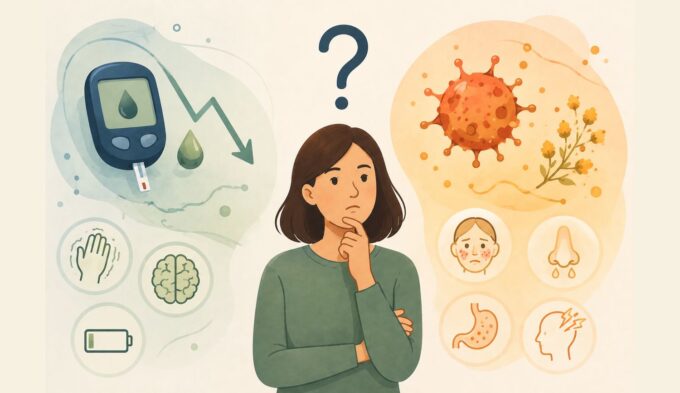


You wake up tired. You may sleep for hours and still wake up feeling unrestored.
Many people search for chronic fatigue syndrome and histamine intolerance when this kind of fatigue does not feel like ordinary tiredness.
A small task, like a shower or a phone call, can drain you for the rest of the day. Then a meal, a hot room, a poor night’s sleep, or a stressful conversation makes everything worse.
At some point you start asking a hard question. Is histamine part of this? Or is something deeper going on with my energy itself?
That question is more reasonable than most people realize. Fatigue, brain fog, crashes, and histamine symptoms genuinely can feel connected. And in some people, they may be.
But feeling connected is not the same as being the same condition. This article walks through where these problems overlap, where they don’t, and how to think about your energy in a way that protects it.
Chronic fatigue syndrome and histamine intolerance in 30 seconds
Chronic fatigue syndrome, known medically as ME/CFS, and histamine intolerance can share several symptoms. Both can involve fatigue, brain fog, disrupted sleep, dizziness, headaches, and a worsening of symptoms after certain triggers.
But they are defined by different core problems.
ME/CFS is an energy regulation condition. Its defining feature is post-exertional malaise, a worsening of symptoms after physical, mental, emotional, or even sensory effort [1].
Histamine intolerance is a histamine clearance and load problem. Symptoms are tied to histamine building up faster than the body can break it down [2].
They can overlap in real life. They are not the same condition, and treating one does not automatically address the other.
The chronic fatigue syndrome and histamine intolerance connection is best understood as an overlap in symptoms and body burden, not as proof that one condition causes the other.
Why these conditions are easy to confuse
The overlap is real, and it’s worth naming clearly so you don’t feel like you’re imagining the connection.
Both can cause deep, persistent fatigue. Both can cause brain fog that makes thinking feel slow and effortful. Both can disrupt sleep, leaving you unrefreshed no matter how long you were in bed.
Dizziness shows up in both, as do headaches. Gut symptoms are common across both pictures. And both can involve a sense of crashing after a trigger, even if the trigger is different.
Histamine intolerance adds a few signatures of its own, like flushing, itching, and congestion. ME/CFS adds its own hallmark, which is the specific exertion-linked crash pattern we’ll cover shortly.
When someone lives with several of these at once, the boundaries blur. That’s exactly why a careful separation matters, both for your understanding and for getting the right kind of help. Our guide to histamine intolerance symptoms covers the histamine side of this picture in more depth.
What ME/CFS is, and why PEM matters
ME/CFS is a serious, long-term illness. It is not the same as ordinary tiredness, and it is not a mindset problem.
According to the diagnostic criteria used by the CDC, ME/CFS involves three core features that must be present [1]:
- A substantial reduction in the ability to do pre-illness activities, lasting more than six months, along with profound fatigue that rest does not fix.
- Post-exertional malaise (PEM).
- Unrefreshing sleep.
At least one of two additional features must also be present: cognitive impairment (often described as brain fog) or orthostatic intolerance, which means symptoms that worsen when upright and ease when lying down [1].
The most important feature to understand is PEM.
PEM is not the normal tiredness anyone feels after a hard day. It’s a worsening of symptoms after exertion that can be physical, mental, emotional, or sensory. It is often delayed, appearing a day or two after the activity, and it can last for days or much longer [1][3].
A person with PEM might feel relatively functional during an activity, then crash hard 24 to 48 hours later. Rest does not quickly reverse it. This delayed, disproportionate response is what makes PEM the defining signature of ME/CFS, and it’s the single most useful feature for telling ME/CFS apart from other causes of fatigue [3].
What histamine intolerance is, and what it is not
Histamine intolerance is a different kind of problem. It’s not primarily about energy production. It’s about histamine balance.
Your body constantly encounters histamine, both from food and from its own internal processes. Your body breaks histamine down through several pathways. Diamine oxidase (DAO) is often discussed in relation to dietary histamine in the gut, while HNMT helps break down histamine inside cells. [2].
When histamine comes in faster than these enzymes can clear it, levels build up. That excess histamine acts on receptors throughout the body, producing symptoms across the skin, gut, sinuses, cardiovascular system, and nervous system [2].
This is why histamine intolerance symptoms are so varied and often tied to meals, cumulative load, and specific triggers. It’s a load-and-clearance issue, not an energy-generation failure.
Histamine intolerance is also not the same as a food allergy. A food allergy involves the immune system’s IgE antibodies reacting to a specific food. Histamine intolerance is a metabolic mismatch between histamine intake and histamine breakdown. Keeping that distinction clear matters for how each is evaluated and managed.
Where MCAS fits into the picture
There’s a third condition worth introducing here, because it sits between the other two and is often confused with both.
Mast cell activation syndrome, or MCAS, involves mast cells that activate inappropriately and release their mediators, including histamine, across multiple organ systems [4]. Where histamine intolerance is about clearing histamine, MCAS is about mast cells releasing too many mediators in the first place.
This matters for the fatigue conversation because MCAS shows up as a comorbidity in a meaningful share of ME/CFS cases. In one Austrian ME/CFS cohort, researchers found that up to around 25% of followed-up patients met criteria for clinically relevant mast cell activation, and this subgroup was more likely to have orthostatic intolerance, particularly POTS [5].
So these conditions can genuinely travel together. But they remain different mechanisms. ME/CFS is an energy and exertion problem. Histamine intolerance is a clearance problem. MCAS is a mast cell activation problem. Our MCAS beginner guide explains that condition in more detail if you want the fuller picture.
ME/CFS vs histamine intolerance vs MCAS
The table below lays out how these three conditions differ at their core. Reading across each row shows why they can feel similar while remaining distinct.
| Comparison point | ME/CFS | Histamine intolerance | MCAS |
|---|---|---|---|
| Core mechanism | Energy regulation impairment and exertion intolerance | Histamine building up faster than enzymes can clear it | Mast cells activating inappropriately and releasing mediators |
| Main fatigue pattern | Profound fatigue, unrefreshed by rest, with delayed post-exertional crashes | Fatigue tied to histamine load and specific triggers | Fatigue tied to episodes of mast cell activation |
| Common triggers | Physical, mental, emotional, or sensory exertion | High-histamine foods, alcohol, heat, hormonal shifts, cumulative load | Foods, temperature, stress, medications, environmental exposures, sometimes no clear trigger |
| What makes it distinct | Post-exertional malaise (PEM), delayed and disproportionate | Symptoms track with histamine intake and clearance capacity | Multi-system mediator symptoms, sometimes with measurable markers |
| Clinician evaluation | Clinical diagnosis by exclusion; specialist ME/CFS team | Clinical history, elimination trials, sometimes DAO testing | Allergy or immunology specialist; specific mediator testing |
No single row confirms which condition someone has. The pattern across the whole row is what tells the story, and a clinician is the right person to interpret that pattern.
Looking at chronic fatigue syndrome and histamine intolerance and MCAS side by side helps prevent one common mistake: treating every crash, flare, or fatigue episode as the same problem.
When a histamine flare can feel like a fatigue crash
A strong histamine reaction can hit hard. It can cause heavy fatigue, brain fog, sudden sleepiness, headache, flushing, gut symptoms, and a wired or activated feeling in the nervous system.
That combination can absolutely feel like a crash. Many people describe it as being suddenly flattened.
But feeling flattened by histamine does not automatically mean you have ME/CFS.
What separates them is the pattern around the crash. A histamine flare usually tracks with a trigger you can often identify, like a high-histamine meal, a hot environment, or a hormonal shift. It tends to move with your histamine load. Our guide to what to eat during a histamine flare covers the practical side of settling one of these episodes.
The timing, the trigger, the recovery pattern, and especially the response to exertion are what help tell these apart. That last one deserves its own section.
Post-exertional malaise vs histamine flare
This is the most important comparison in the article, because getting it wrong can lead to real harm.
The two can look similar in the moment. Both can leave you wiped out, foggy, and unwell. But their underlying pattern is different, and that difference changes what helps and what hurts.
Post-exertional malaise is triggered by exertion of any kind, including physical, mental, emotional, or sensory. It is often delayed, sometimes by a day or two. It can last for days or longer. It tends to cause a global worsening across many symptoms at once, and rest may not quickly reverse it [1][3].
A histamine flare is more often linked to food, heat, allergens, stress, hormones, or environmental load. It may involve flushing, itching, hives, congestion, gut symptoms, or headache alongside the fatigue. It tends to fluctuate with histamine load and trigger exposure, rather than with how much you exerted yourself.
Here’s where it gets complicated. These can overlap. A person can have both, and a single bad day might involve exertion and a histamine trigger at the same time.
The practical clue is the relationship to effort. If your crashes reliably follow exertion, are delayed, and are disproportionate to what you did, that pattern points toward PEM and deserves proper medical evaluation. If your crashes track with histamine triggers and come with classic histamine symptoms, that points more toward a flare.
This distinction is not academic. It directly affects whether pushing through activity is safe, which the next sections address.
Can exertion trigger histamine symptoms?
This is a fair question, and the answer is a careful yes for certain individuals.
Physical exertion, heat, and stress can all influence mast cells in susceptible individuals. Exercise raises body temperature and activates the stress response, and both of these can affect mast cell behavior [4]. Some people notice histamine-type symptoms, like flushing or itching, during or after exercise.
But two cautions matter here.
First, exertion does not always trigger mast cell activation. It happens in some people, not as a universal rule.
Second, and more importantly, not every post-exertional crash is histamine. In ME/CFS, the post-exertional crash is a core feature of the illness itself, driven by impaired energy regulation, not simply by histamine release [1][6]. Assuming a PEM crash is “just histamine” can lead someone to push through activity in a way that makes ME/CFS worse.
So exertion can play a role in histamine symptoms for those who are susceptible. It is not a reason to dismiss the possibility of PEM, which needs its own careful evaluation.
Why energy depletion can feel worse when histamine load is high
Even when histamine is not the root cause of someone’s fatigue, it can still make the fatigue harder to bear. This is where the two problems interact in daily life.
Think of it as added load on a system that’s already stretched thin.
A histamine reaction can bring poor sleep, inflammation, gut symptoms, nervous system activation, headaches, reduced appetite, and a heightened stress response. Each of these carries an energy cost. Research has explored impaired energy metabolism and mitochondrial function in ME/CFS, and some people with ME/CFS appear to have difficulty producing or using energy efficiently from their usual fuel sources [1][6].
Here’s the careful framing. Histamine does not directly destroy the mitochondria or cause the core energy impairment of ME/CFS. There’s no good human evidence for that claim.
But mast cell mediators, inflammation, poor sleep, and autonomic stress may increase the body’s overall energy burden. In someone already living with tight energy limits, that added load can feel significant. Reducing histamine load won’t fix ME/CFS, but for someone dealing with both, it may remove one source of extra strain.
The spoon-saving low-histamine approach
The goal of this section isn’t a cure or a protocol. It’s about protecting the limited energy you have while reducing avoidable histamine strain. This is pacing, applied to food and daily load.
CDC describes pacing, also called activity management, as a way to reduce PEM flare-ups by balancing activity and rest. NICE similarly advises people with suspected ME/CFS not to use more energy than they feel they have and not to push through symptoms [7].
This is why fixed-increase exercise programs, often described as graded exercise therapy, are risky for people with PEM and are not part of the approach in this article.
With that in mind, here are practical ways to lower the daily burden.
Plan meals for low-energy days in advance, so a crash doesn’t leave you with no safe options. Keep a few simple, safe meals available that need almost no preparation.
Reduce decision fatigue by repeating a small set of reliable meals rather than deciding fresh each time. Decision-making itself costs energy that you may need elsewhere.
Avoid over-restriction. An extremely narrow diet adds stress, risks nutrition gaps, and can become its own source of strain. Fresh but simple food routines usually beat elaborate ones.
Rest before and after unavoidable demanding tasks, not just after. Building in rest ahead of exertion can soften the crash that follows.
Break chores into smaller pieces with breaks between them. Avoid the push-crash cycle, where a good day tempts you to do too much and pay for it later.
Track your triggers without obsessing over them. A simple note of what preceded a bad day is useful; hypervigilance is not. Protect your sleep where you can, since unrefreshing sleep affects both conditions.
Finally, remember that histamine load isn’t only about food. Heat, fragrance, overexertion, poor sleep, and stress can all add to the same overall burden. If your symptoms seem to build when several smaller triggers stack together, our guide to the Histamine Bucket Theory explains this pattern in more detail.
When to seek medical evaluation
Self-management has limits, and some symptoms need a professional assessment rather than a pacing strategy. Persistent, unexplained fatigue always deserves a proper medical workup.
See a doctor if you experience:
- Fatigue lasting more than six months, or fatigue that clearly worsens after exertion.
- Fainting or near-fainting, chest pain, or severe shortness of breath.
- Unexplained weight loss, persistent fever, or new neurological symptoms.
- Severe or persistent dizziness.
- Symptoms that are significantly affecting your ability to work or function.
A thorough evaluation matters because many treatable conditions can cause similar fatigue. Anemia, thyroid disease, diabetes, infections, autoimmune conditions, sleep apnea, depression, and medication side effects can all produce overlapping symptoms [1][7]. A good workup checks for these before settling on any single explanation.
If ME/CFS is suspected, current guidelines recommend referral to a clinician or specialist team experienced in the condition, who can confirm the diagnosis and build a personalized management plan [7].
This article is for education and does not replace personalized medical advice. If your symptoms are persistent, worsening, or affecting your daily life, please work with a qualified healthcare provider.
Frequently asked questions
These are the questions that come up most often about the connection between chronic fatigue and histamine problems.
Can histamine intolerance cause chronic fatigue syndrome?
There is no good evidence that histamine intolerance causes ME/CFS. They are different conditions with different core mechanisms. Histamine intolerance can contribute to fatigue and can add to the overall symptom burden, but ME/CFS is defined by post-exertional malaise and energy impairment, not by histamine load. The two can coexist without one causing the other.
Can histamine make fatigue worse?
Yes, this part is well supported. A histamine reaction can bring poor sleep, inflammation, gut symptoms, headaches, and nervous system activation, all of which carry an energy cost. For someone already dealing with limited energy, that added load can make fatigue noticeably worse, even if histamine isn’t the root cause of the fatigue.
What is the difference between ME/CFS and histamine intolerance?
ME/CFS is an energy regulation condition whose defining feature is post-exertional malaise, a delayed and disproportionate crash after exertion. Histamine intolerance is a clearance problem, where histamine builds up faster than enzymes can break it down, producing symptoms tied to meals and triggers. One is about energy and exertion; the other is about histamine balance.
Can MCAS cause severe fatigue?
Yes. Mast cell activation releases mediators that can cause significant fatigue along with multi-system symptoms. Research has found that a meaningful share of ME/CFS patients, up to around 25% in one study, also have clinically relevant mast cell activation as a comorbidity [5]. Severe fatigue with wide-ranging symptoms warrants proper medical evaluation rather than self-diagnosis.
How is PEM different from a histamine flare?
PEM is triggered by exertion of any kind, is often delayed by a day or two, can last for days or longer, and causes a broad worsening that rest doesn’t quickly reverse. A histamine flare more often follows a food, heat, or environmental trigger, comes with classic histamine symptoms like flushing or itching, and tracks with histamine load rather than with how much you exerted yourself. The relationship to effort is the key clue.
Can exertion trigger histamine symptoms?
For some people, yes. Exercise, heat, and stress can influence mast cells and may produce histamine-type symptoms like flushing in susceptible individuals. But this doesn’t happen to everyone, and it’s important not to assume every post-exertional crash is histamine. In ME/CFS, the post-exertional crash is a core feature of the illness itself and needs its own evaluation.
Can a low-histamine diet help ME/CFS?
A low-histamine diet does not treat or cure ME/CFS, and it does not restore energy metabolism. What it may do, for someone who also has histamine issues, is reduce one source of added symptom load. That can make day-to-day life more manageable without addressing the underlying energy condition. It’s a load-reduction tool, not a treatment for ME/CFS.
When should chronic fatigue be checked by a doctor?
Any fatigue lasting more than six months deserves evaluation, as does fatigue that worsens after exertion. Seek prompt care for fainting, chest pain, severe shortness of breath, unexplained weight loss, persistent fever, new neurological symptoms, or fatigue that’s disrupting your daily life. Many treatable conditions cause similar fatigue, so a proper workup is important before settling on any explanation.
What should I track if I suspect both histamine issues and ME/CFS?
Keep it simple to avoid adding stress. Note your activity and any exertion, roughly when symptoms started and how long they lasted, what you ate, and non-food factors like heat, sleep quality, and stress. Over a few weeks, look for two separate patterns: crashes that follow exertion (pointing toward PEM) and symptoms that follow histamine triggers. Bring these notes to a clinician rather than trying to diagnose yourself from them.
References
- Centers for Disease Control and Prevention. Clinical Overview of ME/CFS. CDC. https://www.cdc.gov/me-cfs/hcp/clinical-overview/index.html
- Maintz L, Novak N. Histamine and histamine intolerance. Am J Clin Nutr. 2007;85(5):1185–1196. PMID: 17490952. https://academic.oup.com/ajcn/article/85/5/1185/4648998
- Institute of Medicine. Beyond Myalgic Encephalomyelitis/Chronic Fatigue Syndrome: Redefining an Illness. National Academies Press; 2015. https://www.ncbi.nlm.nih.gov/books/NBK274235/
- Theoharides TC, Tsilioni I, Ren H. Recent advances in our understanding of mast cell activation — or should it be mast cell mediator disorders? Expert Rev Clin Immunol. 2019;15(6):639–656. PMID: 30884251. https://pmc.ncbi.nlm.nih.gov/articles/PMC6533061/
- Rohrhofer J, Ebner L, Schweighardt J, Stingl M, Untersmayr E. The clinical relevance of mast cell activation in myalgic encephalomyelitis/chronic fatigue syndrome. Diagnostics (Basel). 2025;15(22):2828. PMID: 41300853. https://pmc.ncbi.nlm.nih.gov/articles/PMC12651186/
- Tomas C, Newton J. Metabolic abnormalities in chronic fatigue syndrome/myalgic encephalomyelitis: a mini-review. Biochem Soc Trans. 2018;46(3):547–553. PMID: 29666214. https://pubmed.ncbi.nlm.nih.gov/29666214/
- National Institute for Health and Care Excellence (NICE). Myalgic encephalomyelitis (or encephalopathy)/chronic fatigue syndrome: diagnosis and management. NICE guideline NG206. 2021. https://www.nice.org.uk/guidance/ng206