
Histamine intolerance probably doesn’t have one universal root cause. This guide separates better-supported contributors from triggers, symptom amplifiers, and emerging theories where the evidence is still limited.
You used to eat leftovers, drink wine, or enjoy aged cheese without a second thought. Now the same foods leave you flushed, headachy, or running to the bathroom, and you want to know what changed.
If your reactions seemed to appear almost overnight, our guide to how people can develop histamine intolerance suddenly looks more closely at onset patterns, possible triggers, and timing.
That question, what causes histamine intolerance, doesn’t have one tidy answer. It’s tempting to search for a single hidden root cause, but the more useful question is often different: is a factor reducing your capacity to handle histamine, adding to your current load, amplifying how strongly you react, or mimicking histamine intolerance without actually being it?
This guide walks through the proposed causes with that distinction in mind, rating each one by how strong the evidence actually is.
What causes histamine intolerance?
There’s no single proven universal cause. The main proposed mechanism is reduced degradation of ingested histamine, largely through intestinal diamine oxidase (DAO), the enzyme responsible for breaking down dietary histamine in the gut [1].
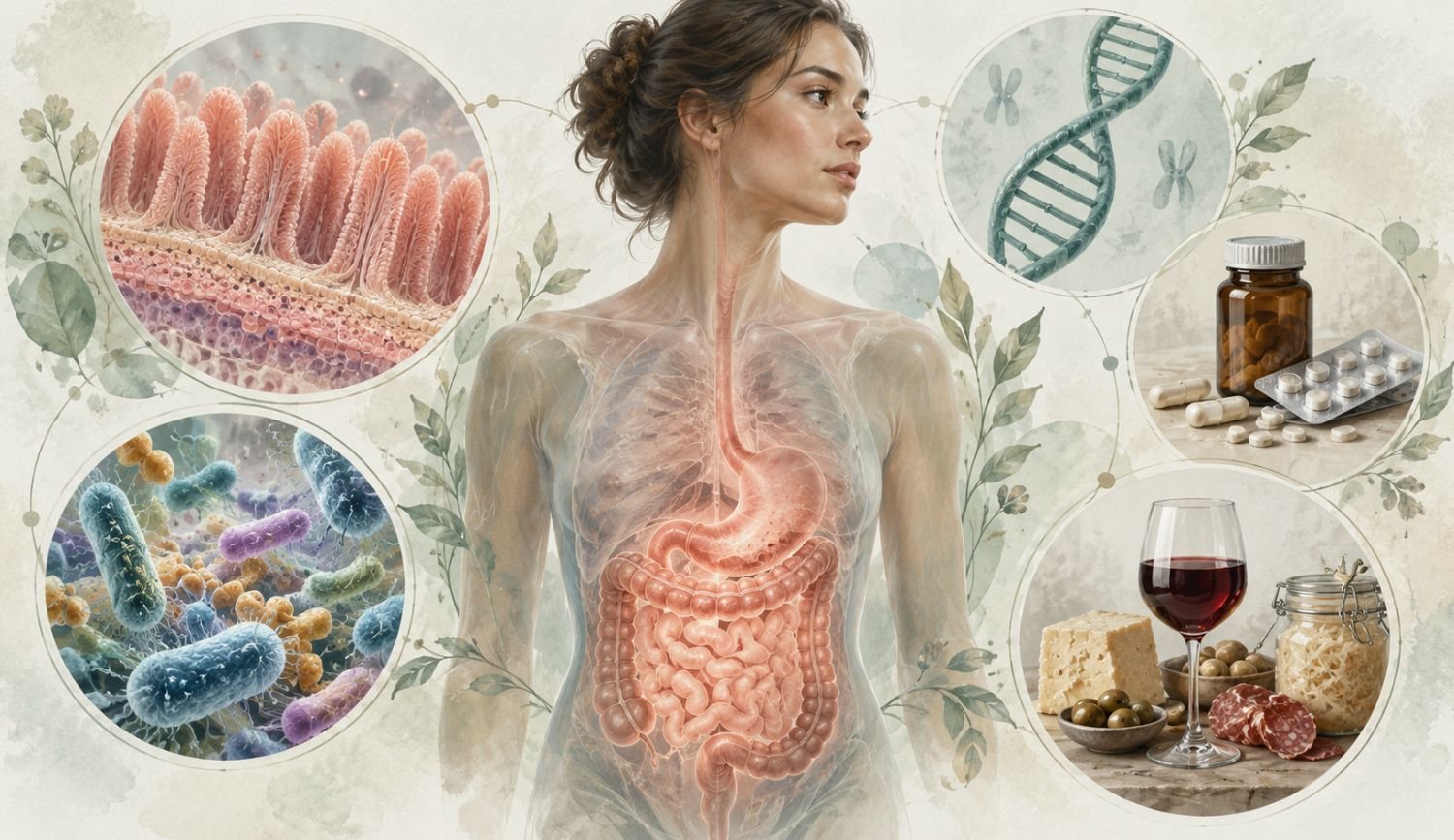
Gut disease or injury affecting the intestinal lining may reduce local DAO activity. Genetics may influence baseline susceptibility. Some medications may affect histamine handling, while alcohol and high-histamine foods more often act as triggers or added load rather than underlying causes [1,2]. Microbiome changes, hormones, stress, and nutrient status are less certain contributors, and other conditions can produce similar symptoms without being histamine intolerance at all.
If you need the broader picture first, our guide to histamine intolerance explains the symptoms, diagnostic uncertainty, and overall management framework.
A cause, trigger and symptom amplifier are not the same thing
Online explanations often treat every possible factor as equally proven, which makes the topic more confusing than it needs to be. A practical Nourishly framework for thinking about possible causes and triggers can help sort that out.
This is an organizing framework rather than an official clinical classification, meant to help you ask better questions, not to diagnose anything.
| Category | What it means | Example | What it does NOT prove |
|---|---|---|---|
| Underlying contributor | A factor that may reduce the body’s capacity to handle ingested histamine | Disease or injury affecting DAO-producing intestinal mucosa | That this factor alone explains every symptom |
| Predisposition | A factor that may lower baseline tolerance or susceptibility | Certain AOC1 genetic variants | That the person currently has histamine intolerance |
| Trigger / load | An immediate exposure that raises histamine burden or challenges clearance | Histamine-rich food, alcohol | That the food itself caused an underlying intolerance |
| Amplifier | A factor that may make existing reactivity easier to provoke | Stress, hormonal changes | That the amplifier is the root cause |
| Mimic / overlap | Another condition capable of producing similar symptoms | IgE-mediated allergy, MCAS, mastocytosis | That dietary histamine intolerance is present |
Sorting a factor into one category doesn’t rule out the others. A person might have a genetic predisposition, a gut condition reducing DAO activity, and a stressful week all contributing to the same bad evening.
Reduced histamine breakdown is the central proposed mechanism
Dietary histamine is broken down largely in the intestinal lining before it reaches general circulation. DAO is the extracellular enzyme responsible for that process, and it’s associated with mature intestinal enterocytes [1,10].
The reasoning goes: if local DAO activity is reduced, dietary histamine may be harder to clear before it causes symptoms. Reduced DAO activity can itself have several possible explanations, which we cover separately in our guide to what can cause DAO deficiency. That’s a biologically coherent model, but it comes with real caveats.
Serum DAO has not been established as a reliable proxy for intestinal DAO activity, and professional guidance considers serum DAO testing inconclusive for diagnosing adverse reactions to ingested histamine [2]. A low result therefore cannot establish either the diagnosis or its underlying cause [2,3].
The lack of a standardized diagnostic approach is part of why histamine intolerance remains genuinely difficult to define, even among specialists [6].
A 2023 placebo-controlled challenge study illustrates why caution matters. Among 59 people referred with suspected histamine intolerance, HIT was excluded in 50 (84.7%), while 37 (62.7%) reported symptoms after placebo. Four were classified as having “plausible HIT” because they developed objective symptoms after histamine but not placebo, and another five were classified as “possible HIT” after case-by-case assessment. Serum DAO also varied considerably and was not specific enough to confirm the diagnosis on its own [3].
That doesn’t mean histamine intolerance isn’t real; it shows why diagnosis requires more than one blood result or a self-reported food reaction.
Gut conditions may reduce intestinal DAO activity
Because DAO is produced by mature cells lining the small intestine, anything that damages that lining offers a biologically plausible way to reduce local histamine-degrading capacity [1,4].
Intestinal diseases that damage or inflame the mucosa, including Crohn’s disease and untreated celiac disease, have been studied in this context because they can affect the mature enterocytes associated with intestinal DAO activity [1,4]. Human tissue studies in Crohn’s disease have also reported lower DAO activity in affected intestinal mucosa [11].
This is meaningfully different from using “leaky gut” as a broad explanation for histamine intolerance. Intestinal permeability can be studied scientifically, but increased permeability by itself does not establish HIT or explain every case.
Having one of these conditions doesn’t mean a person automatically has histamine intolerance, and not everyone with IBS has demonstrable intestinal injury. Our guide to the DAO and gut health connection looks more closely at how intestinal mucosal health may affect DAO activity.
Can histamine intolerance be genetic?
Genetics may influence susceptibility in some people, but a gene variant alone doesn’t diagnose anything.
AOC1 is the gene that encodes DAO, and certain non-synonymous variants have been studied for their relationship to DAO activity and HIT-like symptoms [7]. A 2024 study comparing 100 symptomatic adults with 100 healthy controls found no significant difference in how often individual variants appeared between the two groups. It did find more homozygous risk alleles and a higher cumulative genetic-risk score among symptomatic participants [7].
That’s a nuanced result, not a clean genetic explanation. Consumer DNA testing for a single AOC1 variant isn’t a validated way to diagnose histamine intolerance, and having a risk variant doesn’t mean symptoms are inevitable.
Can medications contribute to histamine intolerance?
Older histamine intolerance literature includes long lists of medications proposed to inhibit DAO or interfere with histamine metabolism. More recent professional guidance is more cautious, noting that evidence for many of these effects is inconsistent and needs further validation [2].
Medication effects, where they exist, are likely drug-specific rather than a single universal mechanism. If you take regular medications and suspect a connection, a review with your prescribing clinician is a reasonable step. Never stop or change a prescribed medication solely because it appears on an online DAO-blocker list.
Alcohol and high-histamine foods are usually triggers, not root causes
Can foods cause histamine intolerance? High-histamine foods may expose or overwhelm limited histamine-handling capacity, but eating those foods doesn’t by itself establish that they caused an underlying intolerance [1,5].
That distinction matters. A trigger reveals a limited capacity; it doesn’t explain why that capacity became limited in the first place. If you want the food side of the picture, our high-histamine foods guide explains which foods contain more histamine, why levels vary, and why food lists often disagree.
Alcohol behaves similarly. Certain beverages add their own histamine or biogenic amine load, and alcohol can affect histamine metabolism directly, but it functions mainly as a trigger and load factor rather than a root cause on the same level as diagnosed intestinal disease [5].
Other biogenic amines can complicate the picture
Histamine isn’t the only biogenic amine in food. Putrescine and cadaverine can also act as DAO substrates, while other biogenic amines may interact with histamine degradation in different ways [1].
How much these interactions matter clinically in people with suspected histamine intolerance remains uncertain.
What about the gut microbiome and SIBO?
This is an emerging area with limited human evidence so far.
Some gut bacteria can produce histamine themselves, and studies comparing the microbiota of people with histamine intolerance symptoms to healthy controls have reported differences, including a lower representation of certain beneficial bacterial families and greater abundance of some histamine-producing species [8].
A small pilot study following five women through nine months of dietary treatment found reductions in some histamine-producing bacteria alongside symptom improvement, though the sample size was too small to draw firm conclusions [9].
The microbiome may influence intestinal histamine exposure, but current human evidence is too limited to call dysbiosis a universal root cause of histamine intolerance.
SIBO is often proposed as a contributor for similar reasons, but direct human evidence that SIBO itself causes HIT remains limited. Because the two can share gastrointestinal symptoms, they should not automatically be treated as the same problem.
Hormones, stress and nutrient status may change your threshold
These factors are better treated as possible modifiers than as established root causes. Hormonal changes have been discussed as one reason histamine tolerance may vary, but current evidence does not establish “estrogen dominance” or any single reproductive hormone pattern as a cause of dietary histamine intolerance [5].
Our estrogen and histamine guide examines the hormone connection and the proposed feedback loop in more detail.
Stress may also change how strongly symptoms are experienced or provoke mast-cell and neuroimmune responses, but that is different from showing that stress causes impaired dietary histamine breakdown. Nutrients such as copper and vitamin C participate in relevant metabolic or antioxidant processes, yet evidence that ordinary nutrient deficiencies are a common direct cause of HIT remains limited [5].
These possibilities can matter clinically, but they should not be promoted as proven explanations simply because the biology sounds plausible.
Popular “root causes” that are not established
A few explanations circulate widely online despite limited human evidence behind them. None of these are being dismissed as impossible; the evidence simply doesn’t currently support treating them as proven causes.
| Claim | What the evidence currently supports |
|---|---|
| MTHFR variants directly cause dietary histamine intolerance | No established direct causal link in current evidence |
| Mold or mycotoxins “destroy DAO” | Not supported as a demonstrated mechanism in humans |
| Generic “leaky gut” explains most HIT | Diagnosed structural or inflammatory GI disease is better supported than this vague framing |
| Detox pathway failure is the cause | Not a validated diagnostic concept in this context |
| Nutrient deficiencies explain most cases | Plausible contributing role, not an established primary cause |
| “Estrogen dominance” is the root cause | Hormonal interaction is plausible; this specific framing isn’t established |
Sometimes the problem may not be histamine intolerance
Several other conditions can produce similar symptoms, which is part of why self-diagnosis is so difficult.
IgE-mediated food allergy is an immune-mediated reaction that can be life-threatening, and it works through a completely different mechanism than dietary histamine handling. Mast cell activation syndrome (MCAS) involves inappropriate release of multiple mast-cell mediators, not only histamine, and systemic mastocytosis is a distinct diagnosed condition involving mast cell proliferation. Gastrointestinal disease, other food intolerances, chronic urticaria, and certain medication reactions can all overlap in presentation as well.
None of these can be diagnosed from a symptom list alone. Throat swelling, severe breathing difficulty, fainting, blue lips, or any other signs of anaphylaxis should always be treated as a medical emergency, never assumed to be “just histamine.”
Why several factors may matter at the same time
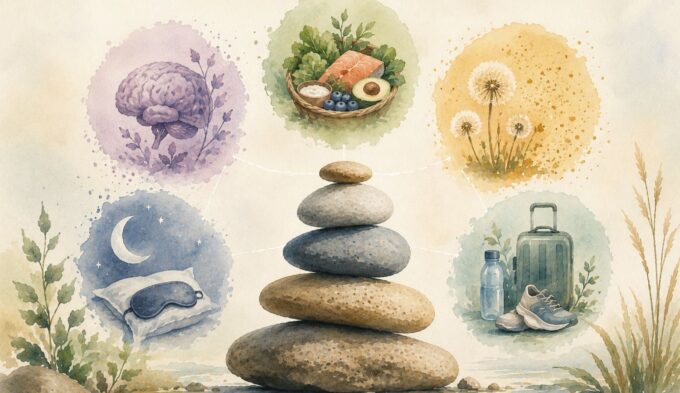
A useful way to picture this: a baseline genetic predisposition, combined with an underlying gut condition, plus a histamine-rich meal, plus a poor night’s sleep, can add up to a lower symptom threshold than any single factor would produce alone.
This is the idea behind the histamine bucket concept, a practical way to understand how multiple exposures and circumstances can stack together. It’s worth being clear here: the bucket is a practical metaphor for how multiple factors can stack, not proof of a specific measurable biochemical mechanism.
How clinicians investigate possible underlying contributors
A careful evaluation typically starts with medical history, focusing on symptom timing, reproducibility, and any pattern connecting symptoms to specific foods or contexts. A medication review is standard, along with investigation of relevant gastrointestinal disease when history suggests it.
Depending on presentation, a clinician may also evaluate for allergy, MCAS, or other differentials. Careful dietary observation, sometimes including a structured elimination and reintroduction process under appropriate guidance, can add useful information. Serum DAO does not confirm the diagnosis on its own, and this overview isn’t a substitute for full testing guidance.
Can histamine intolerance improve if the underlying factor improves?
Sometimes, though not predictably for everyone.
If a reversible contributor resolves, such as an intestinal condition responding to treatment, local DAO capacity could theoretically improve along with it. Symptom thresholds and trigger sensitivity can also shift over time for reasons that aren’t always clear. Inherited genetic susceptibility, by contrast, doesn’t go away, even if symptoms become more manageable.
Symptom improvement after a change doesn’t prove what the original cause was; several factors could have shifted at once. This isn’t a promise of cure, just an honest description of how variable the picture can be. Once possible contributors have been considered, our evidence-based guide to histamine intolerance treatment explains what current research supports for diet, DAO, medications, supplements, and medical evaluation.
Bottom line
There is no single, universally proven cause of histamine intolerance. The strongest proposed mechanism involves reduced degradation of ingested histamine, mainly through intestinal DAO, and intestinal mucosal disease is one of the more biologically plausible acquired contributors.
Genetics may predispose some people to lower baseline capacity, while foods and alcohol typically act as load factors rather than root causes. Microbiome changes, hormones, and stress are better understood as uncertain or amplifying influences than established causes.
Overlapping conditions like allergy and MCAS deserve real consideration rather than being dismissed. If your pattern doesn’t fit neatly into one explanation, that’s normal, and a careful clinical evaluation is more useful than chasing a single hidden root cause online.
Frequently asked questions
A few short answers to the most common versions of this question.
What is the main cause of histamine intolerance?
The leading proposed mechanism is reduced degradation of ingested histamine, mainly through intestinal DAO activity. There’s no single universally proven cause, and the real picture usually involves several contributing factors rather than one.
Can gut problems cause histamine intolerance?
Gut conditions that damage the intestinal lining, such as inflammatory bowel disease or untreated celiac disease, offer a biologically plausible pathway to reduced local DAO activity. Not everyone with a gut condition develops histamine intolerance, and vague “gut damage” isn’t the same as a diagnosed disease.
Is histamine intolerance genetic?
Certain AOC1 gene variants may influence susceptibility, and research has found more risk-allele combinations in symptomatic people. A single gene variant doesn’t diagnose histamine intolerance on its own, and consumer genetic testing isn’t a validated diagnostic tool.
Can medications cause histamine intolerance?
Some medications have been proposed to affect histamine metabolism, but current evidence for many of these effects is inconsistent and likely drug-specific. Never stop or change a prescribed medication without talking to your clinician first.
Can high-histamine foods cause histamine intolerance?
High-histamine foods can trigger symptoms by adding to an already limited histamine-handling capacity, but eating them doesn’t by itself explain why that capacity became limited. Foods are usually better understood as triggers or load factors than as root causes.
Can stress cause histamine intolerance?
Stress can influence mast-cell and nervous-system signaling in ways that may lower your symptom threshold, making existing reactivity easier to provoke. That’s different from stress being a proven cause of the underlying condition.
Can hormones cause histamine intolerance?
Histamine biology interacts with reproductive hormones, and some people notice symptom changes across their cycle or during perimenopause. Current evidence doesn’t support ideas like “estrogen dominance” as an established root cause.
Can histamine intolerance go away?
For some people, tolerance can improve if a reversible contributor resolves or if triggers and thresholds shift over time. Inherited genetic susceptibility tends to persist, and improvement doesn’t necessarily confirm what the original cause was.
References
- Comas-Basté O, Sánchez-Pérez S, Veciana-Nogués MT, Latorre-Moratalla ML, Vidal-Carou MC. Histamine intolerance: the current state of the art. Biomolecules. 2020;10(8):1181. doi:10.3390/biom10081181
- Reese I, Ballmer-Weber B, Beyer K, et al. Guideline on management of suspected adverse reactions to ingested histamine. Allergol Select. 2021;5:305-314. doi:10.5414/ALX02269E
- Bent RK, Kugler C, Faihs V, Darsow U, Biedermann T, Brockow K. Placebo-controlled histamine challenge disproves suspicion of histamine intolerance. J Allergy Clin Immunol Pract. 2023;11(12):3724-3731.e11. doi:10.1016/j.jaip.2023.08.030
- Schnedl WJ, Enko D. Histamine intolerance originates in the gut. Nutrients. 2021;13(4):1262. doi:10.3390/nu13041262
- Jochum C. Histamine intolerance: symptoms, diagnosis, and beyond. Nutrients. 2024;16(8):1219. doi:10.3390/nu16081219
- Hrubisko M, Danis R, Huorka M, Wawruch M. Histamine intolerance—the more we know the less we know. A review. Nutrients. 2021;13(7):2228. doi:10.3390/nu13072228
- Duelo A, Comas-Basté O, Sánchez-Pérez S, Veciana-Nogués MT, Ruiz-Casares E, Vidal-Carou MC, Latorre-Moratalla ML. Pilot study on the prevalence of diamine oxidase gene variants in patients with symptoms of histamine intolerance. Nutrients. 2024;16(8):1142. doi:10.3390/nu16081142
- Sánchez-Pérez S, Comas-Basté O, Duelo A, Veciana-Nogués MT, Berlanga M, Latorre-Moratalla ML, Vidal-Carou MC. Intestinal dysbiosis in patients with histamine intolerance. Nutrients. 2022;14(9):1774. doi:10.3390/nu14091774
- Sánchez-Pérez S, Comas-Basté O, Duelo A, Veciana-Nogués MT, Berlanga M, Vidal-Carou MC, Latorre-Moratalla ML. The dietary treatment of histamine intolerance reduces the abundance of some histamine-secreting bacteria of the gut microbiota in histamine intolerant women. A pilot study. Front Nutr. 2022;9:1018463. doi:10.3389/fnut.2022.1018463
- Maintz L, Novak N. Histamine and histamine intolerance. Am J Clin Nutr. 2007;85(5):1185-1196. doi:10.1093/ajcn/85.5.1185
- Schmidt WU, Sattler J, Hesterberg R, Röher HD, Zoedler T, Sitter H, Lorenz W. Human intestinal diamine oxidase (DAO) activity in Crohn’s disease: a new marker for disease assessment?. Agents Actions. 1990;30(1-2):267-270. doi:10.1007/BF01969057