
You sit down to work, but your brain feels slow. You know what you want to say, but the word will not come. You reread the same sentence three times and still don’t absorb it. You are awake, but your thinking feels heavy, delayed, or strangely offline.
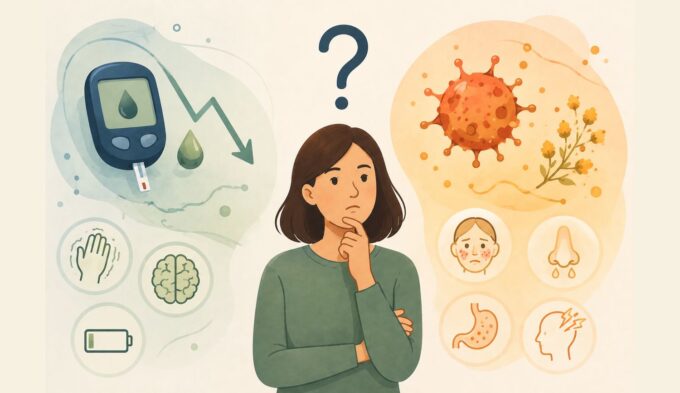
If you live with histamine intolerance, you may have noticed this fog arrives alongside other symptoms such as flushing, congestion, itching, headaches, or digestive changes. Our guide to histamine intolerance symptoms explains that broader symptom pattern in more detail. That raises a fair question. Could histamine be affecting your cognition, not just your skin, sinuses, or digestion?
Understanding the histamine brain fog mechanism requires looking beyond food reactions and into the way histamine communicates with the nervous system. Histamine is not only an allergy chemical. Inside the brain, it works as a signaling molecule that helps regulate attention, alertness, and mental clarity.
This article walks through the neuroscience carefully, without overstating what the evidence shows.
Histamine brain fog mechanism in 30 seconds
Histamine may contribute to brain fog through several overlapping pathways: receptor signaling inside the brain, mast cell activity near brain barriers, blood-brain barrier vulnerability, microglial activation, and overall neuroimmune load.
That does not mean histamine always crosses into the brain, or that it causes inflammation in every person who experiences brain fog. The picture is more layered than that.
For some people with histamine intolerance or mast cell activation, these mechanisms may combine to make thinking feel slow, scattered, and effortful. The sections below explain how, one piece at a time.
Why “brain inflammation” needs careful wording
The title of this article uses the phrase “brain inflammation,” and it’s worth being honest about that phrase right away.
Brain fog can feel like the brain is inflamed or overloaded. The heaviness is real, and the experience is not imagined. But medically, “brain inflammation” is a specific and serious term that should not be used casually.
A more accurate way to understand what may be happening is histamine-related neuroimmune signaling. This means the brain’s immune environment may be affected by histamine and related mediators, without a full inflammatory process occurring.
This article uses “brain inflammation” as a reader-friendly shorthand, but the more accurate scientific framing is histamine-related neuroimmune signaling. The underlying science is more nuanced, and keeping that distinction clear matters for understanding your own body accurately.
Histamine is not only an allergy chemical
Most people know histamine from allergies. It’s the molecule behind sneezing, itching, hives, and congestion. In that role, it acts as an immune mediator, released by cells during a reaction.
But histamine has a second, very different job. Inside the brain, it works as a neurotransmitter and neuromodulator, helping to regulate signals between nerve cells.
This brain histamine is made locally. It comes mainly from a small cluster of nerve cells in a region called the tuberomammillary nucleus, deep in the hypothalamus [1]. These histaminergic neurons send projections across the brain.
One of their best-known roles is supporting wakefulness and attention. When this system is active, it helps the brain stay alert and responsive. This is why brain histamine is considered part of the system that keeps you mentally “switched on” during the day [1].
The blood-brain barrier: why histamine does not simply flood the brain
To understand histamine and cognition, you first need to understand the blood-brain barrier, or BBB.
The BBB is a tightly regulated layer of cells lining the blood vessels of the brain. It acts as a gatekeeper, allowing needed nutrients through while limiting many circulating substances and immune signals from freely entering brain tissue [2].
This is an important point. Peripheral histamine, the histamine circulating in your body from food or an allergic reaction, does not freely cross a healthy blood-brain barrier. The idea that histamine from your last meal simply floods into your brain and inflames it is too simplistic.
The more nuanced mechanism involves the barrier’s condition. When the BBB environment is affected by inflammation, infection, metabolic stress, poor sleep, alcohol, high blood sugar, or chronic immune activation, the brain may become more vulnerable to immune signaling [2][3].
You may have heard the term “leaky brain.” It’s a catchy phrase, but it oversimplifies a complex, tightly regulated system. The barrier doesn’t simply spring a leak. Its permeability shifts in specific ways under specific conditions, and that shift is what may matter for cognition.
Mast cells near the brain may influence neuroimmune signaling
Mast cells are immune cells that store and release histamine along with other mediators. They sit in strategic locations throughout the body, and some sit near barrier surfaces and blood vessels, including regions close to the brain [3].
When mast cells activate, they release histamine, tryptase, and inflammatory signaling molecules. Research suggests these mediators may affect vascular permeability and local immune signaling [3][4].
Here’s why this matters. This mechanism may influence the brain’s immune environment without requiring the simple, incorrect explanation that “histamine crosses the BBB and inflames the brain.” Instead, mast cell mediators near the barrier may change how the barrier behaves and how immune signals reach brain tissue [4][7].
For people with mast cell activation syndrome (MCAS), where mast cells activate inappropriately and release mediators across multiple systems, this pathway may be more relevant. Our MCAS beginner guide explains that condition in detail. The key point here is the mechanism, not a diagnosis.
How H3 receptors may affect focus, memory, and word recall
This is one of the most useful pieces of the puzzle, and it centers on a specific histamine receptor called H3.
Think of H3 receptors as a brake system in the brain. They sit on nerve cells and help regulate how much histamine is released. When histamine levels rise, H3 receptors signal the system to ease off, keeping things in balance [5].
But H3 receptors do something else too. They also act as heteroreceptors, which means they help regulate the release of other neurotransmitters, not just histamine. Several of these are directly involved in thinking and focus [5].
The neurotransmitters influenced by this system include:
- Acetylcholine, central to attention and memory.
- Dopamine, involved in motivation and focus.
- Norepinephrine, tied to alertness and vigilance.
- Glutamate, the brain’s main excitatory signal.
Research on H3 receptor pathways shows that changing H3 activity can influence the release of acetylcholine, dopamine, and norepinephrine in brain regions involved in cognition [5]. This tells us the H3 system sits at a crossroads between histamine and the chemistry of clear thinking.
When histamine signaling is dysregulated, this may affect the balance of neurotransmitters involved in attention, working memory, processing speed, and word retrieval. This is not a simple one-step cause. It’s a shift in a finely balanced system.
That shift may show up in ways you’ll recognize:
- Searching for a word mid-sentence that you know you know.
- Losing your train of thought partway through a task.
- Reading a paragraph without absorbing any of it.
- Slow task switching, where moving between activities feels sticky.
- Mental fatigue after simple cognitive work that used to feel easy.
None of this means H3 receptors “cause” brain fog on their own. It means the histamine system is woven into the chemistry that clear thinking depends on.
Microglia activation: the brain’s immune alarm system
Microglia are the brain’s resident immune cells. Think of them as a built-in surveillance team, constantly scanning brain tissue for injury, infection, and immune signals [4].
In their resting state, microglia support normal brain function. When they detect a problem, they activate. Short-term activation is protective and helps the brain respond to threats and heal.
The concern is sustained activation. When microglia stay activated over a long period, they may contribute to neuroinflammation and cognitive disruption [4][6]. This is where the connection to brain fog becomes relevant.
Interestingly, research shows microglia can express all four histamine receptor types [6]. This means histamine and mast cell mediators may influence microglial behavior, depending on the immune context and which receptor pathways are involved [4][6].
It’s important not to cast microglia as villains. They are essential protectors of the brain. The question researchers are exploring is what happens when immune signaling keeps them activated longer than needed, and whether histamine-related signals play a role in that process.
How neuroimmune signaling can feel like brain fog
The mechanisms above are abstract. Here’s how they may translate into daily experience.
When the brain’s neuroimmune environment is under sustained load, cognitive efficiency may drop. The processing that normally happens smoothly starts to feel effortful and slow.
This can show up as:
- Slowed thinking, where forming thoughts takes longer than it should.
- Poor concentration, where holding attention feels like gripping something slippery.
- Memory lapses, especially with recent details and short-term recall.
- Word-finding difficulty, that frustrating gap between knowing and saying.
- Difficulty multitasking, where juggling two things at once becomes overwhelming.
- Reduced mental stamina, where your thinking tank empties faster than usual.
- Feeling mentally “offline,” present in body but not fully engaged.
The most important thing to understand is this. The issue is not laziness or lack of effort. It may feel like the brain’s processing system is temporarily overloaded, working harder to do less. Recognizing that can remove a layer of unnecessary self-blame.
Why brain fog can worsen when histamine load is high
Histamine in the body isn’t a single fixed amount. It rises and falls based on what you eat, your environment, and how your body is functioning that day.
When your overall histamine load climbs, brain fog may intensify. This isn’t about one specific trigger. It’s about the total burden your system is carrying at any given moment.
Common contributors to a rising histamine load include high-histamine foods, poor meal freshness, heat, fragrance, poor sleep, infection, overexertion, blood sugar swings, alcohol, gut irritation, and environmental allergens. Our histamine bucket theory article explains how these accumulate.
The mechanism-level takeaway is simple. As histamine load rises, the signaling pathways described above may be pushed harder. A brain that was managing fine at a lower load may start to feel foggy as that load increases.
Lifestyle factors that may affect the brain’s histamine burden
You can’t control every factor, but several practical, low-risk habits may help reduce avoidable strain on the system. None of these are cures. They’re about lowering unnecessary load.
Protecting sleep quality is near the top of the list, since poor sleep affects both the BBB environment and overall immune signaling. When brain fog is flaring, being cautious with alcohol may help, given its effects on both histamine and the barrier.
Keeping meals fresh and simple reduces dietary histamine, and reducing ultra-processed foods lowers a common source of added burden. Stabilizing blood sugar with balanced meals may reduce one metabolic stressor on the system.
Other supportive habits include reducing heat exposure when you’re sensitive, using fragrance-free environments if fragrance is a trigger, pacing mental and physical activity to avoid overexertion, and hydrating consistently through the day.
It also helps to identify your own environmental triggers over time, rather than guessing. And a quiet but important point: avoid over-restriction. An extremely narrow diet adds its own stress and can backfire. If you need ideas for simplifying food during an acute flare, our guide on what to eat during a histamine flare offers a practical starting point.
When brain fog should not be blamed on histamine
This section matters as much as any mechanism above. Brain fog has many possible causes, and histamine is only one of them.
Assuming every foggy day is histamine can mean missing something treatable. Several common conditions produce brain fog and deserve proper medical evaluation:
- Thyroid problems, which frequently cause cognitive slowing.
- Anemia, which reduces oxygen delivery to the brain.
- Vitamin B12 deficiency, a well-known cause of cognitive symptoms.
- Diabetes or blood sugar dysregulation.
- Sleep apnea, which disrupts the restorative sleep the brain needs.
- Autoimmune disease.
- Infection or post-viral illness, including lingering effects after viral infections.
- Medication side effects.
- Neurological conditions.
If your brain fog is persistent, worsening, or interfering with daily life, a medical workup is the right next step, not more self-management.
Some symptoms require urgent medical care. Seek immediate help for sudden confusion, slurred speech, one-sided weakness, a severe headache unlike any you’ve had before, fainting, seizures, new vision changes, sudden memory loss, or chest pain with severe shortness of breath. These are not histamine brain fog, and they need prompt evaluation.
This article is educational and does not replace personalized medical advice. If you’re concerned about your cognitive symptoms, please talk with a qualified healthcare provider.
Frequently asked questions
These are the questions people most often ask about histamine and cognitive symptoms.
What is the histamine brain fog mechanism?
It refers to the several overlapping ways histamine may affect thinking. Inside the brain, histamine acts as a neurotransmitter that helps regulate attention and alertness. Its H3 receptors influence other cognition-related neurotransmitters. Meanwhile, mast cell mediators near brain barriers, blood-brain barrier vulnerability, and microglial activity may all contribute to a neuroimmune environment that affects cognitive efficiency. It’s a combination of pathways, not a single switch.
Can histamine cause brain fog?
Histamine may contribute to brain fog in some people, particularly those with histamine intolerance or mast cell activation. The evidence points to several plausible mechanisms rather than one direct cause. It’s more accurate to say histamine-related signaling may be one factor among several, rather than saying histamine simply causes brain fog in everyone.
Does histamine cross the blood-brain barrier?
Peripheral histamine, the histamine circulating in your body, does not freely cross a healthy blood-brain barrier. The barrier blocks much of it. The brain makes its own histamine locally. The more nuanced concern is that when the barrier’s environment is stressed by inflammation, poor sleep, alcohol, or chronic immune activation, the brain may become more vulnerable to immune signaling. That’s different from histamine flooding in directly.
What do H3 receptors have to do with brain fog?
H3 receptors act like a brake system that regulates histamine release. They also help control the release of other neurotransmitters involved in cognition, including acetylcholine, dopamine, and norepinephrine. When histamine signaling is dysregulated, the balance of these cognition-related neurotransmitters may shift, which could affect attention, working memory, and word recall. It’s an indirect, system-level influence rather than a simple cause.
Can mast cells affect the brain?
Mast cells sit near blood vessels and barrier surfaces, including areas close to the brain. When they activate, they release histamine and other mediators that may affect vascular permeability and local immune signaling. This may influence the brain’s immune environment. In people with mast cell activation syndrome, this pathway may be more relevant, though it remains an area of ongoing research.
Can microglia activation cause brain fog?
Microglia are the brain’s immune cells. Short-term activation is protective. The concern is sustained activation, which may contribute to neuroinflammation and cognitive disruption. Since microglia can express histamine receptors, histamine and mast cell mediators may influence their behavior depending on the immune context. This is a plausible contributor to brain fog, not a confirmed one-step cause.
Why do I get word-finding problems with histamine intolerance?
Word-finding difficulty may relate to how histamine signaling interacts with the neurotransmitters involved in language and memory retrieval, particularly acetylcholine and dopamine. When the histamine system is under high load, the balance of these signals may shift, making word retrieval feel slow or stuck. This is a common brain fog symptom and, on its own, is not a sign of anything dangerous. Persistent or worsening problems still deserve medical evaluation.
Is histamine-related brain fog the same as MCAS brain fog?
They overlap but aren’t identical. Histamine intolerance relates to histamine building up faster than the body can clear it. MCAS involves mast cells activating inappropriately and releasing many mediators, of which histamine is only one. Both may produce brain fog through related pathways, but MCAS involves a broader set of mediators. Our MCAS beginner guide explains the distinction more fully.
When should brain fog be checked by a doctor?
Any brain fog that is persistent, worsening, or interfering with your daily life deserves medical evaluation, partly to rule out treatable causes like thyroid problems, anemia, B12 deficiency, or sleep apnea. Seek urgent care for red-flag symptoms: sudden confusion, slurred speech, one-sided weakness, a severe unfamiliar headache, fainting, seizures, new vision changes, sudden memory loss, or chest pain with shortness of breath. These need immediate attention.
References
- Haas HL, Sergeeva OA, Selbach O. Histamine in the nervous system. Physiol Rev. 2008;88(3):1183–1241. PMID: 18626069. https://pubmed.ncbi.nlm.nih.gov/18626069/
- Daneman R, Prat A. The blood-brain barrier. Cold Spring Harb Perspect Biol. 2015;7(1):a020412. PMID: 25561720. https://pmc.ncbi.nlm.nih.gov/articles/PMC4292164/
- Ribatti D. The crucial role of mast cells in blood-brain barrier alterations. Exp Cell Res. 2015;338(1):119–125. PMID: 26004870. https://pubmed.ncbi.nlm.nih.gov/26004870/
- Skaper SD, Facci L, Giusti P. Mast cells, glia and neuroinflammation: partners in crime? Immunology. 2014;141(3):314–327. PMID: 24032675. https://pmc.ncbi.nlm.nih.gov/articles/PMC3930370/
- Passani MB, Blandina P. The histamine H3 receptor: an attractive target for the treatment of cognitive disorders. Br J Pharmacol. 2008;154(6):1166–1181. PMID: 18469850. https://pmc.ncbi.nlm.nih.gov/articles/PMC2483387/
- Carthy E, Ellender T. Histamine, neuroinflammation and neurodevelopment: a review. Front Neurosci. 2021;15:680214. PMID: 34335160. https://pmc.ncbi.nlm.nih.gov/articles/PMC8317266/
- Wang Y, Sha H, Zhou L, et al. The mast cell is an early activator of lipopolysaccharide-induced neuroinflammation and blood-brain barrier dysfunction in the hippocampus. Mediators Inflamm. 2020;2020:8098439. https://pmc.ncbi.nlm.nih.gov/articles/PMC7060448/