

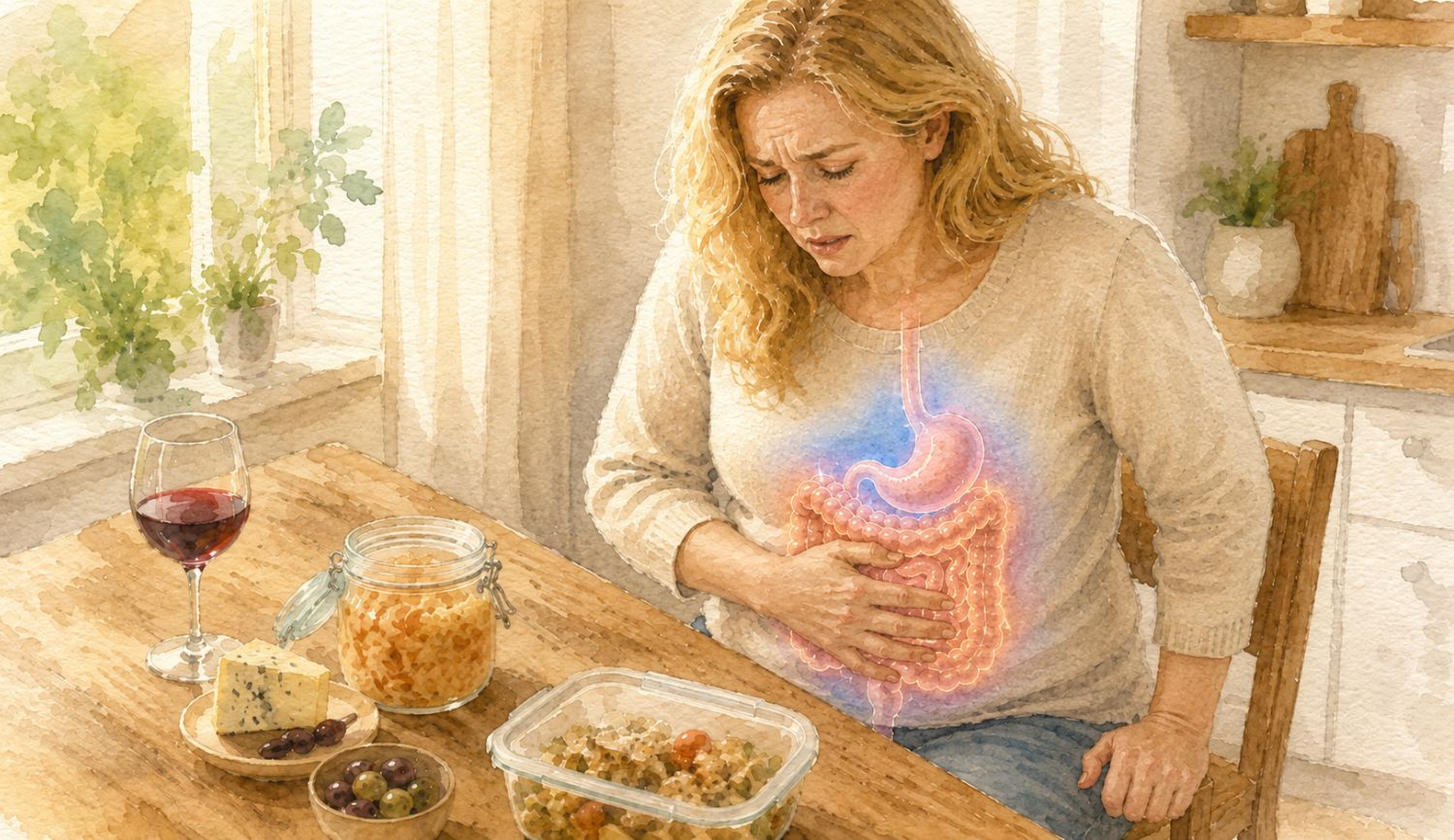
You eat something, and within minutes to an hour your gut cramps hard and you’re running to the bathroom. What comes out is watery and urgent. It can feel like your body just hit a switch and decided to flush everything out.
Histamine is one possible explanation for this pattern, especially when the urgent stool shows up alongside flushing, itching, a stuffy nose, nausea, or a pounding heart. That cluster points toward a histamine-related or mast-cell-related gut reaction in some sensitive people.
Two things are worth saying clearly up front.
First, sudden or severe diarrhea can also come from infection, food poisoning, an allergic reaction, medication side effects, inflammatory bowel disease, and other medical causes.
Second, “histamine-induced diarrhea” is not a formal diagnosis. It’s a useful way to describe a pattern, not a label a doctor writes in a chart. This article explains that pattern and where its limits are.
Can histamine-induced diarrhea happen after eating?
Yes, histamine can contribute to sudden loose or watery stools in some sensitive people. It may do this by increasing fluid movement into the bowel and speeding up intestinal contractions.
This is more likely when diarrhea appears after high-histamine foods, alcohol, leftovers, heat, or mast-cell-type reactions, especially with flushing, itching, nausea, or congestion.
What histamine-induced diarrhea can feel like
The pattern people describe tends to be specific. It’s usually not a slow, gradual stomach upset that builds over hours.
Common descriptions include:
- urgent, loose, or watery stool that arrives with little warning
- cramping, or a hot, twisting sensation low in the belly
- bathroom urgency that starts within minutes to about 90 minutes of eating or drinking
- a feeling that “food goes right through me” or that the body is flushing everything out
This can show up next to other histamine-related signs: flushing, itching, hives, a runny or stuffy nose, headache, nausea, heart pounding, or a wave of anxious body alarm. For some people it’s a one-off reaction to a specific meal. For others, it’s a repeating pattern tied to certain foods or conditions.
If you want to see how this fits the wider symptom picture, our overview of Histamine Intolerance Symptoms covers the full range.
Stool appearance alone doesn’t confirm the cause, so it isn’t a reliable way to diagnose anything. And this article isn’t about chronic constipation or bowel habits that swing back and forth. Those patterns deserve their own evaluation.
The two-part mechanism behind watery urgency
Most explanations of histamine and diarrhea stop at “it irritates the gut.” That misses what actually makes stool watery and urgent.
Two things tend to happen at the same time.
The first is fluid. Histamine and other mast cell mediators can push the intestinal lining to secrete more fluid and electrolytes into the bowel space, so water ends up in the stool instead of being absorbed.
The second is speed. The same signals can make gut nerves more sensitive and gut muscles more active, so contents move forward faster than the body can reabsorb water. This faster movement is called intestinal hypermotility.
Here’s a simple way to picture it. The gut lining turns on the faucet, while the gut muscles hit fast-forward. Fluid pours in, and everything gets pushed along before the body can dry it back out. That combination is what turns an ordinary meal reaction into sudden, watery urgency.
How histamine tells the gut lining to release water
Start with the plain-language version, then the detail.
Mast cells live throughout the gut lining. When they’re triggered, they release histamine along with other chemical messengers. Histamine can then act on receptors found on the intestinal tissue, the gut nerves, and nearby immune cells [2]. One result of this signaling may be an increase in how much fluid the intestinal lining secretes.
When that happens, electrolytes move into the bowel space, and water follows them. That fluid shift is a big part of why stool becomes watery rather than formed.
Many types of watery diarrhea are “secretory,” meaning they involve the movement of chloride and other electrolytes across the gut lining, which drives water into the bowel [1]. Histamine is one mediator that can influence this kind of secretory signaling in the gut, though the exact pathway can vary by tissue and situation [3].
The key point is simple: more fluid in, faster movement out.
Why cramps and urgency can happen so fast
Speed is one of the more distinctive parts of this pattern, and the anatomy helps explain it.
Mast cells sit close to the enteric nerves, the network that controls how the gut moves. Many gut mast cells are positioned near nerve fibers, which gives mast-cell mediators a direct way to influence gut sensitivity and motility [4]. When histamine and related mediators are released, they can raise the sensitivity of these nerves and increase muscle activity in the bowel wall [5].
Histamine receptors are present on the gut nerves, the intestinal muscle, and the lining itself, so a single burst of histamine can affect several systems at once [5]. Cramping tends to happen when the bowel wall contracts quickly and forcefully. Urgency follows because the contents are being moved along faster than usual.
Speed alone doesn’t prove histamine is the cause. It becomes a more convincing pattern when the timing and symptoms repeat with the same known triggers.
Why some reactions happen within minutes
A reaction that arrives ten or twenty minutes after eating can be confusing. It feels like the food went straight through you.
That’s not quite what’s happening.
Food you just ate has not become stool in twenty minutes. Digestion takes many hours. What the meal can do quickly is act as a trigger. Eating stretches the stomach and sets off normal gut reflexes that tell the colon to make room. In sensitive people, a meal may also prompt mast-cell and enteric-nerve signaling. Both can push contents that were already sitting lower in the bowel forward, fast.
So the watery stool that shows up soon after a meal is usually made of material that was already there, moved along quickly and made wetter by fluid secretion. The meal lit the fuse. It didn’t turn into stool on the spot.
That distinction matters because it explains why the timing can be so fast without meaning your gut is somehow broken.
Common triggers that may create a histamine diarrhea pattern
A short list of usual suspects shows up again and again in people who notice this pattern:
- aged cheese
- wine or other alcohol
- fermented foods
- cured meats
- leftover meat or fish
- spoiled or poorly chilled fish
- vinegar-heavy foods
- kombucha
- a high-histamine meal combined with stress, heat, or poor sleep
- MCAS-type triggers, including heat, stress, allergens, and certain foods
For a broader trigger list, see High Histamine Foods.
Histamine intolerance, MCAS, and gut diarrhea are not the same thing
These terms get used interchangeably, but they describe different things. The difference matters for how someone gets help.
Histamine intolerance describes a mismatch between the histamine coming in and the body’s ability to clear it. When intake or release outpaces breakdown, symptoms can follow, sometimes including loose stool.
Mast cell activation syndrome, or MCAS, is different. It involves mast cells releasing their mediators inappropriately, often affecting several body systems at once. MCAS is a clinical diagnosis that requires specific criteria, and it cannot be diagnosed from diarrhea alone [6].
Diarrhea can be one part of a larger picture, but it isn’t proof on its own. If you’re new to this area, the MCAS Beginner Guide walks through what MCAS is and isn’t.
Then there’s the plain gut reaction itself: the watery, urgent stool. That’s a symptom, not a diagnosis. Histamine may be involved in some cases, but the same symptom has many possible causes. That is why the pattern and the context matter more than any single episode.
The DAO and gut lining connection
One reason food histamine can build up in the gut comes down to an enzyme in the intestinal lining.
Diamine oxidase, or DAO, is the main enzyme that breaks down histamine from food inside the gut. When the gut lining is healthy, DAO helps keep food histamine in check. When DAO activity is low or the lining is inflamed or damaged, more food histamine may get through and reach tissue and circulation, which can make a reaction more likely in sensitive people [3].
Our deeper look at the DAO and Gut Health Connection explains this relationship in more detail.
One caution belongs here. A DAO blood test, a stool histamine test, or a blood histamine level cannot definitively diagnose a histamine-related gut pattern. These tests have real limits, and results are interpreted alongside symptoms and history, not on their own.
DAO is a useful concept for understanding the mechanism, not a switch that proves the cause.
Histamine diarrhea vs other causes of sudden diarrhea
Sudden diarrhea has several possible causes, and they can look similar at first. This table is meant to help you notice differences, not to diagnose anything on your own.
| Condition | Typical pattern | What makes it different from a histamine pattern |
|---|---|---|
| Histamine-related gut reaction | Watery stool within minutes to 90 minutes of a trigger food, often with flushing, itching, or congestion | Tends to cluster with multi-system histamine symptoms and repeat with the same foods |
| Food poisoning or infection | Diarrhea, often with vomiting and fever, sometimes hitting others who ate the same food | Usually comes with fever or affects a group who shared a meal |
| Scombroid / histamine fish poisoning | Flushing, headache, and gut upset within 10 to 60 minutes of eating poorly chilled fish [7] | Food poisoning from histamine in the fish itself, not an intolerance, and it can affect anyone |
| IgE food allergy or anaphylaxis | Hives, swelling, or breathing trouble, sometimes with diarrhea | Can be a medical emergency and needs immediate treatment |
| IBS-D | Recurrent loose stool tied to stress or certain foods, without hives or flushing | Rarely comes with flushing, itching, or congestion |
| Inflammatory bowel disease | Ongoing diarrhea, sometimes with blood, weight loss, or fatigue | Persistent, and often shows visible inflammation on testing |
| Celiac disease | Diarrhea after gluten, often with bloating and nutrient deficiencies | Tied specifically to gluten exposure and confirmed through testing |
| Bile acid diarrhea | Urgent, watery stool, often after fatty meals or gallbladder issues | Not usually linked to high-histamine foods specifically |
| Medication-related diarrhea | Diarrhea that starts or worsens after a new medication | Timing lines up with a prescription change, not a specific food |
Anaphylaxis is always an emergency. Blood in the stool, black stool, fever, severe dehydration, fainting, severe abdominal pain, or diarrhea that won’t quit all deserve medical attention regardless of the suspected cause [9].
A special warning about fish reactions
Fish deserves its own note because a reaction to fish can look like histamine intolerance while actually being food poisoning.
Scombroid poisoning, also called histamine fish poisoning, happens when certain fish are not chilled properly after being caught. Bacteria convert compounds in the flesh into large amounts of histamine, and cooking does not destroy it. Someone who eats that fish can develop flushing, headache, sweating, and gut upset including diarrhea, usually within about 10 to 60 minutes [7].
The important part is that scombroid can affect anyone, not just people who are histamine-sensitive. It is a food safety problem, not a personal intolerance.
If several people who shared the same fish all react, or if the fish tasted sharp, peppery, or metallic, scombroid is worth considering. Severe reactions need medical care.
What to do after a histamine-type diarrhea flare
If you’re in the middle of a flare or just came out the other side, here’s a simple recovery approach:
- Stop the suspected trigger food or drink for now.
- Rehydrate with fluids that include electrolytes, especially if stools have been frequent.
- Use an oral rehydration solution when watery stool repeats or dehydration risk feels higher.
- When appetite returns, choose simple, fresh, low-trigger foods you already tolerate well.
- Avoid alcohol, fermented foods, leftovers, and heavy, high-fat meals while recovering.
- Don’t start or stop medications, including antihistamines or prescription treatments, without checking with a clinician first.
Some readers keep oral rehydration salts at home for days when watery stools cause fluid loss. Choose options with simple ingredients and avoid dyes or sweeteners you already react to.
Why electrolytes matter more than plain water alone
When stools are watery and frequent, the body loses more than water. It also loses sodium, potassium, and other electrolytes. Those losses are part of why dehydration can feel so rough.
Plain water is helpful, but when watery stools are frequent, it may not replace the sodium and potassium being lost. That is why an oral rehydration solution can be more useful than water alone during repeated watery diarrhea.
Oral rehydration solutions are built around a specific balance of salt and a small amount of sugar. That balance helps the gut absorb both water and sodium more effectively than water by itself [8].
A stainless steel or glass water bottle can make it easier to sip fluids steadily through the day, which tends to work better than gulping a lot at once. If you’re prone to repeat flares, keeping rehydration supplies on hand means you’re not scrambling for them mid-episode.
What to eat once the flare calms
As the urgency settles and your appetite returns, the goal is gentle and low-trigger, not a full return to normal eating right away.
Freshly cooked, simple foods tend to sit best. Think plainly prepared options you already know you tolerate, served fresh rather than as leftovers. Since aged and reheated foods are common triggers, freshness matters more than usual during recovery.
For a fuller list of gentle choices, our guide on What to Eat During a Histamine Flare has specifics.
A practical habit helps here. Cooking a fresh batch and freezing single portions right away, in freezer-safe glass meal prep containers, keeps food from sitting in the fridge for days. It also means you have simple meals ready when you don’t feel like cooking.
How to track whether histamine is really involved
Tracking a few clear episodes is usually more useful than trying to log everything forever.
A simple checklist to note each time:
- what you ate and drank
- how old any leftovers were
- whether alcohol or fermented foods were involved
- how much time passed between the meal and symptoms
- how urgent and watery the stool was
- whether flushing, itching, hives, congestion, headache, nausea, or heart pounding showed up too
- how much heat, stress, poor sleep, or allergen exposure you had that day
- whether anyone else who ate the same meal got sick
- whether the same trigger has caused this before
- whether the reaction changes when the same food is eaten fresh instead of leftover
A simple food and symptom diary notebook can be easier to stick with than a phone app for some people. This kind of tracking also fits the broader Histamine Bucket Theory idea, where food, stress, heat, and sleep loss stack together until symptoms tip over.
When diarrhea needs medical care
Most flares settle on their own with rest and fluids. Some situations need attention sooner rather than later.
Seek medical care for:
- blood in the stool, or black, tarry stool
- fever above 101°F (38.3°C)
- severe abdominal or rectal pain
- signs of dehydration, including dizziness, confusion, very little urination, extreme thirst, dry mouth, or weakness
- fainting or feeling like you might faint
- repeated vomiting or an inability to keep fluids down
- diarrhea lasting more than 48 hours in adults [9]
- diarrhea in infants, young children, older adults, pregnant people, immunocompromised people, or anyone with a chronic illness, since these groups need extra caution
Throat swelling, trouble breathing, wheezing, widespread hives, or a severe drop in blood pressure after eating is emergency territory. That points toward anaphylaxis, not a histamine-related gut reaction, and needs immediate care.
What not to do during a suspected histamine diarrhea flare
Knowing what to skip is as useful as knowing what to do.
A few common missteps:
- Don’t reach for anti-diarrheal drugs as an automatic first move. They aren’t a default answer, and if fever, blood, suspected infection, or food poisoning is involved, anti-diarrheal medicines may not be appropriate for everyone. Any use is a conversation for a clinician or pharmacist.
- Don’t try to push through by eating more of the suspected trigger to “test” it during an active flare.
- Don’t rely only on plain water when watery stools are frequent, since electrolytes may also need replacing.
- Don’t start random supplements, binders, charcoal, or new products hoping to stop the reaction, especially when you’re already unsettled.
- Don’t stop or change prescribed medications on your own.
- Don’t assume a severe or unusual episode is “just histamine.” When red flags are present, treat it as a medical issue first.
The bottom line
Histamine can be one reason sudden, watery diarrhea shows up after eating. The likely mechanism is two-part: the gut lining secretes more fluid, and the gut moves contents along faster, so water doesn’t get reabsorbed the way it normally would.
A reaction within minutes doesn’t mean the food became stool that fast. The meal acts as a trigger that pushes contents already in the bowel forward quickly. A pattern that repeats with the same timing, alongside other histamine-related symptoms, is more suspicious than a single isolated episode.
Safety still matters, because infection, food poisoning, allergy, inflammatory bowel disease, bile acid diarrhea, and medication reactions can all look similar. Recovery usually comes down to hydration with electrolytes, simple fresh foods, careful tracking, and getting medical evaluation when red flags appear.
Frequently asked questions
A few common questions come up again and again, so here are direct answers to round things out.
Can histamine cause diarrhea?
In some sensitive people, yes. Histamine may increase fluid secretion in the gut lining and speed up intestinal movement, both of which can produce loose or watery stool. It’s one possible pattern, not a formal diagnosis, and it’s worth discussing with a clinician if it happens often.
Why does histamine diarrhea happen so fast?
Mast cells sit near the nerves that control gut movement, and their mediators can raise both nerve sensitivity and muscle activity. The meal also triggers normal gut reflexes. Together, these can move contents that were already in the bowel forward quickly, which is why symptoms can start within minutes rather than hours.
What does histamine intolerance stool look like?
There isn’t one specific look that confirms histamine involvement. People often describe loose or watery stool with urgency and cramping. Stool appearance alone can’t diagnose the cause, so tracking the timing and any other symptoms tends to be more useful than focusing on exactly what the stool looks like.
Can MCAS cause diarrhea after eating?
Mast cell activation syndrome can involve gastrointestinal symptoms, including diarrhea, as part of a broader reaction. MCAS is a clinical diagnosis with specific criteria, and it can’t be diagnosed from diarrhea alone. It usually involves symptoms across more than one body system, and a clinician familiar with mast cell disorders can help sort it out.
Is histamine diarrhea the same as food poisoning?
No. Scombroid poisoning is a specific fish-related food poisoning that happens when fish isn’t chilled properly and builds up high histamine, and it can affect anyone who eats it. A histamine-related gut reaction in someone who is histamine-sensitive is a different process tied to that person’s own reactivity, not to spoiled food.
Can antihistamines stop diarrhea?
Antihistamines aren’t a standard treatment for diarrhea, and whether they help depends on the underlying cause. This is a decision to make with a clinician rather than on your own, and starting or stopping any medication without medical guidance isn’t recommended.
What should I drink after sudden watery diarrhea?
Fluids that include electrolytes tend to help more than plain water alone, especially if stools have been frequent. An oral rehydration solution, or ORS, is a well-studied option for replacing fluid and electrolyte losses, and it’s worth keeping on hand if flares happen more than once.
References
- Thiagarajah JR, Donowitz M, Verkman AS. Secretory diarrhoea: mechanisms and emerging therapies. Nature Reviews Gastroenterology & Hepatology. 2015;12(8):446–457. https://pmc.ncbi.nlm.nih.gov/articles/PMC4786374/
- Xie H, He SH. Roles of histamine and its receptors in allergic and inflammatory bowel diseases. World Journal of Gastroenterology. 2005;11(19):2851–2857. https://pmc.ncbi.nlm.nih.gov/articles/PMC4305649/
- Smolinska S, Winiarska E, Globinska A, Jutel M. Histamine: A Mediator of Intestinal Disorders—A Review. Metabolites. 2022;12(10):895. https://pmc.ncbi.nlm.nih.gov/articles/PMC9610630/
- Ramsay DB, Stephen S, Borum M, Voltaggio L, Doman DB. Mast cells in gastrointestinal disease. Gastroenterology & Hepatology (N Y). 2010;6(12):772–777. https://pmc.ncbi.nlm.nih.gov/articles/PMC3033552/
- Wood JD. Histamine, mast cells, and the enteric nervous system in the irritable bowel syndrome, enteritis, and food allergies. Gut. 2006;55(4):445–447. https://pmc.ncbi.nlm.nih.gov/articles/PMC1856149/
- Mast Cell Activation Syndrome (MCAS): Symptoms & Care. Cleveland Clinic. https://my.clevelandclinic.org/health/diseases/mast-cell-activation-syndrome
- Food Poisoning from Marine Toxins: Scombroid (Histamine) Fish Poisoning. CDC Yellow Book. https://www.cdc.gov/yellow-book/hcp/environmental-hazards-risks/food-poisoning-from-marine-toxins.html
- Oral Rehydration, Maintenance, and Nutritional Therapy. CDC MMWR. https://www.cdc.gov/mmwr/preview/mmwrhtml/00018677.htm
- Diarrhea: Symptoms and Causes. Mayo Clinic. https://www.mayoclinic.org/diseases-conditions/diarrhea/symptoms-causes/syc-20352241
This article is for education and is not medical advice. It does not diagnose, treat, or replace care from a qualified professional. If you’re having a medical emergency, contact emergency services.