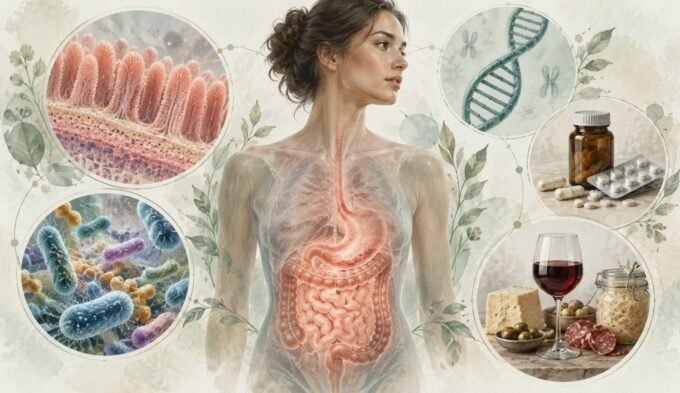


If you’re researching histamine intolerance treatment, you’ve probably already tried something.
Maybe you cut out aged cheese and wine. Maybe you’re taking a DAO supplement before meals. Maybe you’re reaching for an antihistamine when foods you used to eat without issue suddenly cause problems.
And you might still not know if any of it is actually working — or why.
That’s a reasonable place to be. Histamine intolerance is used clinically to describe symptoms linked to trouble processing ingested histamine. But its diagnostic criteria, causes, and biomarkers are still debated. There’s no single test that confirms it.
This article sorts out what actually has evidence behind it from what just gets repeated online. It won’t promise a cure as the evidence doesn’t support one. It will show you where diet, DAO, antihistamines, and supplements each sit on the evidence scale, and when it’s time to see a clinician instead of trying another elimination diet.
What actually helps in histamine intolerance treatment?
Short answer: there’s no single proven cure. A short, structured low-histamine diet is the most commonly recommended first step, but even this has limited controlled evidence. Evidence for adjuncts such as DAO, antihistamines, and supplements is generally weaker or more indirect.
Here’s the evidence-based rundown:
- Dietary trial + reintroduction. The most commonly recommended approach. Evidence is limited but stronger than the alternatives below.
- Oral DAO. May help some people with meal-related symptoms. Evidence is limited and short-term.
- Antihistamines. May reduce symptoms in some situations by blocking histamine receptors, but they do not correct impaired histamine degradation if that mechanism is present.
- Supplements (vitamin C, quercetin, B6, copper, probiotics). Weak or theoretical evidence at best.
- Medical evaluation. Important when symptoms are severe, unclear, persistent, or suggest another condition.
How strong is the evidence for each approach?
Before going deeper, here’s how everything stacks up side by side. Nothing on this list — including diet — is backed by high-quality, histamine-intolerance-specific clinical trials. The differences below are about relative support, not proof.
| Approach | May help with | Evidence strength | Main limitation |
|---|---|---|---|
| Low-histamine dietary trial | Identifying if histamine is a trigger | LIMITED | No completed placebo-controlled diet trial in diagnosed HIT [1][4] |
| Reintroduction & personalization | Avoiding unnecessary restriction | VERY LIMITED | Guideline-driven; direct treatment-trial evidence is sparse |
| Food freshness & storage | Lowering histamine exposure | INDIRECT | Based on food-chemistry data, not symptom trials [12] |
| Oral DAO | Meal-related symptoms | LIMITED | Small, short studies; one trial was in migraine, not HIT [7][8][9] |
| H1/H2 antihistamines | Symptom relief | VERY LIMITED | No HIT-specific controlled trials |
| Addressing an identified contributing condition | Individualized management | INDIRECT | Association does not prove that treating it will resolve HIT [2] |
| Vitamin C | Possible effect on circulating histamine | INDIRECT | Human studies are not in confirmed HIT [13] |
| B6 / copper | Correcting a documented deficiency | INSUFFICIENT | No HIT-specific evidence that routine supplementation improves symptoms |
| Quercetin | Proposed mast-cell stabilization | VERY LIMITED | No HIT trials |
| Probiotics | Strain-specific, investigational | VERY LIMITED | Mostly lab-based, not human HIT trials |
Why histamine intolerance is hard to diagnose — and why that matters for treatment
There’s no single test that confirms histamine intolerance. That’s the root of most of the treatment confusion.
Symptoms like bloating, flushing, headaches, and congestion overlap with dozens of other conditions. Blood tests for the DAO enzyme are inconsistent and don’t reliably match symptom severity [1][2].
A key study makes this concrete. Researchers gave 59 people with suspected histamine intolerance either oral histamine or a placebo, on different days, without telling them which was which. The results:
- Histamine intolerance was ruled out in 84.7% of participants.
- 62.7% reported symptoms after taking the placebo.
- Objective symptoms occurred in 4 of 59 participants (6.8%) after histamine but not placebo [3].
That doesn’t mean histamine intolerance isn’t real for anyone. It means symptoms alone — or one low DAO reading — aren’t enough to confirm the diagnosis in an individual person. This is one study, in one referred group of people with suspected HIT, and its findings shouldn’t be generalized beyond that population.
It also means something for treatment: feeling better on a new diet doesn’t prove histamine was the cause. Plenty of dietary changes reduce symptoms for unrelated reasons. Keep that in mind as you read the rest of this guide.
If you want the fuller picture of symptoms and causes first, Histamine Intolerance Explained: Symptoms, Causes & Relief is a good place to start.
The low-histamine diet: the most commonly recommended first step
A short-term reduction in dietary histamine is the most commonly recommended first-line approach in reviews and professional guidance. It’s also the option with the most human evidence — though the evidence itself remains limited.
If you need the practical food side rather than the histamine intolerance treatment evidence, our low-histamine diet plan explains how to structure the diet, choose foods, and apply it day to day.
What the research actually shows
In a small observational follow-up, 50 of 63 respondents reported improvement or no ongoing symptoms. Serum DAO values were also higher in groups with greater dietary adherence, but the study had no placebo control [4].
A registered randomized trial evaluating low-histamine dietary strategies and DAO supplementation remains listed as ongoing/recruiting, with no results posted as of August 2026 [5][6].
One guideline’s suggested timeline
A joint guideline from German, Austrian, and Swiss allergy societies offers a structured framework instead of open-ended restriction:
- 10–14 days of initial restriction.
- Up to 6 weeks of testing and reintroduction.
- An individualized, longer-term diet based on what you actually react to [1].
This is one guideline’s structure, not a universal rule. Different clinicians and researchers use different timeframes.
Why reintroduction and personalization matter
A structured dietary trial is most informative when it helps identify individual tolerance rather than becoming an ever-expanding permanent avoidance list. That doesn’t mean the restriction phase has no value on its own — it’s the starting point that makes reintroduction possible.
Reintroduction tests which specific foods and amounts you actually react to, and which ones you cut out unnecessarily. That’s how a starting elimination diet turns into a sustainable, personalized way of eating.
Why freshness and storage matter alongside food lists
Published low-histamine food lists contradict each other constantly. The same food shows up as “safe” on one list and “avoid” on another.
That’s not really a mistake. Histamine content in food isn’t fixed — it changes with freshness, storage time, temperature, and how the food was processed [12].
For a broader look at food categories, variability, and why certain foods are commonly limited, see our guide to high histamine foods.
In foods prone to biogenic-amine formation — especially certain fish and fermented products — histamine levels can vary substantially with handling, storage time, temperature, and processing. That is one reason a food name alone cannot predict an exact histamine dose. Treat static food lists as a rough starting point, not a fixed rulebook.
If the cumulative-load model helps make sense of variable food reactions, Histamine Bucket Theory explains how to use it as a practical framework rather than a literal diagnostic model.
Does DAO supplementation help?
Diamine oxidase (DAO) is an intestinal enzyme involved in degrading extracellular histamine, including histamine from food. The theory behind DAO supplements is simple: take extra enzyme before a histamine-heavy meal, and it may help break down some of that histamine before your body absorbs it.
The evidence, study by study
- A randomized, double-blind, placebo-controlled crossover study found that DAO lowered total symptom scores compared with placebo, though individual symptoms weren’t consistently reproduced [7].
- A small open-label study — no placebo group — found symptom improvement in people taking DAO before meals, with symptoms returning after they stopped. One co-author was affiliated with the supplement’s manufacturer [8].
The migraine study isn’t a HIT study
One randomized double-blind trial enrolled 100 people with episodic migraine and low DAO activity — not a general histamine intolerance population. It found a modest drop in migraine hours compared with placebo [9].
That’s a real finding for migraine research. It isn’t direct evidence that DAO treats histamine intolerance broadly.
A note on industry funding
Some of the DAO research involves scientists employed by, or funded by, DAO supplement manufacturers [11]. That doesn’t automatically make a study wrong. It’s a reason to weigh the evidence carefully instead of treating it as independent confirmation.
Bottom line: oral DAO may help some people manage meal-related symptoms. Current evidence is too limited to call it a proven histamine intolerance treatment.
Can antihistamines treat histamine intolerance?
Antihistamines block histamine receptors. That’s different from correcting histamine degradation, which is the process thought to be impaired in histamine intolerance.
In other words: blocking a receptor can ease symptoms without fixing how much histamine your body is actually breaking down.
Direct, controlled evidence for antihistamines specifically in histamine intolerance is very limited. Most of what gets cited actually comes from research on allergies, hives (urticaria), or mast cell activation syndrome (MCAS) — conditions with different mechanisms than histamine intolerance. Results in those conditions don’t automatically apply here [1].
Clinician-guided antihistamine use for symptom control may still make sense in some cases. That’s a decision for you and your prescriber — not something to start, stop, or adjust based on a symptom guess at home.
Should treatment look for a contributing condition?
Some gastrointestinal conditions, certain medications, and alcohol have been linked to reduced DAO activity or altered histamine handling [2]. When one of these is identified, addressing it may be part of your overall management plan.
But it’s worth being precise here. An association between a condition and altered histamine handling isn’t proof that treating the condition resolves histamine intolerance. Claims that “fixing the root cause cures histamine intolerance” go further than current research supports.
A full breakdown of possible contributing factors deserves its own space — this section only covers how they factor into histamine intolerance treatment decisions.
If your symptoms came on suddenly rather than gradually, Sudden Development of Histamine Intolerance walks through possible explanations and timelines.
What about vitamin C, quercetin, B6, copper, and probiotics?
These all show up regularly in histamine intolerance supplement recommendations. Some of the reasoning connects to real biology, but biological involvement isn’t the same as evidence of clinical treatment efficacy. Here’s where each one actually stands:
- Vitamin C. Vitamin C has been studied for effects on circulating histamine in people without confirmed HIT, but this is indirect evidence rather than proof that vitamin C treats histamine intolerance [13].
- Vitamin B6. B6 is often discussed in relation to DAO biology, but that does not establish that supplementing it improves histamine intolerance. Correcting an actual deficiency is reasonable; routine supplementation without one isn’t well supported.
- Copper. Human DAO is a copper-containing enzyme, which is why copper gets mentioned here — but that biological role doesn’t establish that supplementing copper improves histamine intolerance if you’re not deficient. Excess copper carries its own risks.
- Quercetin. Proposed to stabilize mast cells. Evidence is mechanistic and preclinical — no human HIT trials.
- Probiotics. Certain strains are marketed as “histamine-degrading” [2]. Most of that evidence is lab-based, not from controlled human trials in people with histamine intolerance. Some strains may even produce histamine rather than break it down.
Treat strain-specific “good bacteria for histamine” lists as investigational, not established fact.
Why your treatment might not be working
If you’ve tried diet changes, DAO, or antihistamines without consistent improvement, that doesn’t mean the effort was wasted — or that your symptoms aren’t real. A few things could be going on:
- The original diagnosis may be incomplete. MCAS, food allergy, chronic hives, or a GI disorder can look similar.
- Your restriction may be broader than necessary, without addressing your actual trigger.
- The same “safe” foods can carry different histamine levels depending on freshness and storage.
- DAO or a specific antihistamine simply might not work for you — the evidence is limited to begin with.
- A medication or another overlapping condition could be contributing.
None of this means your symptoms are imaginary. It usually means the picture is more complex than one food list or supplement can solve — and that’s a good reason to bring a clinician back in.
What the evidence doesn’t support
Current research does not back up several claims that circulate often in histamine intolerance content:
- That histamine intolerance has one proven cure.
- That everyone needs lifelong low-histamine restriction.
- That DAO permanently corrects histamine metabolism.
- That vitamin C, quercetin, B6, or copper are proven HIT treatments.
- That probiotics reliably remove histamine in people with the condition.
- That one low DAO blood test result confirms the diagnosis.
- That “fixing the gut” universally resolves histamine intolerance.
These claims aren’t necessarily made in bad faith. Some stretch real biology further than the data currently allows. Still, if you’re deciding how much time, money, and dietary restriction to invest, you deserve to know the difference between what’s reasonable and what’s actually been shown.
When to see a doctor
Most treatment decisions can be worked through gradually with a dietitian or physician. Some symptoms need prompt attention instead of another round of elimination:
- Difficulty breathing, throat swelling, or fainting — these are emergencies, not something to self-diagnose as histamine intolerance.
- Unexplained weight loss.
- Gastrointestinal bleeding.
- Symptoms that are severe or getting worse fast.
- Pregnancy or breastfeeding combined with restrictive eating.
- A personal history of, or risk factors for, an eating disorder.
- Symptoms that persist despite extensive dietary restriction.
If any of these apply to you, treat it as a reason to see a clinician — not a reason to cut out more foods.
A practical, evidence-based approach
Here’s one way to organize everything above, ranked by how much evidence currently backs it. This isn’t a strict protocol — just a way to prioritize your effort.
- Most commonly recommended, limited evidence: a short, structured dietary trial, followed by reintroduction and personalization.
- Limited-evidence adjuncts: oral DAO and clinician-guided antihistamine use.
- Individualized contributor management: addressing a contributing condition, if one is identified.
- Mechanistic or insufficient evidence: quercetin, B6, copper, probiotics, and similar supplements.
Even the top tier isn’t backed by high-quality randomized trials specific to histamine intolerance. This is a ranking of relative evidence, not proof.
In practice, that generally looks like:
- Check whether histamine intolerance is a plausible explanation for your symptoms — ideally with a clinician.
- Try a short, structured dietary trial instead of open-ended restriction.
- Reintroduce foods systematically and personalize your diet from there.
- Consider adjuncts like DAO or clinician-guided symptom treatment, with realistic expectations.
- Look into relevant contributing conditions when it’s clinically indicated — not just because it’s an option.
- Treat supplements as optional extras, not foundational therapy.
Treatment evidence for histamine intolerance is genuinely uneven, and that’s worth taking seriously instead of glossing over. A short dietary trial followed by personalization is more commonly recommended in professional guidance and has more direct HIT-specific support than the supplement strategies discussed here.
DAO and antihistamines can be reasonable add-ons for some people, with expectations set accordingly. And symptoms that are severe, persistent, or unclear are worth bringing to a clinician rather than managing through trial and error alone.
Frequently asked questions
These are some of the most common treatment questions people ask after trying diet changes, DAO, or antihistamines. The answers below reflect the current evidence rather than assuming every symptom is caused by histamine intolerance.
What is the best treatment for histamine intolerance?
No single treatment is established as best. A short, structured low-histamine dietary trial followed by reintroduction and personalization is the most commonly recommended first step, though the evidence remains limited. DAO, antihistamines, and supplements are generally considered add-ons, not primary treatment.
Can histamine intolerance be cured?
There’s no evidence supporting a cure. Management focuses on identifying your individual triggers, personalizing your diet instead of restricting permanently, and addressing any contributing factors that come up. Whether symptoms improve over time varies by person.
How long should you follow a low-histamine diet?
There’s no single standard. One guideline suggests roughly 10 to 14 days of initial restriction, followed by up to 6 weeks of testing and reintroduction, then a personalized long-term diet. Other clinicians use different timeframes. Indefinite strict restriction isn’t the goal.
Does DAO actually work for histamine intolerance?
Maybe, for some people, with meal-related symptoms — but the evidence is limited. Studies are small, several are short or open-label, and one randomized trial was conducted in people with migraine, not a general histamine intolerance population. Consider it a possible add-on, not a proven treatment.
Do antihistamines help histamine intolerance?
They may reduce symptoms by blocking histamine receptors, but they do not correct the proposed problem of impaired histamine degradation. There’s very limited controlled evidence specific to the condition. Talk to your prescriber before making any medication changes.
What supplements help histamine intolerance?
Vitamin C, B6, copper, quercetin, and certain probiotic strains are commonly suggested, based mostly on their general role in histamine biology. None have strong human evidence specifically for histamine intolerance. Correcting an actual deficiency makes sense; supplementing without one doesn’t have solid support.
Why am I still reacting on a low-histamine diet?
A few possibilities: an overlapping condition may be contributing, food histamine levels vary with freshness and storage even within “safe” foods, or the original diagnosis might need a second look. Persistent symptoms are a good reason to involve a clinician instead of restricting further.
What kind of doctor evaluates suspected histamine intolerance?
Primary care can coordinate the initial evaluation. Depending on the symptom pattern, an allergist/immunologist may help assess allergy or mast-cell disorders, while a gastroenterologist may be appropriate for prominent digestive symptoms. A registered dietitian can help structure a dietary trial and reintroduction without unnecessary long-term restriction.
References
- Reese I, Ballmer-Weber B, Beyer K, et al. Guideline on management of suspected adverse reactions to ingested histamine. Allergol Select. 2021;5:305-314. doi:10.5414/ALX02269E
- Comas-Basté O, Sánchez-Pérez S, Veciana-Nogués MT, Latorre-Moratalla ML, Vidal-Carou MC. Histamine intolerance: the current state of the art. Biomolecules. 2020;10(8):1181. doi:10.3390/biom10081181
- Bent RK, Kugler C, Faihs V, Darsow U, Biedermann T, Brockow K. Placebo-controlled histamine challenge disproves suspicion of histamine intolerance. J Allergy Clin Immunol Pract. 2023;11(12):3724-3731.e11. doi:10.1016/j.jaip.2023.08.030
- Lackner S, Malcher V, Enko D, et al. Histamine-reduced diet and increase of serum diamine oxidase correlating to diet compliance in histamine intolerance. Eur J Clin Nutr. 2019;73:102-104. doi:10.1038/s41430-018-0260-5
- Duelo A, Sánchez-Pérez S, et al. Study protocol for a prospective, unicentric, double-blind, randomized, and placebo-controlled trial on the efficacy of a low-histamine diet and DAO enzyme supplementation in patients with histamine intolerance. Nutrients. 2025;17(1):29. doi:10.3390/nu17010029
- ISRCTN Registry. Study on the effectiveness of a low histamine diet and diamino oxidase enzyme supplementation in patients with histamine intolerance. ISRCTN64888465. Updated 2026. doi:10.1186/ISRCTN64888465
- Komericki P, Klein G, Reider N, et al. Histamine intolerance: lack of reproducibility of single symptoms by oral provocation with histamine: a randomised, double-blind, placebo-controlled cross-over study. Wien Klin Wochenschr. 2011;123(1-2):15-20. doi:10.1007/s00508-010-1506-y
- Schnedl WJ, Schenk M, Lackner S, Enko D, Mangge H, Forster F. Diamine oxidase supplementation improves symptoms in patients with histamine intolerance. Food Sci Biotechnol. 2019;28:1779-1784. doi:10.1007/s10068-019-00627-3
- Izquierdo-Casas J, Comas-Basté O, Latorre-Moratalla ML, et al. Diamine oxidase (DAO) supplement reduces headache in episodic migraine patients with DAO deficiency: a randomized double-blind trial. Clin Nutr. 2019;38(1):152-158. doi:10.1016/j.clnu.2018.01.013
- Jochum C. Histamine intolerance: symptoms, diagnosis, and beyond. Nutrients. 2024;16(8):1219. doi:10.3390/nu16081219
- Jackson K, Busse W, Gálvez-Martín P, Terradillos A, Martínez-Puig D. Evidence for dietary management of histamine intolerance. Int J Mol Sci. 2025;26(18):9198. doi:10.3390/ijms26189198
- Sánchez-Pérez S, Comas-Basté O, Veciana-Nogués MT, Latorre-Moratalla ML, Vidal-Carou MC. Low-histamine diets: is the exclusion of foods justified by their histamine content?. Nutrients. 2021;13(5):1395. doi:10.3390/nu13051395
- Johnston CS, Martin LJ, Cai X. Antihistamine effect of supplemental ascorbic acid and neutrophil chemotaxis. J Am Coll Nutr. 1992;11(2):172-176. doi:10.1080/07315724.1992.12098241