Bread isn’t inherently high in histamine, but no bread type is guaranteed low in histamine or tolerated by everyone. Measurements of biogenic amines in fermented cereal products are limited, and they vary by sample and process.
A sourdough, yeast, white, wholegrain or gluten-free label doesn’t establish what a specific finished loaf contains. Choosing bread comes down to practical questions about ingredients and preparation, and a reaction can also have causes unrelated to dietary histamine.
What makes bread hard to classify as low histamine?
Bread is not a single recipe or manufacturing process. Studies measure particular doughs, grains and conditions, and their results do not transfer neatly to the finished loaf on your shelf. The cereal and bread measurement literature is also thin compared with foods like fish or cheese, so there’s no all-brand survey to lean on.
Fermentation adds another layer. It isn’t one uniform chemical outcome, because the microbes, the grain and the time involved all shape which compounds form. And histamine is only one of several biogenic amines. Finding another amine in a sample says little about histamine.
None of this means everyone with a histamine concern has to avoid bread. It means the honest starting point is a comparison of practical details, not a verdict on a category. Our low histamine food list puts bread in the wider context of how food lists are built.
Which bread types should you compare?
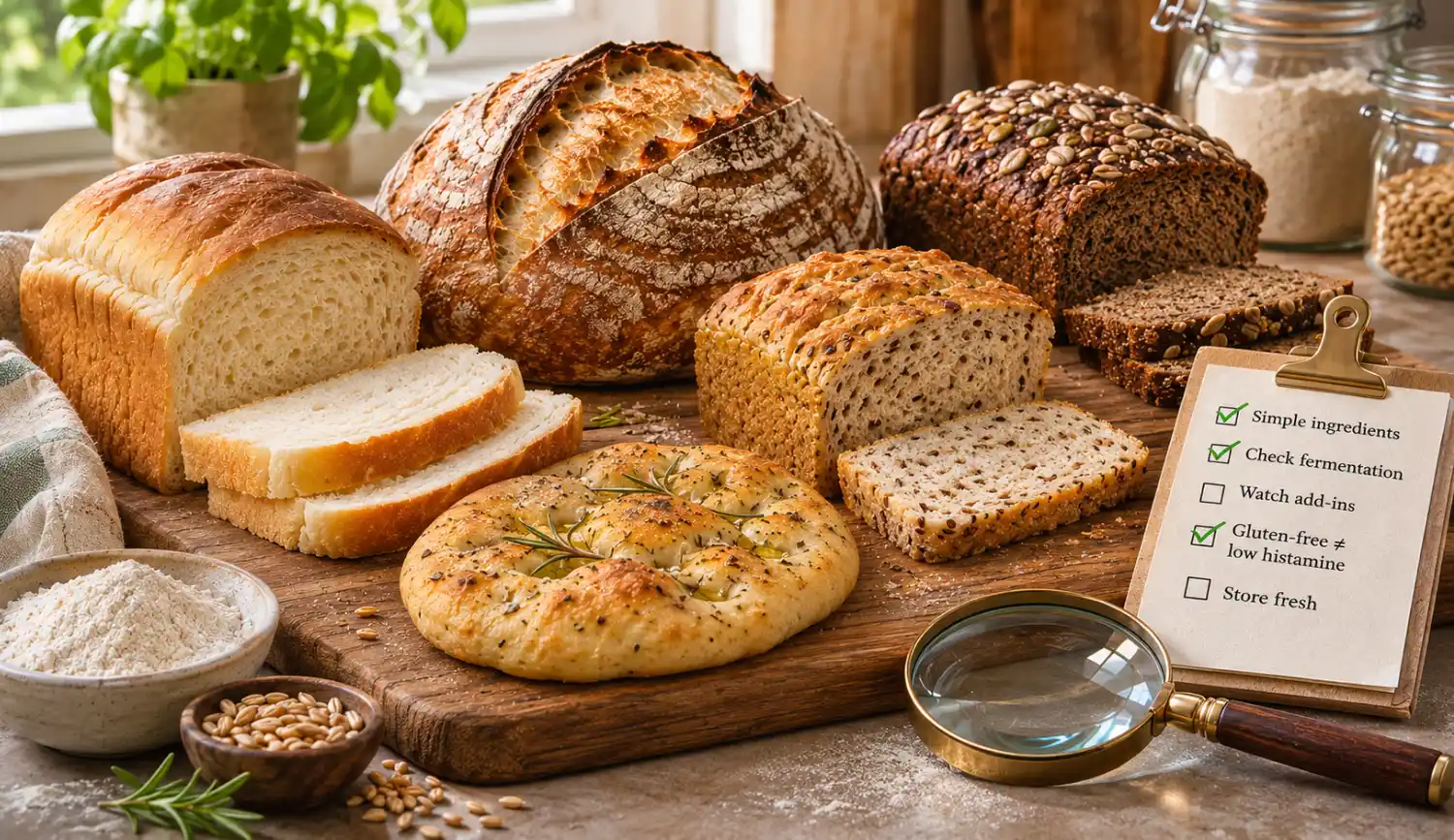
Each bread style tells you something about its ingredients or preparation, but none provides a reliable histamine rating for the finished loaf.
These distinctions can help you make a practical choice without treating any type as universally safe or unsafe.
Standard yeast bread
Baker’s yeast helps the dough rise, but using yeast does not establish whether the finished loaf is high or low in histamine. Check the full ingredient list and, if useful, ask the bakery about its preparation.
Sourdough bread
Sourdough uses a starter culture, but its microorganisms and fermentation conditions differ between bakers. The name alone cannot establish histamine content, so check the ingredients and whether commercial yeast was also added.
Quick breads and unleavened flatbreads
Baking powder can raise a quick bread, while an unleavened flatbread uses no leavening agent. These methods can avoid extended dough fermentation, but other flatbreads may be fermented, and none is automatically histamine-free. Check the leavening method and add-ins.
White, wholegrain, rye and spelt breads
These names describe the flour or grain, not a measured histamine concentration. There is too little comparable testing of finished loaves to rank them reliably, so review the other ingredients and preparation rather than judging by grain alone.
Gluten-free bread
Gluten-free labeling addresses gluten, not histamine. Look at the flours, starches, added ingredients and fermentation method; the label does not confirm that the finished loaf is low in histamine.
Sprouted and grain-mix breads
These descriptions tell you which grains were used or treated, not the histamine level of the finished bread. Sprouting and fermentation can affect biogenic amines under specific experimental conditions, but those findings cannot be assigned to an individual store-bought loaf. Check the ingredients and any available processing details.
Is sourdough bread high in histamine?
It can’t be classified as a whole. The measured findings are small and specific, and they vary with strain and process.
In one analysis of 20 Southern Italian sourdoughs, 10 from bakeries and 10 from home kitchens, six screened positive for biogenic amines overall. Among those six, histamine was detected in a single homemade dough, at about 6.7 ppm.
That doesn’t mean one in twenty sourdough breads contains histamine, and it doesn’t mean the other doughs hold none. It was dough, not baked retail bread, and it wasn’t a symptom challenge in people.
Separate experiments point the other way on process. In a controlled fermented sorghum flatbread, selected lactic acid bacteria starters reduced the formation of target amines, and some combinations eliminated measured histamine in that particular matrix. That doesn’t make every fermented loaf amine-free, and it doesn’t show how wheat sourdough affects a person.
Baker’s yeast can’t be called safer or riskier on this evidence either. The sensible reading is that the starter, the ingredients and the process matter, and a loaf’s name doesn’t tell you any of them.
Is white, rye or wholegrain bread low histamine?
There is not enough comparable testing of finished breads to rank white, rye and wholegrain loaves reliably by histamine content. White flour is not a proven safe default, and rye or wholegrain flour is not proof of a high-histamine loaf. Whether you’re asking about white bread or rye bread, the grain is one question and the fermentation and other ingredients are separate ones.
Sprouted grain breads show why caution runs both ways. In experiments on sprouting and fermenting selected wholegrains, histamine reached up to about 44 mg/kg in one combination of grains and processes.
That doesn’t mean an ordinary sprouted wheat loaf contains that much, and it doesn’t predict how anyone will react at any number. It does show that “sprouted” and “wholegrain” aren’t automatic assurances.
Does gluten-free bread mean low histamine?
No. Gluten is one question, and histamine is another. Gluten-free bread can still be made with fermented doughs, long rises or a long ingredient list, and the label doesn’t say anything about histamine content.
Celiac disease and wheat allergy are also separate from histamine concerns. If celiac disease is possible, don’t drop gluten before testing without professional advice, because eating less gluten beforehand can complicate the diagnosis. Wheat allergy can be serious, and our guide to histamine intolerance versus food allergies explains how the two differ.
How can you choose store-bought bread or compare brands?
Use the label for what it can actually show, which is ingredients and allergens. It cannot confirm a finished loaf’s histamine content. Even a test of one product batch would not guarantee the composition of every future loaf, so this guide does not rank brands as histamine-safe.
- Read the whole ingredient list. Look beyond the front of the pack for the grains, flours, starches, and anything added to the dough.
- Check allergens. Most FDA-regulated packaged foods must declare major allergens present as ingredients, including wheat, milk, eggs, soybeans, peanuts, tree nuts and sesame. Unpackaged bakery items may require asking staff; neither case tells you the histamine content.
- Look for how it was made. “Sourdough” on the front can mean very different things, so check whether a culture or commercial yeast is listed and whether the maker explains the process.
- Check freshness and handling. Follow the product’s storage directions and check its condition. A shorter ingredient list or a fresher loaf is not, by itself, a verified low-histamine rating.
Our low histamine grocery list covers wider shopping decisions.
What about homemade bread, recipes, alternatives and breadcrumbs?
Baking at home gives you control over the ingredients, which is a real advantage for label-reading. It doesn’t certify the amine content of the result, and a different leavening method, such as baker’s yeast, a sourdough starter or baking powder, suits preferences without settling the histamine question.
This article does not offer a kitchen-tested original bread recipe, and a recipe labeled “low histamine” is not evidence that its finished loaf has undergone a histamine assay.
Breadcrumbs are made from bread, so the same ingredient and preparation questions apply. Check the label of packaged breadcrumbs, or make them from a loaf that fits your dietary needs. Neither choice proves a particular histamine level.
Does storage, freezing or heating change histamine?
Standard food handling matters for any bread, so follow the date and storage directions on the pack. Beyond that, the evidence doesn’t give rules. Freezing doesn’t erase histamine that has already formed, and heating in an oven or toaster isn’t a proven way to neutralize it.
Nobody can give you an hourly threshold or a cold-storage window that establishes tolerance, and this article doesn’t invent one. Our meal prep guide for histamine intolerance covers general planning, without making bread-specific promises.
When do bread reactions deserve a different explanation?
Bread reactions can come from many places other than dietary histamine. Wheat allergy, celiac disease, sensitivities to other ingredients in a loaf, and ordinary digestive symptoms can all look similar after a meal.
Seek emergency medical help for breathing difficulty, throat swelling or faintness after eating. If an allergy is possible, don’t try the food again yourself to see what happens. A clinician can sort out wheat allergy and celiac disease, and measured food chemistry doesn’t prove a symptom mechanism.
A practical way to choose without excessive restrictions
Begin by identifying any medically necessary restrictions, such as a diagnosed food allergy or celiac disease. Then compare actual ingredients and preparation. For example, a conventional yeast-raised loaf and an unleavened flatbread may differ in fermentation and added ingredients, but neither can be certified low histamine from its name alone.
For concerns that do not suggest a serious allergy, a brief record of the bread, the rest of the meal and any symptoms can support a discussion with a clinician. Do not deliberately retry a food after a potentially severe allergic reaction. Our guide to how a low histamine diet works explains the broader approach.
If symptoms keep returning, take your notes to a clinician or dietitian before removing entire food groups long term. Clinical guidance cautions against excessive restrictions without a clear, individual reason.
References
- Mannino G, et al. Preliminary investigation of biogenic amines in Type I sourdoughs produced at home and bakery level. Toxins (Basel). 2022;14(5):293. doi:10.3390/toxins14050293.
- Hassan AAA, Jin YH, Mah JH. Effects of lactic acid bacteria on reducing the formation of biogenic amines and improving the formation of antioxidant compounds in traditional African sourdough flatbread fermentation. Antioxidants (Basel). 2024;13(7):844. doi:10.3390/antiox13070844.
- Çelik EE, Canli M, Kocadağlı T, Kanmaz EÖ, Gökmen V. Formation of histamine, phenylethylamine and γ-aminobutyric acid during sprouting and fermenting of selected wholegrains. Food Res Int. 2023;173:113447. doi:10.1016/j.foodres.2023.113447.
- Sánchez-Pérez S, Comas-Basté O, Rabell-González J, et al. Biogenic amines in plant-origin foods: are they frequently underestimated in low-histamine diets?. Foods. 2018;7(12):205. doi:10.3390/foods7120205.
- Reese I, Ballmer-Weber B, Beyer K, et al. Guideline on management of suspected adverse reactions to ingested histamine: Guideline of the German Society for Allergology and Clinical Immunology (DGAKI), the Society for Pediatric Allergology and Environmental Medicine (GPA), the Medical Association of German Allergologists (AeDA) as well as the Swiss Society for Allergology and Immunology (SGAI) and the Austrian Society for Allergology and Immunology (ÖGAI). Allergol Select. 2021;5:305–314. doi:10.5414/ALX02269E.
- Al-Toma A, Zingone F, Branchi F, et al. European Society for the Study of Coeliac Disease 2025 updated guidelines on the diagnosis and management of coeliac disease in adults. Part 1: Diagnostic Approach. United European Gastroenterol J. 2025;13(10):1855–1886. doi:10.1002/ueg2.70119.
- U.S. Food and Drug Administration. Food allergies.