

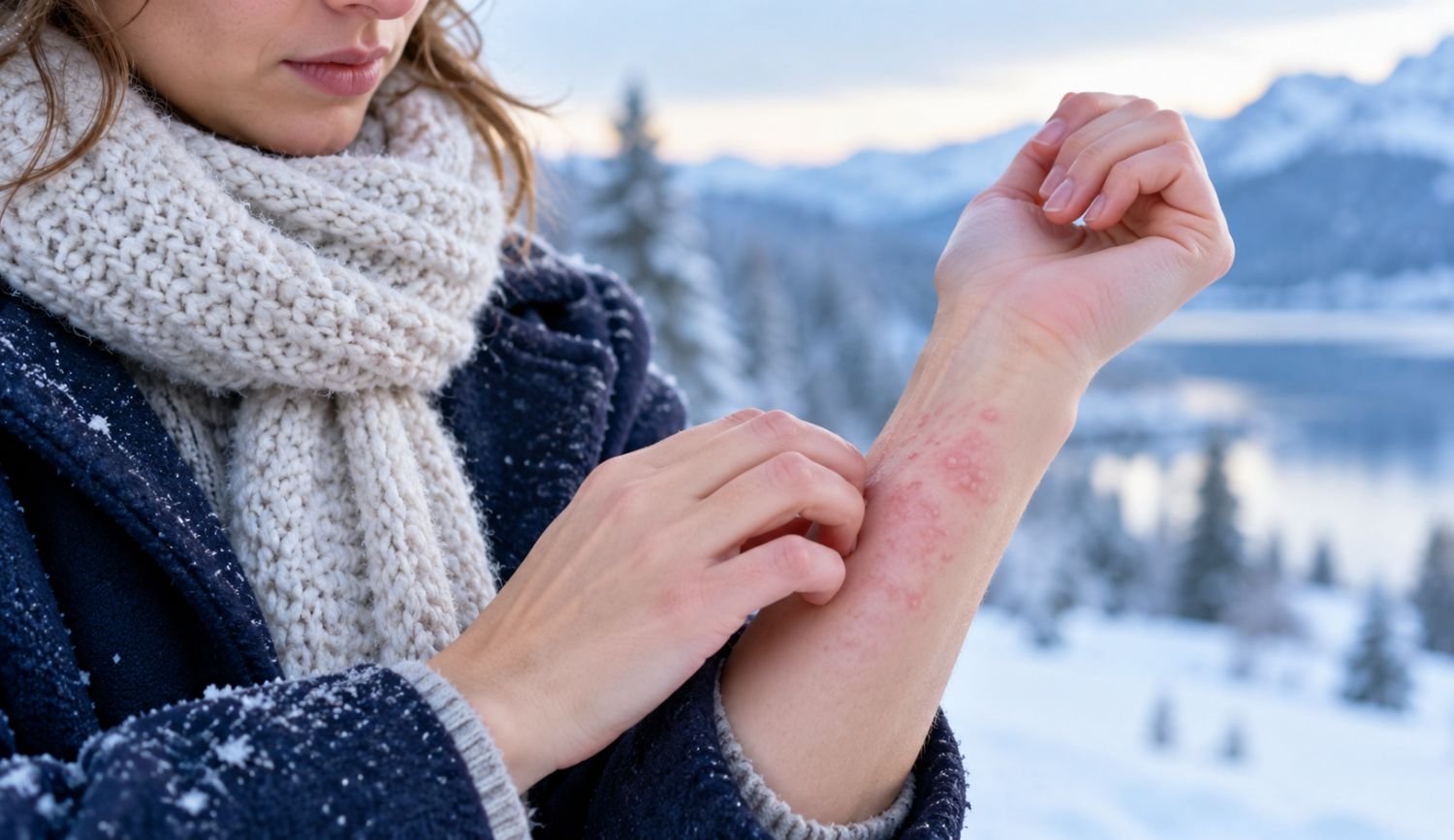
Cold urticaria (ColdU), sometimes called cold-induced urticaria, is a chronic inducible urticaria: wheals, angioedema (deeper swelling) or both that appear when the skin or mucous membranes are cooled. Reactions can stay local, such as hives where an ice pack touched the skin, or become systemic. Full-body cold-water exposure, especially swimming, deserves special caution.
Diagnosis relies on your history plus supervised cold provocation and threshold testing, and second-generation H1 antihistamines are the first-line treatment. Mast cells and histamine are involved in the reaction, but cold urticaria is not the same condition as histamine intolerance.
What cold urticaria looks and feels like
The typical reaction is itchy wheals on skin that has been cooled, sometimes with swelling of exposed areas such as the hands, face or lips. Some people develop generalized hives, and some notice swelling in the mouth or throat after cold food or drink. Not everyone has all of these, and many people never have symptoms beyond the skin.
Timing is a useful clue. The wheals often become most visible as the skin rewarms rather than while it is still cold, and they often settle within about an hour.
In COLD-CE, a large international study of people with typical ColdU, patients reported cold air as a trigger most often (88%). Full-body cold-water immersion followed (68%), then cold liquids touching the skin (65%), cold surfaces (59%) and cold food or drinks (34%). Wind and rapid temperature changes can matter too, so a reaction doesn’t always need ice or water.
Why cold water is the biggest concern
Cold water exposes a large area of skin to rapid cooling at once. That is why full-body exposure is the situation most associated with serious reactions. In the COLD-CE study, cold-induced anaphylaxis (ColdA) was most commonly provoked by complete cold-water immersion.
The danger has two parts. The reaction itself can drop blood pressure or affect breathing, and fainting or collapse in the water adds a drowning risk on top of it.
For that reason, cold plunges, ice baths and swimming are not appropriate ways to test yourself at home. A mild reaction when you put a hand in cold water doesn’t prove that swimming is safe, because a local reaction threshold says little about how your whole body will respond. If you have reacted to cold before, plan any swimming or water activity with the clinician who treats your condition.
Can cold urticaria kill you?
Cold urticaria is often limited to the skin, but cold-induced anaphylaxis can be life-threatening. Severe reactions are particularly concerning with large-area cold exposure such as swimming. How often cold urticaria is fatal is not well established, so any specific death risk would be a guess.
How often anaphylaxis happens depends on who is studied. A meta-analysis of cold urticaria cohorts found cold-triggered anaphylaxis in about one in five patients. In COLD-CE, anaphylaxis occurred in 37% of patients with a positive local cold test. Both are specialist-clinic cohorts, so they may not reflect everyone with mild symptoms.
Call your local emergency number and use any prescribed emergency medication if cold exposure is followed by any of these:
- difficulty breathing or wheezing
- swelling of the throat or tongue
- fainting or collapse
- signs of shock or severe low blood pressure
- a rapidly progressing reaction affecting several body systems
COLD-CE identified several features linked with more severe disease: generalized wheals, angioedema, swelling of the hands or feet, mouth or throat symptoms, and itchy earlobes. If you notice any of these, tell a clinician.
Do you need an epinephrine autoinjector?
Not everyone with cold urticaria needs one. Epinephrine (adrenaline) is the first-line treatment for anaphylaxis, and people at higher risk should be assessed for an emergency plan.
French guidance recommends an autoinjector for patients who have had cold-induced anaphylaxis, or throat or voice-box symptoms after cold exposure. The COLD-CE authors also note that high-risk patients need education on their condition and on using an autoinjector. Prescribing and training are decisions for your clinician.
What causes cold urticaria?
Mast-cell activation is central. When mast cells in the skin are triggered, they release histamine and other inflammatory mediators, which produce the itch and swelling. How cold triggers mast-cell activation is still incompletely understood.
Most acquired cases don’t have one obvious underlying cause. That uncertainty is a feature of the condition, not a sign that your symptoms aren’t real.
Histamine’s role here is mainly as a mediator released by activated mast cells. That local mast-cell response does not show that dietary histamine or reduced DAO activity is causing the condition, and having cold urticaria does not by itself diagnose histamine intolerance or mast cell activation syndrome.
For a broader look at how histamine relates to skin symptoms, see histamine skin reactions.
Can cold urticaria be a sign of cancer?
Usually, no. Cold urticaria does not typically mean cancer.
Older reports and clinical references describe associations with blood and lymph-system disorders, cryoglobulinemia and infections. More recent reviews note that the evidence for a causal link in many of these proposed secondary causes is weak, and most acquired ColdU is never assigned a malignancy cause.
Cryoproteins are one example. A study that combined a literature review with 49 patients found elevated cryoglobulins in about 3% of patients across published studies, and none of 48 patients in its own prospective study had them. The authors concluded that only very few people with cold urticaria have cryoproteins.
That doesn’t mean no one needs further testing. The 2026 international urticaria guideline lists a differential blood count, ESR or CRP, and ruling out other diseases, especially infections, in the work-up for cold urticaria. Anything broader is guided by your history, examination and your clinician’s judgment, and not every reader needs cancer screening.
How doctors diagnose cold urticaria
A reproducible history is the starting point: hives or swelling after cold exposure, reliably and repeatedly. The 2026 international guideline then relies on cold provocation and threshold testing to confirm the diagnosis and measure how sensitive you are.
The ice-cube or cold-contact test is a standard method. A clinician applies a cold stimulus to the skin, usually the forearm, for a set time and watches the skin as it rewarms. A visible wheal is a positive result. Where it’s available, a temperature-controlled device called TempTest can find the temperature at which your skin reacts.
Testing should be done in a clinic, not at home. A local result doesn’t tell you whether whole-body exposure is safe, and a negative local test doesn’t exclude the condition. Atypical forms exist, including people with a convincing history and a negative local test.
A 2026 COLD-CE analysis reinforces that point: 121 of 364 patients with clinically diagnosed ColdU had negative standard cold stimulation testing. That does not make testing unhelpful, but it means the result has to be interpreted alongside the history rather than used as a stand-alone rule-out test.
What else it can look like
Several conditions can look like cold urticaria or overlap with it, and the table shows how they usually differ. It is meant to explain the differences, not to work as a self-diagnosis checklist.
| Condition | Typical trigger | What it looks like | Main clue |
|---|---|---|---|
| Cold urticaria | Cooling of the skin or mucosa | Wheals or swelling, often most visible on rewarming | Reproducible with cold and relatively short-lived |
| Cholinergic urticaria | Heat, sweating and exercise | Very small, itchy or stinging wheals | Triggered by warming rather than cooling |
| Chronic spontaneous urticaria | No consistent external trigger | Wheals that appear unpredictably | Can occur alongside cold urticaria in the same person |
| Chilblains (pernio) | Cold, usually repeated or prolonged exposure | Swollen, discolored patches, often on fingers or toes | Lasts longer than transient wheals |
| Familial cold autoinflammatory syndromes | Cold exposure | Rash with systemic inflammatory symptoms such as fever or joint pain | Rare and inherited |
| Cryoglobulinemic vasculitis | Cold, in some cases | Skin changes caused by inflamed blood vessels | Considered when symptoms and blood tests point to it |
If your hives come with heat and sweat rather than cold, cholinergic urticaria is the closer match.
Treatment
Treatment aims to reduce reactions while helping you manage predictable cold exposure safely. Current urticaria guidance combines second-generation antihistamines with individualized trigger management, while people with severe or persistent reactions may need specialist escalation and an emergency plan.
Antihistamines come first
The 2026 international urticaria guideline recommends a modern second-generation H1 antihistamine as first-line treatment. No single molecule is universally best, so this article doesn’t name one or give a dose.
First-generation antihistamines are not recommended as routine first-line treatment, mainly because of side-effect and safety concerns.
If standard dosing isn’t enough
For chronic urticaria that doesn’t respond to standard dosing, the guideline recommends that a clinician increase the dose of a single second-generation H1 antihistamine, up to fourfold, before other therapies are considered. This is a medical-management step and not self-dosing advice.
If that still isn’t enough, specialists can consider omalizumab, which has evidence and reported efficacy in cold urticaria and other chronic inducible urticarias. Decisions about it, including approval and licensing, vary by country and by clinician.
Everyday trigger management
Treatment works best alongside practical changes, and you don’t need to avoid every cool environment. Sensible steps include:
- protecting exposed skin in cold or windy conditions
- avoiding sudden, large-area cold exposure
- taking care with cold foods and drinks if they cause mouth or throat symptoms
- planning swimming and water activities with your treating clinician if you’ve reacted before
- telling healthcare teams about cold urticaria before surgery or procedures where cold exposure could occur
Cold food and drink can act as a temperature trigger, which is different from the histamine content of what you eat. This article doesn’t recommend a low-histamine diet, DAO supplements or avoiding foods labeled as histamine liberators for cold urticaria.
How rare is cold urticaria?
Cold urticaria is uncommon. An older estimate of around 0.05% of the population is often cited, but the exact general-population figure is uncertain.
A meta-analysis found cold urticaria in about 7.6% of people with chronic urticaria, and its authors estimated roughly 6 in 10,000 people worldwide. That is an extrapolation and not a direct population count. Among people who already have a chronic inducible urticaria, cold urticaria makes up a much larger share, but that is a different denominator and shouldn’t be compared with the general population.
Does cold urticaria go away?
It can go into remission, but many people stay symptomatic for years. There is no guaranteed cure that makes ColdU disappear on demand, so treatment focuses on controlling reactions and reducing risk while the condition remains active. Remission rates differ substantially between cohorts, and nobody can predict how long it will last for you.
If your reactions are getting stronger, involve swelling of the mouth or throat, or you have had any reaction in the water, a clinician who treats urticaria can reassess your risk and your treatment.
References
- Zuberbier T, et al. The International Guideline for the Definition, Classification, Diagnosis and Management of Urticaria. Allergy. 2026;81(8):2582-2632.
- Bizjak M. Cold Urticaria: From Wheals to Anaphylaxis. Allergy Asthma Immunol Res. 2025;17(5):547-562.
- Bizjak M, Košnik M, Dinevski D, et al. Risk factors for systemic reactions in typical cold urticaria: Results from the COLD-CE study. Allergy. 2022;77(7):2185-2199.
- Prosty C, et al. Prevalence, Management, and Anaphylaxis Risk of Cold Urticaria: A Systematic Review and Meta-Analysis. J Allergy Clin Immunol Pract. 2021.
- Ginter K, Ahsan DM, Bizjak M, Krause K, Maurer M, Altrichter S, Terhorst-Molawi D. Cryoglobulins, Cryofibrinogens, and Cold Agglutinins in Cold Urticaria: Literature Review, Retrospective Patient Analysis, and Observational Study in 49 Patients. Front Immunol. 2021;12:675451.
- French Society of Dermatology. Cold urticaria guidelines.
- Bizjak M, et al. Cold Urticaria With Negative Standard Cold Stimulation Testing: Results From the COLD-CE Study. 2026.