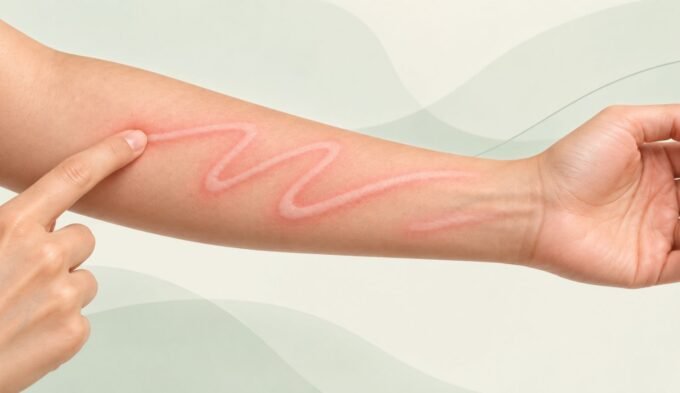
Histamine is part of normal signaling in and around working muscle. Some studies in healthy people detect histamine or its breakdown products in the blood and urine during and after exercise. That does not mean every workout triggers an allergic reaction, and it does not show that exercise causes histamine intolerance or MCAS.
If you develop itchy hives or more serious symptoms while exercising, a separate exercise-related condition may be involved, and that is worth sorting out with a clinician.
How does histamine act during exercise?
Muscle tissue is not a passive bystander during a workout. Histamine is one of the local signals that helps coordinate blood flow and recovery in and around exercising muscle, and reviews of the physiology describe this as an ordinary, expected process rather than an allergic one.
A cellular analysis of human skeletal muscle identified a small population of mast cells considered a likely source of exercise-related histamine in that tissue. The researchers also described signaling involving nearby immune and vascular cells. This local process does not mean someone has a mast cell disorder.
What have recent human studies actually found?
The most direct measurements come from a small 2026 study of 12 healthy, physically trained adults, 11 men and one woman, who completed both aerobic cycling and resistance exercise. After both types of exercise, the histamine breakdown products 1-methylhistamine and 1-methylimidazoleacetic acid rose in the blood, urine or both.
Free histamine itself behaved less uniformly. Unmetabolized plasma histamine rose briefly after aerobic exercise but not significantly after resistance exercise, and unmetabolized urinary histamine did not follow the same pattern. So “histamine metabolites increase with exercise” is supported in this group, while “every workout raises blood histamine” is not.
The study also tells us nothing directly about people with histamine intolerance or MCAS. A group this small and this selected cannot show whether those patients respond the same way or whether exercise sets off clinical flares in them.
Does this mean exercise causes histamine intolerance or MCAS?
No. Normal histamine signaling in muscle is different from suspected histamine intolerance, a proposed explanation for certain symptoms after dietary histamine exposure. The mechanisms and diagnostic criteria remain debated. Our guide to histamine intolerance explains those uncertainties.
“Exercise-induced histamine intolerance” is a search phrase, not a recognized diagnosis. The studies discussed here also do not establish that exercise causes MCAS. Recurrent episodes suggestive of a systemic MCAS flare require their own clinical assessment; local muscle signaling cannot diagnose them.
Why can exercise cause flushing, itching or hives?
Plain post-exercise redness is common. Heat, increased blood flow and exertion can leave the skin flushed without any allergic process, and that on its own does not point to a histamine problem.
Itchy wheals are different. Cholinergic urticaria typically produces small, very itchy hives when body temperature rises, whether from exercise or from passive warming such as a hot shower. Our page on cholinergic urticaria covers recognition and management in detail.
Other conditions include exercise-induced urticaria and exercise-induced anaphylaxis. In food-dependent exercise-induced anaphylaxis, a particular food and exercise act together as triggers, sometimes alongside additional factors. Exercise-related airway disorders can also cause breathing symptoms. A single flushed or itchy workout cannot reliably distinguish these possibilities.
Is there a best exercise for histamine intolerance?
The evidence does not support ranking exercise types as safe or unsafe for histamine problems. There is no good basis for calling yoga, walking, swimming, cycling or stretching inherently “low histamine”, and no basis for fixed heart-rate limits or workout durations.
What may help is documenting a reproducible pattern: the activity, intensity, temperature, time since eating, medicines and symptoms. Bring that record to a clinician if episodes recur. This is more informative than assuming a particular workout is high in histamine. These studies do not support abandoning all exercise, although suspected severe reactions need assessment before resuming the triggering activity.
Does exercise lower or flush out histamine?
There is no established way to “detox” or flush histamine from the body through exercise, and no reliable evidence that working out lowers histamine in people with suspected histamine intolerance. A temporary exercise-related histamine response also does not establish that histamine builds up to harmful levels.
Do antihistamines change exercise adaptations?
Two small training studies point in different directions. In a six-week endurance training trial in 16 healthy adults, blocking both H1 and H2 histamine receptors blunted some fitness, vascular and metabolic adaptations compared with placebo.
A separate 10-week resistance-training study in 18 healthy men tested H1-receptor blockade and found no significant impairment in measured gains in muscle volume or strength. The studies differ in the type of training, the receptors blocked and the people involved, so they cannot be merged into one rule about antihistamines and fitness.
Neither study is a reason to start, stop or change a prescribed medicine. Anyone taking an antihistamine for hives, allergies or another condition should decide about it with the clinician who prescribed it.
When should you get medical advice?
Recurring exercise-related hives should be assessed, even if they settle quickly. Wheezing or other breathing symptoms also warrant evaluation because allergy is not the only possible explanation.
Testing for exercise-related reactions, including any provocation challenge, belongs with qualified clinicians. Do not try to reproduce a suspected severe reaction yourself.
Stop exercising and seek emergency medical help for severe breathing difficulty, throat or tongue swelling, collapse, or a rapidly developing reaction involving more than one body system. These can be signs of anaphylaxis. If you have an epinephrine auto-injector and a prescribed emergency action plan, follow that plan promptly while emergency help is arranged.
Bottom line
Histamine participates in normal exercise physiology. In a small study of healthy, trained adults, its metabolites increased after aerobic and resistance exercise. That finding is not a diagnosis of allergy, histamine intolerance or MCAS, and it does not establish a universally safe or unsafe exercise type for people with suspected histamine problems.
Hives, wheezing or other significant symptoms during exercise are a reason for proper assessment rather than self-diagnosis.
References
- Gibson BM, Abbotts KSS, Cursetjee HF, Wiedenfeld Needham K, Minson CT, Halliwill JR. Evidence of histamine release in response to both aerobic and resistance exercise: histamine metabolites as biomarkers. J Appl Physiol (1985). 2026;140(4):1085–1098. doi:10.1152/japplphysiol.01166.2025.
- Sieck DC, Kobak SH, Larson EA, Dreyer HC, Fogarty MJ, Sieck GC, et al. Histamine is a molecular transducer of adaptation to endurance exercise training in humans. J Appl Physiol (1985). 2025;138(6):1398–1410. doi:10.1152/japplphysiol.00687.2024.
- Van der Stede T, Van de Loock A, Turiel G, Hansen C, Tamariz-Ellemann A, Ullrich M, et al. Cellular deconstruction of the human skeletal muscle microenvironment identifies an exercise-induced histaminergic crosstalk. Cell Metab. 2025;37(4):842–856.e7. doi:10.1016/j.cmet.2024.12.011.
- Van de Loock A, Vandecauter J, Ullrich M, Lievens E, Schroé H, Moreno-Justicia R, et al. Histamine mediates food intake, but not muscle adaptations, following 10 weeks of resistance training in humans. J Physiol. Published online November 16, 2025. doi:10.1113/JP289240.
- Luttrell MJ, Halliwill JR. The intriguing role of histamine in exercise responses. Exerc Sport Sci Rev. 2017;45(1):16–23. doi:10.1249/JES.0000000000000093.
- Price OJ, Walsted ES, Bonini M, Brannan JD, Bougault V, Carlsen KH, et al. Diagnosis and management of allergy and respiratory disorders in sport: an EAACI task force position paper. Allergy. 2022;77(10):2909–2923. doi:10.1111/all.15431.