

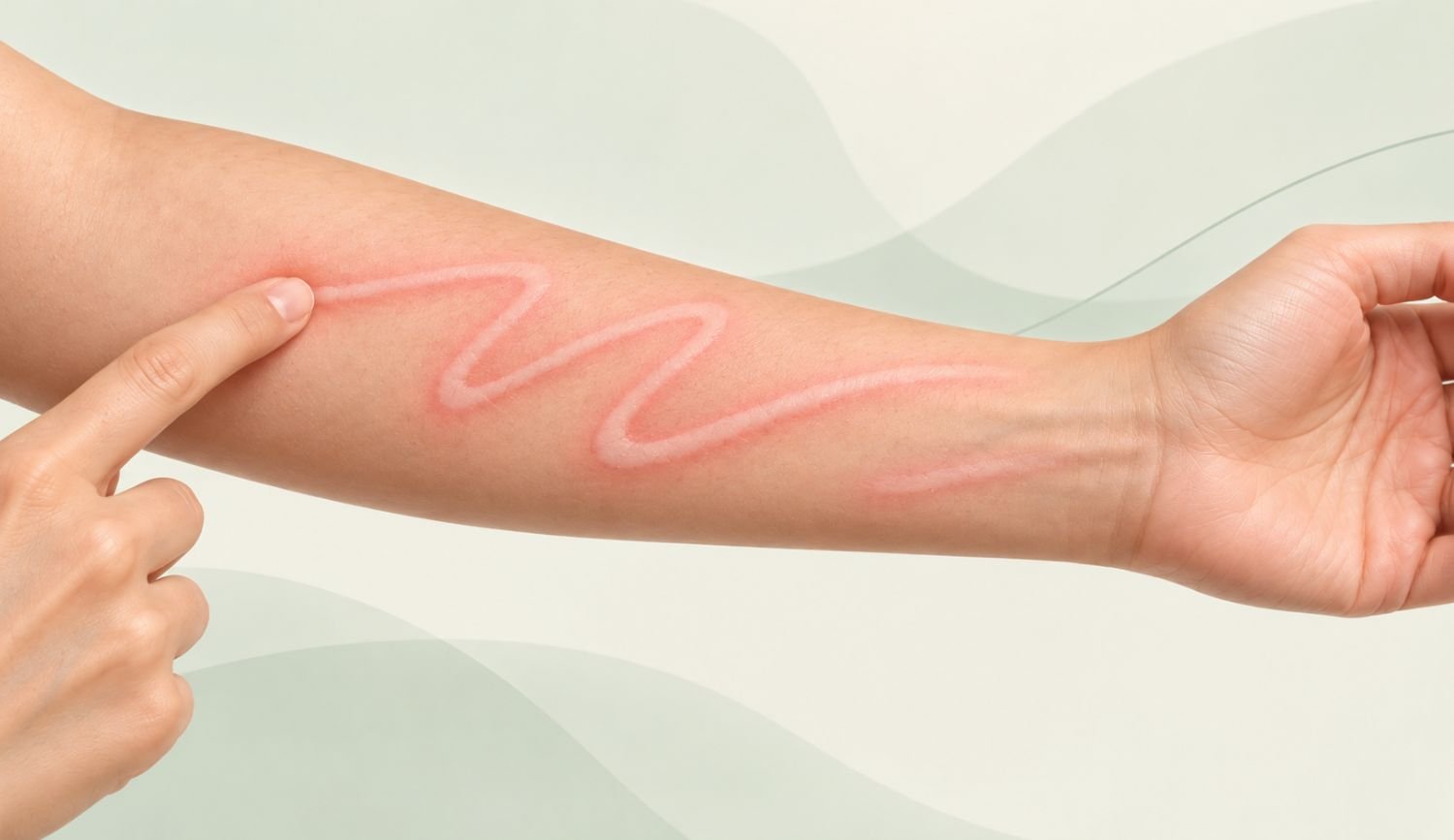
Not every visible scratch mark means you have a clinically important disorder. Symptomatic dermographism is the chronic inducible urticaria form, where even light friction produces recurrent, itchy wheals rather than an unbothersome temporary skin response.
Dermatographia, dermographism and dermatographic urticaria describe the same core phenomenon. The important distinction is whether the response is simply visible or repeatedly itchy and troublesome enough to need evaluation or treatment.
What does “skin writing” actually mean?
Dermatographia, dermographism, dermatographism and dermatographic urticaria are overlapping names for the same dermographic skin response. “Skin writing” is the lay description because stroking or scratching can leave a temporary visible line.
The response happens when mechanical stimulation, such as stroking, scratching or pressure, triggers the skin’s mast cells. They release histamine and other mediators, which produce a wheal (a raised, swollen strip) with a flare of surrounding redness.
That response can be mild and unbothersome, or it can be an itchy, recurring problem. The difference is what the next section covers.
Simple versus symptomatic: who actually has a disorder?
Being able to make a line appear on your skin doesn’t mean you have a clinically important condition. The 2026 PREVALENCE-D work, a large international questionnaire-based study, separates three patterns, and a fourth look-alike is worth knowing about.
| Pattern | What it looks like | What it usually means |
|---|---|---|
| Physiological red dermographism | A red line after firm stroking, without a raised wheal | A physiological skin response, not a disorder |
| Simple urticarial dermographism | A raised wheal after scratching or firm stroking, without itch or burning | An asymptomatic skin response rather than symptomatic dermographism |
| Symptomatic dermographism | Itchy, linear wheals after light friction, recurring over time | The chronic inducible urticaria form that may need treatment |
| White dermographism | A flat pale or white line, with no wheal | Not the same as urticarial dermographism |
The study put the point prevalence of symptomatic dermographism at 3.20%, with a lifetime prevalence of 5.94%. Point prevalence means how many people have it at a given time, while lifetime prevalence counts anyone who has had it at some point.
Physiological red dermographism was much more common, at 10.02%. Simple urticarial dermographism was less common, at 1.21%. A single figure for dermographism overall can therefore mislead, because it blends patterns that differ in how much they affect people.
What does symptomatic dermographism look like?
The classic sign is a linear or strip-shaped raised wheal where the skin was rubbed, scratched or pressed. It is often itchy and usually arises within minutes. It commonly fades within roughly 30 to 60 minutes.
Redness is not a reliable visual cue by itself. On deeper skin tones, the raised contour, the swelling and the itch are often more useful clues than the color of the line.
A flat, pale or white line without a wheal can represent white dermographism, which is different from symptomatic urticarial dermographism.
Some features should make you and a clinician reconsider the diagnosis rather than accepting it as classic dermatographia: persistent bruising, blistering, painful lesions, or lesions that last unusually long.
What causes dermatographia?
The exact upstream cause isn’t fully known. What is understood is the local reaction: mechanical stimulation can trigger mast-cell mediator release in the skin, including histamine, which produces the wheal-and-flare response.
Local mast-cell histamine release in dermatographia does not by itself diagnose dietary histamine intolerance, low DAO or mast cell activation syndrome. The histamine involved is released by cells in your own skin, so dietary histamine isn’t the default explanation. For how histamine intolerance is defined, see histamine intolerance explained.
Why do I suddenly have dermatographia?
Onset can seem sudden, and many people never find a single identifiable cause. In some people, an illness, a medication, stress or a skin disease happened around the same time the problem began.
That kind of timing is an association, not proof of cause. A clinician can help work out whether anything in your history is worth following up.
What factors are linked with it?
The 2026 PREVALENCE-D analysis of associated factors found some strong associations with symptomatic dermographism. People with atopic dermatitis had an adjusted odds ratio of 4.20, and people with allergic rhinitis 2.11. For having at least one atopic condition it was 2.70, and for allergic rhinitis, atopic dermatitis and asthma together it was 7.75.
An odds ratio compares how often something occurs in people with and without a condition. Here it means these conditions were found more often among people with symptomatic dermographism. Female sex, working-age and older groups, dyslipidemia and thyroid disease were also associated.
These are associations, not proof that any of them cause dermographism.
Stress, infections, food and genetics
Several narrower questions come up repeatedly. The evidence is limited on most of them, so the answers stay modest.
Can stress cause it?
Stress may worsen or trigger episodes for some people. It isn’t established as the root cause of dermatographia.
Do infections cause it?
The evidence doesn’t support a standard list of infections that reliably cause dermatographia. Occasional temporal associations have been reported, and scabies and other conditions can coexist with it or mimic or exacerbate the pattern. Evaluation should follow the clinical history, and dermatographia alone isn’t a reason for broad infection screening.
Does diet matter?
There is no standard evidence-based dermatographia diet, and a low-histamine diet isn’t a prescribed treatment for symptomatic dermographism. A small 2022 publication described food-dependent or food-exacerbated symptomatic dermographism in a subset of patients. That doesn’t show that dietary histamine usually causes the condition or that broad food restriction is standard treatment.
If you notice reproducible reactions linked to particular foods, that deserves separate clinical evaluation.
Is it genetic?
Familial cases have been reported, but most cases aren’t established as a simple inherited disorder. Routine genetic testing isn’t recommended.
How is dermatographia diagnosed?
History and provocation are central. The current international urticaria guideline supports eliciting dermographism by provocation, and testing the threshold where that is useful. A clinician strokes the skin in a controlled way and sees whether a wheal appears.
A validated device, called a dermographometer or FricTest, can provide objective provocation thresholds by applying standardized pressure. Studies have supported its validity and its reliability.
Don’t try to confirm it by scratching your skin hard at home. A home scratch test can’t definitively diagnose the condition, and aggressive scratching can injure the skin.
Medication matters too. Antihistamines can suppress provocation results, so any instructions about stopping or continuing them before testing should come from your clinician. Blood tests don’t diagnose dermographism by themselves, although selected tests may be used as part of a broader work-up when the history points that way.
How is symptomatic dermographism treated?
Treatment aims to reduce itch and whealing while limiting the mechanical triggers that repeatedly provoke them. Practical measures such as reducing friction from tight clothing, vigorous towel rubbing or other predictable triggers can help, but trigger reduction does not replace medication when symptoms remain active.
Second-generation antihistamines come first
Modern second-generation H1 antihistamines are the first-line treatment, and a 2020 systematic review supports them as the best-established option. This article stays class-based and doesn’t name a preferred brand.
Sedating first-generation antihistamines aren’t preferred as routine first-line therapy.
If control is inadequate
The current international urticaria guideline supports a clinician increasing the dose of one modern second-generation H1 antihistamine, up to fourfold, before further escalation in uncontrolled chronic urticaria. Direct symptomatic-dermographism studies of this up-dosing strategy remain limited, so this step follows the broader chronic-urticaria treatment framework. It depends on your health, contraindications and local licensing, and it isn’t a self-dosing instruction. Don’t combine several antihistamines on your own.
If symptoms still aren’t controlled
Specialists have further options. A randomized placebo-controlled trial found benefit from omalizumab in symptomatic dermographism, although anti-IgE treatment remains off-label for chronic inducible urticarias in many settings. Phototherapy may also be considered in selected cases, but the dermographism-specific evidence is much smaller. Response varies, and licensing and access differ between countries.
Long-term systemic corticosteroids aren’t recommended for chronic management.
Is there a cure for dermatographia?
There is no guaranteed treatment that permanently switches dermatographia off on demand. Symptoms can often be controlled with treatment.
Spontaneous remission occurs in some people, but the condition may last months or years, and no individual timeline can be predicted reliably. Anyone offering a fixed remission date is going beyond the evidence.
Can you get a tattoo with dermatographia?
There’s no categorical yes or no. Tattooing repeatedly traumatizes the skin, so it may provoke temporary whealing.
Dermographism itself isn’t proof of a tattoo-ink allergy. Tattooing carries its own infection, inflammatory and pigment risks, and direct outcome studies in people with dermatographia are sparse. If your symptoms are active or severe, it is worth discussing elective tattooing with a clinician first.
When does the pattern need a closer look?
Dermatographia is usually limited to the skin, and it isn’t the same thing as anaphylaxis. That doesn’t make it trivial, since itch, visible marks and interference with daily routines can affect quality of life.
Seek emergency assessment for throat swelling, breathing difficulty, fainting or rapidly progressive symptoms affecting several body systems. Those suggest something beyond uncomplicated dermographism.
Several other conditions can look similar or overlap: chronic spontaneous urticaria, delayed pressure urticaria, contact urticaria, atopic dermatitis with white dermographism, mastocytosis (where rubbing a lesion can produce a wheal known as the Darier sign), and ordinary pressure or friction marks.
Hives triggered by heat or sweating belong to cholinergic urticaria, and those triggered by cooling to cold urticaria.
For a broader view of histamine-related skin symptoms, see histamine skin reactions.
References
- Zuberbier T, et al. The International Guideline for the Definition, Classification, Diagnosis and Management of Urticaria. Allergy. 2026;81(8):2582-2632.
- Kulthanan K, et al. The Prevalence of Symptomatic Dermographism: Results of the International UCARE PREVALENCE-D Study. Allergy. 2026;81(2):468-479.
- Kulthanan K, et al. Factors Associated with Symptomatic Dermographism: Findings from the UCARE PREVALENCE-D Study. Am J Clin Dermatol. 2026;27(3):631-645.
- Kulthanan K, et al. Symptomatic Dermographism: A Systematic Review of Treatment Options. J Allergy Clin Immunol Pract. 2020;8(9):3141-3161.
- Maurer M, et al. Omalizumab is effective in symptomatic dermographism: randomized placebo-controlled trial. J Allergy Clin Immunol. 2017.
- Młynek A, et al. Validated instrument for symptomatic dermographism provocation thresholds. Clin Exp Dermatol. 2013;38(4):360-366.
- Gutsche A, et al. Reliability of FricTest 4.0 for symptomatic dermographism. Clin Transl Allergy. 2024;14(11):e70005.
- Yücel MB, et al. Food-dependent and food-exacerbated symptomatic dermographism. J Allergy Clin Immunol. 2022;149(2):788-790.
- Maurer M, et al. Pathophysiology and emerging treatments for dermographic, cholinergic and cold urticaria. J Eur Acad Dermatol Venereol. 2026.
- DermNet. Dermographism.