
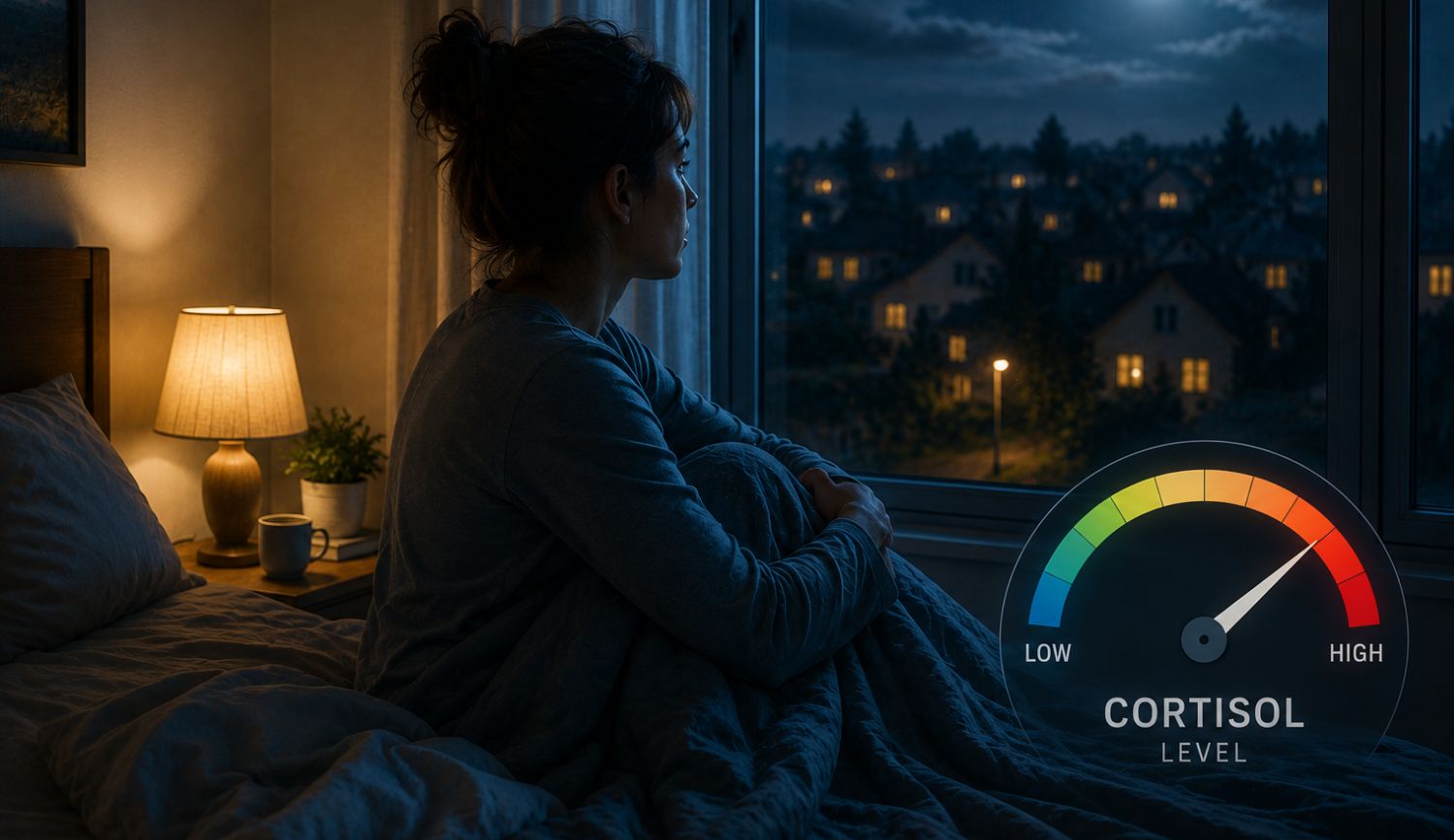
You fall asleep without difficulty. Two or three hours later, you are awake.
Not groggy. Not half-dreaming. Fully alert — as if someone activated a switch inside your brain.
Your mind is already moving. Your heart may feel like it is beating harder than it should. Your face feels warm. Your body is charged or tense before you have even had a thought. There is an anxiety quality to it that arrived before you could think of anything to be anxious about.
If this pattern feels familiar, it’s easy to assume the problem is anxiety, stress, or simply bad sleep.
For some people, however, a different mechanism may be involved. A nighttime interaction between histamine, cortisol, and the body’s stress-response system may help explain why these awakenings feel so sudden, so alert, and so difficult to switch off.
This article unpacks that loop, explains why it surfaces at night specifically, and addresses what may help interrupt it.
Cortisol Spikes at Night and Histamine in 30 Seconds
Cortisol follows a 24-hour rhythm. Levels drop to their lowest point around midnight, then begin climbing between 2 and 3 AM, reaching a peak roughly 30 to 45 minutes after waking [1]. This early-morning rise is a normal physiological event — it mobilizes energy, sharpens alertness, and helps regulate inflammation.
When baseline stress load is already elevated, that rise can become too steep, crossing the threshold that keeps you asleep and tipping you into alertness.
For people with histamine reactivity, a connected mechanism may amplify this. Histamine is not only a peripheral immune molecule — it is also a wake-promoting neurotransmitter in the brain [2]. The stress-response system can activate mast cells, the immune cells that store and release histamine. And histamine, in turn, can stimulate the same stress-response axis that cortisol belongs to — feeding back into the system.
The result is a possible loop between histamine, the body’s stress-signaling chemistry, and cortisol that may help explain why this particular waking pattern feels so specific, so alert, and so hard to switch off.
Why Waking at 3 AM Can Feel Different From Normal Waking
Normal waking — for a noise, a bathroom trip, or no obvious reason — tends to feel drowsy. You surface halfway, notice you are awake, and drift back within a few minutes.
The 3 AM stress-histamine pattern feels qualitatively different. The alertness arrives before any conscious thought does. The brain is switched on before you have registered where you are. The body may feel hot, internally buzzy, or charged. There is often an anxious quality — a diffuse unease with no clear object — that precedes any identifiable thought.
This constellation is the signature of a nervous system that has been activated from the inside, not by an external disturbance but by a biochemical event that occurred while you were asleep.
Nighttime palpitations or a racing heart during these episodes are covered in more depth in our guide to histamine heart palpitations. This article focuses on the upstream stress-cortisol-histamine mechanism rather than the cardiovascular symptoms themselves. Similarly, if your primary concern is what drives the histamine release pattern during sleep generally, our histamine dump at night covers the circadian histamine rhythm in detail. The focus here is specifically on how the stress loop activates and amplifies that window.
The Normal Nighttime Relationship Between Cortisol and Histamine
Cortisol is anti-inflammatory. When levels are adequate, it helps regulate mast cell activity and suppress histamine release — through both slow genomic pathways and faster nongenomic ones [3][4]. This is one reason acute cortisol spikes can briefly dampen allergic-type reactions: high cortisol can suppress mast cell degranulation within minutes.
Through the night, cortisol falls toward its midnight low point. As it does, that anti-inflammatory effect eases. Histamine is less constrained — not because it necessarily spikes, but because one of the body’s counterweights has stepped back.
This is the normal oscillation. The body manages it every night without producing symptoms in most people.
The problem appears when chronic stress, poor sleep recovery, gut inflammation, or prolonged physiological strain erodes the body’s capacity to maintain adequate cortisol buffering overnight. When the HPA axis becomes dysregulated, the cortisol rhythm can distort — arriving too early, too steeply, or too unevenly to do its balancing job.
This also resolves a common contradiction. Competitor articles often say cortisol both suppresses histamine and makes it worse. Both are true — but they describe different situations. Acute, healthy cortisol suppresses mast cell activity. Chronic dysregulation removes that protection. The condition of the system, not cortisol itself, determines the direction.
The Missing Piece: CRH Comes Before Cortisol
Most cortisol explanations skip the step that makes everything else make sense.
Before cortisol rises, the brain sends a different signal. When the hypothalamus detects stress — physical, psychological, or metabolic — it releases a chemical called corticotropin-releasing hormone, or CRH.
CRH is the upstream alarm. It signals the pituitary gland to release ACTH, which then tells the adrenal glands to produce cortisol. That chain is called the HPA axis: hypothalamus → pituitary → adrenal.
Here is what most articles miss. Research suggests CRH may influence mast cells directly, independent of its role in stimulating cortisol production.
Mast cells carry CRH receptors (called CRHR) on their surface. When CRH binds to these receptors, it can directly trigger degranulation — causing mast cells to release histamine and other inflammatory mediators before cortisol has had time to arrive as a counterbalancing signal [5].
Think of it this way: cortisol is the fire department called in to control the blaze. CRH starts the fire first. By the time cortisol arrives, histamine is already in circulation.
This mechanism, documented in research on neuroimmune connections between CRH and mast cells [5], helps explain why stress can trigger histamine-related symptoms so quickly — and why the early morning hours, when CRH begins to rise before the cortisol surge follows, represent a particularly vulnerable window for people with mast cell reactivity.
The Histamine–Cortisol Stress Loop
This is the mechanism at the core of the 3 AM pattern.
The loop has multiple entry points. Accumulated daytime stress, an overnight blood sugar drop, elevated histamine load, gut inflammation, or poor sleep recovery the night before can all start it.
Physiological strain — stress, metabolic dip, or inflammatory load ↓ CRH is released from the hypothalamus ↓ CRH may activate mast cells through CRHR receptors, releasing histamine [5] ↓ Histamine acts on H1 receptors near the HPA axis, stimulating cortisol release [6] ↓ Cortisol rises — in a dysregulated system, the rise may overshoot ↓ Cortisol signals alertness. Histamine reinforces wakefulness through the tuberomammillary nucleus [2] ↓ Wide awake at 3 AM
What makes this a loop rather than a one-time event is the feedback. Histamine stimulates the HPA axis. That produces cortisol. In a dysregulated system, the pattern can repeat the following night.
In a healthy, regulated system, the loop dampens quickly. Under sustained stress, it can deepen over weeks.
The histamine bucket theory provides useful context here. Someone already carrying a high baseline histamine load — from diet, gut dysfunction, hormones, or poor sleep — has less buffer before a nocturnal CRH event tips into waking. The loop does not need to be dramatic to push a person over that threshold.
Why Chronic Daytime Stress Can Show Up at Night
The HPA axis learns patterns.
A period of sustained daytime stress — work pressure, emotional strain, unresolved illness, overtraining, or prolonged caloric restriction — can shift the HPA axis toward a more reactive baseline. The brain begins to anticipate demand. CRH availability increases. Cortisol rhythms can advance earlier in the night cycle [7].
This is why a stressful week often appears as sleep disruption two or three nights later, even on evenings when the person went to bed feeling calm. The daytime load has already primed the system. Sleep simply removes the external stimulation that was masking the activation during waking hours.
Physiological stress does not require an emotional component to affect the HPA axis. Chronic gut inflammation, immune activation from ongoing infections, or sustained caloric deficit can all maintain elevated CRH reactivity overnight without producing any identifiable emotional experience. For someone managing histamine intolerance alongside gut dysfunction or SIBO, the inflammatory burden alone may be sufficient to keep the system primed through the night.
Why You Wake Up Alert Instead of Sleepy
Many people describe this experience the same way: “It feels like someone flipped a switch.”
One moment they are asleep. The next, they are completely awake and wondering why their brain suddenly feels ready to start the day.
Three systems converge in the early morning window to produce alertness rather than a return to sleep.
Cortisol promotes metabolic arousal even at sub-peak levels. It raises blood glucose, increases heart rate, and prepares the body for activity [1]. A cortisol surge at 3 AM does exactly what it is designed to do at 7 AM. It wakes you up.
Histamine produced in the tuberomammillary nucleus of the hypothalamus is one of the brain’s primary wake-promoting neurotransmitters. These histaminergic neurons are most active during wakefulness and go completely quiet during NREM and REM sleep [2]. When histamine rises — through mast cell activation, dietary load, or circadian release — the brain receives an alertness signal that sleep pressure cannot easily override.
Sympathetic nervous system activation, driven by both cortisol and histamine, further sharpens the state. Heart rate increases. Peripheral blood flow shifts. The body moves toward readiness.
Together these three signals explain why early morning waking from this pattern feels charged rather than drowsy. It is not simply an inability to sleep — it is active physiological arousal.
If you experience this consistently alongside other histamine-related symptoms, the sleep and histamine symptoms guide and the histamine intolerance and insomnia article both provide useful context for the broader picture.
Blood Sugar, Cortisol, and Histamine-Sensitive People
There is another common entry point into the 3 AM cortisol loop: overnight blood sugar drops.
When glucose falls too low during sleep, the body releases cortisol and adrenaline to signal the liver to raise it. That is a normal response. But the cortisol release it triggers is the same early-morning surge that can initiate the histamine loop above.
Here is where it becomes complicated for histamine-sensitive people.
Standard guidance for stabilizing overnight blood sugar typically involves protein-and-fat snacks before bed. The common examples are aged cheese, nut butters, leftovers, fermented foods, and other slow-digesting snacks often recommended for overnight blood sugar support. For someone managing histamine intolerance, many of those foods sit at the top of the high-histamine list.
The intervention meant to reduce cortisol-triggering blood glucose dips can add directly to histamine load at the same time. Both problems are real, and addressing them simultaneously requires individual guidance.
Some general principles worth keeping in mind:
- Avoid going to bed significantly under-fueled, especially on very low-carbohydrate eating patterns.
- Very low-carbohydrate diets can sustain nocturnal cortisol activation — and not everyone notices the connection.
- If blood sugar instability is suspected, formal testing is the appropriate path — not self-diagnosis.
- Discuss evening eating adjustments with a clinician or dietitian. Changing both cortisol and histamine at the same time needs individual guidance.
What May Help Stabilize the Evening Stress Response
The goal is reducing the inputs that prime the HPA axis before sleep — without suppressing the body’s natural cortisol rhythm entirely.
Consistent sleep and wake times are among the most reliable interventions. The HPA axis is regulated by the same circadian clock that governs cortisol timing. Irregular schedules shift when cortisol rises — potentially advancing it into the early sleep window.
Morning light exposure — ideally 10 to 15 minutes of natural outdoor light in the first hour after waking — anchors the circadian clock to real environmental time. Circadian desynchrony has documented effects on mast cell function [8]. Getting light in the morning tells the clock when the active day begins, which in turn keeps cortisol where it belongs.
Reducing late-night cognitive load matters. Active mental processing — work problems, anxious planning, high-stimulation media — keeps the hypothalamus engaged and CRH available. A brain processing deadline stress at 11 PM is doing HPA axis work that ideally would have finished hours earlier.
Caffeine timing is relevant because caffeine directly stimulates cortisol secretion. Afternoon and evening caffeine can sustain elevated cortisol into hours when it should be falling, narrowing the window of genuine down-regulation before sleep.
Alcohol needs a direct mention. It initially suppresses cortisol and appears sedating. As it metabolizes, it produces a rebound cortisol release — typically arriving in the 3 to 4 AM window. For histamine-sensitive people, alcohol is also a DAO inhibitor. Both effects point in the same direction.
Balanced dinner timing reduces the metabolic load carried into the first half of sleep — the period when HPA axis activity can most disrupt sleep architecture.
When 3 AM waking continues despite these adjustments, clinical evaluation is the next appropriate step.
When to Look Beyond Histamine
Cortisol and histamine are one possible explanation for the 3 AM waking pattern. They are not the only one.
A full clinical picture should also consider:
- Anxiety and depression — both can produce early morning waking with elevated cortisol on their own.
- Blood sugar dysregulation — reactive hypoglycemia creates a nearly identical pattern.
- Perimenopause — declining estrogen and progesterone shift cortisol timing and disturb sleep.
- Thyroid dysfunction — both overactive and underactive thyroid disrupt autonomic regulation at night.
- Medication effects — corticosteroids, decongestants, some antidepressants, and beta-blockers affect nighttime cortisol.
- Alcohol — produces a cortisol rebound as it metabolizes, typically in the early morning window.
- Acid reflux — nocturnal reflux causes early waking without obvious heartburn.
- Chronic pain — sustained pain activates the HPA axis through the night.
- Sleep apnea — covered separately in the sleep apnea and histamine article.
- Primary insomnia — sleep maintenance problems can exist with no histamine component at all.
The histamine-cortisol framework adds real value for a specific group of people. It does not replace a clinical assessment for anyone with persistent or worsening early morning waking.
One important point is that waking at 3 AM does not automatically indicate a cortisol problem, histamine intolerance, or mast cell activation. The same pattern can appear in several unrelated conditions, which is why symptom patterns should always be interpreted within the broader context of a person’s health history.
When Medical Evaluation May Be Appropriate
Occasional early morning waking with rapid resolution does not usually need clinical attention.
The following warrant evaluation before dietary or lifestyle changes become the primary strategy:
- Chest pain or tightness when you wake.
- Fainting or near-fainting.
- Severe shortness of breath.
- A heart rate that stays fast and won’t settle after a few minutes lying quietly.
- New anxiety or panic that persists into the following day.
- Waking so disrupted that normal daily function is affected.
- Symptoms worsening week over week, not varying.
If you are in the middle of a symptomatic period right now, the histamine flare recovery guide covers practical steps for the acute phase while you seek professional input.
This article is for educational purposes and does not replace individual medical advice. The mechanisms described here represent proposed pathways, not confirmed diagnoses.
Frequently Asked Questions
The questions below address the most frequent points of confusion about cortisol spikes at night and their relationship with histamine.
Can cortisol spikes at night and histamine be connected?
The connection is bidirectional and biochemically documented, though how strongly it affects any one person varies. Histamine can stimulate the HPA axis through H1 receptor pathways, contributing to cortisol secretion [6]. Cortisol can suppress mast cell activity and histamine release — but that suppression is context-dependent. It holds under normal physiology and erodes under chronic stress or HPA dysregulation. Both directions are real; they operate under different conditions.
Why do I wake up at 3 AM feeling anxious?
The early morning hours coincide with the body’s natural cortisol upswing, which starts between 2 and 3 AM. If stress load is already high, that rise can exceed the threshold that keeps you asleep. The anxious feeling typically reflects sympathetic nervous system activation — raised heart rate, heightened vigilance — rather than a psychological anxiety disorder, though both can produce similar feelings and are not mutually exclusive.
Can histamine raise cortisol?
Yes, through H1 receptor pathways on structures in and near the hypothalamus [6]. Mast cell degranulation in brain regions adjacent to the hypothalamus appears capable of influencing adrenocortical output. This means elevated histamine overnight could contribute to a cortisol event — not just follow from one.
Does cortisol lower histamine?
Under normal, acute conditions — yes. Glucocorticoids inhibit mast cell degranulation and histamine release through rapid nongenomic pathways that act within minutes [3][4]. Corticosteroids used in severe allergic reactions work through this pathway. But this suppressive effect requires cortisol to be functioning within a healthy regulatory system. Chronic HPA dysregulation can remove this buffering function entirely.
Why do I wake up with a racing heart at night?
A pounding or racing heart on early morning waking usually reflects sympathetic nervous system activation. Cortisol, CRH, and histamine can all stimulate the sympathetic system. Histamine-mediated vasodilation alongside sympathetic activation can produce the specific sensation of a heart pounding rather than simply beating fast. The histamine heart palpitations article covers this mechanism in more detail, including when these symptoms need clinical attention.
Can blood sugar affect 3 AM waking?
Yes. When blood glucose drops too low overnight, the body secretes cortisol and adrenaline to raise it. That cortisol event can initiate the histamine loop described in this article. The challenge for histamine-sensitive people is that standard blood-sugar-stabilizing bedtime snacks — aged cheese, nut butters, fermented foods — are high-histamine foods. Managing both at once needs individual clinical guidance.
Is waking at 3 AM always a histamine dump?
No. The 3 AM window is also when cortisol naturally begins its morning rise, when blood glucose dips are most common, and when sleep cycles shift into lighter stages. Any of these can produce early morning waking without histamine involvement. The histamine dump at night article covers the circadian histamine release pattern specifically. This article focuses on the stress-loop mechanism that can amplify or trigger waking in that same window.
How can I tell if stress is involved in my 3 AM waking?
Several patterns suggest HPA axis involvement rather than a dietary trigger alone: waking that worsens during high-stress periods, a feeling of activation rather than discomfort on waking, anxiety that arrives before any conscious thought, and difficulty returning to sleep despite physical exhaustion. No self-test can confirm HPA dysregulation. Persistent 3 AM waking warrants clinical evaluation rather than self-diagnosis.
References
- Clow A, Thorn L, Evans P, Hucklebridge F. The awakening cortisol response: methodological issues and significance. Stress. 2004;7(1):29–37. https://pubmed.ncbi.nlm.nih.gov/15204030/
- Thakkar MM. Histamine in the regulation of wakefulness. Sleep Med Rev. 2011;15(1):65–74. https://pmc.ncbi.nlm.nih.gov/articles/PMC3016451/
- Liu C, Zhou J, Zhang LD, Wang YX, Kang ZM, Chen YZ, Jiang CL. Rapid inhibitory effect of corticosterone on histamine release from rat peritoneal mast cells. PMID: 17447165. https://pubmed.ncbi.nlm.nih.gov/17447165/
- Zhou B, et al. Glucocorticoids inhibit degranulation of mast cells in allergic asthma via nongenomic mechanism. Allergy. 2008;63(8):1054–1063. https://onlinelibrary.wiley.com/doi/abs/10.1111/j.1398-9995.2008.01725.x
- Bhuiyan P, Wang YW, Sha HH, Dong HQ, Qian YN. Neuroimmune connections between corticotropin-releasing hormone and mast cells: novel strategies for the treatment of neurodegenerative diseases. Neural Regen Res. 2021;16(11):2184–2197. PMID: 33818491. https://pmc.ncbi.nlm.nih.gov/articles/PMC8354134/
- Bugajski AJ, et al. Studies on the involvement of histamine in the hypothalamic-pituitary-adrenal axis activation induced by nerve growth factor. J Physiol Pharmacol. 2000;51(4):819–829. https://pubmed.ncbi.nlm.nih.gov/11191621/
- Dressle RJ, Feige B, Spiegelhalder K, Schmucker C, Benz F, Mey NC, et al. HPA axis activity in patients with chronic insomnia: a systematic review and meta-analysis of case-control studies. Sleep Med Rev. 2022;62:101588. https://pubmed.ncbi.nlm.nih.gov/35091194/
- Christ P, Sowa AS, Froy O, Lorentz A. The circadian clock drives mast cell functions in allergic reactions. Front Immunol. 2018;9:1526. https://pmc.ncbi.nlm.nih.gov/articles/PMC6043637/