
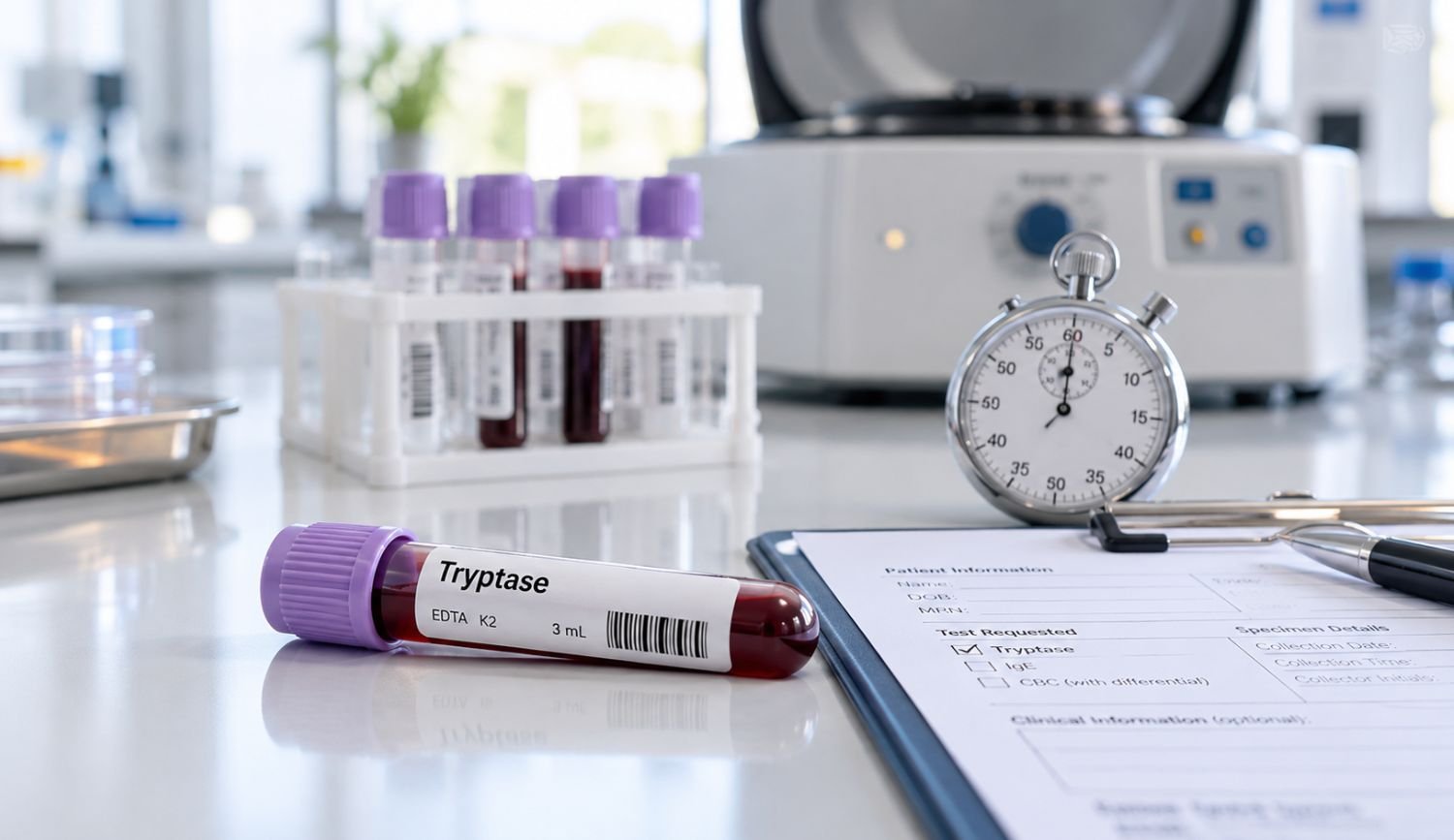
Tryptase is a protein released mainly by mast cells, and the test measures it in blood. It can support evaluation of systemic mast-cell activation, including anaphylaxis, and help investigate conditions associated with persistently elevated baseline tryptase.
An acute result and a baseline result answer different questions. Timing and comparison with your own baseline can matter more than whether one number sits inside or outside a generic laboratory range. One tryptase result does not diagnose MCAS or systemic mastocytosis by itself.
The tryptase test answers two different questions
The same laboratory measurement can answer two different questions. The first is acute: did tryptase rise during this episode? The second is baseline: is tryptase persistently elevated when you are well?
Those questions need different samples. An acute sample is taken during or shortly after a reaction, while a baseline sample is taken once you have fully recovered. A number means very little until you know which type of sample it was.
This is also why a result can feel confusing. A value that looks unremarkable on a lab report may still represent a meaningful rise for you. A value that looks high may instead be your stable baseline and unrelated to an acute event.
The test may be listed as serum tryptase, mast-cell tryptase or total tryptase. These names generally refer to the standard blood test that measures circulating total tryptase.
Timing can make or break the result
If you or someone near you may be having anaphylaxis, treatment comes first. Epinephrine (adrenaline) and emergency assessment take priority, and blood testing must never delay them. Severe breathing difficulty, throat or tongue swelling, collapse, or a rapidly worsening reaction affecting several body systems needs emergency care.
Tryptase typically rises early after systemic mast-cell activation, with peak concentrations often occurring around 1–2 hours after the event and then falling over the following hours. That is why a sample drawn too late can miss the rise.
For adults and young people aged 16 or over, NICE guidance says to take one sample as soon as possible after emergency treatment has started and a second ideally within 1–2 hours, but no later than 4 hours, from symptom onset. For children younger than 16, NICE says to consider the same timed sampling when the suspected cause is venom-related, drug-related or idiopathic.
If you are looking at an old result, the first thing to check is when it was drawn relative to symptom onset and treatment.
A baseline sample comes later. NICE notes that a baseline sample may be needed at specialist follow-up. An expert paper by Valent and colleagues in 2023 recommends waiting at least 48 hours after complete symptom resolution when establishing a precise basal serum tryptase value. Other laboratory guidance may use at least 24 hours, so follow the plan given by the clinician and performing laboratory.
How to read a tryptase result without overinterpreting one number
Four different numbers are often mixed together when people talk about “normal” tryptase. They answer different questions, and none replaces the others.
| Number / rule | What it answers | What it does NOT prove |
|---|---|---|
| Performing laboratory reference interval | How your result compares with that laboratory’s reference population and assay | That you are healthy, or that an acute result did not rise meaningfully for you |
| Expert-proposed physiological basal range: 1–15 ng/mL | A proposed physiological resting range that includes many healthy people, including asymptomatic people with hereditary alpha-tryptasemia (HαT) | That every value in the range is normal for you, or that a value above 15 automatically means disease |
| Basal >20 ng/mL | Meets one minor criterion for systemic mastocytosis in the appropriate diagnostic context | A mastocytosis diagnosis; systemic mastocytosis can also occur with lower values |
| Acute threshold = (baseline × 1.2) + 2 ng/mL | Whether tryptase rose significantly during an event compared with your own baseline | A population reference range, or MCAS on its own |
Do not treat these rows as interchangeable. A result can sit inside the laboratory’s reference interval and still show a significant event-related rise, while a persistently elevated baseline does not prove that an acute reaction occurred.
Laboratory ranges also differ. Mayo Clinic Laboratories currently reports a reference value below 11.5 ng/mL, while Labcorp lists 2.2–13.2 μg/L. For tryptase, 1 ng/mL is numerically equal to 1 μg/L, so the apparent difference in units does not change the number.
There is also no single universally adopted “normal tryptase level for a woman.” A large 2025 study found age- and sex-related differences in baseline tryptase distributions, but routine interpretation still depends on the performing laboratory’s assay, reference interval and clinical context.
What the 20% + 2 rule actually means
The phrase “20-2 rule” is usually referring to the 20% + 2 formula. It is not 20 minus 2. Valent and colleagues describe a significant event-related rise as an acute tryptase level of at least 1.2 times the person’s baseline plus 2 ng/mL.
To calculate it, multiply the baseline by 1.2, then add 2:
- Baseline 5 ng/mL: threshold is 8 ng/mL
- Baseline 10 ng/mL: threshold is 14 ng/mL
- Baseline 20 ng/mL: threshold is 26 ng/mL
The formula needs a baseline to work, which is why a later baseline sample matters. Without one, an isolated acute number is harder to interpret.
It also means an acute result can remain inside a laboratory’s population reference interval and still meet the event-rise formula. A baseline of 4 ng/mL, for example, gives a threshold of 6.8 ng/mL, which is below the upper limit used by many laboratories. The clinically relevant point is the rise compared with you, not only the comparison with a population.
A high result does not mean one thing
Start by separating a transient rise from a persistently elevated baseline. A transient event-related rise can support systemic mast-cell activation at that time. A persistently high level while you are otherwise well points instead to a factor affecting your baseline.
Tryptase is a biomarker, not a disease. There are no unique “symptoms of high tryptase.” Symptoms come from the underlying condition, if there is one, and some people with elevated baseline tryptase have no symptoms at all.
Several factors can raise a persistent baseline:
- Hereditary alpha-tryptasemia (HαT): an inherited increase in alpha-tryptase-encoding copies of TPSAB1. It is a common cause of elevated baseline tryptase, and many carriers are asymptomatic.
- Systemic mastocytosis or another clonal mast-cell disorder: increased clonal mast-cell burden can raise baseline tryptase.
- Reduced kidney function: impaired renal function can be associated with higher baseline levels.
- Selected myeloid or hematologic disorders: some clonal myeloid diseases can also elevate tryptase.
- Other clinical context: age, assay characteristics, medicines and the broader medical picture can affect interpretation.
HαT is not MCAS, and a high baseline alone does not tell you which explanation applies.
A basal serum tryptase above 20 ng/mL is one minor diagnostic criterion for systemic mastocytosis. It is not a diagnosis on its own. If HαT is known, specialist interpretation may adjust the basal tryptase when applying mastocytosis criteria, because inherited extra alpha-tryptase copies can elevate the resting value.
What a normal or low result can, and cannot, tell you
A normal acute result does not rule out anaphylaxis. A 2025 systematic review and meta-analysis by Khalaf and colleagues included 28 studies and 18,749 patients and found pooled tryptase sensitivity of about 0.49 and specificity of about 0.82. That limited sensitivity means many clinically confirmed anaphylaxis cases in the included studies did not have a positive tryptase result.
The clinical picture and treatment decisions therefore take precedence over a “normal” blood test.
A normal baseline also does not by itself exclude MCAS or systemic mastocytosis. Separately, an acute value that remains inside a laboratory’s reference interval can still be significant if it rose enough compared with the person’s own baseline.
A result below the laboratory’s reference range is generally not a disease diagnosis by itself. Low tryptase has no established diagnostic meaning on its own and should not be interpreted as evidence of histamine intolerance, DAO deficiency or weak immunity.
Where tryptase fits in MCAS testing
Under commonly used consensus criteria, an event-related rise in tryptase is strong objective evidence of systemic mast-cell activation. But MCAS is not diagnosed from one blood result. It requires the broader clinical, biochemical and treatment-response framework.
That means a normal baseline does not close the question, and a raised baseline does not settle it. For the full diagnostic framework, including how urinary mediators may fit, see our guide to MCAS testing.
If you are trying to separate MCAS from food-related histamine problems, see MCAS vs histamine intolerance.
For the limits of testing specifically for suspected histamine intolerance, see our histamine intolerance test guide.
What happens when baseline tryptase stays elevated
A persistently elevated baseline calls for context, not alarm. First confirm that the sample was actually collected when you had fully recovered and were in your usual state of health.
If the baseline remains high, a clinician may repeat it, review the laboratory’s reference interval, look at kidney function and blood counts, and consider your symptoms and history. Further evaluation can include testing for HαT through TPSAB1 copy-number analysis and sensitive testing for KIT D816V when clinically appropriate.
HαT testing is a genetic test and is different from serum tryptase. A bone marrow biopsy is not automatic after one high value. Whether specialist hematology or allergy evaluation, molecular testing or bone marrow assessment is appropriate depends on the complete clinical picture.
Getting the test done: the details labs do not explain well
Before having a tryptase test, practical details such as fasting, medications, specimen type, tube requirements, turnaround time and cost can vary between laboratories. The standard test uses venous blood, but collection instructions and reference ranges are not universal, so the performing laboratory’s requirements should always take priority.
What is a tryptase test and what does it test for?
A tryptase test is a blood test that measures tryptase, a protein released mainly by mast cells. It can support evaluation of systemic mast-cell activation, including anaphylaxis, and help investigate persistently elevated baseline tryptase associated with conditions such as hereditary alpha-tryptasemia or systemic mastocytosis. It does not diagnose MCAS or mastocytosis by itself.
Is a tryptase test a blood test?
Yes. Standard clinical tryptase testing uses venous blood, usually reported as serum or plasma tryptase depending on the laboratory method. Urinary N-methylhistamine, leukotriene E4 and prostaglandin metabolites are different mast-cell mediator tests and are not urine tryptase tests.
Is a tryptase blood test an allergy test?
Not in the usual sense. A tryptase blood test can provide evidence that systemic mast-cell activation occurred, but it does not identify the specific food, drug, venom or environmental allergen responsible. Specific IgE testing, skin testing and other allergy tests answer different questions.
Do you have to fast for a tryptase test?
There is no universal fasting requirement for routine tryptase testing. However, expert guidance recommends fasting and low-stress conditions when establishing a precise baseline tryptase in some situations. An urgent tryptase test after a suspected reaction should never be delayed for fasting. For a planned baseline test, follow the ordering clinician’s and laboratory’s instructions.
Can medications affect tryptase test results?
Some treatments can influence baseline tryptase in certain settings. Expert guidance notes possible effects from treatments such as corticosteroids, mast-cell stabilizers and KIT-targeting drugs. Do not stop prescribed medication on your own. Tell the clinician what medicines you take and what treatment you received before the blood sample was collected.
What tube color is used for a tryptase test?
There is no universal tryptase test tube color. Mayo Clinic Laboratories prefers a serum-gel tube and accepts a red-top serum tube, while Labcorp accepts gel-barrier, lavender-top EDTA or green-top heparin tubes for its assay. The correct specimen tube therefore depends on the laboratory performing the test.
What is the normal range for a tryptase blood test?
The normal range depends on the performing laboratory and assay. Mayo Clinic Laboratories currently reports a reference value below 11.5 ng/mL, while Labcorp lists 2.2–13.2 μg/L. Experts have also proposed 1–15 ng/mL as a physiological basal range. These numbers answer different questions and should not be treated as interchangeable cutoffs.
How long do tryptase test results take?
Turnaround time varies by laboratory. Mayo Clinic Laboratories currently lists approximately 2–5 days from specimen receipt, while Labcorp lists a usual turnaround of about 2–4 days. Hospital and local laboratory turnaround times may be different.
How much does a tryptase test cost?
There is no universal tryptase test cost. The price depends on the country, laboratory, insurance coverage and how the test is ordered. CPT 83520 is commonly used by major U.S. laboratories for this type of assay, but the billing code is not a fixed test price.
Can you take a tryptase test at home?
Standard clinical tryptase testing requires venous blood analyzed by a laboratory. Some services allow the test to be ordered online, but the blood sample is still collected at a laboratory or phlebotomy site. A home finger-prick test should not be assumed to be equivalent to the standard clinical tryptase assay.
Is there a urine tryptase test?
The standard clinical tryptase test is a blood test. Urine testing may be used for other mast-cell mediators, such as N-methylhistamine, leukotriene E4 or prostaglandin metabolites, but these are different tests and should not be described as urine tryptase testing.
If the number does not match your symptoms
Tryptase and symptoms do not always line up. You can have clinically diagnosed anaphylaxis with a normal acute result, especially if the sample was mistimed, and you can have a high baseline while feeling entirely well.
When the number and the clinical story disagree, the next step is usually to reconstruct the context: when symptoms started, when blood was drawn, whether treatment had already been given, and whether a reliable baseline exists. Large-volume fluid resuscitation can also dilute serum and lower the measured concentration.
If MCAS evaluation still appears appropriate, clinicians may consider other mast-cell mediator testing in selected cases, but that broader diagnostic pathway belongs to the full MCAS testing guide rather than to one tryptase value.
What to have in front of you when reviewing the result
When you review a tryptase result with a clinician, have these details ready:
- whether the sample was intended as acute/event-related or baseline
- the exact time symptoms began
- the exact date and time the blood was drawn
- treatments given during the episode and when they were given
- any earlier baseline tryptase result and its date
- your current medicines
- the performing laboratory’s reference interval and units
- kidney function and blood-count results, if they are relevant to a persistently elevated baseline
These details often explain more than the number alone.
The bottom line
A tryptase test is useful when you know what question it was meant to answer. An acute sample asks whether tryptase rose during an episode, and the 20% + 2 formula compares it with your own baseline. A baseline sample asks whether your resting level is persistently elevated.
Timing and comparison matter more than whether one number sits inside a printed reference range. No single result diagnoses MCAS or systemic mastocytosis, and a normal acute result cannot rule out anaphylaxis. If you have a result you do not understand, review the timing, baseline and clinical context with the clinician who ordered it.
References
- National Institute for Health and Care Excellence. Anaphylaxis: assessment and referral after emergency treatment. NICE guideline NG258. 2026.
- Valent P, Bonadonna P, Hartmann K, et al. Why the 20% + 2 Tryptase Formula Is a Diagnostic Gold Standard for Severe Systemic Mast Cell Activation and Mast Cell Activation Syndrome. Int Arch Allergy Immunol. 2019;180(1):44-51.
- Beyens M, Toscano A, Ebo D, Gülen T, Sabato V. Diagnostic Significance of Tryptase for Suspected Mast Cell Disorders. Diagnostics (Basel). 2023;13(24):3662.
- Valent P, Hoermann G, Bonadonna P, et al. The Normal Range of Baseline Tryptase Should Be 1 to 15 ng/mL and Covers Healthy Individuals With HαT. J Allergy Clin Immunol Pract. 2023;11(10):3010-3020.
- Khalaf R, Prosty C, Davalan W, Abrams E, Kaouache M, Ben-Shoshan M. Diagnostic Utility of Biomarkers in Anaphylaxis: A Systematic Review and Meta-Analysis. J Allergy Clin Immunol Pract. 2025;13(6):1342-1349.e12.
- Valent P, Akin C, Hartmann K, et al. Updated Diagnostic Criteria and Classification of Mast Cell Disorders: A Consensus Proposal. HemaSphere. 2021;5(11):e646.
- Lyons JJ. Inherited and acquired determinants of serum tryptase levels in humans. Ann Allergy Asthma Immunol. 2021;127(4):420-426.
- Chantran Y, Novakowski H, Vial-Dupuy A, et al. Baseline Serum Tryptase: Sex- and Age-Specific Reference Intervals in the Pediatric and Adult Population. Allergy. 2025;80(11):3217-3221.
- Akin C, Gülen T, Castells MC, Oude Elberink H, Valent P. Diagnosis and Management of Patients With Mast Cell Activation Syndromes: Status 2026. J Allergy Clin Immunol Pract. 2026;14(1):19-28.
- Mayo Clinic Laboratories. Tryptase, Serum. Test catalog.
- Labcorp. Tryptase, Test 004280.
- South West London Pathology. Tryptase. Test database.