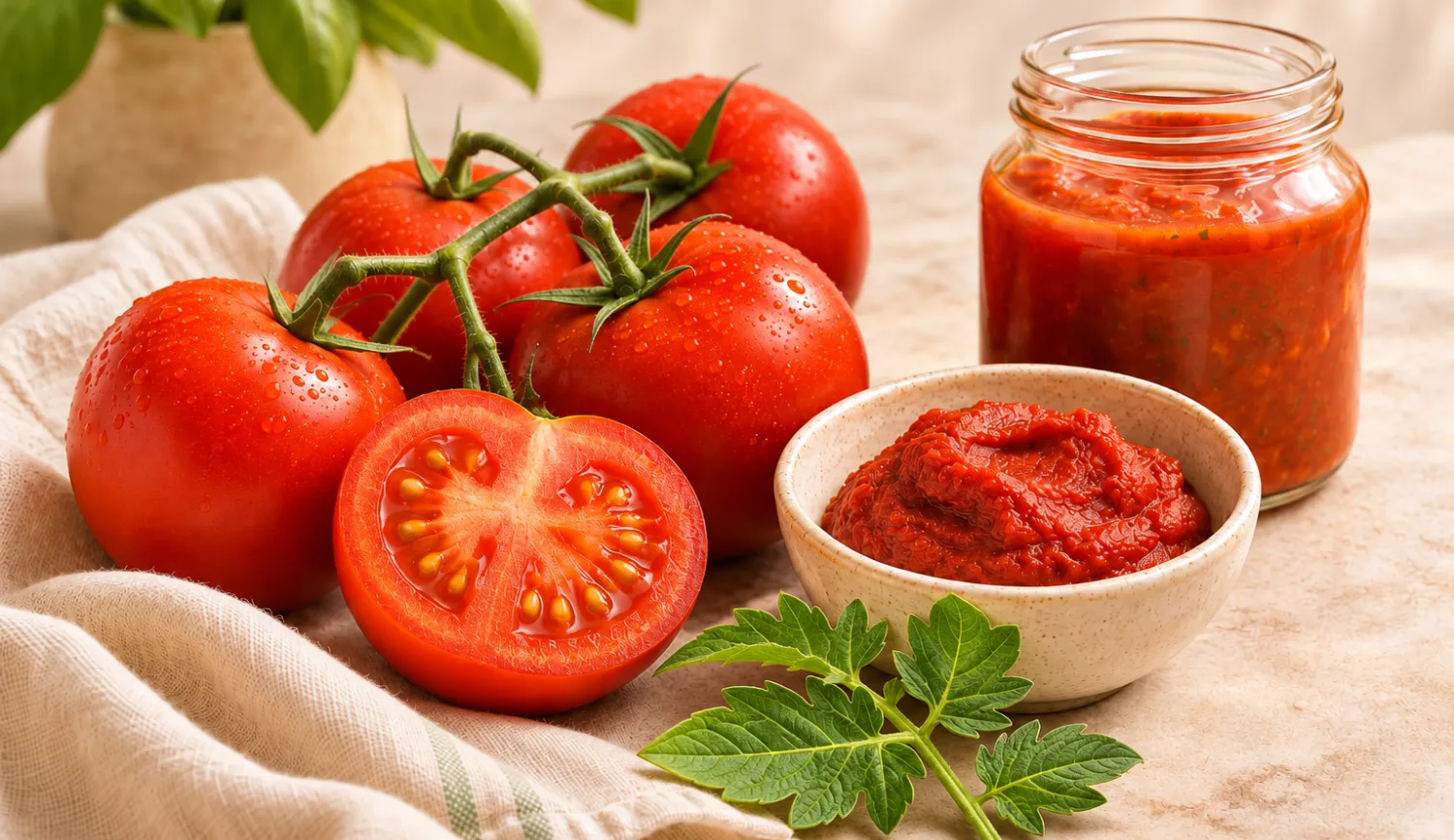
Tomatoes can contain measurable histamine, but the available measurements come from a limited set of samples. In one Greek analysis, five fresh tomatoes measured 0.82 to 1.40 mg/kg. Some concentrated pastes came out higher, while the ketchup and tomato juice weren’t consistently higher than the fresh tomatoes. Those are concentrations in particular products, not a ruling on what counts as “high,” a personal symptom threshold, or proof that tomatoes trigger reactions.
Cooking doesn’t reliably remove histamine, and the idea that tomatoes make the body release its own histamine lacks convincing human evidence.
What do direct tests actually show about tomato histamine?
They show that histamine was detected in the foods tested and that measured levels varied by product. The most useful numbers come from a small Greek market survey that measured histamine in vegetables and related products exactly as sold, using chromatography.
Here are its tomato results, in milligrams of histamine per kilogram of the food as sampled.
| Tomato product in the sampled dataset | Samples (n) | Histamine measured (mg/kg) |
|---|---|---|
| Fresh tomatoes | 5 | 0.82–1.40 |
| Tomato ketchup | 2 | 1.0–1.1 |
| Slightly concentrated tomato juice | 2 | 0.81–0.94 |
| Salsa Napoletana | 1 | 1.8 |
| Tomato paste | 2 | 2.7–4.8 |
| Double-concentrated tomato paste | 2 | 6.6–10.6 |
Read this table as a snapshot, not a reference range. Each product group has between one and five samples, and the figures describe the particular brands that were bought. They don’t describe tomatoes or tomato products everywhere. The measurements may be analytically precise, but such small sample groups cannot establish typical concentrations for these products.
The rows aren’t matched pairs either. Nobody tracked the same tomatoes from fresh to paste, so the table can’t tell you what processing itself does to histamine.
The survey’s own discussion talks about processed tomato products being richer in histamine, but its itemized numbers tell a narrower story. Ketchup, juice and the salsa sat roughly between 0.8 and 1.8 mg/kg, close to the fresh samples, and the salsa is a single sample. Only the concentrated pastes stood clearly higher. So the fair summary is that some concentrated pastes were higher in this dataset, not that processed tomato products always contain more.
One more practical point about the unit. A figure in mg/kg describes the food, not your plate. Serving size, brand and recipe influence how much histamine a meal may contain. These food measurements cannot establish a personal symptom threshold or a guaranteed safe serving.
Are fresh tomatoes high in histamine?
The five tested fresh tomatoes contained measurable histamine, but this dataset cannot place all fresh tomatoes into a validated high-or-low category. Fresh tomatoes measured 0.82 to 1.40 mg/kg, which means they aren’t histamine-free. It also doesn’t make them “high” in any validated sense, because no validated individual symptom threshold exists to compare against.
An older analytical paper, which developed a liquid chromatography and mass spectrometry method, also confirms that histamine can be measured in tomatoes and tomato paste. Its accessible record doesn’t give sample ranges worth quoting here, so it supports the idea that histamine is detectable and nothing more.
What about cherry, green, yellow, grape or riper tomatoes?
The studies supporting this guide do not provide directly comparable histamine measurements across tomato varieties, colors or ripeness stages. The Greek measurements cannot establish whether cherry, green, yellow, grape or riper tomatoes consistently differ in histamine content.
Does cooking destroy histamine in tomatoes?
No, and cooking shouldn’t be treated as a fix. Histamine that is already in food generally survives heat, so roasting, frying, boiling or simmering can’t be counted on to remove it.
What cooking can change is the concentration in a particular dish. Water evaporates and concentrates a sauce, other ingredients dilute it, and some may move into cooking liquid. A study of cooking methods across several foods didn’t include a controlled raw-versus-cooked tomato comparison, so there’s no evidence to rank roasted, boiled, raw or stewed tomatoes.
Are canned tomatoes, sauce, paste, ketchup, juice and sun-dried tomatoes different?
Only the categories in the table were tested, so only those can be compared. Concentrated pastes were higher, while ketchup, tomato juice and the single salsa sample sat close to the fresh tomatoes.
Everything else is unmeasured in this evidence: canned or tinned whole and chopped tomatoes, homemade sauce, sun-dried tomatoes, soups, jarred pasta sauces and leftovers.
Please don’t assume canned is worse or that sun-dried tomatoes are the highest, because nothing here shows either. A product label also lists ingredients, not histamine concentration, which is worth remembering when you use our low histamine grocery list to shop.
Storage deserves a quick word. The Greek paper includes small observations on selected products over five days, but that was not a food-safety study. Follow product storage instructions, refrigerate opened or prepared perishable tomato foods promptly, and avoid prolonged room-temperature storage. Refrigeration slows spoilage but doesn’t remove histamine that is already there, and our meal prep guide for histamine intolerance covers handling leftovers more broadly.
Why do low-histamine tomato lists disagree?
Because they’re built from different kinds of information. A review of ten low-histamine diet approaches found that they disagreed substantially about which foods to exclude, with fermented foods the only group they all excluded. Some lists lean on measured histamine, some on historical habit, some on reports of symptoms, and some on a food’s reputation as a “liberator.”
Measurements can also be misread. Two tomato studies reported total biogenic amines, which include compounds such as putrescine, and one found higher amine amounts in ketchup as a group. Those figures aren’t histamine, and mg/L of total amines can’t be compared with mg/kg of histamine. A review’s average for the whole vegetable category can’t be applied to tomatoes either.
Our high histamine foods page covers how these lists compare more generally.
Are tomatoes histamine liberators?
That’s a different claim from tomatoes containing histamine. A liberator is a food said to prompt the body to release its own histamine. Reviews of low-histamine diets find that this idea, applied to fruits and vegetables such as tomatoes, hasn’t been convincingly established by human clinical studies.
Lack of proof is not proof that it can’t happen, so the fair position is that the claim shouldn’t be presented as settled. Nothing here shows tomatoes are a proven mast cell trigger or that they block the enzyme DAO. Tomatoes are also acidic, and acidity can irritate a sensitive mouth or stomach, but that isn’t evidence of histamine release. Our histamine liberator foods page explains the wider debate.
What if eating tomatoes seems to cause symptoms?
A food containing histamine is one fact, and a person reacting to a meal is another. The other ingredients, irritant effects and true food allergy can all play a part, and one uncomfortable meal doesn’t diagnose histamine intolerance, mast cell activation syndrome or a tomato allergy.
If it keeps happening, it helps to jot down what the meal contained, how much you ate and how long afterward symptoms started. A clinician or dietitian can use that to look at the whole picture. Clinical guidance cautions against blanket food restriction and overconfident diagnosis, and cutting tomatoes out for life on a hunch can shrink your diet without answering the question.
Get urgent medical care for throat swelling, breathing difficulty or fainting. After a severe reaction, don’t try the food again at home to see what happens.
What can you use instead of tomatoes?
If you want something else in a sauce or stew, you can look at flavor and texture. Roasted carrots or butternut squash give sweetness and body, and fresh herbs, olive oil and garlic add depth. These are culinary swaps, not foods certified histamine-free or medically safe, and none of them was tested in the evidence above.
References
- Tsiasioti A, Tzanavaras PD. Simple and reliable determination of the histamine content of selected Greek vegetables and related products in the frame of “low histamine diet”. Foods. 2022;11(20):3234. doi:10.3390/foods11203234.
- Bolygo E, Cooper PA, Jessop KM, Moffatt F. Determination of histamine in tomatoes by liquid chromatography/mass spectrometry. J AOAC Int. 2000;83(3):543–548. doi:10.1093/jaoac/83.3.543.
- Sánchez-Pérez S, Comas-Basté O, Veciana-Nogués MT, Latorre-Moratalla ML, Vidal-Carou MC. Low-histamine diets: is the exclusion of foods justified by their histamine content?. Nutrients. 2021;13(5):1395. doi:10.3390/nu13051395.
- Chung BY, Park SY, Byun YS, Son JH, Choi YW, Cho YS, et al. Effect of different cooking methods on histamine levels in selected foods. Ann Dermatol. 2017;29(6):706–714. doi:10.5021/ad.2017.29.6.706.
- Reese I, Ballmer-Weber B, Beyer K, et al. Guideline on management of suspected adverse reactions to ingested histamine. Allergol Select. 2021;5:305–314. doi:10.5414/ALX02269E.
- Gil RL, Amorim CG, Montenegro MCBSM, Araújo AN. Determination of biogenic amines in tomato by ion-pair chromatography coupled to an amine-selective potentiometric detector. Electrochim Acta. 2021;378:138134. doi:10.1016/j.electacta.2021.138134.
- Chiacchierini E, Restuccia D, Vinci G. Evaluation of two different extraction methods for chromatographic determination of bioactive amines in tomato products. Talanta. 2006;69(3):548–555. doi:10.1016/j.talanta.2005.10.027.
- Comas-Basté O, Sánchez-Pérez S, Veciana-Nogués MT, Latorre-Moratalla ML, Vidal-Carou MC. Histamine intolerance: the current state of the art. Biomolecules. 2020;10(8):1181. doi:10.3390/biom10081181.