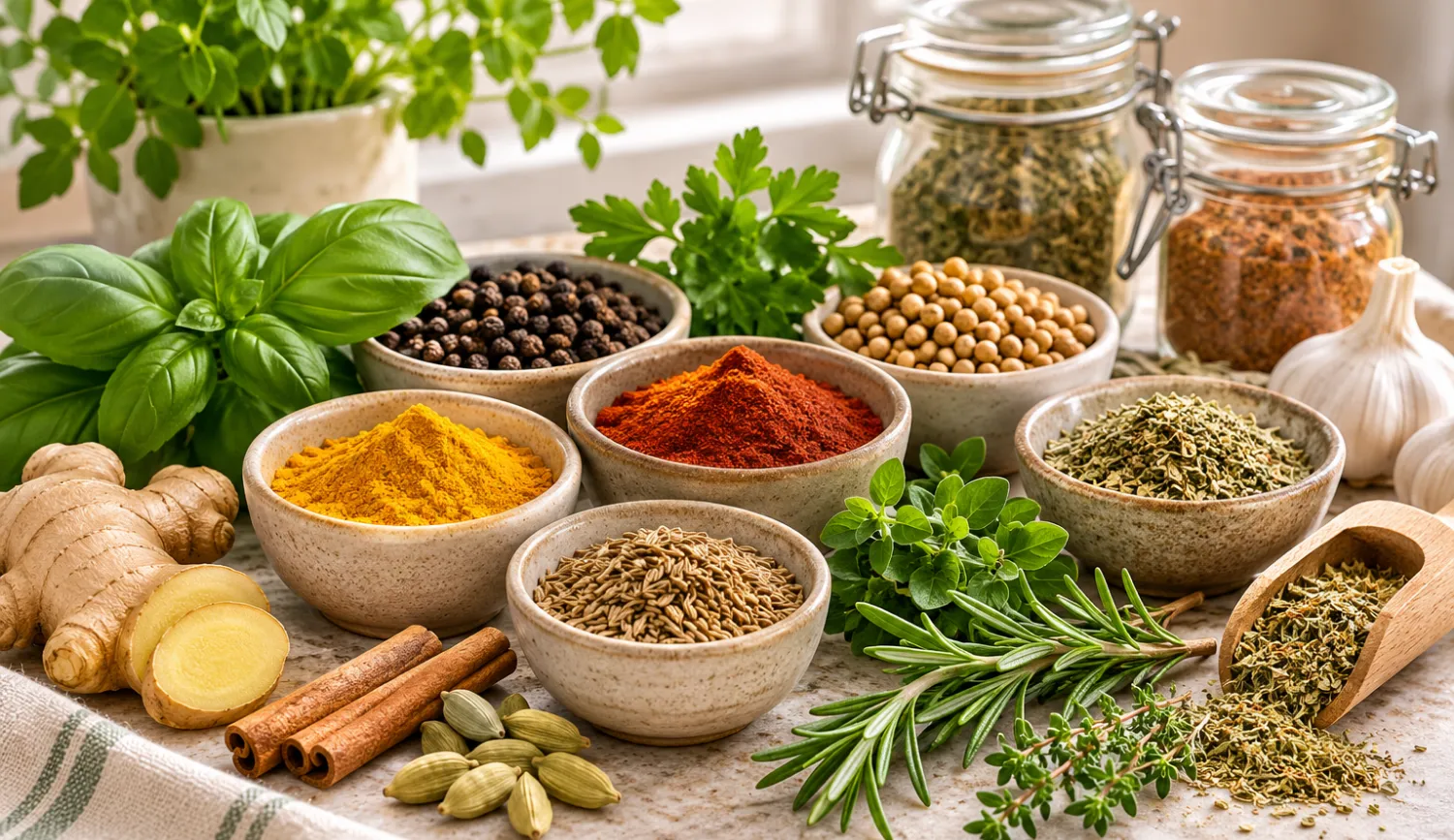
Many plain culinary herbs and spices can be practical flavoring options during a clinician-guided, individualized low-histamine trial. No universal spice list is clinically validated to predict which individual ingredients or products everyone can tolerate.
Food-analysis evidence for particular spices is thin: one review reports a small group of spice samples with no detectable histamine, which does not prove every spice or blend contains none.
Seasoning blends need their ingredient lists read, because formulations differ. Food sensitivity, allergy, irritant effects and measured histamine are separate things, and this guide treats them that way.
What counts as low histamine spices, herbs and seasonings?
In this guide, spices are dried seeds, roots, bark and fruit powders such as cumin, ginger or paprika. Culinary herbs are leafy ingredients such as parsley, basil or thyme, used fresh or dried. Seasonings include blends and rubs, whether store-bought or homemade.
“Low histamine” on a website is a label, not a lab result. It usually reflects a dietary list, and as our overview of the low histamine food list explains, such lists are built from mixed sources.
The one measurement worth knowing about is category-level. A 2020 review reproduced Spanish-market food data that included 12 samples grouped as “spices,” with histamine not detected. That does not tell us which spices were tested, how low the detection limit was, or whether those samples represent what is on your shelf.
“Not detected” also means the method found nothing above its limit, which is different from zero. It cannot be applied to cumin, cinnamon, paprika, turmeric, any herb, or any spice mix by name.
Which individual spices can you use?
For individual spices, the honest answer is that comparable measurements are scarce, so use depends on your own tolerance and your clinician’s advice. Different publishers describe cumin, cinnamon, paprika and chili differently, and this guide does not rank them.
What can be said is grouped by what each ingredient is and how it behaves in a kitchen:
- Turmeric and ginger: Roots used for color, warmth and depth in rice, soups, roasted vegetables and baking. No verified spice-specific histamine measurements were found for either.
- Cumin and coriander seed: Often used together in ground form for roasting and stews. They are also unmeasured here, and cumin appears in the laboratory extract studies described below, which are not food-exposure data.
- Cinnamon, cardamom and cloves: Sweet and aromatic spices for baking and warm dishes. Dietitian guidance on histamine intolerance may place cinnamon and cloves among spices to limit, but that is dietary advice and not a lab measurement of histamine in each spice.
- Paprika, chili and cayenne: Also unmeasured for histamine here. Chili contains capsaicin, an irritant that can cause flushing, burning or stomach upset on its own, which is easy to mistake for a histamine reaction.
- Black pepper: Likewise has no verified measurement in this evidence, though it is a common single-ingredient choice.
Check the label on paprika and chili products. “Hot paprika,” chili powder and some “paprika” blends may be mixes and not a single ground pepper. A plain, single-ingredient spice is a simpler test case than a blend, which is a point about control and not a claim that the spice is safe.
Spices are usually used in small amounts, but no validated serving size or personal threshold exists for any of them. A generous teaspoon in a stew and a pinch on rice are not the same exposure, so it helps to know roughly how much went into a dish if you later review a reaction.
Which fresh and dried herbs work in cooking?
Basil, parsley, rosemary, thyme, oregano, cilantro, dill and mint are all ordinary cooking herbs, and they season food without much else added. No matched fresh-versus-dried histamine ranking has been verified, so neither form can be called lower or higher.
In the kitchen the two groups behave differently. Woody herbs such as rosemary, thyme and oregano hold up to roasting and long cooking. Soft herbs such as parsley, basil, cilantro, dill and mint taste brightest when added near the end or used raw.
For quality, use fresh herbs soon after buying and keep dried herbs in a cool, dark place. That is normal kitchen advice. It is not a validated way to change histamine.
Cooking herbs are also different from herbal teas, concentrated extracts and supplements, which are taken for a different purpose and raise their own questions. This guide covers herbs as food, and not as remedies. Packaged herb pastes and jarred chopped herbs sometimes contain acids or preservatives, so they belong with the label-reading steps in the next section.
Are seasoning blends and spice mixes different?
Yes. A single-ingredient jar contains one thing. A mix can contain many, plus salt, sugar, anti-caking agents and flavorings, and the recipe can change between brands or batches.
A simple three-step check works for most products:
Step 1: Read the whole ingredient list, not just the name of the blend. A line that says only “spices” or “natural flavors” does not tell you which spices or flavorings are inside, and a manufacturer can be asked for details.
Step 2: Note any ingredient you have a reason to avoid, such as a known allergen or something your clinician has flagged. Look for acids, ferments and concentrated bases as well as the spices themselves.
Step 3: Check the brand’s formulation again before you rebuy, since it can change.
Vinegar powder, tomato powder, fermented ingredients, flavorings, and garlic or onion powder are worth noticing on a label. They are things to read, not blanket banned foods, and nobody has shown that each of them triggers histamine reactions. A reaction to a mix can also come from an allergen in it and not from any spice.
Homemade blends give you the most control, because you know every ingredient and its quantity. A basic rub of salt, black pepper, ground cumin and dried thyme is easy to make and easy to adjust. Our low histamine grocery list can help with wider shopping decisions.
How can you season chicken, vegetables, fish and baking?
These are ideas to adapt to your own tolerance and medical advice, not tested “zero histamine” recipes.
- Chicken: Olive oil, fresh parsley and thyme, and black pepper, rubbed on before roasting.
- Vegetables: Roasted carrots or zucchini with ground cumin and coriander seed, finished with chopped fresh parsley.
- Fish: Fresh dill and parsley with olive oil. Herbs do not change how fresh the fish is, and freshness and handling matter independently of any seasoning.
- Baking: Ginger or cardamom, or cinnamon if you tolerate it, with the rest of the recipe checked for its own ingredients.
Change one ingredient at a time when you adapt a dish, so a reaction is easier to trace. Our meal prep guide for histamine intolerance covers planning and storage for batch cooking.
Why do low-histamine spice lists disagree?
Lists disagree because they draw on different kinds of evidence. A 2021 review of ten dietary exclusion approaches found great variation between them, with only fermented foods excluded by all. Some lists lean on historical advice, some on measured food histamine, some on other biogenic amines, and some on reported experiences.
A German guideline on ingested histamine likewise discusses the limits of the evidence behind food-list-based restriction. A 2025 review of dietary management points to inconsistent restriction lists and the risk of unnecessary nutritional harm.
The table below lays out what each kind of evidence can and cannot establish.
| Evidence type | What it can tell you | What it cannot establish |
|---|---|---|
| Product-specific food assay | Histamine in that tested sample under the stated method | Other brands or lots, or anyone’s symptoms |
| Category-level dataset or review | Results for the tested category or reported samples | A safe or unsafe label for each named spice |
| Spice extracts tested against bacteria | Effects on microbial amine production in that model | Benefits or safety from eating culinary spices |
| Dietary list or professional guidance | A suggested framework for restriction | Measured concentrations or personal tolerance |
| Personal experience | What one person reported | Cause, diagnosis or a generalizable list |
An absence of evidence is not evidence of harm. Uncertainty about a spice is different from an established mechanism for it to cause problems.
Are herbs and spices histamine liberators or natural antihistamines?
Those are two different claims, and neither is supported by the evidence here. A “liberator” is a food said to prompt the body to release its own histamine. The 2021 review found that this mechanism has not been elucidated and that no clinical studies in humans support it for foods in general, though that also does not prove liberators cannot exist.
Claims that herbs or spices act as “natural antihistamines” involve several different hypotheses, including effects on histamine signaling or immune cells. The studies cited here test a narrower question: whether concentrated spice extracts alter microbial biogenic-amine production under laboratory or food-storage conditions.
In a 2024 experiment, extracts of sumac, cumin, black pepper and red pepper were tested against bacteria in broth, and a 2026 study did something similar with supercritical CO2 extracts of oregano, cumin, black pepper and red pepper. Those are in-vitro models. An older fish-storage experiment found some spices reduced bacterial histamine formation in mackerel, which concerns spoilage microbes and not what happens when you eat the spice.
None of this shows that eating normal culinary amounts of a spice lowers histamine, supports DAO or calms mast cells. Our page on natural antihistamines covers the broader evidence for supplements and remedies.
What if you react after a meal with spices?
A whole meal has many moving parts: the amount of spice, the other ingredients, allergies, irritants such as capsaicin, medicines, illness and how much you ate. One reaction is not a diagnosis, and a burning mouth or upset stomach after a hot dish does not prove histamine intolerance or mast cell activation syndrome.
If something keeps recurring, a short written record helps a professional more than an ever-longer avoid list. Note the dish, the seasonings and their rough amounts, the timing of symptoms, and any medicine or illness at the time. A targeted food history with a clinician can then separate a pattern from a one-off event.
Seek emergency care for throat swelling, trouble breathing or fainting, and do not test the food again at home after a severe reaction.
Common questions
Is turmeric low histamine?
There is no verified turmeric-specific histamine measurement in this evidence, so it cannot be labeled low or high. Whether you tolerate it is an individual question.
Is cinnamon high in histamine?
No spice-specific measurement supports that label. Some dietary guidance places cinnamon among items to limit, which is advice and not an assay.
Is paprika low histamine?
The same applies. Paprika has no verified measurement here, and any burning or flushing may come from capsicum compounds and not histamine.
Are dried herbs low histamine?
No matched testing shows dried herbs are lower or higher than fresh ones.
Can a store-bought seasoning blend be low histamine?
A label cannot confirm histamine concentration. It can show listed ingredients, including known allergens and ingredients you have reason to avoid, although a line reading “spices” or “flavorings” may group several ingredients together. Specific histamine content usually is not tested or disclosed, so whether a blend suits your diet is an individual question.
Bottom line
Plain single-ingredient herbs and spices are reasonable starting points for seasoning, as long as you treat that as a practical choice and not a proven safe list. Read blend labels, introduce changes one at a time with your clinician’s guidance, and avoid cutting out more than you need to.
References
- Comas-Basté O, Sánchez-Pérez S, Veciana-Nogués MT, Latorre-Moratalla M, Vidal-Carou MC. Histamine intolerance: the current state of the art. Biomolecules. 2020;10(8):1181. doi:10.3390/biom10081181.
- Sánchez-Pérez S, Comas-Basté O, Veciana-Nogués MT, Latorre-Moratalla ML, Vidal-Carou MC. Low-histamine diets: is the exclusion of foods justified by their histamine content? Nutrients. 2021;13(5):1395. doi:10.3390/nu13051395. PMID:33919293.
- Academy of Nutrition and Dietetics. Histamine intolerance. Practice Trends.
- Jackson K, Busse W, Gálvez-Martín P, Terradillos A, Martínez-Puig D. Evidence for dietary management of histamine intolerance. Int J Mol Sci. 2025;26(18):9198. doi:10.3390/ijms26189198.
- Kuley F, Rathod NB, Kuley E, Yilmaz MT, Ozogul F. Inhibition of food-borne pathogen growth and biogenic amine synthesis by spice extracts. Foods. 2024;13(3):364. doi:10.3390/foods13030364.
- Al Bayati MHM, Cengiz MF, Bouali M, Yerlikaya P. Inhibition of biogenic amine production in tyrosine decarboxylase broth using supercritical CO2 extracts of oregano, cumin, black pepper, and red pepper. Food Sci Nutr. 2026;14(7):e72085. doi:10.1002/fsn3.72085.
- Shakila RJ, Vasundhara TS, Rao DV. Inhibitory effect of spices on in vitro histamine production and histidine decarboxylase activity of Morganella morganii and on the biogenic amine formation in mackerel stored at 30°C. Z Lebensm Unters Forch. 1996;203(1):71–76. doi:10.1007/BF01267773.
- Reese I, et al. German guideline for the management of adverse reactions to ingested histamine. Allergo J Int. 2017;26:72–79. doi:10.1007/s40629-017-0011-5.