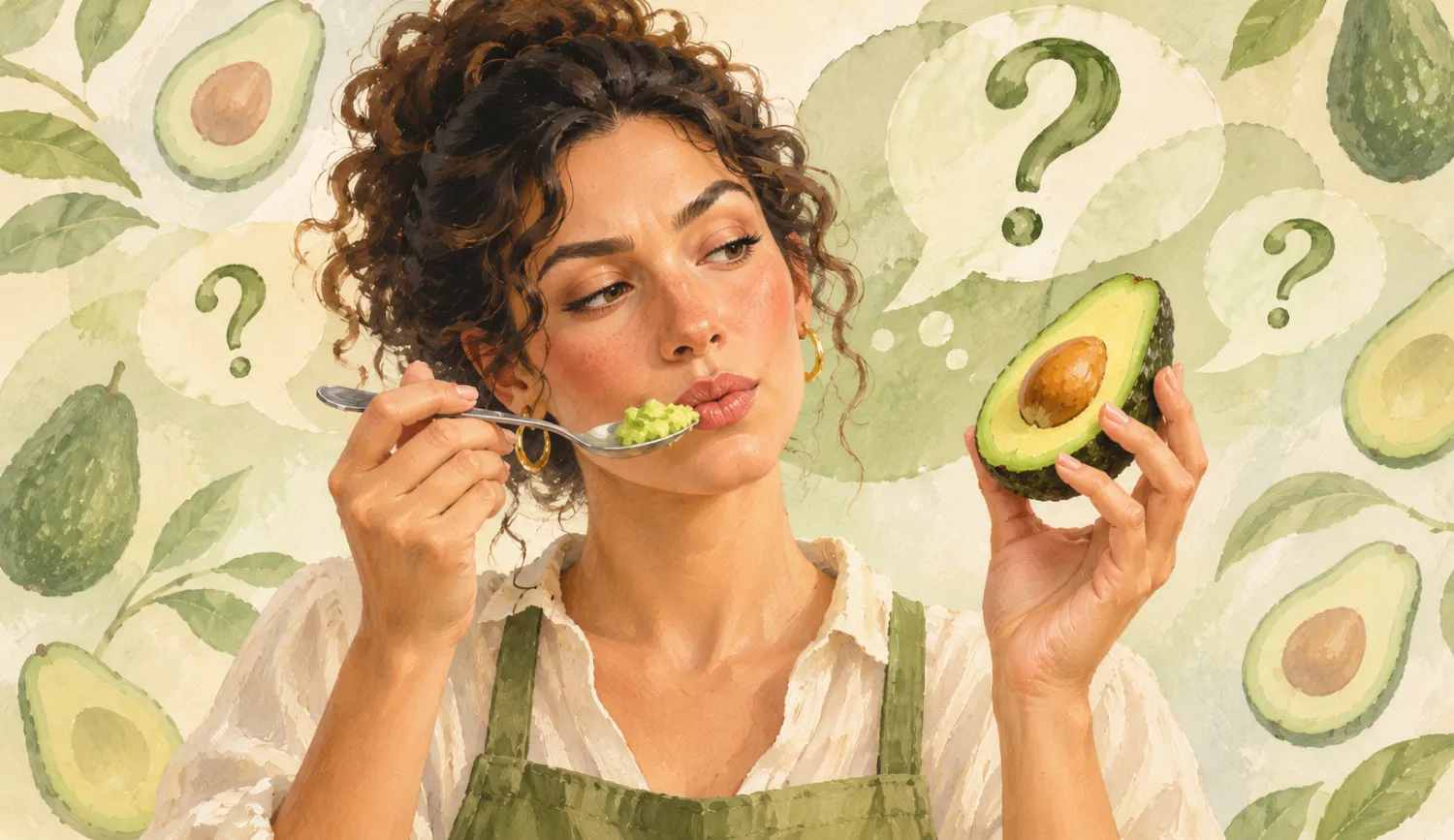
Avocado has not been shown to be consistently high in histamine. In a small analysis of five avocado samples, histamine was not detected. A separate older report listed a higher concentration, but the available details were too limited to establish how representative that result was. These findings cannot predict the histamine content of every avocado or explain why an individual reacts to it.
That distinction matters because food lists, laboratory measurements and personal reactions are three different kinds of information. A reaction after eating avocado may require looking beyond histamine, especially when allergy-type symptoms are involved.
What do food studies show about avocado histamine levels?
The direct measurements are limited. Histamine was not detected in five avocado samples obtained from the Spanish market. “Not detected” describes the result of that test; it does not mean every avocado contains zero histamine.
A separate historical source reported 23 milligrams of histamine per kilogram of avocado. However, important details about the sampled fruit and testing conditions were not available in the later review. That figure cannot be treated as a typical concentration, a guaranteed maximum or a dose likely to cause symptoms.
The same five-sample measurements appear in two scientific publications by the research group. They are not ten independently tested avocados. The evidence remains too limited to establish a dependable histamine range for the fruit sold worldwide.
Why do low-histamine food lists disagree?
A place on a restricted-food list does not necessarily mean laboratory testing found high histamine. Some lists draw on food measurements; others incorporate clinical tradition, reported reactions and theories about substances that might affect histamine handling.
Avocado illustrates the problem. Its disputed reputation cannot be settled by counting how many lists say “avoid” or “safe.” The more useful question is which claim is based on a measured food sample, and which is only a proposed explanation for symptoms?
For wider food categories, see our low histamine food list and high histamine foods guide. Those guides provide context; they cannot assign a measured histamine value to an individual avocado.
Does avocado release histamine in the body?
There is no convincing avocado-specific human evidence establishing that eating avocado causes mast cells to release histamine. The familiar label “histamine liberator” is not a demonstrated mechanism for this food.
That does not dismiss a person’s symptoms. It means the symptoms cannot, by themselves, confirm the explanation being offered. Our histamine-liberator foods guide explains why this distinction matters across commonly restricted foods.
What about tyramine and other biogenic amines?
Histamine is only one of several naturally occurring amines researchers can measure in foods. The five avocado samples contained some tyramine and other polyamines, while two other amines were not detected.
| Compound | Finding in the five avocado samples | What it tells us |
|---|---|---|
| Histamine | Not detected | No detectable histamine in these samples, not a universal zero |
| Tyramine | Mean 1.81 mg/kg; range 0.58–5.44 mg/kg | Present, but its role in avocado-related symptoms is unproven |
| Putrescine and cadaverine | Not detected | Not detected in this small sample set |
| Spermidine | Mean 3.15 mg/kg | Measured food chemistry, not a clinical tolerance threshold |
| Spermine | Mean 4.50 mg/kg | Measured food chemistry, not proof of a reaction |
A measured compound is not the same thing as a proven trigger. These avocado results do not demonstrate that the amounts present interfere with diamine oxidase (DAO) enough to cause symptoms after an ordinary meal.
Does ripeness change avocado’s histamine content?
There is no established avocado-specific rule that ripe or brown fruit contains more histamine than firm fruit. Ripening changes the fruit’s chemistry and texture, but the available research does not establish a dependable histamine pattern across ripeness stages.
Choose avocados that are sound and properly handled for normal food-quality and safety reasons. Do not assume a firm avocado is proven “low histamine,” or that a ripe avocado is proven “high histamine.” Mixed dishes such as guacamole also introduce other ingredients and handling variables; they are not equivalent to a laboratory measurement of plain avocado.
Could a reaction to avocado be an allergy?
Yes. Avocado allergy is a distinct medical possibility, including cross-reactivity in individuals sensitized to natural rubber latex. Not everyone with latex allergy reacts to avocado, and not every symptom after avocado is allergic, but the distinction deserves attention.
Mouth itching, hives or swelling after eating avocado merit clinical assessment. Throat swelling, difficulty breathing, faintness or symptoms affecting more than one body system can indicate a serious allergic reaction and require emergency care. Do not try avocado again at home after a suspected serious reaction.
Neither a reaction to avocado nor improvement after an antihistamine establishes histamine intolerance, DAO deficiency or mast cell activation syndrome. Antihistamines can also reduce symptoms of ordinary allergic reactions.
Is avocado oil low in histamine?
There is not enough directly applicable measurement evidence to classify avocado oil as histamine-free or reliably safer for someone who reacts to the fruit. Available avocado-oil studies primarily address oil composition and quality, not validated histamine concentrations or clinical tolerance.
Whole avocado and its oil are different food products. A conclusion about one should not automatically be transferred to the other.
What should you do if avocado seems to trigger symptoms?
Avoid turning one experience into a diagnosis or a permanent rule for everyone. If symptoms recur, note what you ate, whether it was plain avocado or a mixed dish, the timing, and what happened. That information can help a qualified clinician consider allergy and other explanations.
Do not deliberately re-test avocado at home if you have experienced immediate swelling, breathing symptoms, widespread hives or another potentially serious allergic reaction. For broader context about symptoms often attributed to histamine intolerance, see our histamine intolerance symptoms guide.
The useful conclusion is narrow but important: laboratory results do not justify a universal avocado ban or a universal safety guarantee. The right explanation for an individual reaction cannot be determined from a high-histamine food list alone.
References
- Sánchez-Pérez S, Comas-Basté O, Rabell-González J, Veciana-Nogués MT, Latorre-Moratalla ML, Vidal-Carou MC. Biogenic amines in plant-origin foods: are they frequently underestimated in low-histamine diets? Foods. 2018;7(12):205. doi:10.3390/foods7120205.
- Sánchez-Pérez S, Comas-Basté O, Veciana-Nogués MT, Latorre-Moratalla ML, Vidal-Carou MC. Low-histamine diets: is the exclusion of foods justified by their histamine content? Nutrients. 2021;13(5):1395. doi:10.3390/nu13051395.
- Comas-Basté O, Sánchez-Pérez S, Veciana-Nogués MT, Latorre-Moratalla ML, Vidal-Carou MC. Histamine intolerance: the current state of the art. Biomolecules. 2020;10(8):1181. doi:10.3390/biom10081181.
- Reese I, Ballmer-Weber B, Beyer K, et al. German guideline for the management of adverse reactions to ingested histamine. Allergo J Int. 2017;26(2):72–79. doi:10.1007/s40629-017-0011-5.
- American Academy of Allergy, Asthma & Immunology. Histamine intolerance: fact or fiction? Published August 28, 2023.
- American Academy of Allergy, Asthma & Immunology. Latex allergy.
- American College of Allergy, Asthma & Immunology. Latex allergy.
- Ahlroth M, Alenius H, Turjanmaa K, Mäkinen-Kiljunen S, Reunala T, Palosuo T. Cross-reacting allergens in natural rubber latex and avocado. J Allergy Clin Immunol. 1995;96(2):167–173. doi:10.1016/S0091-6749(95)70004-8.
- Xin Y, Li N, Zhu HT, et al. Widely targeted metabolomics analysis reveals dynamic changes in metabolites of ‘Hass’ avocado during postharvest ripening period. Food Chem. 2025;471:142844. doi:10.1016/j.foodchem.2025.142844.
- Wang M, Yu P, Chittiboyina AG, et al. Characterization, quantification and quality assessment of avocado (Persea americana Mill.) oils. Molecules. 2020;25(6):1453. doi:10.3390/molecules25061453.