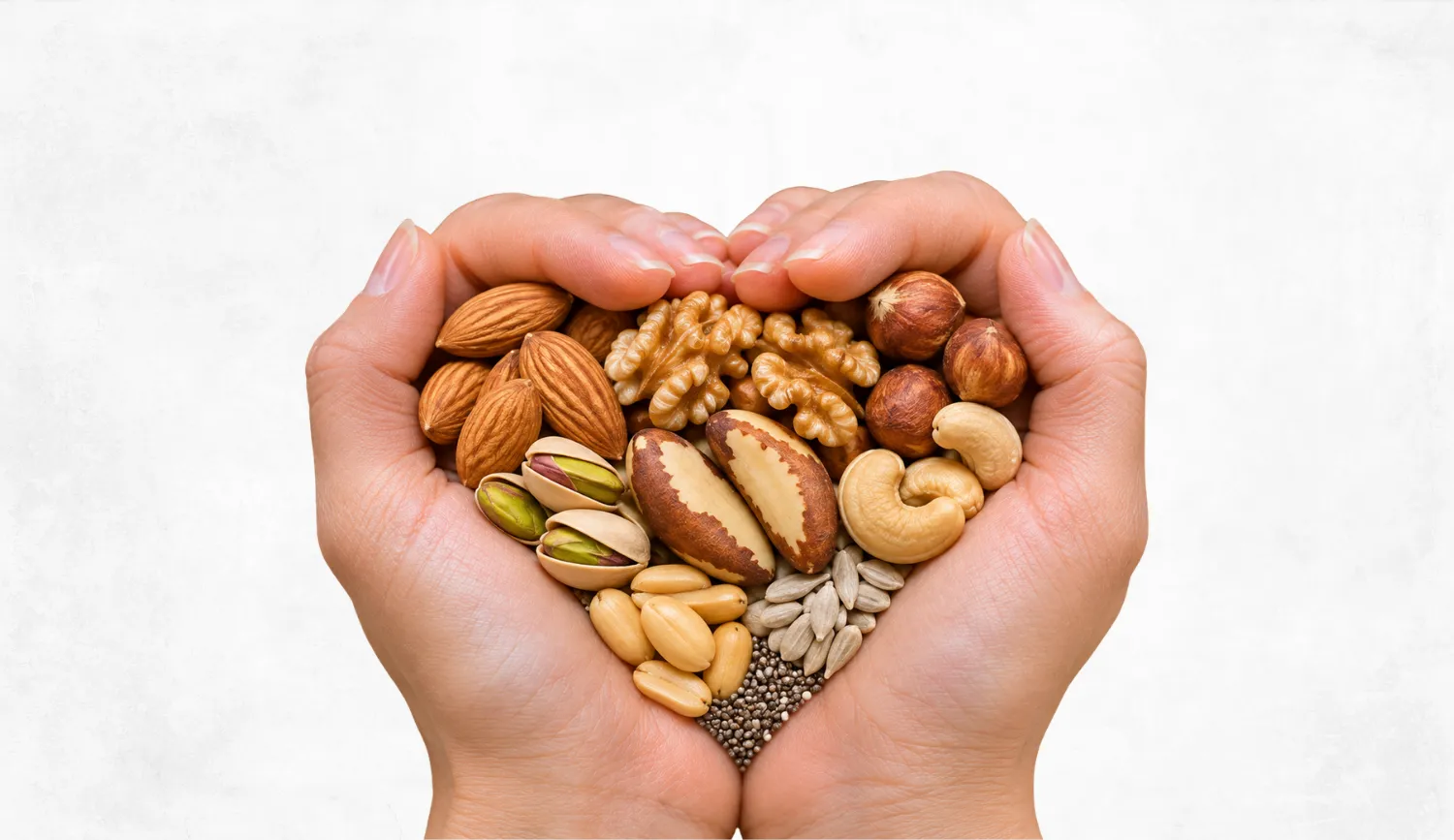
Histamine was not detected in limited tested samples of several nuts and seeds, including almonds, hazelnuts and pistachios. That doesn’t prove any product is free of it. Published nut-category datasets don’t agree with each other, and results from different studies can’t be merged into a universal ranking.
A sample’s result is also not an allergy or symptom threshold for you. Food-list ratings and other amines, such as putrescine, shouldn’t be mistaken for measured histamine.
Which nuts and seeds are actually low in histamine?
Many food lists classify particular nuts and seeds as “low histamine,” but laboratory results support only narrower conclusions. Histamine was not detected in small groups of certain nuts and seeds. For others, comparable individual measurements were not verified in the research considered here.
A non-detect result can help interpret a food choice, but it cannot certify that food as safe. A laboratory analysis describes the samples tested, while a compatibility rating reflects a practical classification. Neither predicts an individual’s response.
What have laboratory tests measured in nuts and seeds?
Mostly small numbers of samples with nothing detected, which is useful but narrow. The table sets out what was measured, and just as importantly what each result can’t tell you.
| Nut or seed | What was actually measured | What the result cannot establish |
|---|---|---|
| Almonds | Histamine not detected in 7 samples (Spanish market analysis, 2018). A 2025 Brazilian literature review also cites older almond data: 3 samples, not detected. | Zero histamine in all almonds, or anyone's tolerance. |
| Chestnuts | Not detected in 2 samples. | A reliable species-wide level or personal tolerance from just two samples. |
| Hazelnuts | Histamine not detected in 9 samples. Other amines were detected. | That all hazelnuts lack histamine or that detected other amines predict reactions. |
| Pistachios | Histamine not detected in 7 samples. Putrescine averaged 14.84 mg/kg in the same set. | Clinical DAO inhibition, a high-histamine classification or a symptom threshold from putrescine levels. |
| Brazil nuts and cashews | Not detected in 3 samples each, as cited from older (2015) data in the 2025 review. | That the 2025 review performed new assays or that results apply to all products. |
| Roasted peanuts | Not detected in 5 samples, as cited in the same review. | Results for raw peanuts or peanut butter. Peanuts are botanically legumes, though often sold with nuts. |
| Sunflower seeds | Not detected in 2 samples. | A representative estimate for all sunflower seed products. |
| Chia seeds | Not detected in one experimental study, in unfermented controls and two 24-hour fermentation conditions. Three analytical replicates per condition, not three brands. | Market-wide results, or that fermentation lowers histamine. Other amines were measured separately and are not histamine. |
| Pumpkin seeds | Putrescine, spermidine and spermine were measured in a genotype analysis. Histamine was not. | Any seed-specific histamine concentration. A food-list score doesn't fill that gap. |
| Macadamias, pecans, walnuts, pine nuts, flax, hemp, sesame and tahini, poppy seeds, nut and seed butters and milks | Comparable individual histamine assays were not verified in the sources behind this article. | That no such study exists anywhere. "Not measured" is different from "not detected." |
“Not detected” means an assay found nothing under its stated conditions and sensitivity. It isn’t confirmed zero. Small sample counts can’t describe a whole market, and numbers from different studies can’t be combined into a serving threshold or a “lowest histamine nuts” ordering.
Two reviews also report grouped “nuts” categories that don’t line up. One lists 41 samples with a mean of 0.45 mg/kg, a maximum of 11.86 mg/kg and a median not detected. The other lists 47 samples with histamine not detected.
The underlying datasets and assays weren’t reconciled, so the two can’t be averaged, and neither can be said to override the other. The 11.86 mg/kg maximum also can’t be pinned on any named nut, and group figures shouldn’t be read as if they were species-level rankings.
Which popular nuts have limited or conflicting evidence?
Almonds, hazelnuts, pistachios, cashews and Brazil nuts all have “not detected” results, but from very few samples, and some from older data. That makes them reasonable to consider, not proven safe. The hazelnut and pistachio rows also come with other amines detected, which is a separate question from histamine.
Macadamias, pecans and walnuts sit in a different spot. Lists may rate them one way or another, but no comparable individual histamine tests for them were verified here. Treat compatibility ratings for these foods as opinions about use, not as measured histamine concentrations.
What do tests show for sunflower, chia, flax, sesame and pumpkin seeds?
Sunflower seeds had histamine not detected in two samples, and chia seeds in an experiment with three analytical replicates per condition. Both are narrow results, and neither is a survey of what’s on shelves.
Flax, hemp, sesame, tahini and poppy seeds have no verified individual histamine assay in this evidence. Pumpkin seeds were measured for other polyamines but not histamine, and our pumpkin seeds histamine article covers them in detail.
Why do low-histamine nuts and seeds lists disagree?
Because they rely on different evidence and assumptions. A review of ten low-histamine diet approaches found substantial disagreement over which foods to exclude. Some lists weigh measured histamine, some weigh other amines, some reflect reported symptoms, and some follow tradition.
Compatibility lists such as the Swiss SIGHI list express tolerability judgments, not assay results. A rating of 0 or 1 on that list is not 0 or 1 mg/kg. Two lists can also rate the same nut differently even when tested samples showed nothing detected. That doesn’t make lists useless, but a list rating and a lab number answer different questions. Our low histamine food list explains how we treat that gap.
Are putrescine and spermidine the same as histamine?
No. Histamine is one specific compound. Putrescine and cadaverine are diamines, spermidine and spermine are polyamines, and tyramine and tryptamine are separate compounds again. Histidine is an amino acid and a biochemical precursor of histamine. Its presence in a food is not a measurement of that food’s histamine content.
Finding putrescine in pistachios, or tryptamine and spermidine in chia, cannot substitute for measuring histamine itself. Some biochemical discussion suggests other amines could compete with histamine for the same breakdown enzymes, including DAO. That is a hypothesis, and the limited experimental evidence doesn’t show that a typical serving of pistachios, chia or other nuts and seeds blocks DAO or raises histamine in a person. Those laboratory findings do not establish a validated clinical threshold for nut or seed servings.
Do nuts and seeds act as histamine liberators or block DAO?
Not in any way that human evidence has established. A 2021 guideline on ingested histamine questions the clinical validity of the “histamine liberator” idea, and no convincing human studies show that ordinary named nuts and seeds work as a universal non-allergic liberator group. “Not established” doesn’t mean “impossible,” so the claim shouldn’t be treated as settled either way. Our histamine liberator foods page covers the wider debate.
Allergy is a different matter. An IgE-mediated allergy to a nut or seed can activate mast cells and cause serious reactions, and that is a well-recognized mechanism, unlike the liberator claim.
Does roasting, soaking, sprouting or making butter change histamine?
The evidence reviewed here does not establish a consistent effect. Directly comparable before-and-after measurements for common preparation methods across commercial nuts and seeds were not verified, so it would be wrong to claim that roasting always destroys or creates histamine, soaking removes it, sprouting raises it, or raw products are automatically safer.
The chia experiment showed histamine not detected in every condition tested, which is not the same as fermentation removing it.
Nut and seed butters, milks and crackers add their own ingredients and allergen exposures. A label identifies declared ingredients and allergens but does not quantify histamine. A short ingredient list, organic certification, freshness or refrigeration cannot guarantee a particular histamine level, so this article offers no brand rankings or “safest products” list.
What if nuts or seeds cause symptoms?
First, separate allergy from everything else. Peanuts, tree nuts and sesame are major allergens, and swelling of the lips, tongue or throat, difficulty breathing, fainting, or several body systems reacting quickly all need urgent medical care. After any serious reaction, get an allergy assessment and don’t test the food again yourself.
Milder or slower symptoms have many possible explanations, including other ingredients, digestive conditions and individual sensitivities. None of those proves that food histamine was the cause. A food diary can give a clinician or dietitian useful context, but it can’t diagnose a food allergy, histamine intolerance or mast cell activation syndrome.
How should you use this information?
Treat the test results as a reason to be curious and not as a safety stamp. If you regularly tolerate a nut or seed and have no medical reason to avoid it, a conflicting color-coded list alone may not justify removing it.
If reactions keep happening, a clinician or dietitian can help you avoid cutting out more than you need to while still looking at the whole picture. For shopping decisions beyond nuts and seeds, our low histamine grocery list is a practical next step.
References
- Sánchez-Pérez S, et al. Biogenic amines in plant-origin foods: are they frequently underestimated in low-histamine diets? Foods. 2018;7(12):205. doi:10.3390/foods7120205.
- Comas-Basté O, Sánchez-Pérez S, Veciana-Nogués MT, Latorre-Moratalla M, Vidal-Carou MC. Histamine intolerance: the current state of the art. Biomolecules. 2020;10(8):1181. doi:10.3390/biom10081181.
- Sánchez-Pérez S, Comas-Basté O, Veciana-Nogués MT, Latorre-Moratalla ML, Vidal-Carou MC. Low-histamine diets: is the exclusion of foods justified by their histamine content? Nutrients. 2021;13(5):1395. doi:10.3390/nu13051395.
- Gloria MBA, et al. Histamine in Brazilian foods: a comprehensive review of occurrence and risk assessment for intoxication and intolerance. Food Sci Nutr. 2025;13(11):e71151. doi:10.1002/fsn3.71151.
- Bartkiene E, et al. Changes in the physicochemical properties of chia (Salvia hispanica L.) seeds during solid-state and submerged fermentation and their influence on wheat bread quality and sensory profile. Foods. 2023;12(11):2093. doi:10.3390/foods12112093.
- Charaya A, et al. Evaluation of biochemical composition of hulled and hull-less genotypes of pumpkin seeds grown in subtropical India. Heliyon. 2023;9(1):e12995. doi:10.1016/j.heliyon.2023.e12995.
- Reese I, et al. Guideline on management of suspected adverse reactions to ingested histamine. Allergol Select. 2021;5:305–314. doi:10.5414/ALX02269E.
- U.S. Food and Drug Administration. Food allergies.
- American Academy of Allergy, Asthma & Immunology. Anaphylaxis.
- Swiss Interest Group Histamine Intolerance (SIGHI). Food compatibility list. 2024 Aug 29.