
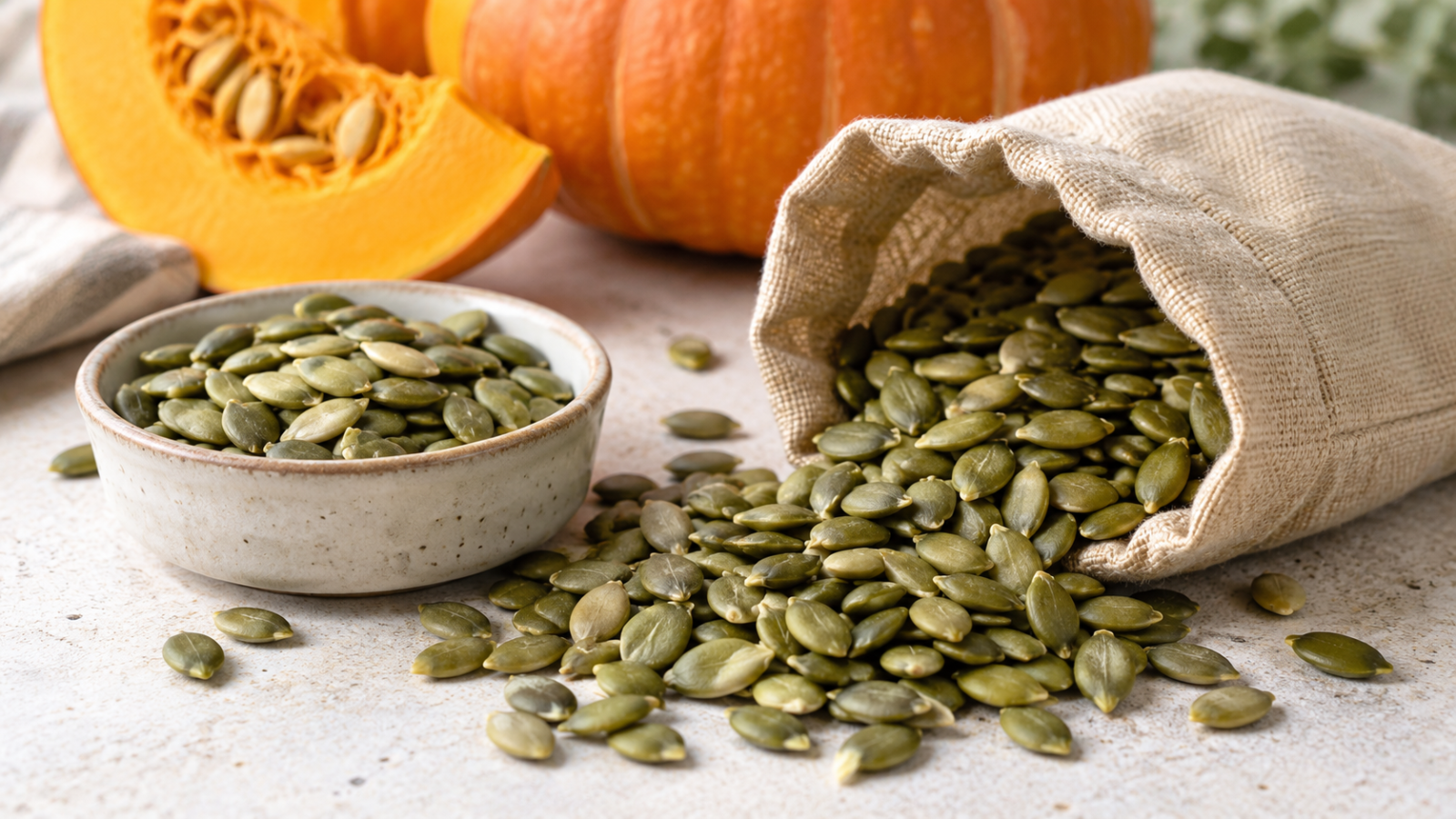
Pumpkin seeds are generally considered compatible with a low-histamine diet, and SIGHI currently rates plain pumpkin seeds in its most compatible category. But that rating is a practical tolerance classification, not a laboratory result showing zero histamine.
In the research reviewed for this article, we did not verify a direct seed-specific histamine measurement. Pumpkin seeds also contain other polyamines such as spermidine, putrescine and spermine, whose clinical significance for histamine intolerance remains uncertain.
Are pumpkin seeds low or high in histamine?
Based on current guidance, they are more likely to be a reasonable choice than a problem food. The SIGHI food list (document dated 29 August 2024) rates pumpkin seeds 0 A, meaning compatible with no symptoms expected at usual intake. It notes that the seeds contain substantial spermidine but are nevertheless tolerated in usual quantities.
The limits of that rating matter. SIGHI states that its histamine column does not show measured histamine content. It reflects perceived compatibility, and it applies to pure ingredients without additives.
That is why we say the conclusion rests more on practical guidance than on laboratory data. We did not verify a direct seed-specific histamine measurement in the literature reviewed for this article. So pumpkin seeds should not be called “histamine-free,” and no universal histamine number applies to them.
Food histamine varies widely in general, as the 2021 clinical guideline by Reese and colleagues points out. The same guideline stresses limited and contradictory evidence around ingested histamine, and it advises against unnecessary blanket dietary restriction.
What pumpkin seeds actually contain: spermidine, putrescine and spermine
Pumpkin seeds contain polyamines, which are other biogenic amines. In a 2023 analysis of two pumpkin-seed genotypes grown in India, Charaya and colleagues measured spermidine at 10.4 mg per 100 g in hulled seeds and 7.9 mg per 100 g in hull-less seeds. Putrescine was 5.6 versus 3.2 mg per 100 g, and spermine 3.2 versus 1.8 mg per 100 g. Total measured polyamines were 19.2 versus 12.9 mg per 100 g.
These are not histamine values. They also come from two genotypes, so they should not be generalized to every commercial product.
Spermidine is not the same thing as histamine. The presence of other polyamines does not prove that pumpkin seeds are high in histamine. Whether those compounds matter for histamine intolerance at usual servings is uncertain, and the 2021 review by Sánchez-Pérez and colleagues says the role of other biogenic amines remains incompletely established.
You may also see the argument that a protein-rich seed must be high in histamine because it contains histidine. It does not follow. Histidine is an amino acid, not histamine. Histamine can be generated from histidine by microbial decarboxylation under suitable conditions, but the presence of histidine alone does not tell us how much histamine a food contains.
Are pumpkin seeds histamine liberators?
No reliable human evidence establishes pumpkin seeds as a histamine liberator. The 2021 guideline by Reese and colleagues finds no reliable evidence for food histamine liberators or their clinical significance, and Sánchez-Pérez and colleagues found no human clinical evidence validating the liberator mechanism.
That does not prove liberators are impossible, only that the idea is unproven. We keep the debate brief here. Our guide to histamine liberator foods covers the broader evidence and theory.
Raw vs roasted vs sprouted pumpkin seeds
There is no categorical winner. Roasting and sprouting do change seed chemistry, but the studies we reviewed did not measure histamine.
A 2017 study by Raczyk and colleagues showed that roasting pumpkin seeds changes the composition and oxidative stability of cold-pressed oils. A 2022 study by Liang and colleagues showed that germination changes seed chemistry, specifically γ-aminobutyric acid. Histamine was not an endpoint in either study.
So these papers cannot tell us that roasting or sprouting raises or lowers histamine in the seeds. Raw is not always lower than roasted, and roasted is not worse. If you notice that you tolerate one form better than another, that is your own observation, and a single reaction does not establish histamine intolerance.
How to choose a pumpkin-seed product
If you decide to buy, the useful questions are about transparency. A good starting point is a short ingredient list, ideally just pumpkin seeds, with salt if you want it.
A few criteria help:
- Plain or flavored: Flavored products add ingredients, and SIGHI’s rating covers pure ingredients without additives.
- Added oils and seasonings: Check whether oil, sugar, spices or sauces are included.
- Package size relative to usage: A large bag only suits you if you will use it, and storage instructions matter once opened.
- Storage instructions: Follow the manufacturer’s directions on the pack.
- Certifications and testing: Consider them only if they matter to you.
- Allergen facility statements: These matter for allergic individuals.
Organic certification does not mean lower histamine. It may matter to you for other reasons, but it is not a histamine criterion.
Best simple-ingredient pumpkin seed options
The table below is a purchasing comparison, not a medical safety ranking. We did not verify product-specific histamine testing for any of these products, and this comparison does not treat any of them as safe for MCAS or histamine intolerance.
Packaging claims such as gas-flushing and third-party contaminant testing do not show that a product is lower in histamine. Product details were checked in October 2026 and can change, so verify the current label and price before purchasing.
Affiliate disclosure: As an Amazon Associate, Nourishly earns from qualifying purchases. Product links below are affiliate links, which means we may receive a small commission at no extra cost to you.
| Product | Format | Ingredients | Best for | Label / storage note |
|---|---|---|---|---|
| NOW Real Food Organic Pumpkin Seeds, Raw & Unsalted↗ | Raw, unsalted | Organic raw pumpkin seeds; no added oils | Best simple raw organic option | Refrigeration recommended after opening; gas-flushed packaging; peanut-free facility that processes tree nuts |
| Terrasoul Superfoods Organic Pumpkin Seeds↗ | Raw, unsalted | Organic pumpkin seeds (Cucurbita pepo) | Best bulk / testing-transparency option | Lots tested by an accredited lab for heavy metals and contaminants; store cool, dark, dry; facility also processes tree nuts |
| Go Raw Sprouted Dry Roasted Pumpkin Seeds↗ | Sprouted, dry-roasted | Organic sprouted pumpkin seeds, sea salt | Best simple sprouted/roasted option | Store cool and dry; facility also processes tree nuts, wheat, soy, sesame, milk and eggs |
| Eden Organic Pumpkin Seeds, Dry Roasted & Salted↗ | Dry roasted | Organic pumpkin seeds, sea salt; plain version has no added oil | Best plain dry-roasted option | The separate spicy/tamari product is a different item |
Choosing the sprouted option does not make it superior for histamine, and the same goes for any other format. Pick based on the ingredient list, the facility statement and what you will actually use.
Why you might still react to pumpkin seeds
A reaction does not establish histamine intolerance. Several explanations are possible, and symptoms alone cannot tell them apart.
- true pumpkin-seed allergy
- ingredients in a flavored or seasoned product
- cross-contact, for people with allergies
- unrelated gastrointestinal or food sensitivities
- individual tolerance
IgE-mediated pumpkin-seed allergy has been reported and can be severe. A 2021 case report by Gawryjołek and colleagues described anaphylaxis after pumpkin seeds in a 2-year-old child who tolerated the pulp, so tolerating pumpkin flesh does not rule out a seed allergy. Immediate hives, swelling, breathing difficulty, faintness or other severe symptoms need appropriate allergy or emergency evaluation, not casual home reintroduction. Our comparison of histamine intolerance vs food allergies explains how the two differ.
The same caution applies to extrapolating from the flesh. Data on cooked or canned pumpkin cannot be applied to the seeds, which is covered in our article on pumpkin and histamine.
Frequently asked questions
A few specific questions come up often enough to answer briefly.
Are pepitas the same as pumpkin seeds?
Pepitas are generally pumpkin seeds, usually the hulled kind. We did not find histamine data that distinguishes them, so the same cautions apply to both.
Are roasted pumpkin seeds high in histamine?
There is no verified evidence that roasting raises or lowers histamine in pumpkin seeds, because the roasting studies we reviewed did not measure it.
Are sprouted pumpkin seeds low histamine?
Sprouting changes seed chemistry, but the sprouting study we reviewed did not measure histamine, so we cannot say it lowers or raises it.
Are pumpkin seeds histamine liberators?
No reliable human evidence establishes them as liberators.
Are pumpkin seeds an antihistamine?
No. There is no evidence that they act as an antihistamine treatment.
Is pumpkin seed butter low histamine?
We did not verify histamine data for pumpkin seed butter. SIGHI’s rating covers pure ingredients, so a butter with added oils, sweeteners or flavorings falls outside it. Read the ingredient list as you would for whole seeds.
The bottom line
Plain pumpkin seeds are generally a reasonable candidate for a low-histamine diet. The evidence does not justify calling them histamine-free, ranking raw above roasted or sprouted, or promising that they will suit everyone.
If you are building a broader plan, our low histamine food list gives wider context. Treat any reaction as information to investigate, and seek proper evaluation for anything severe.
References
- Swiss Interest Group Histamine Intolerance (SIGHI). Compatibility list for the diagnostic and therapeutic elimination diet for histaminosis (mast cell activation syndrome MCAS, mastocytosis, histamine intolerance). Food Compatibility List EN. Updated 29 August 2024.
- Reese I, Ballmer-Weber B, Beyer K, et al. Guideline on management of suspected adverse reactions to ingested histamine: Guideline of the German Society for Allergology and Clinical Immunology (DGAKI), the Society for Pediatric Allergology and Environmental Medicine (GPA), the Medical Association of German Allergologists (AeDA) as well as the Swiss Society for Allergology and Immunology (SGAI) and the Austrian Society for Allergology and Immunology (ÖGAI). Allergol Select. 2021;5:305-314. doi:10.5414/ALX02269E. PMID:34651098.
- Sánchez-Pérez S, Comas-Basté O, Veciana-Nogués MT, Latorre-Moratalla ML, Vidal-Carou MC. Low-Histamine Diets: Is the Exclusion of Foods Justified by Their Histamine Content? Nutrients. 2021;13(5):1395. doi:10.3390/nu13051395. PMID:33919293.
- Charaya A, Chawla N, Dhatt AS, Sharma M, Sharma S, Kaur I. Evaluation of biochemical composition of hulled and hull-less genotypes of pumpkin seeds grown in subtropical India. Heliyon. 2023;9(1):e12995. doi:10.1016/j.heliyon.2023.e12995. PMID:36747941.
- Raczyk M, Siger A, Radziejewska-Kubzdela E, Ratusz K, Rudzińska M. Roasting pumpkin seeds and changes in the composition and oxidative stability of cold-pressed oils. Acta Sci Pol Technol Aliment. 2017;16(3):293-301. doi:10.17306/J.AFS.0494. PMID:29055977.
- Liang L, Chen L, Liu G, et al. Optimization of germination and ultrasonic-assisted extraction for the enhancement of γ-aminobutyric acid in pumpkin seed. Food Sci Nutr. 2022;10(6):2101-2110. doi:10.1002/fsn3.2826. PMID:35702278.
- Gawryjołek J, Ludwig H, Żbikowska-Götz M, Bartuzi Z, Krogulska A. Anaphylaxis after consumption of pumpkin seeds in a 2-y-old child tolerant to its pulp: A case study. Nutrition. 2021;89:111272. doi:10.1016/j.nut.2021.111272. PMID:34091191.