
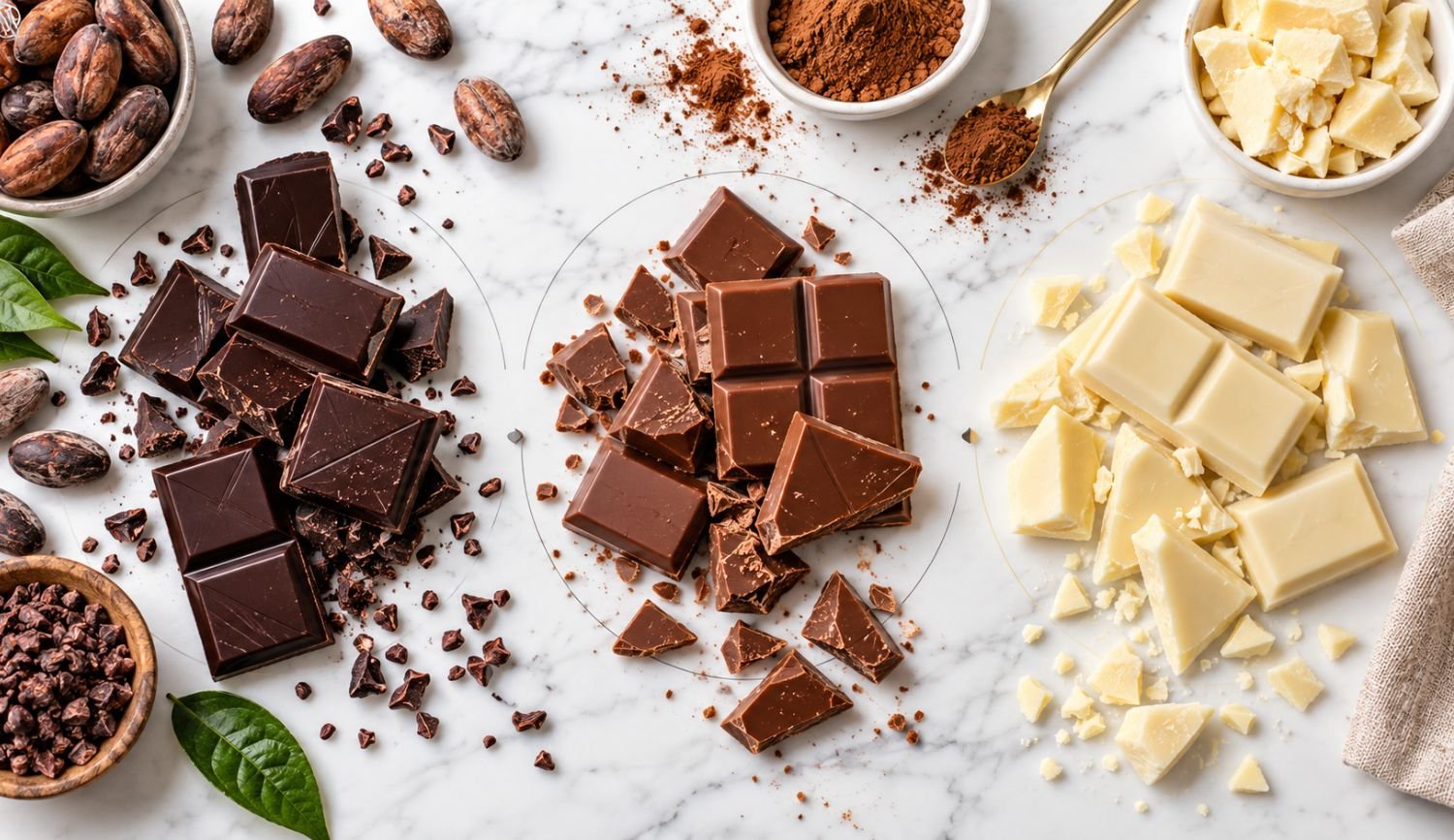
Is chocolate high in histamine? It can contain histamine, but you cannot reliably predict how much from the words dark, milk or white, or from a cocoa percentage. Published measurements range from not detected in some samples to tens of mg/kg in others.
If you have been told to avoid chocolate, or told it is fine, you have probably noticed that the advice does not line up. The useful question is not which internet list is right, but what direct testing actually found and what those results can reasonably tell you.
Is chocolate high in histamine?
Chocolate can contain histamine, but “high” or “low” does not hold up as one universal label. Direct analyses have found measurable histamine in dark, milk and white chocolate, with large differences between products and studies.
Other studies found little or no detectable free histamine in some 60% and 70% chocolate samples. So chocolate is not universally high in histamine, and it is not universally low either.
A laboratory result belongs to the product and sample that were tested. Origin, formulation, cocoa source, processing and analytical method can differ from one study to another. For the broader evidence behind food classifications, see our guide to high histamine foods.
What studies actually found in chocolate
The direct measurements make the variability easier to see. Some studies report µg/g, which is numerically equivalent to mg/kg, so the results below are shown in mg/kg for easier comparison.
| Chocolate/sample | Reported histamine result | What the result tells us |
|---|---|---|
| Conventional 70% dark chocolate | About 30.3–35.0 mg/kg in sampled products | Some commercial dark chocolate contained clearly measurable histamine |
| Conventional 32% milk chocolate | About 37.1–45.4 mg/kg in sampled products | Milk chocolate was not lower than dark in these samples |
| Conventional white chocolate | Measurable histamine in sampled products | White chocolate was not histamine-free in this analysis |
| 60% chocolate in Brazilian datasets | Not detected in the reviewed 4-sample datasets | Some tested 60% chocolate samples were below the method’s detection limit |
| 70% chocolate in Brazilian datasets | Some not detected; others about 0.59–3.42 mg/kg, with dataset means of 1.02 and 1.70 mg/kg | The same stated cocoa percentage produced far lower values in these datasets |
| One tested commercial 70% dark chocolate | Free histamine was not detected before simulated digestion; histamine appeared during in vitro digestion | This was a laboratory digestion model, not a measurement of what a person absorbs or how they will feel |
These results should not be averaged into one “chocolate histamine level.” They are not one apples-to-apples ranking study. The variation between products and datasets is the important finding.
A 2015 analysis of cocoa-based products reported histamine from 1.9 to 38.1 mg/kg across the products tested. A related 2016 analysis also found that organic and fair-trade samples generally contained much lower biogenic-amine concentrations than their conventional counterparts. Those findings are useful, but they still do not create a universal rule for the chocolate on a store shelf.
Is dark chocolate higher in histamine than milk or white?
Not reliably. In the 2016 commercial-product analysis, the sampled conventional milk and white chocolates contained measurable histamine, and the milk samples were comparable with or higher than the conventional 70% dark samples.
Other 70% dark chocolates tested much lower or had no detectable free histamine. White chocolate also cannot be assumed histamine-free simply because it lacks cocoa solids. Type alone does not sort chocolate into a dependable dark-high, milk-medium, white-low hierarchy.
That does not make dark, milk or white chocolate universally well tolerated either. It means the label on the front of the bar cannot make that decision for you.
Does cocoa percentage predict histamine?
No validated cocoa-percentage threshold reliably predicts histamine.
The 60% and 70% results show why. Brazilian 60% samples had no detectable histamine, while 70% samples ranged from not detected to about 3.42 mg/kg in the 2025 review. Yet conventional 70% dark chocolate in the 2016 analysis measured around 30–35 mg/kg.
Cocoa genetics may be another source of variation. In one study of chocolates made from nine cocoa clones, histamine was detected in seven of the nine, with different amine profiles between clones. That finding does not tell us what a particular retail bar will contain, but it is another reason cocoa percentage alone is too simple a predictor.
Is there such a thing as low-histamine chocolate?
Specific products or batches can test very low or below detection, but no chocolate type can be assumed low in histamine from its label alone. A measurement belongs to the tested sample, not to every dark, milk, white, raw or unfermented chocolate.
A “histamine-free” claim also needs context. A result below an analytical method’s detection limit is not proof that every batch contains absolutely zero histamine, and it says nothing by itself about whether you will tolerate the product.
No evidence-based universally best chocolate or serving size exists for histamine intolerance. Even a bar with a very low measured value may contain other ingredients or compounds that matter to you.
What about low-histamine chocolate alternatives?
Cocoa-free does not automatically mean low histamine. A chocolate substitute is a different food with its own ingredients, processing and evidence, so it should not inherit a “safe” label simply because cocoa has been removed.
If you are choosing an alternative, a short ingredient list can make your own response easier to interpret. But substitutes still need to be evaluated on their own rather than treated as universally low-histamine replacements.
What about raw or unfermented chocolate?
Fermentation and processing can change a chocolate’s overall amine profile, but not in one predictable direction. In one controlled study, different proportions of under-fermented and fermented cocoa changed several amines, while histamine itself was not significantly affected by the tested proportions.
A separate study of Colombian cocoa beans found that histamine and other amines changed differently across fermentation, drying and roasting. Based on current evidence, calling raw or unfermented chocolate inherently lower in histamine, or easier to tolerate, is not justified.
What about cocoa powder, cacao nibs and hot chocolate?
The 2025 Brazilian review reported no detectable histamine in several datasets of fermented cocoa, fermented and roasted cocoa, and cocoa liquor. Those findings do not establish that every cocoa powder, cacao nib product or cocoa-based ingredient is histamine-free.
Hot chocolate is also a prepared drink rather than one standardized food. The cocoa product, milk or plant milk, flavorings, sweeteners and storage can all change the final product, so “hot chocolate” cannot be assigned one universal high- or low-histamine value.
Is chocolate a histamine liberator?
Chocolate is commonly described as a histamine liberator, but a general, clinically proven food-liberator mechanism has not been established.
The 2021 guideline on suspected adverse reactions to ingested histamine cautions against presenting presumed food-liberator mechanisms as established clinical fact and against unnecessarily broad food restriction.
That does not mean a reaction after chocolate should be dismissed. It means the liberator label is not a proven explanation for that reaction. For the broader evidence, see our guide to histamine liberator foods.
Why might you feel worse after eating chocolate?
If you notice symptoms after chocolate, that observation is worth taking seriously. A reaction can be real without proving that the bar itself was high in histamine.
Chocolate can contain other biogenic amines, including tyramine and phenylethylamine, as well as other bioactive compounds. These are chemically distinct from histamine and do not, by themselves, prove histamine intolerance or explain your particular reaction.
You may also see claims that theobromine blocks DAO. Experimental findings in other enzyme systems are not the same as demonstrated inhibition of intestinal DAO after ordinary chocolate intake, so that explanation is not established. Milk, nuts, flavorings and other ingredients in a finished product may matter too.
Could it be cocoa allergy instead?
True IgE-mediated cocoa and chocolate allergy has been documented, including challenge-confirmed cases. That is a different mechanism from dietary histamine intolerance.
Immediate hives, facial swelling, wheezing, throat symptoms or an anaphylaxis-type reaction need allergy or urgent medical evaluation rather than an assumption that food histamine was the cause. Our guide to histamine intolerance vs food allergies explains how the two differ.
Can you eat chocolate with histamine intolerance?
There is no universally safe chocolate type or serving, and that cuts both ways. If you already tolerate a particular chocolate, a generic internet label does not automatically overrule your own experience.
If you react repeatedly, take the pattern seriously without assuming histamine is automatically the mechanism. If you are testing tolerance again, choose a simple product and change one variable at a time so what you notice is easier to interpret. After allergic-type symptoms, do not re-challenge without medical guidance.
For a broader starting point on food categories, our low histamine food list shows how lower-histamine options compare with more variable foods.
Being told to give up chocolate can feel especially restrictive when the lists themselves disagree. You do not have to force your experience into a simple “good” or “bad” category. The direct evidence supports a more useful answer: chocolate varies, product labels do not reliably predict histamine, and your individual response still matters.
References
- Restuccia D, Spizzirri UG, Puoci F, Picci N. Biogenic Amines as Quality Marker in Organic and Fair-Trade Cocoa-Based Products. Sustainability. 2016;8(9):856. doi:10.3390/su8090856.
- Restuccia D, Spizzirri UG, Puoci F, Picci N. Determination of biogenic amine profiles in conventional and organic cocoa-based products. Food Addit Contam Part A Chem Anal Control Expo Risk Assess. 2015;32(7):1156-1163. doi:10.1080/19440049.2015.1036322.
- Dala-Paula BM, Deus VL, Tavano OL, Gloria MBA. In vitro bioaccessibility of amino acids and bioactive amines in 70% cocoa dark chocolate: What you eat and what you get. Food Chem. 2021;343:128397. doi:10.1016/j.foodchem.2020.128397.
- Deus VL, Bispo ES, Franca AS, Gloria MBA. Influence of cocoa clones on the quality and functional properties of chocolate — Nitrogenous compounds. LWT. 2020;134:110202. doi:10.1016/j.lwt.2020.110202.
- Silva GS, Dala-Paula BM, Bispo ES, Gloria MBA. Bioaccessibility of bioactive amines in dark chocolates made with different proportions of under-fermented and fermented cocoa beans. Food Chem. 2023;404(Pt B):134725. doi:10.1016/j.foodchem.2022.134725.
- Delgado-Ospina J, Di Mattia CD, Paparella A, Mastrocola D, Martuscelli M, Chaves-Lopez C. Effect of Fermentation, Drying and Roasting on Biogenic Amines and Other Biocompounds in Colombian Criollo Cocoa Beans and Shells. Foods. 2020;9(4):520. doi:10.3390/foods9040520.
- Gloria MBA, Diniz FB, Dala-Paula BM, et al. Histamine in Brazilian Foods: A Comprehensive Review of Occurrence and Risk Assessment for Intoxication and Intolerance. Food Sci Nutr. 2025;13(11):e71151. doi:10.1002/fsn3.71151.
- Reese I, Ballmer-Weber B, Beyer K, et al. Guideline on management of suspected adverse reactions to ingested histamine. Allergol Select. 2021;5:305-314. doi:10.5414/ALX02269E.
- Lopes JP, Kattan J, Doppelt A, Nowak-Węgrzyn A, Bunyavanich S. Not so sweet: True chocolate and cocoa allergy. J Allergy Clin Immunol Pract. 2019;7(8):2868-2871.e1. doi:10.1016/j.jaip.2019.04.023.