
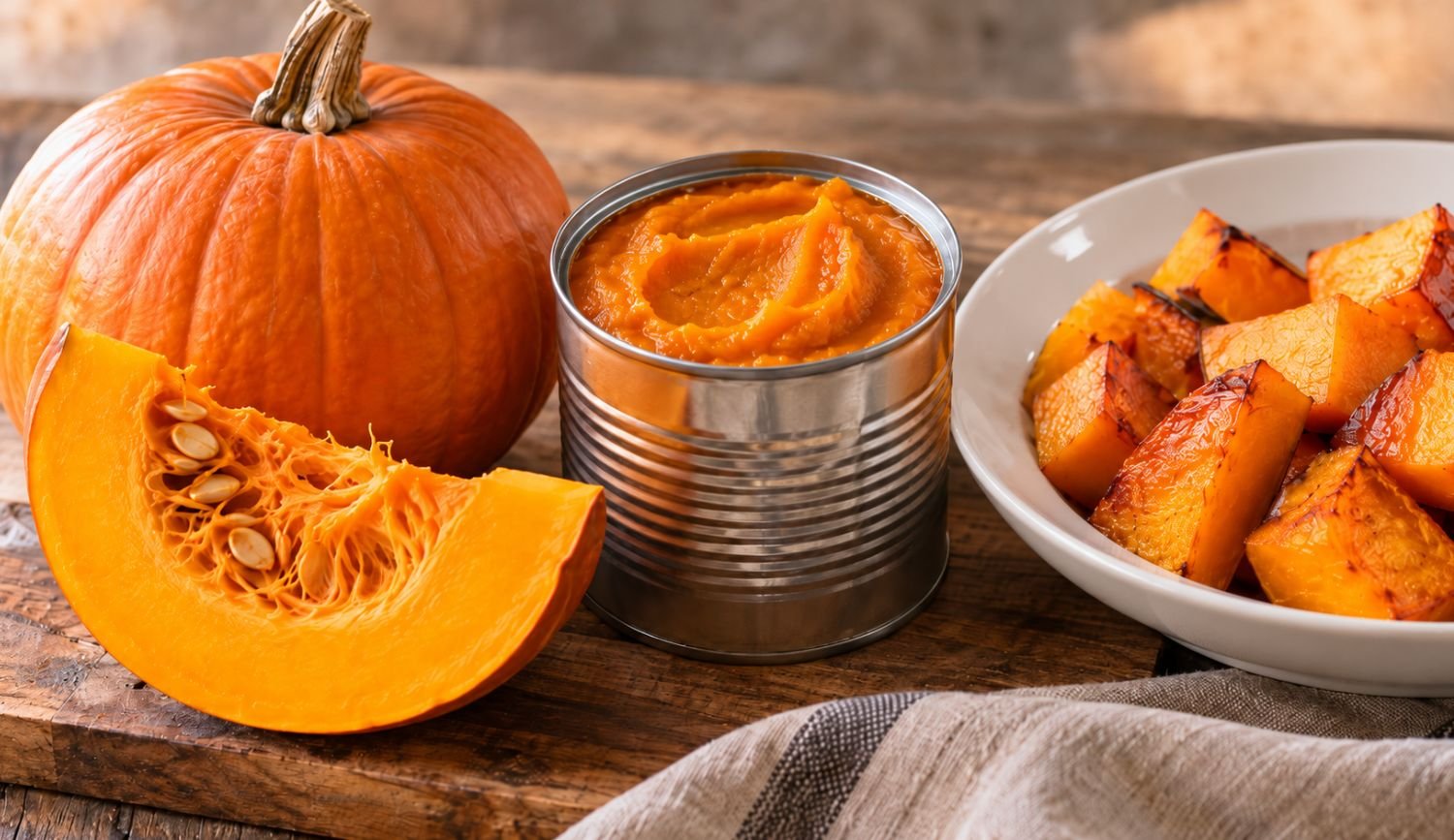
Is pumpkin high in histamine? Generally, no. In the available studies, pumpkin usually falls in the low or non-detectable range. But the numbers are not identical: Spanish datasets found histamine absent or very low, while one Brazilian dataset of 14 Cucurbita maxima samples averaged 5.10 mg/kg. The 2025 review that summarized that result still categorized the level as low.
That difference matters because a simple “safe” or “unsafe” label misses part of the story. Fresh pumpkin has some direct laboratory data behind it. Canned pumpkin and specific cooking methods have much less, so it helps to separate what has actually been measured from what low-histamine food lists often assume.
Is pumpkin high or low in histamine?
Taken as a whole, the available evidence points toward pumpkin being low in measured histamine rather than a high-histamine food. In one Spanish dataset, results ranged from not detected to 1.90 mg/kg, while the Brazilian dataset averaged 5.10 mg/kg.
Even that higher Brazilian value still fell within the “low” category used by the 2025 review. The important caveat is that there is no universal scientific cutoff separating a “high-histamine” food from a “low-histamine” one, and those laboratory categories are not symptom thresholds.
What do laboratory studies actually measure in pumpkin?
This is where the numbers become more useful than a simple food-list label. The three datasets below point in the same general direction, but they are not identical.
| Evidence source | Samples | Histamine result | What it suggests | What it does not prove |
|---|---|---|---|---|
| Sánchez-Pérez et al. 2018 (Spanish data) | n = 12 | Mean 0.28 mg/kg; not detected to 1.90 mg/kg | Histamine was absent or very low in these samples | That every pumpkin is this low, or that the result applies to other regions and products |
| Sánchez-Pérez et al. 2021 (Spanish database) | n = 13 | Not detected | Histamine was not detected in this dataset | That pumpkin is histamine-free; a result depends on the samples and method |
| Gloria et al. 2025 (Brazilian dataset, Batista 2007) | n = 14 C. maxima | Mean 5.10 mg/kg | Falls in the review’s “low” category, but is materially higher than the Spanish values | That pumpkin is high in histamine, or why it differs from the Spanish data |
The overall pattern is fairly consistent: pumpkin does not emerge as a high-histamine food in these datasets. At the same time, the spread between “not detected” and a 5.10 mg/kg mean is exactly why calling pumpkin “histamine-free” would go too far.
These are also small sample sets. They are useful snapshots, not a definitive range for every pumpkin variety, growing region, product, or preparation.
Why do pumpkin histamine numbers differ?
The Brazilian average is clearly higher than the Spanish results, which naturally raises the question of why. Botanical variety, geography, sampling, or analytical conditions could all contribute.
But the studies did not establish the reason for the difference. So while it is reasonable to acknowledge those possibilities, it would not be accurate to say that one specific factor, such as pumpkin variety or country of origin, explains the result.
Is canned pumpkin low histamine?
If fresh pumpkin is generally low, canned pumpkin is the next obvious question. This is also where the evidence becomes much less direct.
No pumpkin-specific study comparing fresh pumpkin with canned pumpkin was verified in the research behind this article. That means canned pumpkin should not automatically be labelled high in histamine, but it also cannot be described as proven identical to fresh pumpkin.
Product type matters too. Plain 100% pumpkin purée and pumpkin pie filling are not the same product because pie filling can contain additional ingredients. For someone deciding between the two, reading the label tells you more than assuming that every canned pumpkin product behaves the same way.
The practical takeaway is therefore not “avoid canned pumpkin” or “canned is definitely the same as fresh.” It is simply that the evidence for canned pumpkin is thinner, and the distinction between plain pumpkin and a multi-ingredient product matters.
Does cooking pumpkin change histamine?
Cooking raises a similar question: does boiling, roasting, steaming, or baking make pumpkin lower in histamine?
At the moment, we do not have a verified pumpkin-specific study that measured histamine before and after those cooking methods. So there is no evidence-based reason to rank one preparation as safer than another or to claim that cooking reduces pumpkin histamine.
Histamine already present in food is generally not assumed to disappear with ordinary cooking. That is useful background chemistry, but it should not be mistaken for a pumpkin-specific cooking experiment.
Why can food lists and laboratory measurements seem to disagree?
At first glance, a food list and a laboratory result can look as though they are answering the same question. They are not.
Laboratory studies measure how much histamine was found in a particular set of food samples. Compatibility lists are broader tools that classify foods for use in a low-histamine diet, often drawing on tolerance observations and expert judgement as well as chemistry.
SIGHI, for example, currently lists pumpkins of various varieties with a compatibility score of 0. That is useful compatibility guidance, but it is not a laboratory measurement proving that pumpkin contains zero histamine.
The distinction matters because low-histamine lists do not always agree with one another. A 2021 review highlighted that lack of consensus and also noted that the commonly repeated “histamine liberator” mechanism behind many food exclusions is not established by reliable human clinical evidence. We explain that issue in more detail in our guide to histamine liberator foods.
What if pumpkin causes symptoms?
If pumpkin repeatedly causes symptoms, that still does not tell us why. A reaction does not prove that the serving contained a high amount of histamine, and it does not establish histamine intolerance, DAO inhibition, or a histamine-liberator mechanism.
This is especially important with prepared pumpkin dishes, which may contain several other ingredients. True food allergy and other non-histamine explanations are separate possibilities, and our guide to histamine intolerance vs food allergies explains why those mechanisms should not be treated as interchangeable.
If reactions are significant, reproducible, or making your diet increasingly restrictive, it is reasonable to discuss them with a clinician or dietitian rather than trying to identify the mechanism from a food list alone.
Are pumpkin seeds low histamine?
Pumpkin seeds are a separate food with their own evidence and their own search question. The measurements summarized above apply to pumpkin flesh, not the seeds, so seed-specific conclusions should not be drawn from them.
Can pumpkin fit a low-histamine diet?
So where does this leave pumpkin in practical terms? Based on the evidence we have, pumpkin is generally compatible with a low-histamine diet, and the direct measurements are mostly low. They are not completely uniform, and no laboratory result can guarantee individual tolerance.
That makes a generic internet food list a weak reason, by itself, to remove pumpkin from an already restricted diet. For the bigger picture, see our low histamine food list and our overview of high histamine foods.
References
- Sánchez-Pérez S, Comas-Basté O, Rabell-González J, Veciana-Nogués MT, Latorre-Moratalla ML, Vidal-Carou MC. Biogenic Amines in Plant-Origin Foods: Are They Frequently Underestimated in Low-Histamine Diets? Foods. 2018;7(12):205.
- Sánchez-Pérez S, Comas-Basté O, Veciana-Nogués MT, Latorre-Moratalla ML, Vidal-Carou MC. Low-Histamine Diets: Is the Exclusion of Foods Justified by Their Histamine Content? Nutrients. 2021;13(5):1395.
- Gloria MBA, Diniz FB, Dala-Paula BM, et al. Histamine in Brazilian Foods: A Comprehensive Review of Occurrence and Risk Assessment for Intoxication and Intolerance. Food Sci Nutr. 2025;13(11).
- SIGHI (Swiss Interest Group Histamine Intolerance). Food compatibility list. Available from the SIGHI downloads page.