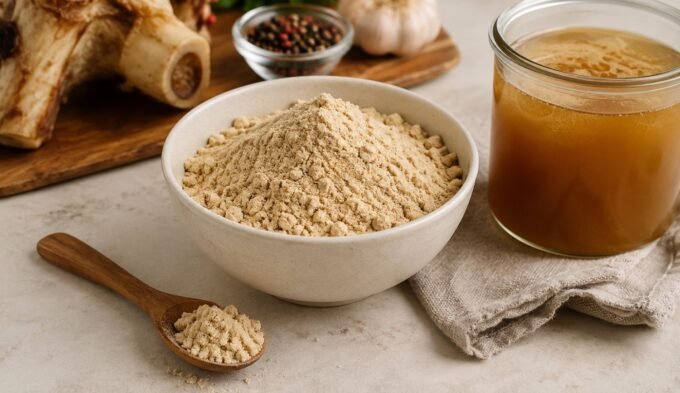


You tolerated plain collagen peptides for months. Then a “glow” powder from the same brand left you flushed and itchy within an hour.
Maybe gelatin in a homemade dessert never bothered you, but marine collagen made your heart race. Or bone broth triggered a reaction that a simple scoop of powder never did.
None of that means you imagined it, and none of it means one experience proves the others wrong. Collagen and histamine intolerance intersect in more than one way, because “collagen” isn’t a single, standardized product.
It’s a category. Bovine peptides, marine collagen, gelatin, bone broth, and beauty blends are related, but they behave differently in the body and in the kitchen.
This guide maps the whole topic in one place and points to the dedicated Nourishly article for any question that needs a full answer.
The short answer: can collagen affect histamine intolerance?
Some people report symptoms after using collagen products, but a reaction does not prove that the collagen was high in histamine or that histamine intolerance was the cause. Source, processing, additives, dose, allergy history, and handling can all affect what happens with a particular product.
No collagen format is universally tolerated or universally unsafe. The useful question is not simply whether “collagen is high histamine,” but which variables are present in the specific product and whether another explanation, such as an allergy or added ingredient, better fits the reaction.
Direct research on collagen supplements in people with diagnosed histamine intolerance is sparse, and most commercial collagen powders do not publish batch-specific histamine measurements.
Much of what can be said about risk therefore comes from broader evidence on biogenic-amine formation, collagen processing, seafood handling, allergy, and product formulation rather than collagen-specific histamine trials. That lets us identify meaningful variables, but not declare every product high or low histamine without testing.
| Question | Best-supported answer |
|---|---|
| Is collagen automatically high histamine? | Not established. Product-specific testing is usually unavailable. |
| Does hydrolysis make collagen low histamine? | No. Hydrolysis describes peptide size, not histamine content. |
| Is marine collagen automatically worse? | No. Seafood handling and fish allergy are relevant variables, but source alone cannot establish finished-product histamine. |
| Is bone broth the same as collagen powder? | No. Broth is a variable food matrix, while plain collagen peptides are a more standardized ingredient. |
| Does a reaction prove histamine intolerance? | No. Allergy, additives, dose, and other mechanisms can produce overlapping symptoms. |
First, separate histamine content from reaction potential
These two ideas get treated as the same thing constantly, and they aren’t.
Histamine content refers specifically to the amount of histamine present in a product or batch. Other biogenic amines are separate compounds, even though they may arise under similar handling and storage conditions. Reaction potential is broader: it can reflect histamine exposure and clearance, but also allergy, additives, dose, and other individual factors [1][2].
A product can trigger real symptoms without ever being tested for, or proven to contain, elevated histamine. The reaction might come from a true allergy, a digestive response to an additive, niacin flushing, a sweetener, or simply a dose that was too large for that day. Is Collagen High in Histamine? works through this specific question in full.
A “low histamine” label doesn’t provide a numerical batch result unless the manufacturer supplies product-specific testing. Don’t assume a symptom means histamine, and don’t assume a lack of symptoms means a product is analytically low histamine either.
Collagen formats at a glance
Before going deeper, it helps to see the major formats side by side.
| Format | What it is | Main tolerance variables | Dose clarity | Best next guide |
|---|---|---|---|---|
| Plain bovine collagen peptides | Hydrolyzed collagen from cattle hide or bone | Source, processing, dose | High, measured per scoop | ⟶ Collagen Supplements and Histamine |
| Marine collagen peptides | Hydrolyzed collagen from fish skin/scales | Fish handling, fish allergy | High, measured per scoop | ⟶ Marine Collagen and Histamine |
| Gelatin | Partially hydrolyzed collagen, gels when cooled | Source, recipe context, storage | Moderate, depends on use | ⟶ Collagen Peptides vs Gelatin |
| Homemade bone broth | Long-simmered liquid from bones and connective tissue | Starting-ingredient freshness, cooling, storage, concentration, and recipe | Low, highly variable | ⟶ Bone Broth and Histamine |
| Bone broth powder | Dehydrated broth solids | Same as broth, plus additives if flavored | Low to moderate | ⟶ Bone Broth Powder and Histamine |
| Collagen beauty blends | Collagen plus vitamins, probiotics, botanicals | Many added ingredients at once | Low, often hidden in blends | ⟶ Collagen Beauty Blends and Histamine |
| Fresh protein / non-collagen alternatives | Tolerated whole foods, targeted amino acids | Freshness, personal tolerance | High, food-based | ⟶ Low Histamine Collagen Alternatives |
Simplicity helps troubleshooting: a single-ingredient product gives you one real variable to evaluate. It doesn’t guarantee tolerance on its own, since even a plain product can trigger a reaction tied to source, dose, or your histamine load that day.
Why collagen products can affect people differently
Several layers sit between “collagen” as a word and how any specific product actually behaves in your body.
Source material
Collagen comes from a handful of animal sources: bovine, marine, porcine, chicken, or occasionally eggshell membrane. Marine collagen raises fish-handling and fish-allergy questions specifically, while bovine and porcine sources can be relevant to alpha-gal syndrome, a tick-bite-related allergy to a carbohydrate found in mammalian tissue.
No single source is universally safer; personal allergy history matters more than which animal a product came from.
Processing and manufacturing
Hydrolysis is the process that breaks collagen into smaller, water-soluble peptides. It’s a structural change, not a histamine test, and it doesn’t automatically create or rule out histamine either way.
Raw-material quality, microbial activity, time, temperature, and storage can influence biogenic-amine formation in protein foods [3]. Histamine that has already formed is also relatively heat stable, so later cooking or processing does not reliably remove it.
But those food-chemistry principles cannot tell us the histamine concentration of an untested collagen powder. “Hydrolyzed” only describes how collagen proteins were broken into smaller peptides; it is not a histamine measurement or tolerance guarantee [4]. Marketing terms such as “grass-fed,” “wild-caught,” or “clean” describe sourcing or positioning, not measured histamine content.
Added ingredients and formula complexity
Plain collagen is one ingredient; many products aren’t. Sweeteners, gums, natural flavors, acids, added vitamins, probiotics, botanical extracts, adaptogens, stimulants, and proprietary blends can all ride along with the collagen, and any one of them can cause a reaction that has nothing to do with the collagen itself.
That’s exactly why beauty and “glow” formulas are harder to troubleshoot than a plain powder.
Dose and timing
A full serving is a bigger variable than a small one, and taking several new supplements at once makes it nearly impossible to know which one caused a reaction, if any of them did. Digestive symptoms tied to dose size don’t automatically prove histamine intolerance; they might just mean the amount was too much for that day.
This guide won’t give you a fixed dosing protocol, since the right starting point depends on the specific product and your own history.
Current threshold and background load
Tolerance isn’t fixed day to day. Poor sleep, alcohol, illness, stress, heat, hormonal shifts, other foods, and medications can all shift how your body handles the same product on different days, sometimes described as a histamine “bucket” filling from multiple sources at once.
Histamine Bucket Theory Explained covers that concept in depth. It’s a useful way to think about cumulative load, not a diagnostic test you can run at home.
Collagen peptides and hydrolyzed powders
Collagen peptides are collagen proteins broken down through hydrolysis into smaller peptide fragments that generally dissolve readily in liquid. That’s the main appeal: measured dosing, easy mixing, and no gelling.
Hydrolyzed doesn’t mean histamine-free, and it doesn’t mean high histamine either; the word describes molecular size, not a safety category [4]. A plain, single-ingredient peptide powder is generally easier to evaluate than a flavored or fortified blend, since there’s one variable instead of several.
Collagen Peptides and Histamine covers sourcing, processing, and testing approaches for this format specifically.
Collagen peptides versus gelatin
Collagen peptides and gelatin come from the same starting protein, but they behave differently in food and supplements. Collagen peptides are more fully hydrolyzed, dissolve readily, and do not form a gel. Gelatin is only partially hydrolyzed and sets when cooled.
Those differences affect how the two are used and how precisely a serving can be measured, but they do not establish which one will be better tolerated. Both can also retain source-related allergy considerations.
If you’re deciding between the two formats, Collagen Peptides vs Gelatin compares them directly.
Marine collagen versus mammalian collagen
Marine collagen is commonly made from fish skin, scales, or other fish-derived material. Poor time-temperature control is a well-established cause of histamine accumulation in susceptible fish, but that evidence comes from seafood safety, not from direct testing of finished marine collagen supplements [5]. Without product-specific analysis, a fish-derived label alone cannot tell you how much histamine is present in the final powder.
Marine collagen also raises a separate fish-allergy question. Mammalian collagen, mainly bovine and porcine, raises different source-allergy considerations. IgE-mediated reactions to bovine collagen have been reported, although the published clinical literature suggests they are uncommon [9].
Mammalian-derived collagen products may also deserve caution in people with alpha-gal syndrome. Mammalian gelatin is a recognized allergy concern, and individual risk can vary by product and person [6][7][8]. This is an allergy issue, not evidence that bovine collagen is inherently high histamine.
Neither marine nor mammalian collagen is automatically lower histamine than the other. Personal allergy history and product-specific factors matter more than marketing language on the label. Marine Collagen and Histamine and Bovine Collagen and Histamine each cover their source in full.
Bone broth is not the same as collagen powder
Bone broth is a broader and less standardized food matrix than plain collagen peptides. Its composition can change with the bones used, water volume, recipe, preparation, cooling, storage, and serving size.
Long simmering itself should not be described as directly creating histamine. Biogenic amines are produced mainly through microbial activity acting on available amino acids. The more defensible concerns are raw-material quality and time-temperature handling before cooking, followed by cooling and storage afterward. Histamine already present is not reliably destroyed by cooking [3].
For a deeper look at broth preparation, handling, cooling, and storage, Bone Broth and Histamine covers those variables in detail.
Bone broth is also an unreliable way to know exactly how much collagen-related material you are getting. One analysis found substantial variation in collagen-related amino acids across bone broths and concluded that broth was less reliable than the reference collagen supplements studied [16].
If your question is specifically about quantity rather than histamine, How Much Collagen Is in Bone Broth? explains why there is no dependable collagen-grams-per-cup figure. For the direct format comparison, see Bone Broth vs Collagen Powder.
Bone broth powder adds another distinction. Dehydration removes water, but it does not reveal what happened to the broth before drying or prove that histamine already present was removed. Added flavors, seasonings, gums, and other ingredients can introduce still more variables.
If you’re evaluating instant broth itself, see Bone Broth Powder and Histamine. If you’re choosing between the two dry formats, Bone Broth Powder vs Collagen Powder compares them directly.
Why beauty and “glow” powders create extra variables
A beauty blend rarely stops at collagen. Niacin, biotin, vitamin C, hyaluronic acid, probiotic strains, fruit powders, acids, natural flavors, sweeteners, gums, adaptogens, and caffeine or green tea extract all show up in these formulas.
A few deserve quick notes. Niacin flushing produces warmth, redness, and itching through a specific receptor pathway, and it isn’t proof of a collagen allergy or a dietary histamine reaction, even though it can look similar on the skin [10][11].
High-dose biotin isn’t a known histamine trigger, but it can interfere with certain lab tests [12]. Probiotic efficacy and histamine production are both strain-specific: some gut bacteria strains carry histidine-decarboxylase activity capable of producing histamine, while overall probiotic benefit also depends on the exact strain, so a single ingredient line item can’t be labeled universally histamine-producing or histamine-friendly without knowing which strain is in the product [13][14].
Collagen Beauty Blends and Histamine works through each of these variables individually. More ingredients means more places for a reaction to hide, whether or not histamine is involved at all.
What collagen powder side effects may look like
Symptoms noticed after collagen products can include digestive upset, flushing, itching, rash, headache, congestion, sleep changes, or palpitations. The timing alone does not establish that collagen caused the symptom or identify histamine as the mechanism.
Digestive symptoms may be related to dose size or added ingredients, while flushing can overlap with histamine-type reactions, niacin, heat, hormonal changes, or allergy. The pattern and context matter more than any single symptom.
Hives and swelling deserve more caution because they can occur in allergic and non-allergic histaminergic reactions [15]. Swelling of the lips, tongue, or throat, breathing symptoms, fainting, rapidly spreading hives, or symptoms involving several body systems require urgent assessment for anaphylaxis.
Collagen Powder Side Effects walks through these patterns by body system in more depth.
Histamine-type reaction, allergy, or another side effect?
This table is a starting point for thinking clearly, not a diagnostic tool, and it cannot rule out allergy at home.
| Pattern | Possible clues | What it does not prove | Appropriate next step |
|---|---|---|---|
| Digestive intolerance or dose effect | Bloating, cramping, loose stool tied to serving size | Does not prove histamine intolerance | Stop and review the serving size and ingredients. Only consider another trial if symptoms were mild and no allergy-like features occurred. |
| Additive-related reaction | Symptoms only with flavored or fortified versions | Does not prove the collagen itself is the trigger | Stop the blend and compare ingredient lists. Do not deliberately retest after hives, swelling, breathing symptoms, or fainting. |
| Possible histamine-type reaction | Flushing, itching, or gut symptoms clustering with other known triggers | Does not confirm histamine intolerance or MCAS | Record the timing and full context. Discuss repeated or multi-system reactions with a clinician. |
| Possible source allergy | Hives, swelling, or symptoms tied to one specific source | Does not resolve on its own with a different product from the same source | Stop the product. Seek urgent care for severe or multi-system symptoms and arrange allergy assessment. |
| Niacin flush | Warmth and redness shortly after a beauty-blend dose | Does not indicate a collagen or histamine reaction | Check the label for niacin and stop the product if the reaction is significant or difficult to interpret. |
| Concerning cardiovascular or neurological symptoms | Chest tightness, fainting, severe or persistent palpitations | Cannot safely be attributed to collagen or histamine at home | Seek medical assessment rather than attempting another trial. |
Histamine Intolerance vs Food Allergies explains the mechanism-level difference in more depth; that determination belongs with a clinician, especially when symptoms are severe or repeated.
How to evaluate a collagen product before trying it
A little label-reading beats marketing copy.
- Identify the animal source, since that shapes which allergy questions apply.
- Check whether the product is plain or multi-ingredient.
- Read the full ingredient list, not just the front of the label.
- Check allergen and shared-facility statements if you have a known allergy.
- Don’t assume “natural,” “clean,” “grass-fed,” “wild-caught,” or “beauty” proves tolerance; none of these describe histamine content.
- Look for proprietary blends or ingredients without individual amounts listed.
- Note the serving size before you start.
- Avoid testing several new products at the same time.
- Record other foods, supplements, alcohol, illness, heat, stress, and cycle timing alongside any reaction.
- Stop testing if you notice anything resembling an allergic reaction; don’t continue to see if it repeats.
A cautious way to track tolerance
Only consider a tolerance trial when there has been no previous serious or allergy-like reaction. After swelling, breathing difficulty, fainting, rapidly spreading hives, or another systemic reaction, do not conduct a home rechallenge.
This is an educational framework, not a medical protocol. Test only when symptoms are relatively stable, not during an active flare, and change one variable at a time while keeping the rest of your routine consistent.
Record the source, full ingredient list, amount taken, timing, what else you ate that day, and any symptoms, including onset and duration. Stop if symptoms clearly worsen, and involve a clinician when symptoms are repeated, affect multiple body systems, or are hard to interpret on your own.
There’s no fixed gram dose that works for everyone, and starting slowly doesn’t guarantee you’ll avoid a reaction; it just gives you better information if one happens.
When collagen is not the right experiment
Some situations deserve more caution than routine self-testing. That includes a known allergy relevant to the product’s animal source, known or suspected alpha-gal syndrome, a previous systemic reaction to collagen or gelatin, or a medical condition that requires protein restriction.
Pregnancy, breastfeeding, chronic medical conditions, or regular medication use do not automatically mean collagen is prohibited, but they are good reasons to review a supplement with a clinician, particularly when the product contains vitamins, botanicals, probiotics, stimulants, or other active ingredients beyond collagen.
Do not conduct a home rechallenge after breathing difficulty, throat or facial swelling, fainting, rapidly spreading hives, severe chest symptoms, or another serious systemic reaction. Seek urgent medical care for trouble breathing, wheezing, throat tightness or swelling, swelling of the lips, face or tongue, fainting, blue lips, rapidly spreading hives, or other signs of anaphylaxis.
Persistent or severe palpitations, severe chest symptoms, faintness, or neurological symptoms also require medical assessment rather than continued self-testing. A collagen reaction does not diagnose histamine intolerance, MCAS, DAO deficiency, alpha-gal syndrome, or food allergy on its own.
In the United States, dietary supplements are regulated differently from medicines and are not FDA-approved for safety and effectiveness before marketing [17].
What to use when collagen does not suit you
If collagen in every format keeps causing trouble, that doesn’t mean you’re out of options. Fresh, tolerated dietary protein supplies amino acids the body can use during collagen synthesis.
Glycine, proline, vitamin C, zinc, or copper should not be presented as equivalent replacements or automatically useful supplements; their relevance depends on overall diet, deficiency status, medical history, and the specific goal being addressed. Collagen itself is not an essential supplement, and targeted nutrient supplementation should be based on individual need rather than applied indiscriminately.
Low Histamine Collagen Alternatives covers this full approach, including food choices, tracking, and what to avoid while you’re troubleshooting.
A practical decision guide
This is a navigation framework, not a safety ranking: it points toward the lower-variable direction worth investigating first.
| Your situation | Lower-variable direction to investigate | Important caution | Read next |
|---|---|---|---|
| You want the simplest measurable format | A plain, single-ingredient collagen peptide product may be easier to evaluate | Source allergy and dose still matter | ⟶ Collagen Peptides and Histamine |
| You react only to flavored products | Review sweeteners, gums, flavors, acids, and added nutrients | Do not deliberately retest after allergy-like symptoms | ⟶ Collagen Beauty Blends and Histamine |
| You react specifically to glow powders | Separate the collagen base from the beauty formula | Niacin, probiotics, stimulants, and other additions may produce overlapping symptoms | ⟶ Collagen Beauty Blends and Histamine |
| You have a fish allergy | Avoid using marine collagen as a home experiment | Fish allergy is different from histamine intolerance | ⟶ Marine Collagen and Histamine |
| You have known or suspected alpha-gal syndrome | Review mammalian collagen and gelatin with an allergist | Do not assume hydrolysis removes alpha-gal risk | ⟶ Bovine Collagen and Histamine |
| You need a cooking ingredient | Compare gelatin and peptides according to function rather than assumed tolerance | Both may retain source-related allergy considerations | ⟶ Collagen Peptides vs Gelatin |
| You react to long-simmered broth | Separate broth handling and storage from collagen itself | A broth reaction does not predict a powder reaction | ⟶ Bone Broth vs Collagen Powder |
| You react to bone broth powder | Review the original broth process and any ingredients added after dehydration | Drying does not reveal earlier handling history | ⟶ Bone Broth Powder and Histamine |
| Every collagen format causes symptoms | Stop forcing collagen and review food-first alternatives | Repeated systemic symptoms deserve medical assessment | ⟶ Low Histamine Collagen Alternatives |
| You experience severe allergy-like symptoms | Stop the product and seek urgent medical care | Do not conduct another home trial | ⟶ Histamine Intolerance vs Food Allergies |
| Digestive symptoms are the main concern | Review serving size, sweeteners, gums, acids, and formula complexity | Digestive symptoms alone do not prove a histamine reaction | ⟶ Collagen Powder Side Effects |
The bottom line
Collagen and histamine intolerance do not deserve one universal verdict, because collagen is not one standardized product. Peptides, gelatin, marine collagen, bovine collagen, bone broth, and beauty blends each introduce a different combination of source, processing, preparation, and formula variables.
A reaction is not proof that a product is genuinely high in histamine, and a lack of reaction isn’t proof that a product is analytically low histamine either. Simpler formulas are easier to troubleshoot, but that doesn’t guarantee tolerance on its own.
Allergy history matters more than sourcing claims on a label. Preparation and storage matter for broth, and additives matter for beauty blends.
Severe or repeated symptoms deserve medical assessment rather than continued self-testing. The supporting guides linked throughout this hub exist to go deeper into whichever specific variable applies to you, rather than trying to answer every collagen question with one rule.
Frequently asked questions
These questions cover the broad collagen-and-histamine overlap this hub is built around; the linked guides throughout answer each one in more depth.
Is collagen high in histamine?
There isn’t enough product-specific evidence to classify collagen products as uniformly high or low histamine. Source, handling, processing, and storage can matter, but the actual histamine content of a finished product cannot be known without appropriate testing.
Can collagen cause histamine-like symptoms?
Yes. Some people notice flushing, itching, digestive symptoms, congestion, or palpitations after a collagen product, but those symptoms do not confirm histamine intolerance as the cause. Additives, dose, allergy, or another reaction mechanism can produce similar patterns.
Are collagen peptides low histamine?
Not guaranteed. Hydrolysis describes how the peptides were made, not a histamine measurement, so a “low histamine” claim on a peptide product still needs real testing behind it to mean much.
Is marine collagen worse for histamine intolerance?
Fish-derived raw material does carry handling-related histamine risk if time and temperature controls fail, but that’s a raw-material concern, not proof about the finished powder. Fish allergy is a separate issue worth ruling out specifically for marine products.
Is bone broth higher histamine than collagen powder?
Not necessarily, though broth is harder to standardize. Its histamine risk depends on the starting ingredients, handling, cooling, and storage, not on simmering time alone.
Why can collagen beauty powders cause side effects?
Added ingredients may sometimes be responsible rather than the collagen itself. Niacin, probiotics, sweeteners, botanical extracts, and other additions can introduce separate reaction pathways.
How can I tell whether I reacted to collagen or an additive?
Start by comparing ingredient lists rather than deliberately recreating the reaction. If the previous symptoms were mild and clearly non-allergic, discuss whether another controlled trial is reasonable. Do not intentionally rechallenge after hives, swelling, breathing symptoms, fainting, or a systemic reaction.
What can I use if I cannot tolerate collagen?
Fresh tolerated protein supports the same amino acids collagen synthesis relies on, and targeted nutrients may help depending on individual need. Our article on Low Histamine Collagen Alternatives covers this in full.
References
- Maintz L, Novak N. Histamine and histamine intolerance. Am J Clin Nutr. 2007;85(5):1185-1196. doi:10.1093/ajcn/85.5.1185
- Comas-Basté O, Sánchez-Pérez S, Veciana-Nogués MT, Latorre-Moratalla ML, Vidal-Carou MC. Histamine intolerance: the current state of the art. Biomolecules. 2020;10(8):1181. doi:10.3390/biom10081181
- Gardini F, Özogul Y, Suzzi G, Tabanelli G, Özogul F. Technological factors affecting biogenic amine content in foods: a review. Front Microbiol. 2016;7:1218.
- León-López A, Morales-Peñaloza A, Martínez-Juárez VM, Vargas-Torres A, Zeugolis DI, Aguirre-Álvarez G. Hydrolyzed collagen: sources and applications. Molecules. 2019;24(22):4031. doi:10.3390/molecules24224031
- Centers for Disease Control and Prevention. Food poisoning from marine toxins: scombroid (histamine) fish poisoning. CDC Yellow Book.
- Centers for Disease Control and Prevention. About alpha-gal syndrome.
- Mullins RJ, James H, Platts-Mills TAE, Commins SP. The relationship between red meat allergy and sensitization to gelatin and galactose-α-1,3-galactose. J Allergy Clin Immunol. 2012;129(5):1334-1342. doi:10.1016/j.jaci.2012.02.038
- Bogdanovic J, Halsey NA, Wood RA, Hamilton RG. Bovine and porcine gelatin sensitivity in children sensitized to milk and meat. J Allergy Clin Immunol. 2009;124(5):1108-1110. doi:10.1016/j.jaci.2009.06.021
- Mullins RJ, Richards C, Walker T. Allergic reactions to oral, surgical and topical bovine collagen. Anaphylactic risk for surgeons. Aust N Z J Ophthalmol. 1996;24(3):257-260. doi:10.1111/j.1442-9071.1996.tb01589.x
- Benyó Z, Gille A, Kero J, Csiky M, Suchánková MC, Nüsing RM, Moers A, Pfeffer K, Offermanns S. GPR109A (PUMA-G/HM74A) mediates nicotinic acid-induced flushing. J Clin Invest. 2005;115(12):3634-3640. doi:10.1172/JCI23626
- National Institutes of Health, Office of Dietary Supplements. Niacin: fact sheet for health professionals.
- U.S. Food and Drug Administration. Update: the FDA warns that biotin may interfere with lab tests: FDA safety communication.
- McFarland LV, Evans CT, Goldstein EJC. Strain-specificity and disease-specificity of probiotic efficacy: a systematic review and meta-analysis. Front Med (Lausanne). 2018;5:124. doi:10.3389/fmed.2018.00124
- Fiorani M, Del Vecchio LE, Dargenio P, Kaitsas F, Rozera T, Porcari S, Gasbarrini A, Cammarota G, Ianiro G. Histamine-producing bacteria and their role in gastrointestinal disorders. Expert Rev Gastroenterol Hepatol. 2023;17(7):709-718. doi:10.1080/17474124.2023.2230865
- Zuberbier T, Abdul Latiff AH, Abuzakouk M, et al. The international EAACI/GA²LEN/EuroGuiDerm/APAAACI guideline for the definition, classification, diagnosis, and management of urticaria. Allergy. 2022;77(3):734-766. doi:10.1111/all.15090
- Alcock RD, Shaw GC, Burke LM. Bone broth unlikely to provide reliable concentrations of collagen precursors compared with supplemental sources of collagen used in collagen research. Int J Sport Nutr Exerc Metab. 2019;29(3):265-272. doi:10.1123/ijsnem.2018-0139
- U.S. Food and Drug Administration. Dietary supplements.