
Collagen peptides and gelatin often get grouped together because both come from collagen. But in real life, people don’t always tolerate them the same way.
One dissolves into coffee or a smoothie with almost no texture. The other turns liquid into something you can cut with a spoon. One is usually taken like a supplement, measured in scoops; the other often hides inside foods, capsules, desserts, gummies, and broths.
For someone with histamine intolerance, the collagen peptides vs gelatin question isn’t really “which one is healthier.” It’s closer to: which one brings fewer variables into my body right now?
Why collagen peptides and gelatin get confused
The confusion makes sense. Both start from animal collagen, and both supply collagen-related amino acids, especially glycine and proline. Marketing doesn’t help either: skin, joints, gut health, and connective tissue support show up on both labels, sometimes in nearly identical language.
But their structure and their place in daily use are different enough to matter, especially for someone paying close attention to what their body can handle.
The real difference is how far the collagen has been broken down
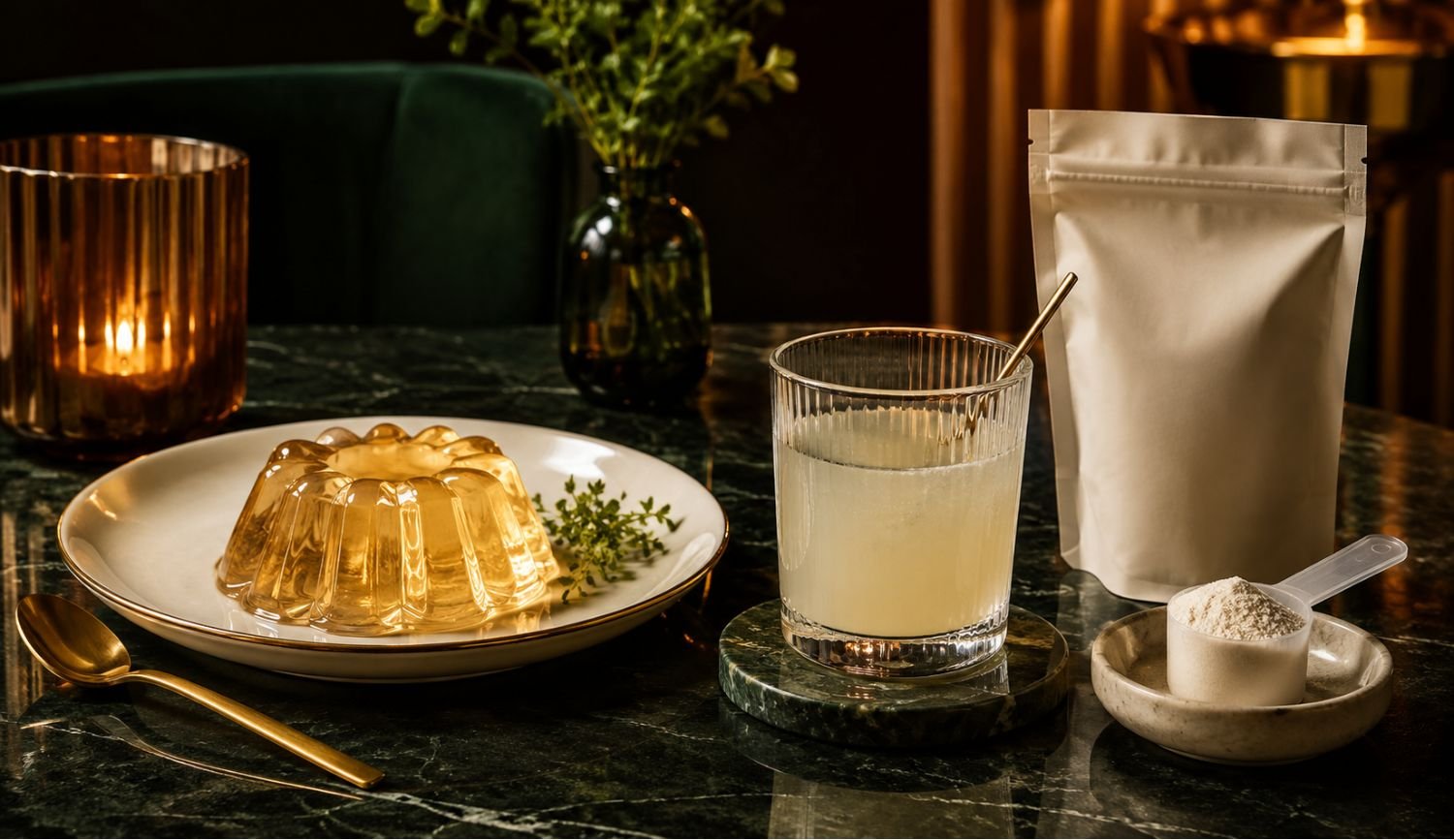
Gelatin is partially hydrolyzed collagen. Collagen peptides are hydrolyzed further, which breaks the protein into smaller fragments. Gelatin forms a gel when cooled in liquid, while collagen peptides dissolve into drinks without setting.
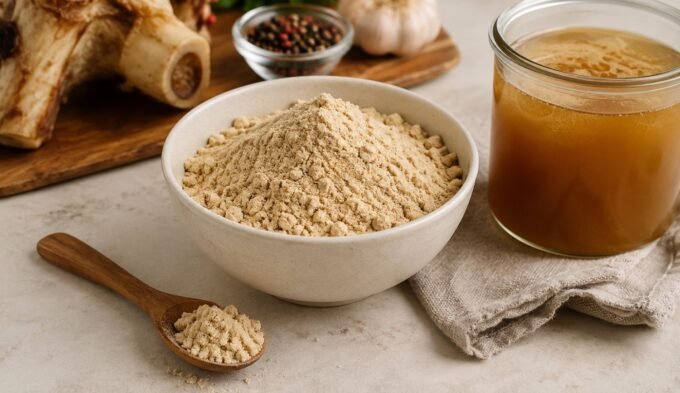
That difference shows up immediately in the kitchen. Gelatin, being less broken down, still forms a gel when it cools in liquid, which is why it thickens desserts, sauces, and gummies. Collagen peptides are broken into smaller fragments, so they dissolve into a drink without gelling and without much texture at all [1][2].
Is hydrolyzed collagen the same as gelatin? Not quite. In supplement language, “hydrolyzed collagen” usually refers to collagen peptides, the more fully broken-down form; gelatin sits at a different point on the same spectrum, its own distinct product even though both trace back to the same source protein.
Why “more natural” does not always mean safer
There’s a quiet assumption that tends to creep into this comparison: gelatin feels more traditional, more like a real food, while collagen peptides feel more processed, clinical.
It’s an understandable instinct, but not a reliable guide for a histamine-sensitive person.
“Natural” doesn’t control where the raw material came from, how it was handled, what got added to the final product, or how it was stored once it left the shelf.
A homemade gelatin dessert that sat in the fridge for four days is a different food, chemically, than the same dessert eaten fresh, and a single-ingredient collagen peptide powder can still cause trouble if the dose is large or lands on a day when your histamine load was already high.
Neither format earns automatic trust. Both deserve the same questions.
Histamine-sensitive people react to variables, not just names
This is really where the whole comparison lives. The name on the label, “collagen peptides” or “gelatin,” matters far less than the specifics behind it.
Source animal is one variable, since marine, bovine, and porcine collagen each carry their own handling considerations, and fish-derived material needs careful chilling to avoid histamine buildup before it’s processed [3]. Additives change the picture too: flavorings, sweeteners, capsule materials, dyes, and preservatives can each cause a reaction that has nothing to do with the collagen itself.
Serving size and timing matter as well. Reacting to a small amount on a stable day is different from reacting to a large dose during an active flare, since histamine symptoms depend on total load, not any single ingredient in isolation [4][5].
Freshness plays a role too; a stored, days-old preparation carries more risk than something made and eaten the same day.
Histamine Bucket Theory goes deeper into how these variables stack together.
Where collagen peptides may be easier
There’s a real case for collagen peptides being simpler to evaluate. A single-ingredient, unflavored powder dissolves cleanly, doesn’t require cooking, and doesn’t involve storing a prepared food for days.
Serving size can be measured precisely, which makes it easier to test in isolation than a multi-ingredient recipe.
Collagen Peptides and Histamine covers this format in more depth.
The caution: the dose in a scoop of peptides is concentrated, and people often take a full serving right away rather than easing in. “Easy to digest” is a claim about absorption, not a promise that everyone will tolerate it.
Where gelatin may be easier
Gelatin has its own case to make. It’s often used in smaller food quantities than a full scoop of powder, and it can create texture in a simple, freshly prepared dish without much fuss. Some people find it easier to work into a routine, especially when it’s kept plain and made fresh.
The catch is that gelatin rarely stays plain in the real world. It shows up in gummies, capsules, desserts, marshmallows, and broths, and those forms often bring sugar alcohols, flavors, colors, acids, or preservatives along with them.
A gelatin-based dessert kept in the fridge for several days isn’t the same low-variable food it was on day one, which matters more for highly sensitive people than for most.
Is gelatin high in histamine?
Gelatin is not automatically high histamine in the same way as fermented foods, aged meats, or long-simmered bone broth. But it is not guaranteed low histamine. Source, processing, additives, storage, recipe context, and personal threshold still matter.
Not in the way fermented foods, aged meats, or long-simmered bone broth are. Gelatin used fresh and plain doesn’t carry the same built-in fermentation or long-cooking risk that pushes those foods into higher-risk territory.
That doesn’t make it guaranteed low histamine. Source, processing, additives, storage, and recipe context all still matter. Beef and bovine gelatin aren’t automatically high histamine, but where it came from and how it was made still shapes the real risk for any given product.
Gelatin pulled from a long-simmered bone broth is a different situation, since broth’s extended cooking, cooling, and storage time introduces its own risk profile. Bone Broth and Histamine covers that specific case.
What about gelatin powder, Jell-O-style desserts, and gummies?
Plain gelatin powder, used fresh in a simple recipe, is very different from a sweetened, flavored gelatin dessert. Jell-O-style desserts typically bring in colors, flavors, acids, sweeteners, and preservatives, any of which can trigger a reaction that has nothing to do with the gelatin itself.
Sugar-free versions swap in sugar alcohols or artificial sweeteners, which can bother a sensitive gut on their own, and gummies tend to combine gelatin with acids, colorings, and longer shelf storage, stacking several possible triggers into one small candy.
A reaction to a gelatin dessert or a gummy doesn’t prove plain gelatin was the problem. The simpler the formula and the fresher the preparation, the easier any of this becomes to evaluate.
Why gelatin capsules can confuse supplement reactions
Plenty of unrelated supplements ship in gelatin capsules, which creates a specific kind of confusion. Someone reacts to a capsule and blames the active ingredient inside, when the shell, a filler, or a dye may be the actual cause.
Gelatin allergy is uncommon, but it is documented in medical literature, including reactions linked to gelatin-containing products [6].
A reaction to gelatin capsules does not prove every gelatin food is unsafe, but repeated reactions across different capsule products are worth discussing with a clinician.
Switching to a vegetarian capsule isn’t an automatic fix either, since cellulose capsules and other plant-derived fillers can bother sensitive people just as easily.
Throat or facial swelling, wheezing, trouble breathing, fainting, severe chest tightness, or hives spreading rapidly across the body are signals to seek urgent medical care rather than keep experimenting.
Can you use gelatin instead of collagen peptides?
Nutritionally, gelatin and collagen peptides both deliver collagen-derived amino acids, so in that narrow sense, they overlap. Functionally, they are not interchangeable. Gelatin gels; collagen peptides dissolve.
A recipe that depends on structure, such as a gummy or set dessert, needs gelatin. A drink or smoothie is usually better suited to collagen peptides because they dissolve without setting.
For a histamine-sensitive person, the substitution question shouldn’t stop at texture. Dose, freshness, additives, and your own tolerance history matter just as much.
When neither collagen peptides nor gelatin is the best starting point
Sometimes the honest answer is to step back from both. During an active flare, after repeated reactions to more than one collagen product, or when symptoms have included anything allergy-like, pushing forward with another format of the same source material rarely helps.
The same goes for anyone already reacting to multiple supplements at once, or reaching for collagen or gelatin specifically to “heal the gut” but flaring every time. That pattern is worth listening to rather than working around.
In those situations, it may make more sense to support collagen production without a collagen-derived product at all. Low Histamine Collagen Alternatives walks through what that can look like.
How to choose without turning it into a product hunt
The decision should stay practical. Favor the fewest ingredients you can find, choose unflavored over flavored where possible, skip beauty blends, and be cautious with gummies that contain acids, colors, sweeteners, or artificial flavors.
Test when you’re relatively stable, not mid-flare, and start with a small amount rather than a full serving.
Avoid testing gelatin buried inside a complex, multi-ingredient dish, since you won’t learn much if something goes wrong. Give it 24 to 48 hours before drawing conclusions, and stop if the same pattern shows up more than once.
The bottom line
Collagen peptides and gelatin are related, but they aren’t interchangeable for someone managing histamine intolerance. Peptides tend to be easier to measure and isolate, but arrive in a more concentrated dose.
Gelatin can feel more food-like, yet it hides easily inside complex recipes, capsules, gummies, and foods that have sat around longer than they should have.
Neither one wins by default. The better choice is the one with fewer variables, a smaller test burden, and a pattern your body has already shown it can tolerate.
Frequently asked questions
Are collagen peptides and gelatin the same thing?
No. Both come from collagen, but gelatin is only partially hydrolyzed and gels in liquid, while collagen peptides are more fully broken down and dissolve without gelling.
What is the difference between collagen peptides and gelatin?
How far the collagen has been hydrolyzed. Gelatin retains enough structure to set into a gel; collagen peptides are broken into smaller fragments that dissolve freely.
Is gelatin high in histamine?
Not automatically, and not in the same category as fermented or long-simmered foods. Source, processing, additives, and storage still shape the real risk for any given product.
Is beef gelatin high in histamine?
Not by default. It depends on the same variables as any gelatin: how the raw material was handled, how it was processed, and how fresh it is.
Is gelatin low histamine?
It can be a lower-variable choice when used plain and fresh, but that’s not a guarantee. Sweetened, flavored, or long-stored versions carry more risk.
Is gelatin better than collagen peptides?
Neither is universally better. Gelatin may involve smaller servings but more hidden additives; collagen peptides are easier to isolate but arrive in a more concentrated dose.
Can I use gelatin instead of collagen peptides?
Only in some situations. Gelatin works when a recipe needs structure or gelling. Collagen peptides work better in drinks or smoothies because they dissolve without setting.
Can collagen peptides be used as gelatin?
No. Collagen peptides won’t set or gel a recipe the way gelatin does, since they’ve been broken down too far to form that structure.
Can gelatin capsules cause histamine symptoms?
They can contribute in some people, though the capsule shell, a filler, or a dye is sometimes the actual trigger rather than the gelatin itself. True gelatin allergy is uncommon but documented, and repeated reactions are worth discussing with a clinician.
Are Jell-O-style gelatin desserts high histamine?
Not necessarily because of the gelatin alone. These desserts often include colors, flavors, acids, sweeteners, or preservatives that can trigger symptoms separately from the plain gelatin base.
Is hydrolyzed collagen the same as gelatin?
Not exactly. “Hydrolyzed collagen” usually describes the more thoroughly broken-down collagen peptides, while gelatin sits at an earlier, less-hydrolyzed stage of the same process.
What should I use if both collagen peptides and gelatin trigger me?
Fresh tolerated protein, along with targeted nutrients like glycine, proline, and vitamin C, can support the same goal without relying on either collagen-derived product.
References
Liu D, Nikoo M, Boran G, Zhou P, Regenstein JM. Collagen and Gelatin. Annual Review of Food Science and Technology. 2015;6:527–557. https://doi.org/10.1146/annurev-food-031414-111800
León-López A, Morales-Peñaloza A, Martínez-Juárez VM, Vargas-Torres A, Zeugolis DI, Aguirre-Álvarez G. Hydrolyzed Collagen—Sources and Applications. Molecules. 2019;24(22):4031. https://pmc.ncbi.nlm.nih.gov/articles/PMC6891674/
Gardini F, Özogul Y, Suzzi G, Tabanelli G, Özogul F. Technological Factors Affecting Biogenic Amine Content in Foods: A Review. Frontiers in Microbiology. 2016;7:1218. https://pmc.ncbi.nlm.nih.gov/articles/PMC4982241/
Maintz L, Novak N. Histamine and histamine intolerance. American Journal of Clinical Nutrition. 2007;85(5):1185–1196. https://doi.org/10.1093/ajcn/85.5.1185
Comas-Basté O, Sánchez-Pérez S, Veciana-Nogués MT, Latorre-Moratalla M, Vidal-Carou MC. Histamine Intolerance: The Current State of the Art. Biomolecules. 2020;10(8):1181. https://pmc.ncbi.nlm.nih.gov/articles/PMC7464760/
Bogdanovic J, Halsey NA, Wood RA, Hamilton RG. Bovine and porcine gelatin sensitivity in children sensitized to milk and meat. Journal of Allergy and Clinical Immunology. 2009;124(5):1108–1110. https://doi.org/10.1016/j.jaci.2009.06.021
Reviewed for scientific accuracy and editorial clarity under Nourishly standards.