
Collagen peptides are often marketed as clean, easy to digest, and gut friendly. But if you’re histamine-sensitive, the word “peptides” does not settle the risk question.
Collagen peptides and histamine can overlap because peptide powders still depend on source material, processing quality, additives, storage, dose, and personal threshold. Breaking a protein into smaller pieces doesn’t erase all of those variables.
This article looks specifically at what “collagen peptides” and “hydrolyzed collagen” actually mean, and why the processing step alone doesn’t settle the histamine question.
Why collagen peptides and histamine can overlap
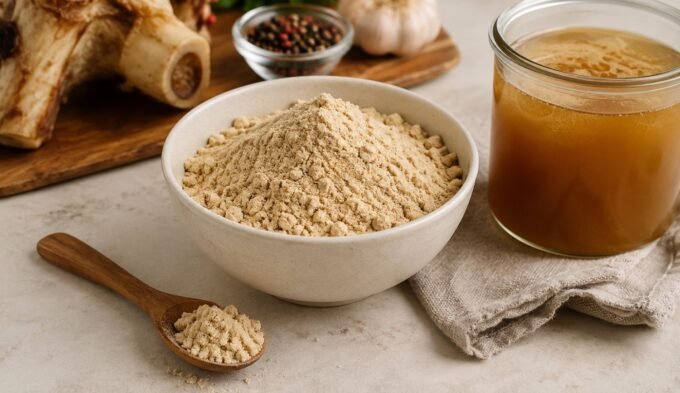
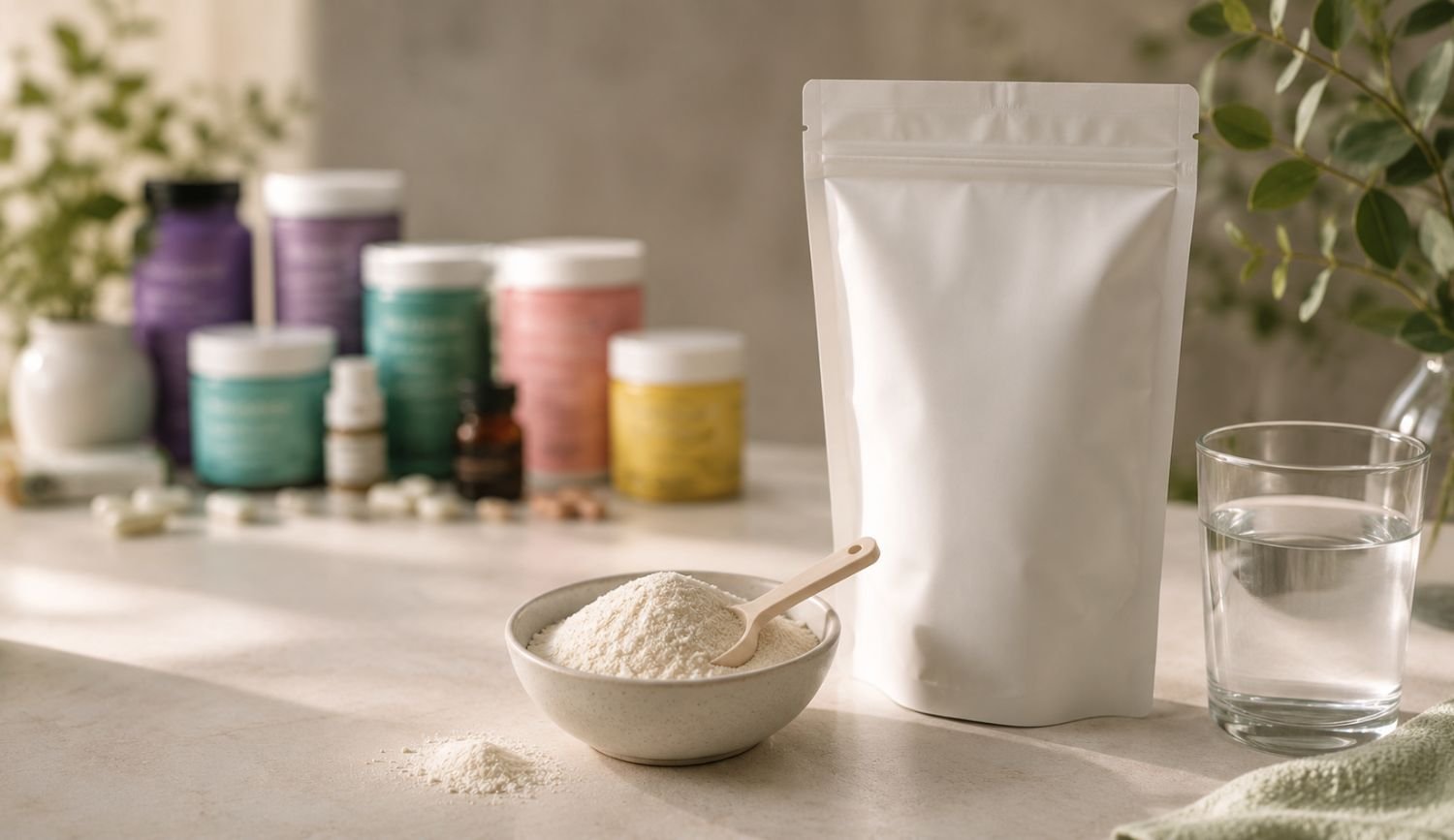
Collagen peptides are processed animal-derived protein powders, usually made from bovine, marine, porcine, or chicken collagen sources. The raw material always starts as animal connective tissue before it becomes a dissolvable powder.
The question of collagen peptides and histamine is not really about collagen as a molecule. It is about everything that happens around it: where the raw material came from, how it was handled before processing, how the finished product was manufactured and stored, what else was added to it, and how much you took.
Some people react simply because their histamine threshold was already high that day from food, stress, heat, or other triggers, and the collagen serving was the addition that tipped things over. This threshold effect is part of how histamine intolerance is understood to work more broadly, not something unique to collagen [4][5].
For a broader explanation of why the same food or supplement can feel different from one day to the next, see our guide to the Histamine Bucket Theory.
Are collagen peptides high in histamine?
Collagen peptides are not usually in the same high-histamine risk category as fermented foods, aged meats, wine, vinegar, or long-simmered bone broth, where time, aging, fermentation, or extended storage are central variables.
That said, most supplement labels do not disclose histamine or biogenic amine content. So “not high histamine by default” is not the same as “tested low histamine” or “safe for every sensitive person.” Is Collagen High in Histamine? covers the general version of this question in more depth.
Are collagen peptides low histamine?
Collagen peptides may be lower-variable than long-simmered bone broth for some people, but that does not make them proven low histamine. Treat a product as genuinely low histamine only when the company provides meaningful testing or quality documentation, not just clean branding.
A short ingredient list helps, and it is a reasonable thing to look for. But it is not enough on its own to guarantee tolerance.
Unflavored products tend to carry fewer variables than flavored ones, which is worth factoring in, though it is still not a promise. Treat any “low histamine” claim as something to evaluate critically, not something to take at face value.
Useful documentation would ideally include batch testing, third-party quality controls, or clear handling standards rather than vague claims like “clean,” “pure,” or “gut friendly.”
What hydrolyzed collagen actually means
Hydrolyzed collagen means the large collagen protein has been broken down into shorter peptide chains, usually through an enzymatic process. In supplement language, “collagen peptides” and “hydrolyzed collagen” are essentially describing the same thing [1][2].
This breakdown process is largely why collagen peptide powders dissolve easily and are designed to be digested and absorbed as smaller peptides and amino acids [1][2]. Hydrolysis is a structural and manufacturing detail, not a histamine safeguard.
It’s worth being precise here: hydrolysis does not create histamine by itself, and it does not remove the risks tied to source material, additives, processing conditions, or dose. It changes molecular size, not the entire safety profile.
Here is the practical difference between the common collagen terms you may see on labels or in low-histamine discussions.
| Collagen term | What it usually means | Histamine-sensitive takeaway |
|---|---|---|
| Collagen peptides | Collagen broken into smaller peptide chains, usually sold as a dissolvable powder. | Not automatically high histamine, but source, additives, dose, and processing still matter. |
| Hydrolyzed collagen | Another common term for collagen that has been enzymatically broken down into peptides. | Hydrolyzed does not mean histamine-free or guaranteed safe for sensitive people. |
| Gelatin | Partially broken-down collagen that gels in liquid and behaves differently in recipes. | Do not assume gelatin and collagen peptides will be tolerated the same way. |
| Bone broth | A long-simmered liquid made from bones, connective tissue, and sometimes meat. | Different risk profile because simmering time, cooling, and storage become major variables. |
Once those terms are clear, the next question is why a hydrolyzed powder can still bother some people even when the label looks clean.
Why hydrolyzed collagen can still trigger reactions
Several variables sit between “hydrolyzed” and “well tolerated.” Source material quality is one of the biggest. For marine-derived collagen especially, delayed chilling or poor handling can raise concern because fish histamine risk is strongly tied to time, temperature, and handling before processing [3][6].
That does not mean marine collagen peptides are the same as spoiled fish. It means the source and handling chain matter more than the word “peptides” on the label.
Bovine, porcine, or marine source sensitivity is possible on its own, separate from any histamine question. Added ingredients, flavor systems, sweeteners, gums, preservatives, vitamin blends, probiotics, and “beauty blend” extras can each cause symptoms independent of the collagen itself. Collagen Supplements and Histamine goes deeper into these product-level triggers.
Serving size plays a role too, since a larger dose is simply more to process at once. Taking collagen peptides during an active flare, or stacking them with other histamine triggers that day, can also make a reaction more likely regardless of the product’s quality.
Symptoms people report after collagen peptides
Reports vary, but common ones include flushing, itching, hives or rash, headache, congestion, nausea, diarrhea or gut urgency, a racing heart, an anxious or wired feeling, and insomnia.
These symptoms can overlap with allergy, MCAS, food poisoning, medication reactions, or other medical issues. They don’t prove histamine intolerance or MCAS on their own, and sorting out the actual cause usually needs more than a single reaction to go on.
Some symptoms need faster action than tracking allows. Seek urgent medical care for throat swelling, trouble breathing, wheezing, facial, lip, or tongue swelling, fainting, severe chest tightness, rapidly spreading hives, or any other signs of anaphylaxis.
Once safety is covered, source material becomes the next major variable.
Marine vs bovine collagen peptides
Marine collagen peptides add fish-handling and fish-allergy variables that bovine collagen doesn’t carry. Bovine collagen sidesteps those specific concerns but can still trigger some people for other reasons.
Neither source is universally safe or universally unsafe. Readers who react to fish or seafood should be especially cautious with marine collagen specifically. Marine Collagen and Histamine covers this comparison in far more depth.
Collagen peptides vs bone broth
Collagen peptides are a processed powder. Bone broth is a long-simmered food or liquid, and those two things carry genuinely different risk profiles.
Bone broth’s main variables are long cooking time, cooling speed, and storage duration. Collagen peptides’ main variables are sourcing, manufacturing conditions, additives, and dose.
They aren’t interchangeable from a histamine-risk standpoint, even though both get marketed for similar goals. Bone Broth and Histamine covers the broth side of this in detail.
That difference matters when you are standing in front of a supplement label trying to decide what is actually lower-variable.
What to check before buying collagen peptides
A few practical checks can narrow the variables before you even open the tub. Look for a single-ingredient formula, unflavored, with no added gums, sweeteners, natural flavors, vitamin blends, probiotics, herbal blends, or “beauty complex” extras.
Clear source labeling matters, ideally naming the animal source rather than using a vague description. Batch testing or quality documentation, if a brand provides it, is a genuine plus.
If a brand uses “low histamine” language but cannot explain what was tested, how often it is tested, or what quality controls are used, treat the claim cautiously.
A smaller serving size option gives more room to test cautiously, and a vague “proprietary blend” listing is generally a reason for more scrutiny, not less.
How to test collagen peptides more carefully
If you want to test tolerance, a careful approach beats guessing. Don’t test during an active flare, and choose one simple, single-ingredient product rather than a blend.
Start well below the full recommended serving, and avoid stacking the test with new foods or other new supplements at the same time. Testing earlier in the day, rather than right before bed, makes it easier to notice a reaction while you’re awake to track it.
Track symptoms for 24 to 48 hours afterward, since reactions aren’t always immediate. Stop if the same reaction repeats, and talk with a clinician if symptoms are severe or confusing.
What to use instead if collagen peptides trigger you
If collagen peptides genuinely don’t agree with you, there are other ways to support the same underlying goal. Fresh tolerated protein, glycine, proline, vitamin C, and certain minerals all play a role in the body’s own collagen production.
Short-cooked fresh meat broth, if tolerated, may also help people who want a warm broth option without relying on traditional long-simmered bone broth. Low Histamine Collagen Alternatives covers this full picture in detail.
Who should avoid collagen peptides or ask a clinician first
Some situations call for extra caution rather than self-testing. A known allergy to the source animal or fish is the clearest reason to avoid a specific collagen type.
Previous throat swelling, breathing symptoms, facial swelling, fainting, or rapidly spreading hives after any supplement are reasons to stop rather than retest.
Unstable MCAS-type symptoms, pregnancy or breastfeeding, kidney disease, immune compromise, complex medication use, medically prescribed diets, and a history of severe supplement reactions are all situations where a clinician’s input should come before trying collagen peptides.
The bottom line
Collagen peptides are not usually in the same high-histamine category as fermented foods or long-simmered broth, but they are not proven low histamine by default.
Hydrolyzed simply means collagen has been broken into smaller peptides; it does not prove the product is histamine-free, tested, or suitable for every sensitive person.
The real question is the full product chain: source material, handling, processing quality, additives, serving size, and your current histamine threshold. If collagen peptides repeatedly trigger symptoms, forcing them is not necessary.
Fresh tolerated protein, targeted amino acids, vitamin C, minerals, and other collagen-support options can cover the same goal with fewer product variables.
Frequently asked questions
These answers summarize the most common collagen peptide questions for histamine-sensitive readers. They are not a substitute for medical evaluation if reactions are severe, repeated, or allergy-like.
Are collagen peptides high in histamine?
Usually no. Collagen peptides are not in the same category as fermented foods, aged meats, wine, vinegar, or long-simmered bone broth. But source material, processing, additives, dose, and individual threshold can still affect tolerance.
Are collagen peptides low histamine?
Not guaranteed. Some products may be well tolerated, but “low histamine” on a label should be treated as a claim unless the company provides meaningful testing or quality documentation.
Are collagen peptides the same as hydrolyzed collagen?
Yes. In supplement language, collagen peptides and hydrolyzed collagen usually refer to collagen protein that has been broken down into smaller peptide chains.
Can hydrolyzed collagen cause a skin reaction?
Yes, skin reactions can happen after any supplement, including hydrolyzed collagen. The cause is not always histamine; it could be allergy, an additive, the dose, the source material, or another medical issue.
Why do collagen peptides make me flush?
Flushing can come from a histamine-type reaction, a true allergic response, an additive like niacin in a fortified blend, or simply a larger dose than your body tolerates. Collagen Supplements and Histamine covers this in more depth.
Are marine collagen peptides higher histamine than bovine collagen peptides?
Marine collagen peptides can carry extra fish-handling and fish-allergy variables. Bovine collagen avoids those specific fish-related concerns, but it can still trigger some sensitive people.
Are unflavored collagen peptides safer?
They tend to carry fewer variables than flavored or fortified blends because there are fewer added ingredients to react to. That makes unflavored collagen peptides a cleaner starting point, not a guarantee.
What should I look for in low histamine collagen peptides?
Look for a single-ingredient, unflavored product with clear sourcing, no added flavors or blends, and meaningful quality documentation if the company makes low histamine claims.
Should I take collagen peptides during a histamine flare?
Testing any new supplement during an active flare makes it harder to know what caused what. Most people get more useful information by waiting until symptoms are relatively stable.
What can I use instead of collagen peptides?
Fresh tolerated protein, targeted amino acids like glycine and proline, vitamin C, minerals, and short-cooked fresh meat broth if tolerated can support the same underlying goal with fewer collagen-powder variables.
References
- León-López A, Morales-Peñaloza A, Martínez-Juárez VM, Vargas-Torres A, Zeugolis DI, Aguirre-Álvarez G. Hydrolyzed Collagen—Sources and Applications. Molecules. 2019;24(22):4031. https://pmc.ncbi.nlm.nih.gov/articles/PMC6891674/
- Liu D, Nikoo M, Boran G, Zhou P, Regenstein JM. Collagen and Gelatin. Annual Review of Food Science and Technology. 2015;6:527–557. https://doi.org/10.1146/annurev-food-031414-111800
- Gardini F, Özogul Y, Suzzi G, Tabanelli G, Özogul F. Technological Factors Affecting Biogenic Amine Content in Foods: A Review. Frontiers in Microbiology. 2016;7:1218. https://pmc.ncbi.nlm.nih.gov/articles/PMC4982241/
- Maintz L, Novak N. Histamine and histamine intolerance. American Journal of Clinical Nutrition. 2007;85(5):1185–1196. https://doi.org/10.1093/ajcn/85.5.1185
- Comas-Basté O, Sánchez-Pérez S, Veciana-Nogués MT, Latorre-Moratalla M, Vidal-Carou MC. Histamine Intolerance: The Current State of the Art. Biomolecules. 2020;10(8):1181. https://pmc.ncbi.nlm.nih.gov/articles/PMC7464760/
- Food Poisoning from Marine Toxins: Scombroid (Histamine) Fish Poisoning. CDC Yellow Book. https://www.cdc.gov/yellow-book/hcp/environmental-hazards-risks/food-poisoning-from-marine-toxins.html
Reviewed for scientific accuracy and editorial clarity under Nourishly standards.