
You started collagen for your skin, your joints, or your gut, and it felt like a small act of self-care. Then, not long after a scoop in your coffee or smoothie, your face went warm and red.
Maybe your skin started itching, your head began to ache, your heart picked up pace, or your stomach turned uneasy. It’s a confusing moment.
Collagen is supposed to be one of the “safe,” almost boring supplements. So why did it seem to set something off?
The reaction can be real without collagen being some hidden villain. In histamine-sensitive people, a collagen supplement can sometimes contribute to symptoms like flushing, itching, or a racing heart.
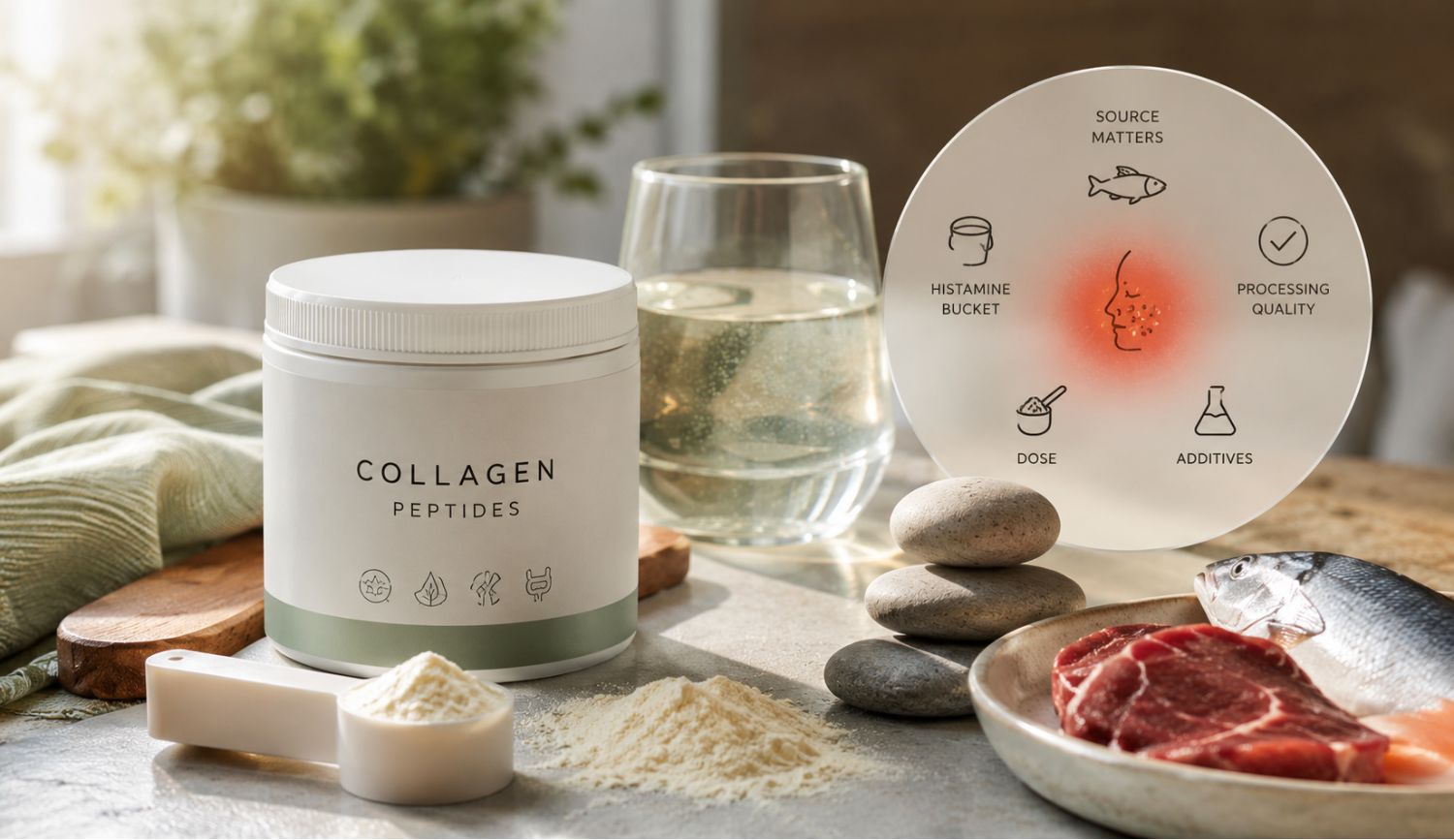
But the reason is rarely as simple as “collagen is high in histamine.” Source, processing, additives, dose, and your own histamine threshold that day all play a role.
How collagen supplements and histamine symptoms can overlap
In some sensitive people, collagen supplements can contribute to histamine-type symptoms such as flushing, itching, headache, a faster heartbeat, or digestive upset. But this usually isn’t because collagen itself is automatically loaded with histamine.
What tends to matter more is where the collagen came from, how it was processed and stored, what else is mixed into the product, how much you took, and how full your personal histamine bucket already was that day. Two people can take the same tub of collagen and have completely different experiences.
That’s a clue that the picture is more layered than “collagen equals histamine.”
Is collagen high in histamine?
This is the question most people are really asking, and it deserves a direct but nuanced answer: not automatically.
High-quality collagen peptides made from properly handled raw material are generally considered lower-risk than long-simmered broths, aged meats, or fermented foods. But they are not automatically histamine-free, and most consumers cannot verify the final amine content of a powder just by reading the front label.
The concern is that biogenic amine risk can rise when raw materials are poorly handled, temperature control fails during processing or storage, microbial contamination occurs, or the finished product contains reactive additives layered on top of the collagen itself [1].
Bone broth is a useful contrast here. Long, slow simmering and extended storage give more opportunity for amine buildup than a well-processed collagen peptide powder does.
That’s part of why some people tolerate collagen powder better than homemade bone broth, or vice versa. Bone Broth and Histamine covers that comparison in more depth.
Marine collagen adds another layer of variability, since fish-derived raw material carries its own handling considerations. And once you add flavors, sweeteners, or “beauty blend” extras, it becomes genuinely hard to know whether a reaction is about the collagen at all.
Why collagen powder can make your face flush
Flushing is one of the more common complaints, and it can have more than one explanation.
Some people may experience something closer to a histamine-type response, where the body’s histamine load was already high from food, stress, heat, alcohol, or hormones. The collagen serving may simply be the final addition that tipped things into a visible reaction Histamine Bucket Theory.
Others may be reacting to something else entirely, like niacin (vitamin B3) added to a “beauty blend” formula. Niacin is well known for causing a harmless but startling skin flush on its own.
A true allergic or immune reaction is also possible, especially with marine collagen and fish-related allergies, and this is different from a histamine-type reaction. Taking a large dose on an empty stomach, or blending collagen into a smoothie with other personal trigger foods, can also make it hard to isolate collagen as the true cause.
In a small subset of sensitive people, hydrolyzed protein powders may also feel stimulating or uncomfortable for reasons that are not purely histamine-related, including dose size, peptide breakdown, free amino acids, and individual nervous-system sensitivity.
This article isn’t the place for a deep dive into treating flushing itself. If skin flushing and reactions are a recurring theme for you beyond collagen, Histamine Skin Reactions covers that ground more fully.
What hydrolyzed collagen actually is
It helps to understand what’s actually in the tub before deciding whether to blame it.
Collagen is a structural protein found in the skin, bones, cartilage, and connective tissue of animals. On its own, collagen is a large, tightly coiled molecule that doesn’t dissolve well in water.
Hydrolysis is the process that breaks that large protein down into much smaller peptide fragments. That’s why hydrolyzed collagen dissolves easily in coffee or water and is generally considered easier for the body to absorb [1][2].
It’s worth being clear about what hydrolysis is not. It is not bacterial fermentation, and it is not the same process that lets histamine build up as food spoils or ages.
Hydrolysis is typically done under controlled manufacturing conditions using heat, water, or enzymes to break peptide bonds. That said, the quality of the starting raw material and how carefully a manufacturer controls temperature and contamination during processing still matter for whether the finished powder is easy or difficult for a sensitive person to tolerate [1].
Collagen is also not a complete protein because it lacks tryptophan. That does not make it harmful, but it means collagen should not replace complete protein foods in the diet. If someone uses collagen as a major protein source, the amino acid pattern can become unbalanced.
Marine collagen vs bovine collagen for histamine-sensitive people
Collagen supplements typically come from a handful of animal sources, and the source is one of the more meaningful variables for histamine-sensitive people.
Marine collagen is usually derived from fish skin and scales. Fish tissue is known to generate histamine relatively quickly if it isn’t chilled properly after harvesting, which is the same underlying issue behind scombroid poisoning in fish that’s eaten directly [3].
That doesn’t mean all marine collagen is problematic. But it does mean raw material handling and sourcing transparency matter more here, and fish allergy is a separate consideration worth ruling out.
For some histamine-sensitive people, a plain bovine collagen peptide may be easier to evaluate than marine collagen because it removes the fish-handling variable. That does not make bovine collagen automatically safe, histamine-free, or appropriate for everyone.
Beef sensitivity exists, and for a small number of people, mammalian-derived products can be relevant to alpha-gal syndrome, a distinct tick-bite-related allergy discussed more below [4].
Porcine collagen and “multi-collagen” blends that combine several animal sources add another layer of complexity, since you’re now troubleshooting more than one variable at once. Individual tolerance is still the deciding factor.
This section only scratches the surface, since a full comparison deserves its own dedicated look at marine collagen specifically.
The supplement label may be the real problem
Before blaming collagen itself, the ingredient label deserves a close read.
Many collagen products aren’t just collagen. They’re built around collagen peptides but layered with flavors, sweeteners like stevia, monk fruit, or sugar alcohols, thickening gums, added probiotics, fermented “superfood” blends, vitamin complexes, niacin (B3), biotin, citric acid, herbal extracts, or a whole “beauty blend” formula aimed at hair and skin.
Any one of those additions can cause flushing, digestive upset, or itching on its own, completely separate from the collagen. Niacin flush is a well-known, harmless example.
Citric acid, certain gums, and herbal extracts can also be individual triggers for sensitive people.
This is exactly why a single-ingredient, unflavored collagen peptide product tends to be far easier to test than a flavored, fortified blend. When you strip out the extras, you’re left with one variable instead of eight.
Collagen reaction, allergy, niacin flush, or histamine intolerance?
Several very different things can look similar in the moment. This table is meant to help you notice patterns worth mentioning to a clinician, not to diagnose yourself.
| Possible cause | Typical pattern | What to check |
|---|---|---|
| Histamine-type reaction | Flushing, itching, headache, or a faster heartbeat, often when other triggers already stacked that day | Timing relative to other high-histamine foods, alcohol, heat, or stress; whether it eases as other triggers are removed |
| Fish allergy / marine collagen reaction | Hives, swelling, or breathing symptoms after marine collagen specifically | Known fish or shellfish allergy history; source listed on the label |
| Beef or bovine sensitivity | Digestive upset or skin symptoms tied specifically to bovine-sourced products | Whether symptoms also occur with beef or other bovine products |
| Alpha-gal-type concern | Delayed reaction, often hours later, after mammalian-derived products | History of tick bites; reactions to red meat or gelatin, discussed with an allergist |
| Niacin flush from added B3 | Warm, red, tingly skin shortly after a dose, without itching or hives | Whether the product contains added niacin or a “beauty blend” vitamin mix |
| Additive or sweetener reaction | Bloating, headache, or skin symptoms tied to flavored or sweetened versions | Comparing a flavored product against a plain, unflavored one |
| Digestive intolerance / dose too high | Nausea, bloating, or discomfort tied to serving size | Whether a smaller dose or spreading it across the day changes the response |
A quick note on alpha-gal syndrome, since it comes up in collagen conversations. It’s an allergy to a sugar molecule found in mammalian tissue, typically triggered by a tick bite, and reactions are usually delayed by hours rather than immediate [4].
It’s worth mentioning to an allergist if you have a history of tick bites and delayed reactions to red meat or other mammalian products. It isn’t something to self-diagnose from a collagen reaction alone.
Two conditions are also worth keeping clearly separate here. Histamine intolerance is different from an IgE-mediated food allergy, and mast cell activation syndrome (MCAS) is its own distinct diagnosis rather than simply “severe histamine intolerance.”
Histamine Intolerance Symptoms and DAO and Gut Health Connection go deeper on how histamine intolerance itself works [5][6].
How to test whether collagen is the trigger
If you suspect collagen is playing a role, a careful, methodical approach beats guessing.
Stop the product as soon as symptoms appear, rather than pushing through to “see if it passes.” Do not retest a product that caused anything resembling a severe allergic reaction, such as swelling or breathing changes; that’s a conversation for a clinician, not a self-experiment.
Check the label first, since a flavored, fortified blend gives you far less useful information than a single-ingredient product.
Avoid testing during an active flare, when your histamine bucket is already fuller than usual from food, stress, heat, alcohol, or poor sleep. Change one variable at a time.
If you decide to try again, start with a small amount rather than a full serving. Only do this if it feels safe and, ideally, with a clinician’s input, especially if you have any allergy history.
A food and symptom diary notebook can make this process far more useful, since patterns are much easier to spot on paper than in memory. Don’t test collagen for the first time inside a high-histamine smoothie loaded with other potential triggers; that muddies the results before you start.
And if symptoms return with a retest, that’s useful information, not a failure.
What to use instead if collagen keeps causing symptoms
If collagen genuinely doesn’t agree with you, there are practical ways to support the same goals without it.
Fresh, quick-cooked protein foods that you already tolerate well remain a solid foundation. Freezing leftovers quickly helps limit the same amine buildup that makes aged or slow-cooked proteins harder for sensitive people to handle What to Eat with Histamine Intolerance.
Some people explore pure glycine powder or pure L-proline powder as single amino acids rather than a full collagen peptide blend, since these are individual building blocks collagen synthesis relies on.
Vitamin C is a genuinely essential piece of the collagen picture, since it’s a required cofactor for the enzymes that stabilize collagen’s structure during synthesis in the body [7]. Getting vitamin C, zinc, and copper from tolerated foods supports your body’s own collagen production.
The same goes for the basics: sun protection, sleep, hydration, and resistance training, rather than replacing all of that with a supplement.
Freezer-safe glass meal prep containers are a practical tool here too, since they make it easier to batch-cook and freeze fresh protein quickly instead of letting it sit in the fridge. None of this treats a medical condition.
It’s simply supporting the same underlying goals collagen supplements are marketed for, using approaches that may be gentler for a sensitive system.
When to avoid collagen completely
Some situations call for skipping collagen supplements altogether, or only using them under direct medical guidance.
That includes a known fish allergy paired with marine collagen, a known beef allergy paired with bovine collagen, or any previous severe reaction to a collagen product. Suspected alpha-gal syndrome deserves an allergist’s input before trying any mammalian-derived collagen.
Pregnancy and breastfeeding are also reasons to check with a clinician first, simply because supplement research in these groups is often limited.
Kidney disease or a protein-restricted diet is another situation where a clinician should weigh in, since collagen supplements add to overall protein intake. The same goes for active, unstable MCAS-type symptoms, where introducing new supplements without guidance can complicate an already unpredictable picture.
And if you ever experience throat swelling, trouble breathing, wheezing, rapidly spreading hives, facial or tongue swelling, fainting, severe chest tightness, or severe vomiting after any supplement, that’s an emergency. Seek urgent medical care immediately rather than waiting to see if it passes.
The bottom line
Collagen supplements and histamine symptoms can overlap, but collagen supplements are not automatically high in histamine, and most people take them without incident. But in histamine-sensitive people, a reaction is possible, and it’s rarely about collagen alone.
Source, processing quality, additives, dose, and your personal histamine threshold that day all shape whether a serving sits fine or sets off symptoms.
Marine collagen tends to carry more variables worth checking, largely tied to fish handling and fish allergy. A single-ingredient, unflavored bovine collagen may be easier for some people to evaluate, though it is not guaranteed to be tolerated.
If collagen doesn’t work for you, there are real alternatives. Fresh tolerated protein, individual amino acids, and nutrients like vitamin C can all support your body’s own synthesis pathway.
Frequently asked questions
Is collagen high in histamine?
Not automatically. Well-processed, single-ingredient collagen peptides are generally treated as lower-risk than long-simmered broths, aged meats, or fermented foods, but they are not automatically histamine-free.
Risk tends to rise with poor raw material handling, temperature abuse during processing or storage, contamination, or added ingredients layered into the product.
Can collagen powder cause flushing?
It can, in some sensitive people. Flushing may come from a histamine-type reaction when the body’s histamine load was already high, from added niacin in beauty-blend formulas, from a true allergic reaction, or from a large dose taken quickly.
It’s rarely one single, universal reason.
Is marine collagen worse for histamine intolerance?
It can be more variable for some people, mainly because fish tissue can develop histamine quickly if it isn’t chilled properly during handling. Fish allergy is also a separate consideration.
That doesn’t mean all marine collagen is unsafe, but it’s a reason to look closely at sourcing.
Is bovine collagen low histamine?
It may be easier for some people to evaluate because it avoids fish-handling variables. But it is not automatically histamine-free or guaranteed safe for everyone.
Beef sensitivity and, rarely, alpha-gal-type concerns are still worth ruling out.
Can collagen cause hives or itching?
In sensitive individuals, yes, it’s possible, whether from a histamine-type reaction, an additive, or a true allergic response. Hives, in particular, are worth mentioning to a clinician, especially if they spread quickly or come with swelling or breathing changes.
Can collagen powder cause anxiety or heart racing?
Some people report a wired or anxious feeling or a faster heartbeat after collagen, which may relate to a histamine-type response, a large dose, or other ingredients in the blend. This article isn’t the place to fully unpack panic-like symptoms.
Histamine Intolerance Symptoms covers that broader picture.
What is the best collagen for histamine intolerance?
There is no universal “best” collagen for histamine intolerance. If someone chooses to test collagen, the easiest product to evaluate is usually single-ingredient, unflavored, and free of vitamin blends, sweeteners, probiotics, gums, and herbal extracts.
Some people start by avoiding marine collagen because of fish-handling and fish-allergy variables, but bovine collagen is not guaranteed safe either.
What can I take instead of collagen?
Fresh, tolerated protein foods, individual amino acids like glycine or proline, and nutrients that support your body’s own collagen production, such as vitamin C, are common alternatives. These support the same underlying goals without necessarily involving the same supplement.
References
- Sibilla S, Godfrey M, Brewer S, Budh-Raja A, Genovese L. An Overview of the Beneficial Effects of Hydrolysed Collagen as a Nutraceutical on Skin Properties: Scientific Background and Clinical Studies. The Open Nutraceuticals Journal. 2015;8:29–42. https://benthamopen.com/contents/pdf/TONUTRAJ/TONUTRAJ-8-29.pdf
- Biochemistry, Collagen Synthesis. StatPearls. NCBI Bookshelf. https://www.ncbi.nlm.nih.gov/books/NBK507709/
- Joint FAO/WHO Expert Meeting on the Public Health Risks of Histamine and Other Biogenic Amines from Fish and Fishery Products: Meeting Report. World Health Organization / FAO. https://www.who.int/publications/i/item/9789240691919
- About Alpha-gal Syndrome. Centers for Disease Control and Prevention. https://www.cdc.gov/alpha-gal-syndrome/about/index.html
- Maintz L, Novak N. Histamine and histamine intolerance. American Journal of Clinical Nutrition. 2007;85(5):1185–1196. https://doi.org/10.1093/ajcn/85.5.1185
- Comas-Basté O, Sánchez-Pérez S, Veciana-Nogués MT, Latorre-Moratalla M, Vidal-Carou MC. Histamine Intolerance: The Current State of the Art. Biomolecules. 2020;10(8):1181. https://pmc.ncbi.nlm.nih.gov/articles/PMC7464760/
- Physiology, Connective Tissue. StatPearls. NCBI Bookshelf. https://www.ncbi.nlm.nih.gov/books/NBK542226/
- WebMD. Collagen Peptides – Uses, Side Effects, and More. https://www.webmd.com/vitamins/ai/ingredientmono-1606/collagen-peptides
Reviewed for scientific accuracy and editorial clarity under Nourishly standards.