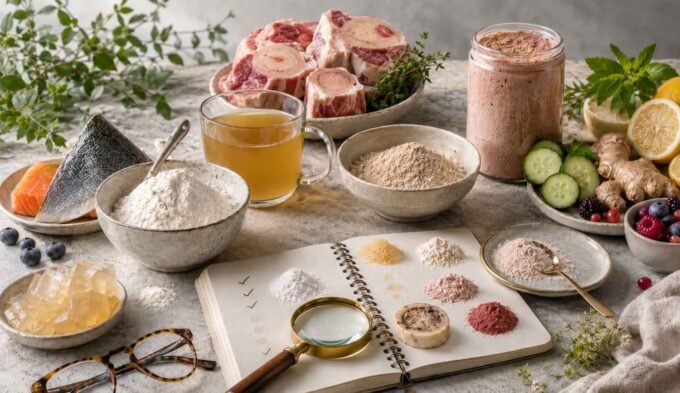

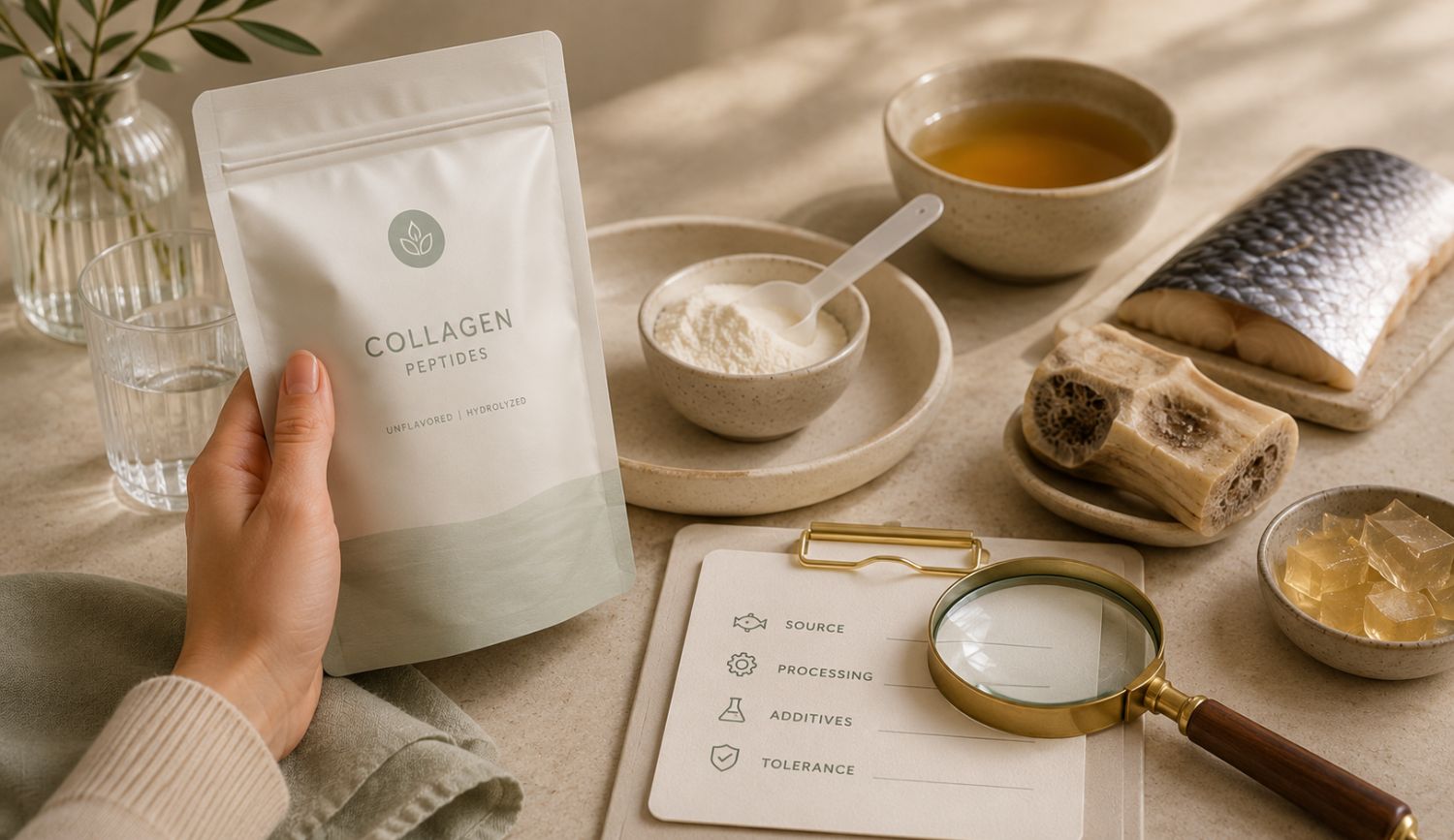
If you are asking, “is collagen high in histamine?”, the honest answer is: collagen is not automatically in the same category as aged, fermented, or long-stored foods.
Collagen peptides are not the same thing as long-simmered bone broth, aged cheese, or fermented foods. But that doesn’t mean collagen is guaranteed histamine-free either.
Source, processing quality, additives, dose, and your own histamine threshold that day all matter.
This article gives the short answer. For flushing, itching, heart racing, additives, and step-by-step tolerance testing, the broader guide on collagen supplements and histamine goes deeper.
Is collagen high in histamine?
Is collagen high in histamine? Not as a blanket rule.
Collagen peptides are processed animal protein products, not fermented foods by default. That distinction matters, because most classic high-histamine foods, like aged cheese, cured meat, or wine, get their histamine load from fermentation, long aging, or bacterial activity over time [1].
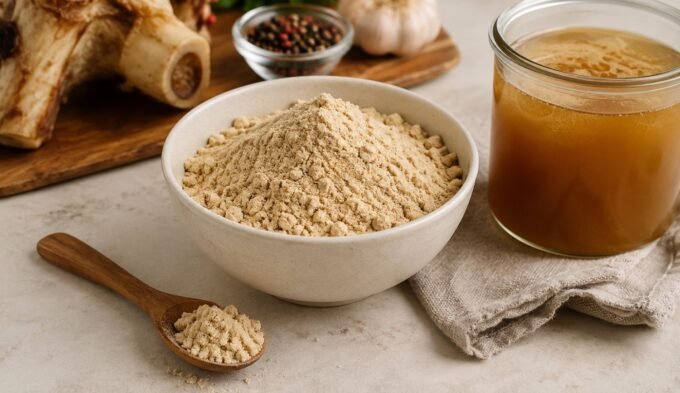
Collagen powder is typically made through hydrolysis, a manufacturing process that breaks down the large collagen protein into smaller peptides so it dissolves easily and absorbs more readily [2]. That process is mechanical or enzymatic, not fermentation, so the risk question is more about raw material handling, microbial control, storage, and additives than hydrolysis alone.
Well-manufactured collagen powder avoids many of the same aging and fermentation conditions that make classic high-histamine foods more predictable triggers. That is why it may be a lower-risk option for some people, though “lower-risk” is still not the same as “risk-free.”
Why some people still react to collagen
Reactions still happen, and they’re rarely about one single factor.
A collagen serving can be the addition that tips an already full histamine load into visible symptoms, sometimes called a histamine bucket effect. In histamine intolerance, this happens when the amount of histamine coming in, or being released internally, outpaces how quickly the body can break it down [4][5].
Raw material quality, how the fish or animal source was handled, and how the powder was processed and stored can all shift the histamine or biogenic amine content of the finished product [1][4]. Added ingredients, dose size, and your personal tolerance on a given day matter too.
This article covers the short version; Collagen Supplements and Histamine walks through the fuller reaction picture, including flushing and testing.
Collagen powder is not the same as bone broth
People often lump these together, but they behave differently.
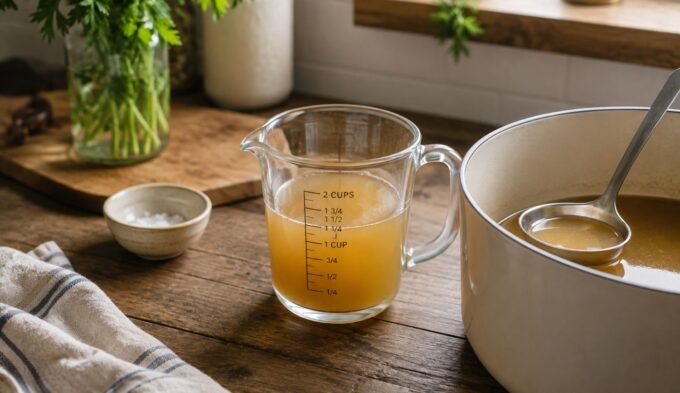
Bone broth typically involves many hours of simmering, plus days of storage in the fridge as leftovers. Both of those steps give histamine and other biogenic amines more time to build up [1][4].
Collagen peptide powder is made through a more controlled hydrolysis process, breaking the protein down under manufacturing conditions rather than through prolonged home simmering. Some people tolerate collagen powder better than bone broth, though this is individual, not universal. Bone Broth and Histamine covers that comparison directly.
Are collagen peptides histamine-free?
No. No collagen product should be assumed histamine-free unless it has actually been tested and verified.
“Low-risk” and “histamine-free” are two different claims. Most supplement labels don’t list histamine or biogenic amine content at all, so you’re rarely working with real numbers.
Third-party quality testing can confirm things like purity or heavy metal levels, but it doesn’t automatically prove a specific histamine level [7]. Treat any “low histamine” claim on a collagen label as a starting point, not a guarantee.
Marine collagen vs bovine collagen: which is lower histamine?
Marine collagen comes from fish skin and scales. Fish tissue can generate histamine quickly if it isn’t chilled properly right after harvesting, which is why sourcing and handling matter more here than with most other proteins [3].
Fish allergy is a separate issue from histamine intolerance, and it’s worth ruling out on its own. Bovine collagen removes the fish-handling variable, which may make it easier for some people to evaluate, but it is not guaranteed to be safe or well tolerated [6].
Individual tolerance still decides the outcome either way. Marine Collagen and Histamine covers this comparison in far more depth.
Ingredients that can make collagen feel high histamine
Often, it isn’t the collagen at all.
Many products are collagen peptides layered with flavors, sweeteners, thickening gums, added probiotics, fermented “superfood” blends, vitamin complexes, niacin (B3), or herbal extracts. Any one of those can cause flushing, itching, or digestive symptoms on its own.
Niacin flush, for example, is a well-known and separate reaction from a histamine-type one. A single-ingredient, unflavored product removes most of these variables at once.
How to tell if collagen is the problem
A careful, methodical approach works better than guessing.
Stop the product if symptoms appear, and don’t retest after anything resembling a severe reaction. Compare a single-ingredient product against a flavored blend, since they behave very differently.
Test only when you’re relatively stable, not mid-flare, and change one variable at a time. A food and symptom diary notebook can help you spot a real pattern instead of relying on memory. If any allergy-type red flags show up, that calls for medical attention rather than more self-testing.
What to choose if you want to be cautious
This isn’t a buyer’s guide, and no brand is being recommended here. In general, a more cautious choice tends to be single-ingredient, unflavored, and free of added probiotics or vitamin blends.
Transparent sourcing and third-party testing are reasonable things to look for. Starting with a tiny dose, only if that feels safe for you, gives more room to notice a reaction early.
If you have a known fish allergy, avoiding marine collagen specifically is a sensible precaution. None of these steps guarantee tolerance, but together they narrow the number of variables you’re troubleshooting at once.
When collagen may not be worth testing
Some situations call for skipping the experiment altogether, or only trying under a clinician’s guidance.
That includes a known fish allergy with marine collagen, a known beef allergy with bovine collagen, or suspected alpha-gal syndrome [6]. Previous severe reactions and active, unstable MCAS-type symptoms both warrant caution rather than self-testing.
Pregnancy, breastfeeding, kidney disease, and protein-restricted diets are all reasons to check with a clinician first. And if you ever experience severe hives, swelling, wheezing, throat tightness, fainting, chest tightness, or severe vomiting after any supplement, that’s an emergency. Seek urgent medical care right away.
The bottom line
Collagen is not high histamine by default, but it should not be treated as histamine-free either. Source, handling, processing quality, additives, and dose all shape the real answer for any given product.
Bone broth is a genuinely separate issue, with its own risk profile from long simmering and storage. For the fuller picture on reactions, flushing, and how to test tolerance, Collagen Supplements and Histamine goes deeper than this direct-answer piece can.
Frequently asked questions
Is collagen high in histamine?
Not as a blanket rule. Collagen peptides are processed animal protein, not fermented food, so they do not carry the same predictable histamine risk as aged or fermented foods.
Are collagen supplements high in histamine?
Not as a rule, though it depends on the specific product. Source quality, processing, storage, and added ingredients can all shift the picture from one brand to another.
Is collagen powder high histamine?
Usually lower-risk than bone broth or aged meats, but “lower-risk” doesn’t mean zero risk. Individual tolerance still varies.
Is marine collagen high in histamine?
It can be more variable, mainly because fish tissue develops histamine quickly if not chilled properly during handling. This isn’t true of every marine collagen product, but sourcing matters more here.
Is bovine collagen low histamine?
It may be easier for some people to evaluate because it avoids fish-handling variables, but it is not guaranteed low histamine or safe for everyone.
Are collagen peptides histamine-free?
No. Assume some biogenic amine content is possible unless a product has been specifically tested and verified.
Why does collagen make me flush?
Flushing can come from a full histamine load, added niacin in a beauty blend, a true allergic reaction, or a large dose taken quickly. Collagen Supplements and Histamine covers this in more depth.
What is a low histamine collagen option?
A single-ingredient, unflavored product without added probiotics, vitamin blends, or fermented extras tends to carry fewer variables. That’s a starting point for testing, not a guarantee of tolerance.
References
- Sibilla S, Godfrey M, Brewer S, Budh-Raja A, Genovese L. An Overview of the Beneficial Effects of Hydrolysed Collagen as a Nutraceutical on Skin Properties: Scientific Background and Clinical Studies. The Open Nutraceuticals Journal. 2015;8:29–42. https://benthamopen.com/contents/pdf/TONUTRAJ/TONUTRAJ-8-29.pdf
- Biochemistry, Collagen Synthesis. StatPearls [Internet]. NCBI Bookshelf. https://www.ncbi.nlm.nih.gov/books/NBK507709/
- Joint FAO/WHO Expert Meeting on the Public Health Risks of Histamine and Other Biogenic Amines from Fish and Fishery Products: Meeting Report. World Health Organization / FAO. https://www.who.int/publications/i/item/9789240691919
- Maintz L, Novak N. Histamine and histamine intolerance. American Journal of Clinical Nutrition. 2007;85(5):1185–1196. https://doi.org/10.1093/ajcn/85.5.1185
- Comas-Basté O, Sánchez-Pérez S, Veciana-Nogués MT, Latorre-Moratalla M, Vidal-Carou MC. Histamine Intolerance: The Current State of the Art. Biomolecules. 2020;10(8):1181. https://pmc.ncbi.nlm.nih.gov/articles/PMC7464760/
- About Alpha-gal Syndrome. Centers for Disease Control and Prevention (CDC). https://www.cdc.gov/alpha-gal-syndrome/about/index.html
- Collagen Peptides. WebMD. https://www.webmd.com/vitamins/ai/ingredientmono-1606/collagen-peptides
Reviewed for scientific accuracy and editorial clarity under Nourishly standards.