
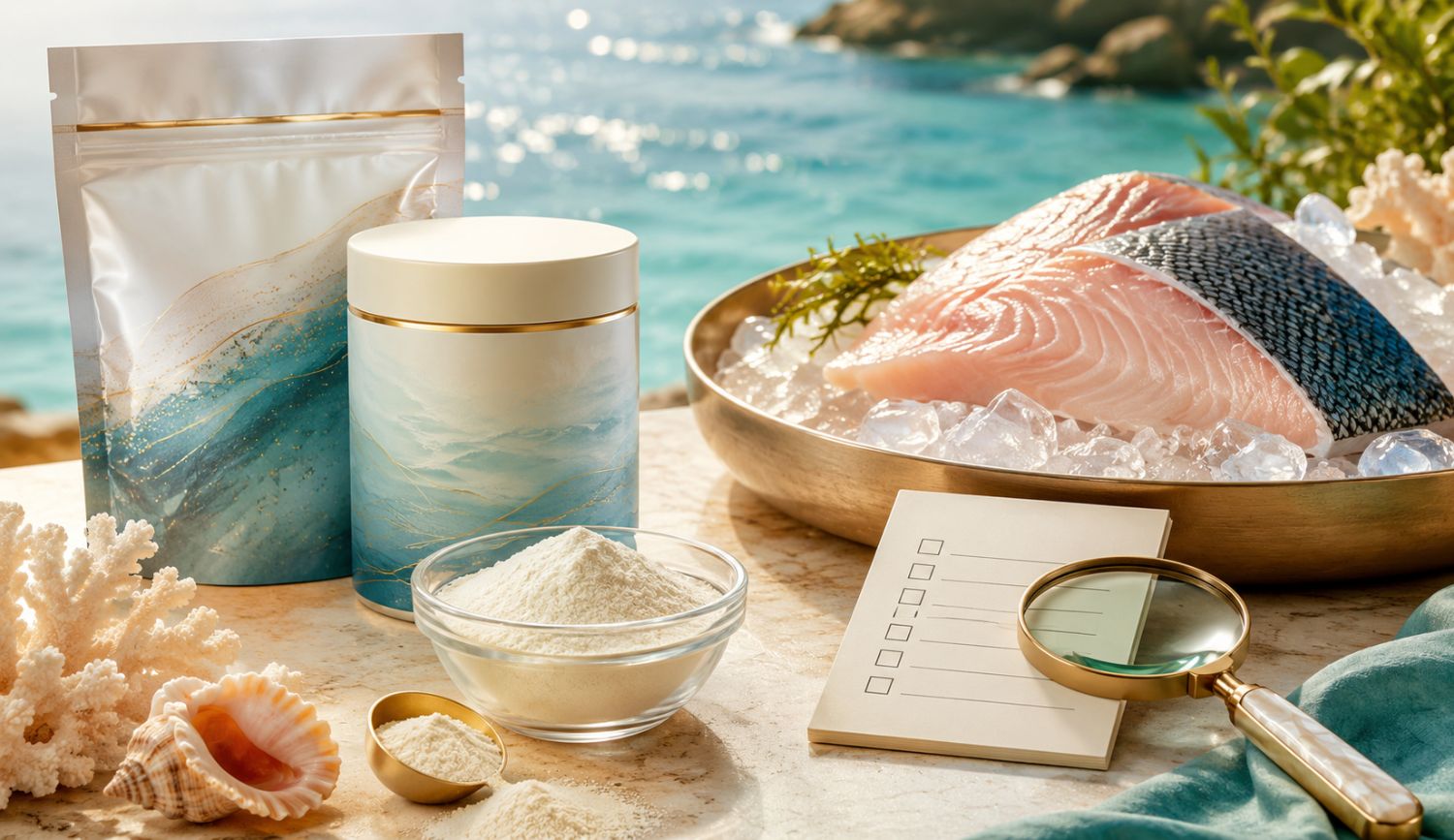
Marine collagen is often marketed as clean, light, and easy to absorb. But for some histamine-sensitive people, fish-derived collagen can feel more reactive than expected.
Marine collagen and histamine can overlap because fish-derived raw materials require careful handling, chilling, and processing. That’s a different variable than most other protein sources carry.
This article looks specifically at the fish-source side of the collagen conversation. Marine collagen is not just collagen from a different animal source; it brings seafood handling and fish-allergy variables into the picture.
For the broader collagen-and-histamine answer, Is Collagen High in Histamine? covers that ground.
Why marine collagen and histamine can overlap
Marine collagen typically comes from fish skin, scales, or other fish-derived connective tissue. That raw material starts out closer to a food safety category than most other collagen sources.
Fish tissue is more histamine-sensitive than many land-animal tissues, largely because of how quickly certain fish species can generate histamine after they’re caught [1]. How the fish was chilled, stored, and processed before it ever became a collagen supplement matters.
This doesn’t mean every marine collagen product carries a histamine risk. It means the raw material category itself has more room for variation than something like bovine collagen does.
Is marine collagen high in histamine?
Not as a blanket rule. Some marine collagen products are made from carefully sourced, rapidly chilled fish and processed under controlled conditions, which may limit histamine formation before it starts.
At the same time, no consumer should assume any marine collagen product is histamine-free. Supplement labels rarely list actual histamine or biogenic amine content, so you’re working with sourcing claims rather than lab numbers in most cases.
Product quality matters here. A marine collagen made from carefully handled raw material is not the same risk profile as one made from poorly handled fish material, even if both sit on the same store shelf.
Why fish handling matters
Fish tissue naturally contains an amino acid called histidine. When fish isn’t kept cold enough after being caught, certain bacteria can convert that histidine into histamine [1][2].
This is the same underlying mechanism behind scombroid poisoning, which happens when fish like tuna or mackerel sit too long at unsafe temperatures before being eaten [3]. Once histamine has formed in the tissue, cooking or later processing doesn’t reliably remove it.
That’s why seafood handling is treated as a genuine food-safety issue, not just a taste or freshness concern, and why the FDA maintains specific guidance on preventing histamine formation in fish and fishery products [2]. For collagen made from fish material, the same handling window applies before the raw material ever reaches a processing facility.
Marine collagen reaction vs fish allergy
This distinction matters more than almost anything else in this article.
Histamine intolerance and fish allergy are not the same thing. Histamine intolerance involves how the body handles a chemical compound already present in food or released internally [5][6], while fish allergy is an immune-mediated reaction to specific fish proteins, most often a protein called parvalbumin [4].
A true fish allergy can be serious, and marine collagen may contain trace fish proteins depending on how it’s processed. Someone with a known fish allergy should treat marine collagen as a real consideration, not an automatic exception just because it’s “just collagen.”
Certain symptoms point toward an allergic reaction rather than a histamine-type one, and they need urgent care. Throat swelling, wheezing, facial or lip swelling, rapidly spreading hives, fainting, or breathing difficulty after marine collagen are signs to treat as an emergency, not something to monitor at home.
This article can’t tell you which one you’re experiencing. That distinction belongs to a clinician, ideally an allergist if a true allergy is suspected.
| Possible issue | Why marine collagen matters | What to watch for |
|---|---|---|
| Histamine-type reaction | Fish-derived raw material can be more sensitive to handling, chilling, and storage before processing. | Flushing, headache, itching, congestion, faster heartbeat, or digestive upset, often when other triggers are already stacked. |
| Fish allergy | Marine collagen comes from fish material and may not be appropriate for people with known fish allergy. | Rapid hives, swelling, wheezing, throat tightness, breathing symptoms, faintness, or spreading rash. |
| Additive reaction | Marine collagen beauty formulas often include flavors, sweeteners, gums, vitamins, probiotics, or “superfood” blends. | Symptoms only with flavored or blended products, but not with simpler formulas or other fish foods. |
| Dose sensitivity | A full scoop may be more than a sensitive system can process at once. | Symptoms that track serving size and timing more than the source itself. |
Marine collagen vs bovine collagen for histamine-sensitive people
Marine collagen carries both the fish-handling variable and the fish-allergy variable. Bovine collagen removes the fish-specific concerns entirely, since it’s sourced from cattle hide or bone instead.
That doesn’t make bovine collagen automatically safe. Beef sensitivity exists, and for a small number of people, mammalian-derived products can be relevant to alpha-gal-type concerns, a separate tick-bite-related allergy.
Individual tolerance still decides the outcome either way. Neither source is a guaranteed win or loss for a histamine-sensitive person, so the safest takeaway is not “marine bad, bovine good.” It is: know which variables each source brings.
Symptoms people report after marine collagen
People describe a range of reactions after trying marine collagen, and they don’t all point to the same cause.
Common reports include flushing, itching, hives, headache, nausea, bloating, loose stools, a racing heart, an anxious or wired feeling, nasal congestion, and throat tightness. Some of these show up within minutes, others build more gradually.
It’s worth being direct here: these symptoms don’t prove histamine intolerance on their own. They’re pattern clues, not a diagnosis, and the same list overlaps with allergy, additive reactions, and simple dose sensitivity. Collagen Supplements and Histamine walks through this broader symptom picture and how to think about it.
Product factors that can make marine collagen more reactive
The collagen itself is sometimes the smaller part of the story. Flavored formulas, added sweeteners, thickening gums, vitamin blends, niacin (B3), probiotics, and fermented “superfood” additions can each cause symptoms on their own.
Storage after purchase can matter too, especially with opened powders exposed to heat, moisture, or humidity. That said, the bigger histamine question usually starts earlier, with raw material handling and manufacturing control.
Serving size plays a role as well; a large dose taken quickly is simply more to process than a small one. Deeper label analysis, including a full look at beauty-blend formulas, belongs to a separate piece in this hub.
How to test whether marine collagen is the issue
If you suspect marine collagen specifically, a careful approach works better than guessing. Stop the product as soon as symptoms appear.
Don’t rechallenge after anything resembling a severe reaction. If you have a known fish allergy, avoid marine collagen unless a clinician has specifically said otherwise.
Test only when you’re relatively stable, not during an active flare, and change one variable at a time. A food and symptom diary notebook can help you compare timing against other known histamine triggers instead of relying on memory.
If symptoms are repeated, severe, or confusing, that’s a conversation for a clinician rather than more self-testing.
When to avoid marine collagen completely
Some situations call for skipping marine collagen altogether, or only trying it under direct medical guidance.
A known fish allergy is the clearest reason. Prior throat tightness or breathing symptoms after fish or marine collagen, rapidly spreading hives, or swelling of the lips, tongue, throat, or face are all reasons to stop and seek care rather than test again.
Severe vomiting, fainting, or chest tightness after marine collagen also need urgent medical attention. Pregnancy or breastfeeding without a clinician’s input, unstable MCAS-type reactions, and kidney disease or medically restricted protein intake are all situations where professional guidance should come before any supplement decision.
The bottom line
Marine collagen is not high histamine by default. But its fish-derived source adds handling variables and a genuine allergy question that other collagen sources don’t carry in the same way.
If someone reacts to marine collagen, the cause could be histamine, a true fish allergy, an additive, the dose, or their personal threshold that day. Sorting out which one applies isn’t something a label or a single reaction can answer on its own.
For the general “is collagen high histamine” answer, Is Collagen High in Histamine? covers that directly.
For the fuller reaction and testing picture across all collagen types, Collagen Supplements and Histamine is the place to start.
Frequently asked questions
Is marine collagen high in histamine?
Not as a blanket rule. It depends on how the source fish was handled, chilled, and processed before manufacturing, along with the quality controls the brand uses.
Can marine collagen trigger histamine symptoms?
In some sensitive people, yes. Flushing, itching, or a racing heart can appear, especially when raw material handling was poor or when other histamine triggers were already present that day.
Is marine collagen bad for histamine intolerance?
Not universally. Marine collagen has more fish-specific variables to check than bovine collagen, but that does not mean every marine product will trigger symptoms or that every bovine product will be tolerated.
Is marine collagen worse than bovine collagen?
It can be more variable due to fish-handling and fish-allergy factors, but bovine collagen isn’t automatically safer for everyone. Tolerance is individual either way.
Can I take marine collagen if I have a fish allergy?
This needs a clinician’s input rather than a general answer here. A known fish allergy is a serious consideration, since marine collagen may contain trace fish proteins.
Why does marine collagen make me flush?
Flushing can come from a histamine-type reaction, an allergic response, an additive like niacin, or a dose that was simply too large. Collagen Supplements and Histamine covers this in more depth.
Are marine collagen peptides histamine-free?
No product should be assumed histamine-free without testing. Labels rarely disclose actual histamine content, so “clean” or “pure” marketing language isn’t the same as a lab-verified number.
What should I use instead of marine collagen?
Some people avoid marine collagen and use fresh tolerated protein foods, plain bovine collagen, or non-collagen support strategies instead. Tolerance still varies by individual, and the dedicated low-histamine collagen alternatives guide covers this question in full.
References
- Joint FAO/WHO Expert Meeting on the Public Health Risks of Histamine and Other Biogenic Amines from Fish and Fishery Products: Meeting Report. World Health Organization / FAO. https://www.who.int/publications/i/item/9789240691919
- Fish and Fishery Products Hazards and Controls Guidance, Chapter 7: Scombrotoxin (Histamine) Formation. U.S. Food and Drug Administration. https://www.fda.gov/files/food/published/Fish-and-Fishery-Products-Hazards-and-Controls-Guidance-Chapter-7-Download.pdf
- Food Poisoning from Marine Toxins: Scombroid (Histamine) Fish Poisoning. CDC Yellow Book. https://www.cdc.gov/yellow-book/hcp/environmental-hazards-risks/food-poisoning-from-marine-toxins.html
- Kalic T, Radauer C, Lopata AL, Breiteneder H, Hafner C. Fish Allergy Around the World—Precise Diagnosis to Facilitate Patient Management. Frontiers in Allergy. 2021;2:732178. https://pmc.ncbi.nlm.nih.gov/articles/PMC8974716/
- Maintz L, Novak N. Histamine and histamine intolerance. American Journal of Clinical Nutrition. 2007;85(5):1185–1196. https://doi.org/10.1093/ajcn/85.5.1185
- Comas-Basté O, Sánchez-Pérez S, Veciana-Nogués MT, Latorre-Moratalla M, Vidal-Carou MC. Histamine Intolerance: The Current State of the Art. Biomolecules. 2020;10(8):1181. https://pmc.ncbi.nlm.nih.gov/articles/PMC7464760/
Reviewed for scientific accuracy and editorial clarity under Nourishly standards.