
Marine collagen gets most of the suspicion in histamine-sensitive circles because it comes from fish. So when a collagen powder causes flushing, itching, hives, or a wired feeling, bovine collagen can look like the cleaner next step.
That is where many bovine collagen histamine questions begin. The swap makes sense on the surface: bovine collagen avoids fish-derived raw material and the cold-chain problems that can matter with marine collagen. But it does not remove every concern.
Bovine collagen and histamine can still overlap through processing quality, additives, dose, personal threshold, beef sensitivity, and alpha-gal risk. So the better question is not whether beef collagen is automatically safer. It is whether it gives your body fewer variables to sort through.
For the broader mechanism behind collagen reactions in general, see Collagen Supplements and Histamine.
The practical answer: fewer fish variables, not zero risk
For some histamine-sensitive people, bovine collagen genuinely is a more manageable starting point than marine collagen. It removes the fish-handling and fish-allergy questions that come with a marine source, which is one less thing to account for.
That’s a meaningful difference, not a small one. But it’s a difference in which risk points you’re dealing with, not a promise that they disappear. Source quality, processing speed, additives, dose, beef sensitivity, alpha-gal risk, and your own histamine threshold on a given day still shape the real answer for any specific product, since histamine intolerance itself depends on total load and clearance capacity rather than any single food or supplement [2][3].
What bovine collagen actually comes from
Bovine collagen comes from cattle hide, bone, or connective tissue, hydrolyzed into smaller peptides the same way most collagen supplements are made [1]. Collagen Peptides and Histamine covers that hydrolysis process in more depth than a source-specific article needs to.
Bovine sources commonly provide type I and type III collagen, which are often discussed in relation to skin, tendons, and connective tissue. That’s as far as the source-material story needs to go here.
Why bovine collagen can look safer than marine collagen
Bovine collagen isn’t a perfect option. Its appeal for many histamine-sensitive readers comes from removing one very specific category of marine-related risk.
Marine collagen comes from fish skin and scales, and fish tissue carries specific handling and cold-chain considerations. Improperly chilled fish can build histamine relatively quickly, which is the same underlying issue behind scombroid poisoning in fish eaten directly [5].
Fish allergy is also a separate concern from histamine intolerance, adding another layer some readers want to sidestep.
Bovine collagen removes both of those fish-specific issues. That’s a legitimate reason some sensitive readers consider switching after a marine reaction, and Marine Collagen and Histamine covers the fish side of this comparison in full.
Why bovine collagen histamine risk is not only about the source
Removing the fish factor does not remove every tolerance question. Bovine raw material still needs proper handling, chilling, and processing hygiene, and biogenic amine formation tracks the same underlying conditions across almost any animal source: how quickly the tissue was cooled, how it was stored, and how carefully the manufacturer ran things [4].
Third-party testing, when a brand does it at all, often covers purity or heavy metals rather than histamine or biogenic amine content specifically.
A clean-looking certificate of analysis isn’t the same as histamine-tested. Is Collagen High in Histamine? covers this uncertainty across all collagen sources.
Myth vs reality: does “grass-fed” mean low histamine?
Myth: Grass-fed or pasture-raised collagen is inherently low histamine because the animal was raised more naturally.
Reality: Grass-fed and pasture-raised describe how the animal was raised, not how quickly the hide was processed afterward, how it was stored, or whether the finished product was ever tested for histamine. A farm-quality claim and a biogenic-amine result are two different things measured at two different points in the supply chain.
None of this makes grass-fed collagen a bad choice. It just answers a different question than the one a histamine-sensitive reader is actually asking.
Alpha-gal syndrome is not histamine intolerance
Alpha-gal deserves its own pause because it is not a histamine issue.
This is an allergy to a carbohydrate found in mammalian tissue, most often triggered by a tick bite that sensitizes the immune system to that molecule [6].
Bovine and porcine collagen products can matter for someone with alpha-gal, since the carbohydrate has been detected in bovine gelatin at measurable levels, and it’s been linked to skin-test and antibody reactivity in patients with red meat allergy [7].
Reactions tend to run on a slower clock than a histamine-type response, often delayed by several hours rather than showing up right away. This isn’t something to self-diagnose from a single collagen reaction.
A history of tick bites paired with delayed reactions to red meat or other mammalian products is worth raising with an allergist directly, rather than something to work out on your own.
That’s not the only mammalian-source question worth separating from histamine. A less common but distinct concern is true bovine collagen or gelatin allergy.
Beef allergy and bovine collagen allergy are different from histamine sensitivity
True immune-mediated allergy to bovine collagen or gelatin is uncommon, but documented, including cases involving hives, swelling, and IgE cross-reactivity with milk and meat allergy [8]. One physician-answered case series through the American Academy of Allergy, Asthma & Immunology estimated that 2 to 4 percent of people carry some pre-existing sensitivity to bovine collagen, with roughly 1 percent going on to react clinically [9].
Histamine intolerance works through a different mechanism entirely: a load-and-clearance issue rather than an immune response to a specific protein. The two can look similar on the skin, which is exactly why severity and pattern matter more than any single symptom.
Hives, swelling, wheezing, throat symptoms, or vomiting can point toward an allergic process, and that distinction changes what you should do next. Don’t keep testing a product once symptoms start looking allergy-like.
Bovine vs marine collagen: the variables that actually change
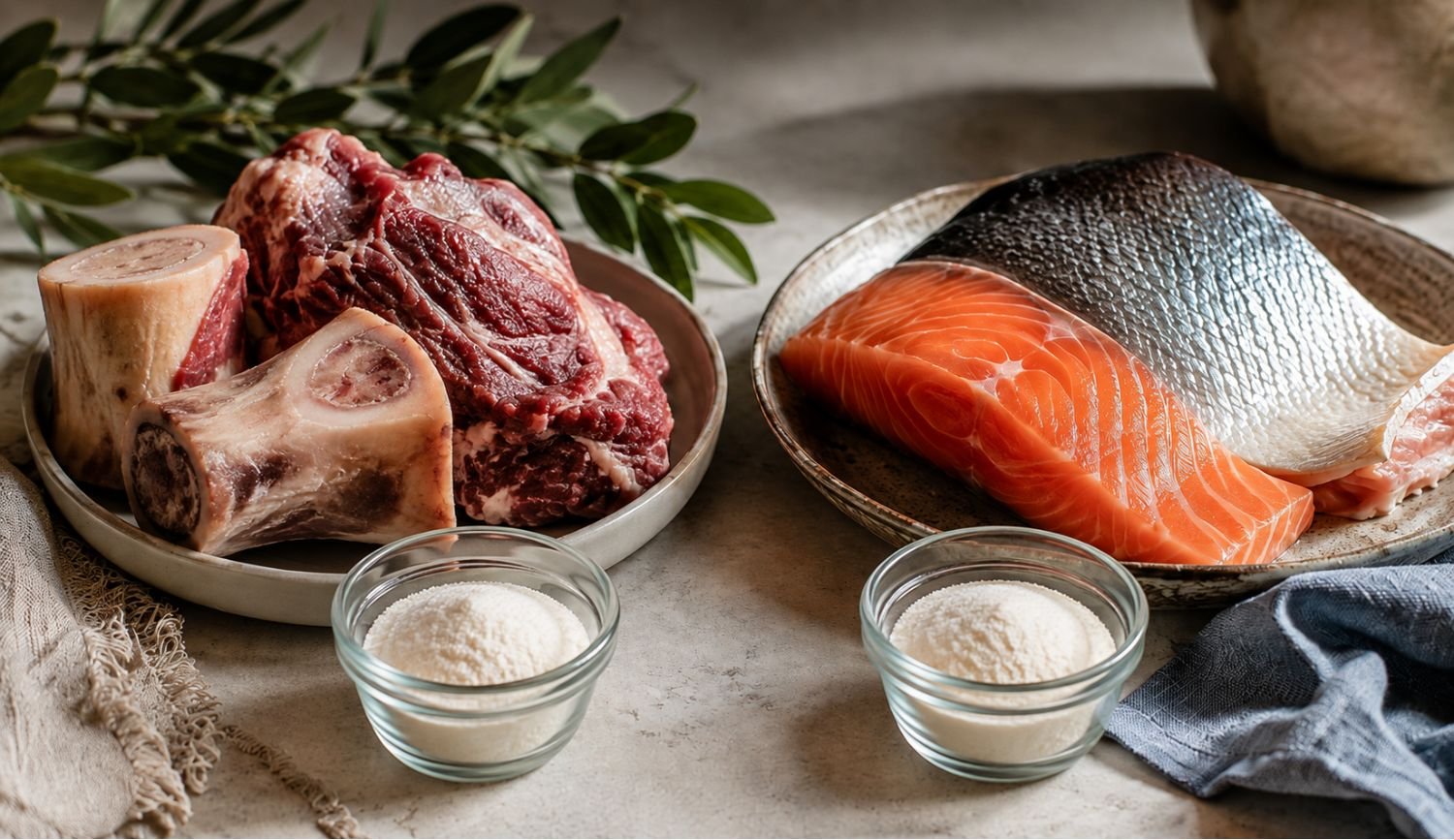
| Factor | Bovine collagen | Marine collagen | Histamine-sensitive takeaway |
|---|---|---|---|
| Main source | Cattle hide, bone, or connective tissue | Fish skin and scales | Different raw material, different handling risks |
| Fish allergy concern | Not applicable | Relevant for fish-sensitive readers | Bovine sidesteps this specific issue entirely |
| Alpha-gal concern | Relevant for mammalian-source sensitivity | Not applicable | Marine sidesteps this specific issue entirely |
| Raw material handling variable | Hide/tissue freshness, chilling, processing hygiene | Fish freshness and cold-chain speed | Both depend on how quickly and cleanly material was processed |
| Label/additive risk | Same as any collagen: flavors, sweeteners, blends | Same as any collagen: flavors, sweeteners, blends | Additives matter equally regardless of source |
| Best use case | Fish-sensitive readers wanting to avoid marine variables | Readers without fish sensitivity seeking a different amino acid profile | Match the source to your actual allergy history, not general assumption |
| Higher caution situations | Suspected alpha-gal, known beef allergy | Known fish/shellfish allergy | Personal allergy history should drive the choice more than marketing |
This is why the answer is not simply “bovine is better” or “marine is worse.” The better question is which source removes the most relevant risk points for your own history.
Additives still matter, even when the collagen is bovine
A bovine label doesn’t exempt a product from everything else that can go wrong. Bovine collagen shows up in flavored powders, beauty blends, gummies, and multi-collagen mixes just as often as any other source.
Sweeteners, gums, probiotics, niacin, biotin, acids, natural flavors, and herbal extracts can each drive a reaction that has nothing to do with the collagen itself. Collagen Beauty Blends and Histamine and Collagen Powder Side Effects cover this ground in more depth. A reaction to a flavored bovine product doesn’t necessarily mean bovine collagen was the trigger.
When bovine collagen is not the right experiment
A few situations call for skipping the test altogether, or only trying under a clinician’s direct guidance:
- Known or suspected alpha-gal syndrome
- Known beef allergy
- A previous severe reaction to bovine collagen or gelatin
- An active flare or currently unstable symptoms
- Recent hives or swelling from any supplement
- Breathing symptoms or chest tightness from any prior reaction
- Pregnancy or breastfeeding without a clinician’s input
- Kidney disease, liver disease, gout, protein restriction, or another complex medical condition
- A multi-ingredient formula with too many unknowns to test cleanly
A safety note before you test anything
Stop the product and speak with a healthcare professional if symptoms are severe, repeated, worsening, or allergy-like. A reaction to bovine collagen doesn’t prove histamine intolerance, MCAS, beef allergy, or alpha-gal syndrome by itself. Treat it as a signal to investigate, not a diagnosis to settle on your own.
Seek urgent medical care for throat swelling, trouble breathing, wheezing, facial, lip, or tongue swelling, fainting, severe chest tightness, rapidly spreading hives, or signs of anaphylaxis.
Do not attempt a home re-challenge after a serious allergic reaction; that decision belongs with a clinician. Speak with a doctor before starting collagen supplements at all if you have a known beef allergy, suspected alpha-gal syndrome, a history of repeated hives or swelling, breathing symptoms, are pregnant or breastfeeding, manage kidney or liver disease, gout, take prescription medications, or have a complex chronic illness. Collagen is a supplement, not a treatment for histamine intolerance, MCAS, DAO deficiency, alpha-gal syndrome, allergy, leaky gut, or any chronic condition [10].
The bottom line
Bovine collagen may be a cleaner comparison point for someone trying to avoid fish-derived collagen, but it is not a free pass. It removes marine-specific concerns and introduces mammalian-source questions of its own.
For histamine-sensitive readers, the better test is not the animal name on the label. It is the full picture: source, processing, additives, dose, allergy history, alpha-gal risk, and what your body has already shown you.
A plain, single-ingredient bovine peptide product is usually easier to make sense of than a flavored blend, but repeated or severe symptoms still mean stop and get medical guidance, regardless of which source you started with.
If both bovine and marine formats keep causing trouble, Low Histamine Collagen Alternatives covers food-first ways to support the same goal.
Frequently asked questions
Questions about bovine collagen often come down to source, processing, allergy risk, and how it compares with marine collagen. These answers clarify the most common concerns without assuming that one collagen type is automatically lower histamine or better tolerated.
Is bovine collagen high in histamine?
Not by default. It isn’t in the same risk category as fermented or long-aged foods, but raw material handling, processing, and additives still shape the real answer for any specific product.
Is beef collagen high in histamine?
The same answer applies: not by default, but not guaranteed low either. Source and processing quality matter more than the animal itself.
Is bovine collagen safer than marine collagen for histamine intolerance?
It may be easier to evaluate for people without a fish sensitivity, since it removes fish-handling and fish-allergy questions. It isn’t universally safer, and it introduces its own considerations like alpha-gal risk.
Is grass-fed collagen low histamine?
Not necessarily. Grass-fed describes how the animal was raised, not how the hide was processed, stored, or whether the product was tested for histamine.
Can bovine collagen trigger allergy symptoms?
Yes, though true bovine collagen allergy is uncommon. Documented cases exist, and estimates suggest a small percentage of people carry some pre-existing sensitivity to bovine collagen or gelatin.
What is the alpha-gal risk with bovine collagen?
Alpha-gal syndrome is a distinct, tick-bite-related allergy to a sugar molecule found in mammalian tissue, including cattle. It’s relevant to bovine collagen for people with that specific sensitization, and it typically produces delayed reactions rather than immediate ones.
Can I take bovine collagen if I reacted to marine collagen?
Possibly, since bovine removes the fish-specific source issues that may have contributed to a marine reaction. It isn’t a guarantee, since bovine collagen has its own separate risk factors to consider first.
Can bovine collagen cause flushing or hives?
In some people, yes, whether from a histamine-type response, an additive in the product, or a true allergic reaction. The pattern and severity matter more than the symptom alone in figuring out which one applies.
What type of collagen is best for histamine intolerance?
There isn’t one universal answer, since tolerance depends on your personal allergy history and the specific product. The more useful question is which source leaves fewer open questions for your body and the product you’re actually considering.
When should I avoid bovine collagen?
Avoid it, or only use it with a clinician’s guidance, if you have a known beef allergy, suspected alpha-gal syndrome, a previous severe reaction to bovine collagen or gelatin, or if you’re currently in an active flare.
References
- León-López A, Morales-Peñaloza A, Martínez-Juárez VM, Vargas-Torres A, Zeugolis DI, Aguirre-Álvarez G. Hydrolyzed Collagen—Sources and Applications. Molecules. 2019;24(22):4031. https://doi.org/10.3390/molecules24224031
- Maintz L, Novak N. Histamine and histamine intolerance. American Journal of Clinical Nutrition. 2007;85(5):1185–1196. https://doi.org/10.1093/ajcn/85.5.1185
- Comas-Basté O, Sánchez-Pérez S, Veciana-Nogués MT, Latorre-Moratalla M, Vidal-Carou MC. Histamine Intolerance: The Current State of the Art. Biomolecules. 2020;10(8):1181. https://pmc.ncbi.nlm.nih.gov/articles/PMC7464760/
- Gardini F, Özogul Y, Suzzi G, Tabanelli G, Özogul F. Technological Factors Affecting Biogenic Amine Content in Foods: A Review. Frontiers in Microbiology. 2016;7:1218. https://pmc.ncbi.nlm.nih.gov/articles/PMC4982241/
- Joint FAO/WHO Expert Meeting on the Public Health Risks of Histamine and Other Biogenic Amines from Fish and Fishery Products: Meeting Report. World Health Organization / FAO. https://www.who.int/publications/i/item/9789240691919
- About Alpha-gal Syndrome. Centers for Disease Control and Prevention (CDC). https://www.cdc.gov/alpha-gal-syndrome/about/index.html
- Mullins RJ, James H, Platts-Mills TAE, Commins SP. The relationship between red meat allergy and sensitization to gelatin and galactose-α-1,3-galactose. Journal of Allergy and Clinical Immunology. 2012;129(5):1334–1342. https://doi.org/10.1016/j.jaci.2012.02.038
- Bogdanovic J, Halsey NA, Wood RA, Hamilton RG. Bovine and porcine gelatin sensitivity in children sensitized to milk and meat. Journal of Allergy and Clinical Immunology. 2009;124(5):1108–1110. https://doi.org/10.1016/j.jaci.2009.06.021
- Ledford DK. Bovine collagen allergy. Ask the Expert, American Academy of Allergy, Asthma & Immunology (AAAAI). https://www.aaaai.org/allergist-resources/ask-the-expert/answers/2022/bovine
- Dietary Supplements. U.S. Food and Drug Administration. https://www.fda.gov/food/dietary-supplements