
Bone broth and collagen powder are often promoted for the same goals: gut support, skin, joints, and connective tissue. So it’s easy to assume they are just two versions of the same “healthy” choice.
For someone with histamine intolerance, that assumption doesn’t hold up. Bone broth vs collagen powder isn’t really a nutrition question here. It’s a question about which one carries fewer reaction variables on a given day, because a “healthy” choice can still trigger symptoms if the wrong variables are present.
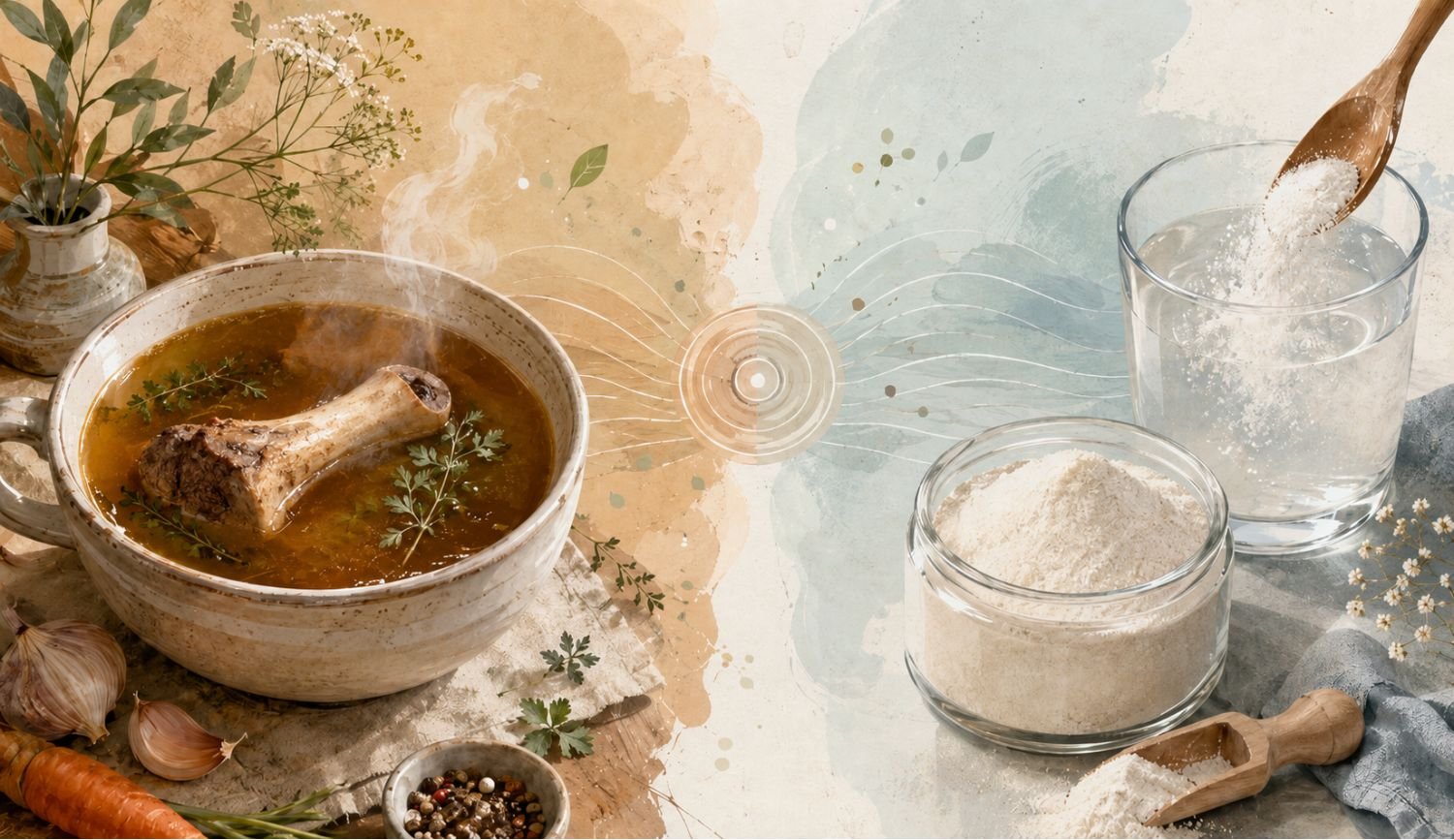
This article compares the two through that lens, rather than the usual protein-grams-and-taste comparison you’ll find elsewhere.
The short answer: they carry different histamine risks
Bone broth’s risk comes mostly from the kitchen: how long it simmered, how quickly it cooled, how long it was stored, and how many times it was reheated. Collagen powder’s risk comes mostly from the product: where the collagen came from, how it was processed, what was added, and how much you take.
Neither one wins for everyone. For many histamine-sensitive readers, a plain, single-ingredient collagen powder may be easier to evaluate than a long-simmered broth, simply because it skips the cooking and storage steps. That doesn’t make it guaranteed safe. It just moves the variables somewhere else.
What standard bone broth vs collagen powder comparisons miss
Most articles comparing these two focus on protein content, collagen grams per serving, skin and joint benefits, taste, and which one is more convenient for a busy week. Those are reasonable questions, and they’re just incomplete for a histamine-sensitive reader.
The missing piece is process. What happened before the broth or powder reached you, during its preparation, and after it was made all shape the real risk, in a way that a protein-content chart never captures.
Why bone broth can be harder for histamine-sensitive people
Bone broth is usually simmered for 8 to 24 hours, then cooled, stored, and often reheated over several days. Each of those steps adds time for biogenic amines to build up in a protein-rich liquid [5].
That’s not the same as saying bone broth is toxic or automatically dangerous. It means a warm, protein-rich liquid with a long handling and storage window carries more opportunity for amine buildup than a food made and eaten quickly, since time, temperature, and microbial activity are the main drivers of that process rather than heat alone [5][6].
Bone Broth and Histamine covers the full mechanism and what to do about it.
Why collagen powder may be easier to evaluate, but not risk-free
Collagen powder sidesteps the simmering, cooling, and multi-day storage that make bone broth harder to pin down. Serving size is also more predictable because a scoop can be measured more consistently than a mug of broth, which may vary widely in size and concentration.
That predictability is real, but it doesn’t erase the product’s own variables. Source material, processing quality, additives, and dose still shape whether a specific product sits well or not, since collagen powder is manufactured through hydrolysis to a more consistent concentration than a home-simmered broth ever achieves [1][2].
A single-ingredient, unflavored powder generally carries fewer variables than a flavored “beauty blend” loaded with sweeteners, gums, probiotics, or vitamin complexes. Collagen Supplements and Histamine and Collagen Peptides and Histamine go deeper into these product-level factors.
Bone broth vs collagen powder comparison
| Factor | Bone broth | Collagen powder | Histamine-sensitive takeaway |
|---|---|---|---|
| Main form | Long-simmered liquid | Processed, dissolvable powder | Different preparation paths, different variables |
| Main risk variable | Simmering time, cooling, storage | Source, processing, additives, dose | Kitchen handling vs product manufacturing |
| Collagen consistency | Varies by bones, cook time, batch | More consistent from batch to batch | Powder is easier to standardize |
| Additive risk | Low if homemade and plain | Higher in flavored or fortified blends | Plain versions of either are simpler to evaluate |
| Storage risk | High if kept for several days | Lower once opened, if stored properly | Broth’s storage window is the bigger concern |
| Dose control | Harder to measure precisely | Easy to measure by scoop | Powder offers more precise testing |
| Best use case | Savory meals, hydration, minerals | Quick daily collagen support | Depends on the reader’s actual goal |
| Higher caution situations | Store-bought broth, unclear handling, active flare | Marine source with fish sensitivity, fortified blends, large dose | Both have specific red flags to watch for |
The practical takeaway is not that one option is always better. It is that each one asks you to control a different set of variables.
Is collagen powder safer than bone broth for histamine intolerance?
For some people, yes, mainly because it removes the simmering, cooling, and leftover-storage variables that make bone broth harder to control at home. A plain, unflavored, single-ingredient powder gives you fewer things to account for when testing tolerance.
Safer isn’t the same as safe for everyone, though. Collagen powder can still trigger a reaction tied to its source, its additives, or simply too large a dose taken too quickly. It can be a more controlled first test for some people, but it still needs to be tested cautiously rather than assumed safe.
When bone broth may be the higher-risk option
A few situations push bone broth toward the riskier end. A batch simmered 12 to 24 hours, cooled slowly on the counter, kept in the fridge for several days, and reheated more than once carries more opportunity for amine buildup than a fresh, quickly cooled batch.
Store-bought broth with unclear handling history adds its own uncertainty. A large serving, or any new broth during an active flare, can raise the odds of a reaction because the total histamine load may already be high.
When collagen powder may be the higher-risk option
Collagen powder has its own higher-risk situations. Marine-sourced collagen is worth extra caution for anyone with a fish sensitivity, since fish tissue can develop histamine relatively quickly if it isn’t chilled properly before processing [6], and flavored powders bring sweeteners, gums, or natural flavors that can trigger symptoms separate from the collagen itself.
Probiotic blends, added vitamins, and “beauty complex” formulas layer in more variables than a plain product. A large scoop taken quickly, testing a new product during an active flare, or a prior allergy-like reaction to another supplement are all reasons to move more cautiously with collagen powder specifically.
Can collagen powder replace bone broth?
For some collagen-support goals, yes. Collagen powder delivers a concentrated, easily dosed source of collagen peptides, which covers part of what people reach for bone broth to do.
It doesn’t replace everything broth offers, though. The minerals, the savory meal context, and the hydration and electrolyte content of a mug of broth aren’t things a powder recreates. For a histamine-sensitive reader, the more useful question usually isn’t nutritional completeness. It’s which option brings fewer variables into a given day.
Can you take bone broth and collagen powder together?
People without histamine sensitivities sometimes combine the two without issue. For someone managing histamine intolerance, combining them at the same time makes it much harder to know what caused what if a reaction happens, and it can raise your total histamine load for the day, since symptoms tend to depend on overall load rather than any single food in isolation [3][4].
Testing one variable at a time gives you far more useful information than testing both together.
How to choose the lower-variable option
If you’re deciding where to start, a few practical criteria can help.
Collagen powder makes sense as a first test when your symptoms are relatively stable, the product is single-ingredient and unflavored, the source is clearly labeled, there are no added gums, sweeteners, flavors, probiotics, or vitamin blends, and you can start with a small test dose rather than a full scoop.
Bone broth makes more sense to test when you’re working with very fresh ingredients, a shorter cook time where possible, quick cooling, portions frozen promptly rather than left in the fridge for days, and a small serving rather than a full mug.
Neither path is the “correct” one across the board. The right starting point depends on your current stability, what you have access to, and what you’re actually trying to test.
The bottom line
Bone broth vs collagen powder isn’t really a whole-food-versus-supplement question for a histamine-sensitive reader. It’s kitchen variables versus product variables. Collagen powder may be easier to evaluate because it skips the simmering and storage steps, but it isn’t guaranteed low histamine. Bone broth carries more built-in variability because of how long it cooks, cools, and sits before you drink it.
If both options keep triggering symptoms, collagen support doesn’t have to stop there. Fresh tolerated protein and a few targeted nutrients can fill a similar role. Low Histamine Collagen Alternatives covers what that looks like in practice.
Seek urgent medical care for throat swelling, trouble breathing, wheezing, facial, lip, or tongue swelling, fainting, severe chest tightness, rapidly spreading hives, or any other signs of a serious allergic reaction, regardless of which product was involved.
Frequently asked questions
These answers summarize the most common questions about bone broth vs collagen powder for histamine-sensitive people. They are not a substitute for medical care if reactions are severe, repeated, or allergy-like.
Is bone broth better than collagen powder?
Neither is universally better. Bone broth offers a whole-food format with minerals and hydration, while collagen powder offers a more concentrated, easier-to-dose option. For histamine-sensitive people, the deciding factor is usually which one carries fewer variables that day.
Is collagen powder better than bone broth for histamine intolerance?
It’s often easier to evaluate since it skips the simmering, cooling, and storage steps that make bone broth harder to control. That doesn’t make it automatically safe; source, additives, and dose still matter.
Can collagen powder replace bone broth?
For collagen-support goals, often yes. It doesn’t replace the minerals, savory meal use, or hydration that a mug of broth provides, so the two serve somewhat different purposes.
Does bone broth have more collagen than collagen powder?
Bone broth’s collagen content varies widely depending on the bones used and how long it simmered, while collagen powder is manufactured to a more consistent concentration [1]. Neither format guarantees a specific amount without testing.
Is bone broth high in histamine?
Not automatically, but long simmering time, slow cooling, and extended storage all raise the risk compared to fresh, quickly cooked foods. Bone Broth and Histamine covers this in full.
Is collagen powder low histamine?
Not guaranteed. A plain, single-ingredient product tends to carry fewer variables, but source, processing, and additives still shape the real risk. Our article on Is Collagen High in Histamine? covers the general question in depth.
Can I take bone broth and collagen powder together?
You can, but combining them makes it harder to track what caused a reaction and can raise your total histamine load. Testing one at a time gives clearer information.
Is bone broth powder different from collagen powder?
Yes. Bone broth powder is dehydrated broth, carrying the same simmering and processing history as liquid broth, while collagen powder is a more purified, hydrolyzed collagen product with a different manufacturing path.
Which is better during a histamine flare?
Neither is an ideal time to test something new. If you need to choose, a small amount of a plain, already-tolerated product usually carries less risk than introducing something untested mid-flare.
What should I use if both trigger symptoms?
Fresh tolerated protein, along with targeted nutrients like glycine, proline, and vitamin C, can support the same underlying goal without relying on either bone broth or collagen powder. Low Histamine Collagen Alternatives covers this in detail.
References
- Liu D, Nikoo M, Boran G, Zhou P, Regenstein JM. Collagen and Gelatin. Annual Review of Food Science and Technology. 2015;6:527–557. https://doi.org/10.1146/annurev-food-031414-111800
- León-López A, Morales-Peñaloza A, Martínez-Juárez VM, Vargas-Torres A, Zeugolis DI, Aguirre-Álvarez G. Hydrolyzed Collagen—Sources and Applications. Molecules. 2019;24(22):4031. https://pmc.ncbi.nlm.nih.gov/articles/PMC6891674/
- Maintz L, Novak N. Histamine and histamine intolerance. American Journal of Clinical Nutrition. 2007;85(5):1185–1196. https://doi.org/10.1093/ajcn/85.5.1185
- Comas-Basté O, Sánchez-Pérez S, Veciana-Nogués MT, Latorre-Moratalla M, Vidal-Carou MC. Histamine Intolerance: The Current State of the Art. Biomolecules. 2020;10(8):1181. https://pmc.ncbi.nlm.nih.gov/articles/PMC7464760/
- Gardini F, Özogul Y, Suzzi G, Tabanelli G, Özogul F. Technological Factors Affecting Biogenic Amine Content in Foods: A Review. Frontiers in Microbiology. 2016;7:1218. https://pmc.ncbi.nlm.nih.gov/articles/PMC4982241/
- Fish and Fishery Products Hazards and Controls Guidance, Chapter 7: Scombrotoxin (Histamine) Formation. U.S. Food and Drug Administration. https://www.fda.gov/files/food/published/Fish-and-Fishery-Products-Hazards-and-Controls-Guidance-Chapter-7-Download.pdf