
Bone broth powder can feel like the safer shortcut. No pot simmering all day, no slow cooker running in the background, no container of leftovers sitting in the fridge.
Scoop it into hot water and you’re done.
That convenience doesn’t answer the question histamine-sensitive readers actually need answered. Bone broth powder histamine risk still exists because the powder form skips the cooking mess without necessarily skipping the chemistry that happened before drying.
What matters isn’t whether the final product is wet or dry. It’s what happened to that broth before it ever became a powder.
The practical answer: instant does not mean low histamine
Bone broth powder isn’t a safer bet than a batch of homemade broth by default. It isn’t a riskier one either.
Both claims skip the part that actually matters.
Dehydration mainly removes water.
It doesn’t reach back in time and undo whatever happened during the original simmering, cooling, and storage of the broth before it was dried down into powder [3]. If histamine or other biogenic amines built up during that earlier stage, drying does not reliably remove them.
So the real question isn’t dry versus liquid. It’s what the broth went through before it lost its water, and what got added to the powder afterward.
What bone broth powder actually is
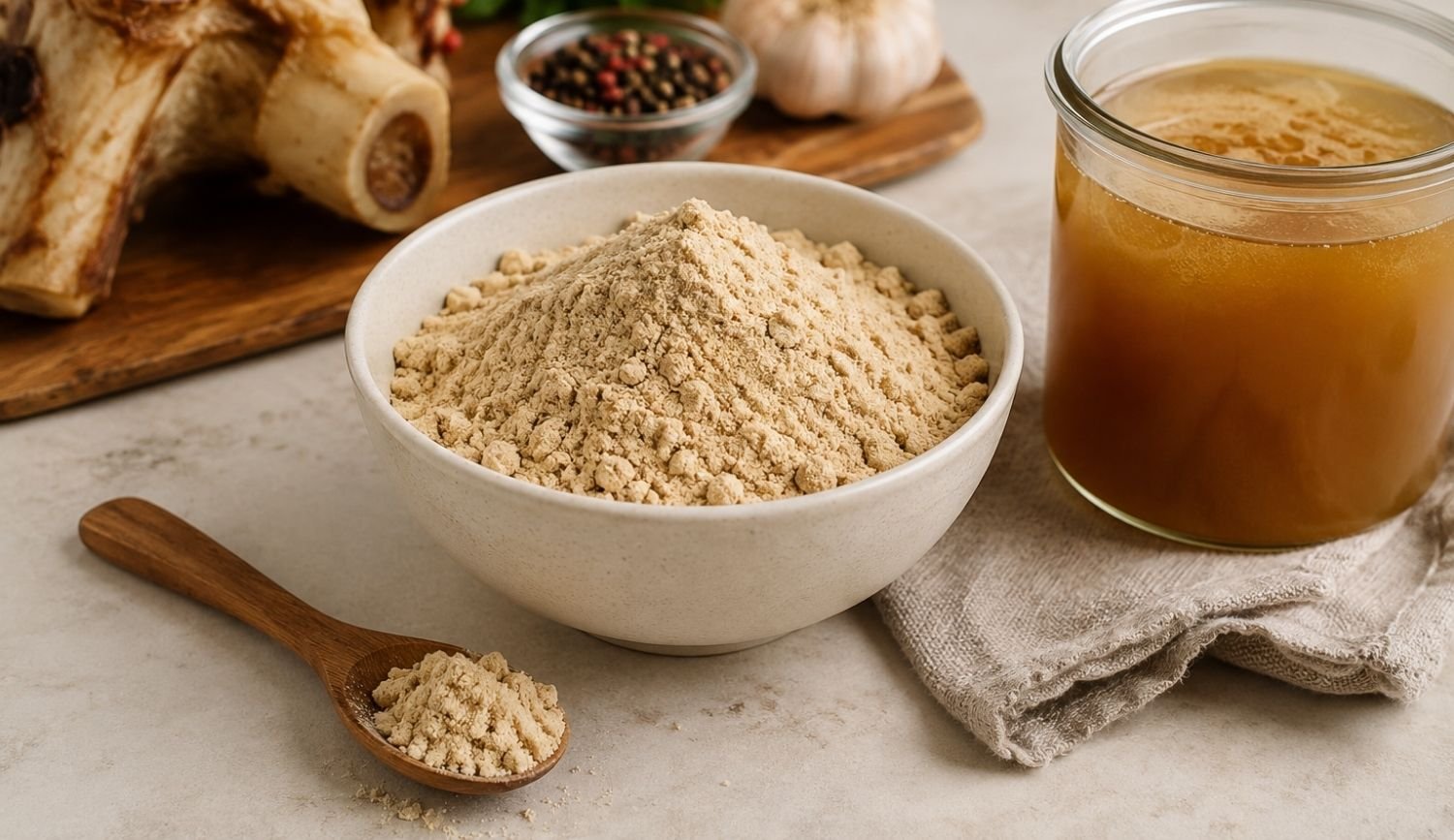
At its simplest, bone broth powder is dehydrated broth solids, made by concentrating or drying liquid broth until only the solid components remain.
Some brands spray-dry it. Others use different dehydration methods, and the result gets sold under several names: bone broth powder, bone broth protein, instant broth, or broth concentrate.
Some versions stay plain and unseasoned. Others are built more like an instant soup mix, with flavoring systems layered on top of the base broth.
Those two categories behave very differently for someone trying to figure out what triggered a reaction. This article stays focused on the broth powder itself.
For how it stacks up against collagen powder specifically, Bone Broth Powder vs Collagen Powder and Bone Broth vs Collagen Powder cover both the dry and liquid versions of that comparison.
Why dehydration does not erase the histamine question
Histamine and related biogenic amines typically form through microbial activity acting on amino acids like histidine. That process is driven by time, temperature, and handling, not by whether a food eventually gets dried [3].
The formation happens during the simmering, cooling, and storage stages, well before a manufacturer ever runs the broth through a dryer.
Once those amines exist, removing water doesn’t remove them. This mirrors a principle well established in food safety around fish and scombroid poisoning: histamine is heat-stable, and cooking, freezing, or otherwise processing a food that already contains it doesn’t reliably destroy it [5][6].
Dehydration works the same way. In some cases, drying can even concentrate what’s left, since you’re compacting a full serving of broth down into a fraction of its original volume.
That doesn’t prove any specific bone broth powder is high in histamine. Dry alone isn’t proof of anything, one way or the other.
The manufacturing history behind that particular batch, most of which never makes it onto the label, is what actually decides the outcome.
The pre-dehydration step matters most
A few details from before drying carry more weight than anything printed on the tub. How long the broth simmered, how quickly it cooled afterward, how long it sat in storage before processing, and how fresh the original bones or meat were all shape the histamine picture more than the drying method itself.
Bone Broth and Histamine covers this earlier stage of the process in full, because many powder concerns begin with the same broth-making variables before dehydration.
Plain broth powder is different from instant soup-style mixes
Here’s where formula complexity starts to matter as much as the broth itself. A single-ingredient, unseasoned bone broth powder carries fewer variables: dehydrated broth solids, and not much else.
Flavored instant broth products often look more like a soup mix than a plain protein powder. Yeast extract, natural flavors, spice blends, garlic or onion powder, gums, anti-caking agents, and added sodium can all show up in a “savory broth” formula, none of which a front-label “gut health” claim discloses.
A reaction to one of these products doesn’t necessarily point to the broth itself.
Bone broth powder types compared
| Product type | What it usually contains | Histamine-sensitive concern | Best interpretation |
|---|---|---|---|
| Long-simmered homemade broth | Bones, water, simmered 8–24 hours | High variability from cooking time, cooling, storage | Time and handling matter more than the recipe |
| Short-cooked fresh meat broth | Fresh meat, shorter cook time | Fewer time-related variables | Often a lower-variable starting point |
| Single-ingredient unseasoned bone broth powder | Dehydrated broth solids only | Depends entirely on pre-drying process | Simplest to evaluate, but low histamine isn’t guaranteed |
| Flavored instant bone broth powder / soup mix | Broth solids plus flavorings, spices, gums, sodium | Additive-driven reactions possible alongside histamine | Hardest to interpret; too many moving pieces |
| Bone broth protein powder | Concentrated broth protein, sometimes fortified | Similar to instant powder, depending on formula | Read the full label, not just “protein” on the front |
The table shows why “bone broth powder” is not one single risk category. A plain broth powder and a flavored instant mix may sit next to each other online, but they create very different troubleshooting problems.
Why bone broth powder may cause side effects
A reaction to bone broth powder rarely has one single explanation. Histamine or other biogenic amines from the original broth are one possibility, since histamine intolerance depends on total load relative to how well the body clears it, not any one food in isolation [1][2].
Sodium load, yeast extract or hydrolyzed protein, garlic and onion (which also carry FODMAP considerations for some people), spice blends, gums, and simply a concentrated dose of protein can each contribute on their own.
Flushing or headache could be histamine-related, or could trace back to one of these other ingredients entirely. A food and symptom diary notebook can help separate these possibilities over time rather than guessing from a single episode.
Allergy-like symptoms, hives, swelling, wheezing, or throat tightness, call for stopping the product and getting medical guidance rather than more testing.
What to check on the label
A short ingredient list is usually the clearest sign that a bone broth powder is simple to evaluate. A long one, with things like yeast extract, garlic or onion powder, or an unlisted “proprietary blend,” means more to account for if something goes wrong.
Bone Broth Powder vs Collagen Powder walks through a fuller label-reading checklist than a dehydration-focused article needs here.
One item worth flagging on its own: yeast extract naturally carries free glutamate, and a small share of people report headache or flushing after glutamate-rich foods, though the evidence behind that link stays mixed [4]. It’s a separate question from histamine, worth keeping distinct rather than folding every reaction into one explanation.
If a product claims “low histamine” without testing behind it, treat that the same way you’d treat any unverified “clean label” claim. It’s marketing language, not proof.
A single-ingredient unflavored bone broth powder remains the simplest starting point for anyone trying to isolate what their body is actually reacting to.
Is low histamine bone broth powder possible?
In theory, yes. A product made from fresh, well-handled material, processed quickly after cooking, kept unseasoned, and genuinely tested for histamine content could reasonably earn that description.
In practice, most labels don’t show that work. “Low histamine” without any testing behind it is a marketing phrase, not a verified fact.
And even a product that has been tested isn’t guaranteed to suit every person, since individual thresholds vary regardless of what a certificate of analysis says.
When bone broth powder is not the right experiment
A handful of situations call for skipping this test rather than pushing through it:
- You’re currently in an active flare
- You’ve had a strong reaction to broth before, in any form
- The product is a multi-ingredient formula you can’t fully account for
- You have a known meat, fish, shellfish, gelatin, or alpha-gal allergy relevant to the source
- You’ve recently had hives, swelling, wheezing, chest tightness, or throat symptoms from any supplement
- You’re pregnant, breastfeeding, or managing a complex medical condition without a clinician’s guidance
A safety note before you test
Stop the product and speak with a healthcare professional if symptoms are severe, repeated, worsening, or allergy-like. A reaction to bone broth powder doesn’t prove histamine intolerance, MCAS, allergy, or DAO deficiency by itself.
Seek urgent medical care for throat swelling, trouble breathing, wheezing, facial, lip, or tongue swelling, fainting, severe chest tightness, rapidly spreading hives, or signs of anaphylaxis.
Don’t attempt a home re-challenge after a serious allergic reaction. If you have a known meat, fish, shellfish, beef, poultry, pork, alpha-gal, or gelatin allergy, discuss animal-derived powders with a clinician first.
The same goes for pregnancy, breastfeeding, kidney disease, liver disease, gout, protein restriction, prescription medications, or a complex chronic illness. Bone broth powder is a food, not a treatment for histamine intolerance, MCAS, DAO deficiency, leaky gut, allergy, or chronic illness [7].
The bottom line
Instant bone broth powder doesn’t get a free pass on safety just because it skips homemade broth’s cooking mess. Drying it down doesn’t erase whatever histamine formed before it hit the dehydrator.
The process behind the powder, and the ingredient list sitting next to it, both matter more than whether the product comes wet or dry.
Plain, unseasoned powders are generally easier to evaluate than flavored soup-style mixes, though easier to evaluate isn’t the same as guaranteed safe. Severe or repeated symptoms are a reason to stop and get medical guidance, not a reason to keep experimenting.
If bone broth in any format keeps causing trouble, Low Histamine Collagen Alternatives and What to Eat During a Histamine Flare both cover other ways to meet the same goals.
Frequently asked questions
These questions focus on the practical concerns people often have after reacting to bone broth powder or seeing “low histamine” claims online. They are not a substitute for medical advice, especially if symptoms are severe or allergy-like.
Is bone broth powder high in histamine?
Not automatically, and not guaranteed low either. It depends on how the original broth was simmered, cooled, and stored before it was dried, none of which shows up on the label.
Does dehydration remove histamine from bone broth?
No. Dehydration removes water, not the biogenic amines that may have already formed. If histamine built up before drying, it can still be present in the powder, sometimes at a more concentrated level per scoop.
Is instant bone broth safer than homemade bone broth?
Not necessarily. The powder format doesn’t erase the risk factors tied to the broth’s original preparation; it just changes the presentation.
Why did bone broth powder make me react?
It could be histamine or another biogenic amine from the original broth, sodium, yeast extract, garlic or onion, spices, gums, or simply a concentrated protein dose. More than one of these can be true at once.
Is low histamine bone broth powder possible?
In theory, yes, if the product is made from fresh material, processed quickly, kept unseasoned, and actually tested. Most labels don’t provide that proof, so treat the claim with some skepticism.
What ingredients should I avoid in bone broth powder?
Watch for yeast extract, autolyzed yeast, hydrolyzed vegetable protein, natural or savory flavors, garlic or onion powder, spice blends, gums, and high sodium content. None of these are automatically unsafe, but all of them add variables.
Is bone broth protein high in histamine?
It depends on the same factors as any bone broth powder: how the original broth was made and what was added during formulation. There’s no blanket answer that applies to every product.
Can bone broth powder trigger MCAS symptoms?
It’s possible for someone with MCAS to react to bone broth powder, but a reaction on its own doesn’t confirm MCAS as the cause. That distinction is worth making with a clinician rather than assuming it.
Is plain bone broth powder better than flavored instant broth?
For testing purposes, yes, since it carries fewer ingredients to account for. That’s a different claim than saying it’s guaranteed to be tolerated by everyone.
When should I avoid bone broth powder?
During an active flare, after a previous strong reaction to broth, with a relevant meat or fish allergy, or when the product is a flavored multi-ingredient formula that’s hard to fully evaluate. Do not keep retesting it at home after hives, swelling, wheezing, chest tightness, throat symptoms, faintness, or rapidly worsening symptoms.
References
- Maintz L, Novak N. Histamine and histamine intolerance. American Journal of Clinical Nutrition. 2007;85(5):1185–1196. https://doi.org/10.1093/ajcn/85.5.1185
- Comas-Basté O, Sánchez-Pérez S, Veciana-Nogués MT, Latorre-Moratalla M, Vidal-Carou MC. Histamine Intolerance: The Current State of the Art. Biomolecules. 2020;10(8):1181. https://pmc.ncbi.nlm.nih.gov/articles/PMC7464760/
- Gardini F, Özogul Y, Suzzi G, Tabanelli G, Özogul F. Technological Factors Affecting Biogenic Amine Content in Foods: A Review. Frontiers in Microbiology. 2016;7:1218. https://pmc.ncbi.nlm.nih.gov/articles/PMC4982241/
- Questions and Answers on Monosodium Glutamate (MSG). U.S. Food and Drug Administration. https://www.fda.gov/food/food-additives-petitions/questions-and-answers-monosodium-glutamate-msg
- Fish and Fishery Products Hazards and Controls Guidance, Chapter 7: Scombrotoxin (Histamine) Formation. U.S. Food and Drug Administration. https://www.fda.gov/files/food/published/Fish-and-Fishery-Products-Hazards-and-Controls-Guidance-Chapter-7-Download.pdf
- Food Poisoning from Marine Toxins: Scombroid (Histamine) Fish Poisoning. CDC Yellow Book. https://www.cdc.gov/yellow-book/hcp/environmental-hazards-risks/food-poisoning-from-marine-toxins.html
- Dietary Supplements. U.S. Food and Drug Administration. https://www.fda.gov/food/dietary-supplements