

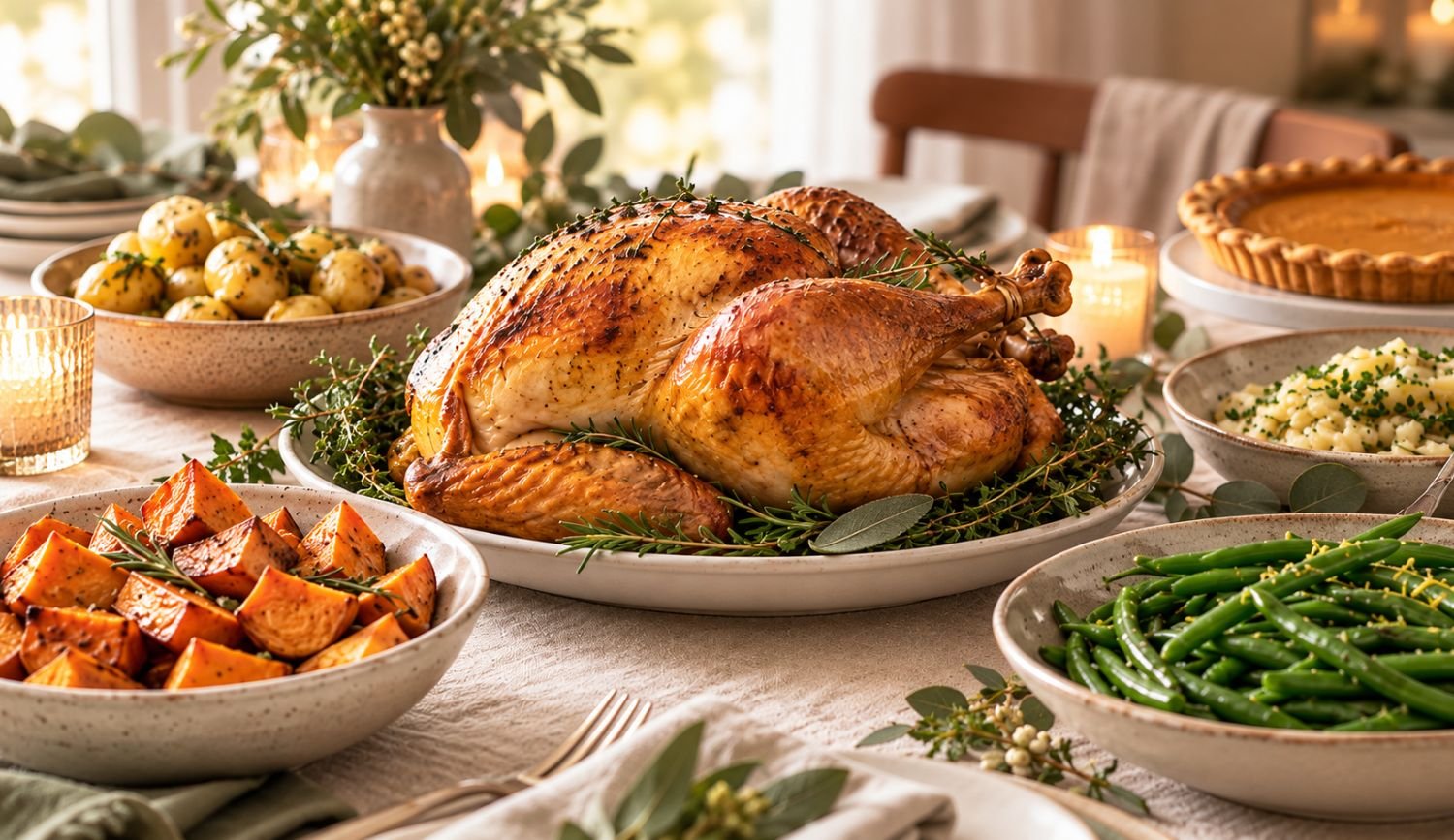
You can build a low histamine Thanksgiving or holiday meal, and turkey itself is a better starting point than many food lists suggest. Direct studies of plain turkey have reported histamine as not detected or below the limit of quantification under controlled chilled storage.
Storage history, processing and personal tolerance still matter, though. This guide starts with the turkey, then moves through sides, stuffing, gravy, dessert and leftovers, so you can assemble a menu from the evidence instead of from fixed rules.
Is turkey low in histamine?
Plain turkey can be very low in measured histamine, but the format you buy and how it is stored change the picture. Three direct studies show where that holds and where it stops.
In a 2012 study, sliced turkey was kept at 0 ± 1°C for up to 25 days, in air and in several modified-atmosphere packages. Histamine was either not detected or below the 1.03 mg/kg quantification limit.
A 2018 study of retail meats found no detectable histamine in turkey leg stored at 2°C on days 0, 3, 6 or 10.
Other amines did change over that time, though. Tyramine rose from not detected to 6.88 mg/kg by day 10, which is a reminder that undetectable histamine is not the same as an unchanged piece of meat.
What matters here is that these were controlled conditions. They show turkey can stay very low in histamine. They do not turn ten days in the fridge into a recommendation for someone with histamine intolerance.
Smoked turkey tells a different story. Sliced smoked turkey breast stored at 4°C for 30 days accumulated histamine, reaching 11.9 to 32.9 mg/kg depending on the packaging.
So the useful distinction is plain turkey versus processed turkey, and fresh handling versus long storage. None of this makes turkey histamine-free, and none of it guarantees that a particular bird will agree with you.
Fresh, frozen, ground, smoked or pre-seasoned: what changes?
If turkey is the centerpiece, the next question is which version of it to buy. The evidence covers some formats well and others barely at all, so the table below separates what we know from what remains open.
| Turkey format | What the evidence suggests | What remains uncertain |
|---|---|---|
| Plain, fresh or chilled | Direct studies found histamine not detected or below quantification under controlled chilled storage | Whether a given retail bird or home fridge behaves the same way |
| Frozen | Freezing prevents microbial growth while the food stays frozen and can limit further amine formation | Frozen turkey has not been shown to be lower in histamine than fresh, because freezing does not remove histamine already present |
| Ground | No verified direct comparison with whole turkey | Handling and freshness still matter; it is not ranked here |
| Smoked or deli-style | Smoked turkey accumulated histamine during prolonged refrigerated storage | Whether other processed turkey behaves the same, and what the starting levels are |
| Marinated | A 2026 experimental study found histamine remained low after turkey breast was refrigerated for 24 hours in lactic acid, yogurt whey, kefir or yogurt marinades | Those findings apply to the tested preparations and should not be generalized to every commercial marinade |
| Pre-brined or self-basting | No direct comparative histamine study was verified for these commercial formats | Ingredients, processing, storage and handling differ widely, so the category cannot be assigned a universal histamine rating |
The 2026 experiment tested turkey breast refrigerated for 24 hours with specific lactic-acid and fermented-dairy marinades, and histamine remained low in the tested treatments.
That is a narrow finding. It does not establish every commercial marinade as low in histamine, and it does not establish pre-brined or self-basting turkey as low in histamine either.
Marination itself is not shown to raise histamine here, but that is not a clearance for all marinades. Commercial ingredient lists and handling history remain important, so read the label rather than relying on the format name.
Ground turkey is the format people ask about most. Grinding changes handling and storage characteristics, but no verified direct evidence establishes that ground turkey is categorically higher in histamine than whole turkey, so it is not ranked as high histamine here. For the wider picture on cured and fermented products, see high histamine foods.
Which sides give you the most to work with?
Once the turkey is settled, the plate fills in quickly. Several familiar Thanksgiving vegetables have low or undetectable measured histamine in published datasets.
In Spanish data, green beans (12 samples) and potatoes (10 samples) had no detectable histamine. A Brazilian review reported the same for cooked potatoes (14 samples), onion (10 samples) and parsley (10 samples), and Spanish onion samples (4) were also not detected. Sweet potato averaged 0.60 mg/kg, although that figure comes from only three samples.
For Thanksgiving, that means these are reasonable building blocks, not guarantees. A measurement describes the food in particular samples, and your own tolerance is a separate question. For broader category context, the low histamine food list compares lower-histamine starting options with more variable ones.
Stuffing without the guesswork
Stuffing is where internet advice gets most confident and the evidence gets thinnest. Baker’s yeast appears on many exclusion lists, yet the 2021 clinical guideline notes that some low-histamine diets prohibit yeast despite a lack of relevant histamine content. Treating yeast as a high-histamine ingredient is not supported.
Sourdough is a different case. It is fermented, and its biogenic amine profile can depend on the microorganisms and the process, so no universal number applies without product-specific data.
The simplest route is to build stuffing from ingredients you already tolerate. A bread you know agrees with you, sautéed onion, parsley and the fat you cook with every week is enough. Fewer unfamiliar ingredients means fewer unknowns if you do react.
What about gravy?
Gravy raises the question of cooking time. Long cooking itself is not what creates histamine. Histamine accumulation is primarily linked to microbial activity, so ingredient freshness, time-temperature control, cooling and storage matter more than the number of hours a properly heated gravy or stock simmers.
A freshly made gravy with a short ingredient list does reduce ingredient uncertainty, because there is less to track. That is a practical advantage, not a proven histamine advantage.
No direct measurements verified in this review compare quick gravy with long-simmered stock prepared under equivalent conditions. Quick gravy cannot be ranked as proven lower in histamine, and long-simmered gravy should not be assumed to become high in histamine automatically.
Cranberry sauce: where the evidence stops
Cranberry sauce is a place where honesty works better than reassurance. This evidence review did not verify any direct histamine measurements for cranberries, so they cannot be described as analytically low or high in histamine.
Compatibility lists and personal tolerance may differ here. If cranberry sauce is on your table, treat it as an ingredient choice to make from your own history rather than a food with a proven histamine profile.
Pumpkin dessert and holiday spices
Pumpkin has its own page, is pumpkin high in histamine. The short version is that measured histamine is generally low, though studies vary, and there are no verified comparisons of fresh and canned pumpkin or of cooking methods.
A pie is a different question. It is a multi-ingredient dish, so pumpkin measurements cannot assign one histamine value to the whole dessert. Treat it as a recipe decision: what is in this pie, and have I tolerated those ingredients before?
The same caution applies to cinnamon, cloves, nutmeg and ginger. Food lists often label them as histamine liberators, but those lists disagree with one another. The 2021 diet review found the mechanism behind so-called histamine-releasing foods unresolved, and the clinical guideline found no reliable evidence for these foods or their clinical relevance.
Individual tolerance can still differ, so a spice you have reacted to before is worth leaving out, but the label alone is not the reason. For more, see histamine liberator foods.
Leftovers and freezing: where internet rules get rigid
That brings us to leftovers, where internet rules often become much more rigid than the evidence. There is no validated 24-hour or 48-hour histamine cutoff for turkey, and no study supports a specific number of days.
Here is what the science does support. Biogenic amines form mainly through microbial activity. Refrigeration slows that process without stopping it, since some amine-forming bacteria can grow below 5°C.
Freezing prevents microbial growth while the food stays frozen and helps limit further amine formation, but it does not remove histamine already present. Reheating does not reliably destroy histamine that is already present.
USDA guidance sits in a different category. It advises refrigerating or freezing Thanksgiving leftovers promptly, generally within two hours, using refrigerated cooked turkey and most leftovers within three to four days, and reheating leftovers to 165°F.
These are food-safety limits and worth following. They are not histamine-intolerance thresholds, and day three or four should not be read as symptom-safe for someone with histamine intolerance.
Within those food-safety limits, if you prefer to minimize how long food sits in the fridge, portioning and freezing leftovers promptly is a reasonable practical strategy. It is a personal choice, not a validated universal histamine rule.
Eating at someone else’s Thanksgiving or holiday meal
Hosting gives you control. Being a guest does not, and that shifts the goal from perfecting the menu to reducing unknowns.
- Ask what is in mixed dishes such as stuffing, gravy and casseroles
- Choose simpler foods when ingredients are unclear
- Bring one dish you already know and tolerate
- Avoid trying many unfamiliar foods at once if you are following a clinician or dietitian guided elimination or reintroduction plan
A reaction at a gathering is worth noting, but one meal does not diagnose histamine intolerance. Food allergy is a separate possibility, and histamine intolerance vs food allergies explains how the two differ. Breathing difficulty, swelling of the throat or tongue, or fainting needs urgent medical care rather than a histamine explanation.
Putting together a low histamine Thanksgiving meal
To pull this together, here is one example plate. It is an illustration built from the evidence above, not a medically safe menu, and every item still depends on what you personally tolerate.
- Plain roasted turkey
- Baked potato or sweet potato
- Green beans
- A simple onion and parsley side, or stuffing made from ingredients you already tolerate
- A pumpkin-based dessert, keeping the caveats above in mind
- Optional cranberry sauce, with the evidence gap in mind
If you take three things from this guide, make them these. Plain turkey is not automatically a high-histamine food, but processing and storage history matter.
Food-safety guidance comes first; within those limits, someone who is histamine-sensitive may choose a shorter refrigeration window or freeze portions promptly, according to personal tolerance.
A holiday menu built around familiar foods you already tolerate is more useful than any universal internet list, because no menu can guarantee symptom prevention.
Frequently Asked Questions
These quick answers cover the most common questions about turkey, leftovers, yeast, and reheating during Thanksgiving and holiday meals. They summarize the evidence without replacing individual tolerance or standard food-safety guidance.
Is turkey low in histamine?
Plain turkey can contain very little measured histamine under controlled chilled conditions. Processing, storage history and individual tolerance still matter, so turkey should not be described as universally histamine-free.
Are Thanksgiving leftovers high in histamine?
There is no validated 24-hour or 48-hour histamine cutoff for Thanksgiving leftovers. Refrigeration slows microbial activity, while freezing can limit further amine formation. Food-safety storage limits should still be followed.
Does reheating food destroy histamine?
No. Cooking and reheating can kill bacteria, but histamine that has already formed is heat-stable and is not reliably removed by normal cooking temperatures.
Is yeast high in histamine?
Current clinical guidance does not support classifying baker’s yeast as high in histamine simply because it is yeast. Individual tolerance and the complete food product still matter.
References
- Fraqueza MJ, Alfaia CM, Barreto AS. Biogenic amine formation in turkey meat under modified atmosphere packaging with extended shelf life: Index of freshness. Poultry Science. 2012;91(6):1465-1472. doi:10.3382/ps.2011-01577
- Triki M, Herrero AM, Jiménez-Colmenero F, Ruiz-Capillas C. Quality Assessment of Fresh Meat from Several Species Based on Free Amino Acid and Biogenic Amine Contents during Chilled Storage. Foods. 2018;7(9):132. doi:10.3390/foods7090132
- Ntzimani AG, Paleologos EK, Savvaidis IN, Kontominas MG. Formation of biogenic amines and relation to microbial flora and sensory changes in smoked turkey breast fillets stored under various packaging conditions at 4°C. Food Microbiology. 2008;25(3):509-517. doi:10.1016/j.fm.2007.12.002
- Biçakci G, Sarica E. Impact of Lactic Acid and Fermented Dairy-Based Marinades on Quality Attributes and Biogenic Amine Formation in Turkey Breast Meat. Food Science & Nutrition. 2026;14(8):e72185. doi:10.1002/fsn3.72185
- Naila A, Flint S, Fletcher G, Bremer P, Meerdink G. Control of Biogenic Amines in Food: Existing and Emerging Approaches. Journal of Food Science. 2010;75(7):R139-R150. doi:10.1111/j.1750-3841.2010.01774.x
- Sánchez-Pérez S, Comas-Basté O, Rabell-González J, et al. Biogenic Amines in Plant-Origin Foods: Are They Frequently Underestimated in Low-Histamine Diets? Foods. 2018;7(12):205. doi:10.3390/foods7120205
- Sánchez-Pérez S, Comas-Basté O, Veciana-Nogués MT, Latorre-Moratalla ML, Vidal-Carou MC. Low-Histamine Diets: Is the Exclusion of Foods Justified by Their Histamine Content? Nutrients. 2021;13(5):1395. doi:10.3390/nu13051395
- Gloria MBA, Diniz FB, Dala-Paula BM, et al. Histamine in Brazilian Foods: A Comprehensive Review of Occurrence and Risk Assessment for Intoxication and Intolerance. Food Science & Nutrition. 2025;13(11):e71151. doi:10.1002/fsn3.71151
- Reese I, Ballmer-Weber B, Beyer K, et al. Guideline on management of suspected adverse reactions to ingested histamine. Allergol Select. 2021;5:305-314. doi:10.5414/ALX02269E
- USDA Food Safety and Inspection Service. Turkey Basics: Handling Cooked Dinners.
- USDA Food Safety and Inspection Service. Freezing and Food Safety.

