
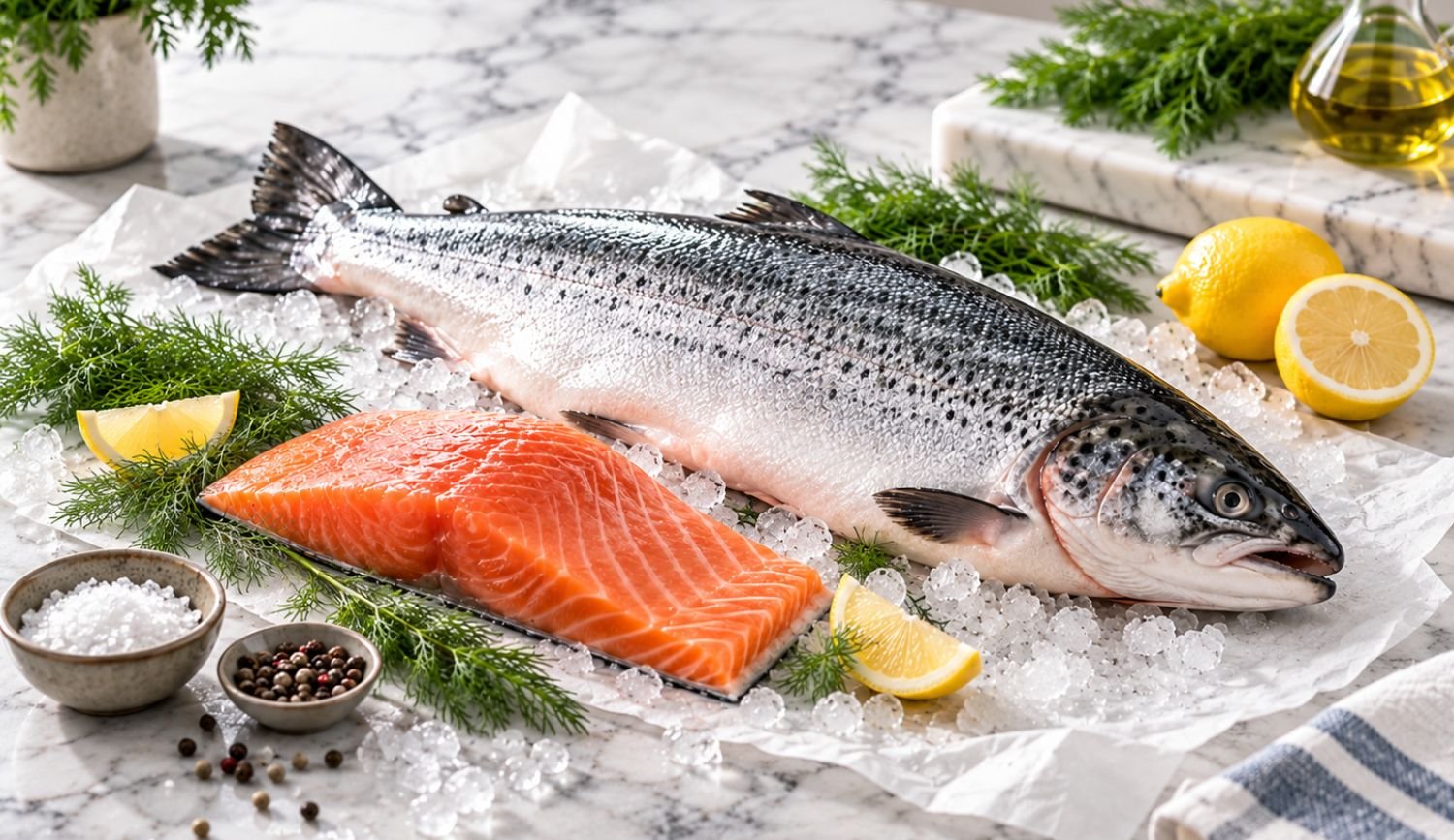
Salmon isn’t a classic high-histamine fish, but it can’t be given one fixed histamine level either. The FDA doesn’t list salmon among its histamine-producing finfish, and well-handled fresh or frozen salmon often contains little histamine. It can still accumulate histamine when handling, storage or decomposition let histamine-producing bacteria act, and occasional commercial samples have measured high.
Smoked and canned salmon are variable rather than automatically high. Freezing doesn’t remove histamine already present, cooking doesn’t reliably destroy it, and no validated universal food-level cutoff exists for histamine intolerance.
Usually lower when properly chilled and handled well.
Often a practical option, but freezing does not remove histamine already formed.
More variable because processing and storage can affect histamine levels.
Variable, with limited salmon-specific evidence for a universal high or low label.
Is salmon a high-histamine fish?
Not in the way tuna or mackerel are. The FDA’s Food Traceability List gives tuna, mahi-mahi, mackerel, amberjack, swordfish and yellowtail as examples of histamine-producing finfish, and it gives salmon as an example of finfish not associated with histamine or ciguatoxin.
That is a food-safety classification, though. It describes which species are most associated with histamine formation. It isn’t proof that every salmon batch is low enough for every histamine-sensitive person.
What have studies measured in salmon?
Laboratory work shows both ends of the range. In a controlled study, fresh and frozen-then-thawed Atlantic salmon were packed in modified atmosphere and stored at 2°C. The fresh salmon had less than 20 mg/kg of histamine before it showed sensory spoilage. Freezing eliminated the spoilage bacterium Photobacterium phosphoreum in that experiment and extended shelf life after thawing.
That is one study under controlled conditions, and it shouldn’t be turned into a universal threshold.
Commercial surveys show the other end. A Polish market survey of 421 fish samples found histamine in some raw, smoked, canned and marinated fish, and one raw Atlantic salmon exceeded 100 mg/kg. A 2021 review of low-histamine diets cites a fresh salmon value of 111 mg/kg, using it to show how inadequate freshness or handling can produce high values even in foods that aren’t uniformly high.
The units are the same throughout. One mg/kg equals one part per million (ppm).
Fresh, frozen, smoked and canned salmon compared
The table summarizes how each form behaves, and the sections below it explain why. In every case, the main message is variability, and in canned salmon, limited evidence.
| Salmon form | What the evidence suggests | Main variable | Reliable high/low label? |
|---|---|---|---|
| Fresh | Well-chilled fresh salmon often tests low, though occasional high samples exist | Time and temperature handling before and after purchase | No. “Fresh” is a retail description, not a laboratory result |
| Frozen/thawed | Freezing can preserve a low starting state, but does not remove histamine already formed | What happened to the fish before it was frozen | No. A frozen label does not reveal earlier handling |
| Smoked | Cold-smoked salmon can support spoilage organisms that produce histamine in storage, though low-histamine samples have also been measured | Raw-material quality, storage time and temperature | No. More variable than uniformly high |
| Canned/tinned | Salmon-specific analytical evidence is limited | Quality and handling before canning | No. It cannot be assigned from the canning process alone |
Fresh salmon
Fresh, well-chilled salmon often tests low, but “fresh” is a description used at the fish counter. It isn’t a measurement. Appearance or smell alone can’t guarantee a low histamine concentration, and occasional high samples do exist.
Frozen salmon
Freezing can preserve a low-histamine starting state by suppressing further microbial activity. It doesn’t remove histamine that formed before the fish was frozen, and a frozen label tells you nothing about what happened earlier.
There is no universal rule here, such as a fixed time between catch and freezer or a fixed thawing cutoff. Frozen salmon also isn’t always safer than fresh.
Smoked salmon
Smoked salmon is more variable, not universally high.
Cold-smoked salmon can support spoilage organisms capable of producing histamine and other biogenic amines during storage. A 2000 study found that Photobacterium phosphoreum was the only species that produced histamine when inoculated onto sterile cold-smoked salmon, and the amounts matched what is seen when naturally contaminated product spoils. Older studies likewise found histamine could rise in spoiled cold-smoked salmon.
Low values also exist. A 2024 review of analytical methods describes a study in which a Norwegian smoked salmon sample measured about 1.7 mg/kg. That is one sample, and smoking itself doesn’t make salmon high in histamine.
Canned or tinned salmon
This is the form with the weakest evidence. Salmon-specific analytical data on canned salmon are limited, so canned salmon can’t be called universally high or low from the canning process alone.
Quality and handling before canning matter. If histamine formed before heating, canning doesn’t reliably destroy it. Histamine data from canned tuna or canned sardines shouldn’t be transferred to salmon.
Does cooking remove histamine from salmon?
No, not reliably. Histamine is heat-stable. FDA guidance for histamine-forming fish states that once histamine forms, washing, freezing or heating cannot reliably remove it. That principle is why cooking should not be treated as a dependable way to reduce histamine already present in salmon.
Baking, grilling, reheating, smoking and canning therefore do not “reset” a batch in which histamine has already formed. Cooking also cannot make questionable fish safe.
Histamine fish poisoning versus histamine intolerance
These two are easy to confuse because they share a molecule, but they are different problems with different thresholds.
Histamine fish poisoning
Histamine fish poisoning, or scombrotoxin poisoning, is a food-safety intoxication. It can affect people who have no pre-existing intolerance, and its symptoms can resemble an allergic reaction. It is associated with unusually high histamine from mishandling.
The FDA’s 2024 guidance uses 35 ppm as a decomposition or adulteration action criterion in susceptible fish, and 200 ppm as a level associated with possible human illness. These are regulatory figures for fish safety. They are not histamine-intolerance thresholds.
Histamine intolerance
The low-histamine diet literature has no agreed universal cutoff for a low-histamine food. Proposed food thresholds vary widely, and personal symptom tolerance can’t be predicted from a single regulatory number. For how histamine intolerance is defined, see histamine intolerance explained.
Practical guidance for buying, storing and eating salmon
Practical steps follow from how histamine forms, not from a rule about hours:
- Buy from sources with a reliable cold chain.
- Keep refrigerated fish consistently cold and follow standard food-safety storage guidance.
- Freeze portions when appropriate, to limit further microbial growth, while remembering that freezing preserves and doesn’t remove histamine.
- Don’t use cooking to rescue fish you doubt.
- If you are testing your own tolerance, change one variable at a time.
For broader shopping context, see the low histamine food list and the low histamine grocery list.
Could a reaction to salmon be something else?
A symptom after salmon doesn’t prove histamine intolerance. Fish allergy is a separate, immune-mediated possibility, and it should be considered before assuming histamine was the cause.
If several people become ill after eating the same fish, food poisoning is more likely than individual intolerance, and it is worth treating that way.
Bottom line
Salmon is not classified by the FDA as a classic histamine-producing finfish, and well-handled fresh or frozen salmon often contains little histamine. But no form of salmon can be assigned one guaranteed histamine level because handling, storage and processing can change what is present in a specific batch.
For histamine intolerance, the most defensible approach is to focus on reliable cold-chain handling and personal tolerance rather than treating “fresh,” “frozen,” “smoked” or “canned” as automatic safety labels. Freezing can limit further formation, but it does not remove histamine already present, and cooking does not reliably destroy it.
References
- U.S. Food and Drug Administration. Food Traceability List.
- U.S. Food and Drug Administration. FDA Issues Final Compliance Policy Guide: Scombrotoxin (Histamine)-Forming Fish and Fishery Products. 2024.
- Emborg J, Laursen BG, Rathjen T, Dalgaard P. Microbial spoilage and formation of biogenic amines in fresh and thawed modified atmosphere-packed salmon (Salmo salar) at 2°C. J Appl Microbiol. 2002;92(4):790-799. doi:10.1046/j.1365-2672.2002.01588.x.
- Pawul-Gruba M, Osek J. Identification of Histamine in Fish and Fish Products in Poland During 2014-2018. J Vet Res. 2021;65(4):483-486. doi:10.2478/jvetres-2021-0066.
- Sánchez-Pérez S, Comas-Basté O, Veciana-Nogués MT, Latorre-Moratalla ML, Vidal-Carou MC. Low-Histamine Diets: Is the Exclusion of Foods Justified by Their Histamine Content?. Nutrients. 2021;13(5):1395. doi:10.3390/nu13051395.
- Jørgensen LV, Huss HH, Dalgaard P. The effect of biogenic amine production by single bacterial cultures and metabiosis on cold-smoked salmon. J Appl Microbiol. 2000;89(6):920-934. doi:10.1046/j.1365-2672.2000.01196.x.
- Jørgensen LV, Dalgaard P, Huss HH. Multiple compound quality index for cold-smoked salmon (Salmo salar) developed by multivariate regression of biogenic amines and pH. J Agric Food Chem. 2000;48(6):2448-2453. doi:10.1021/jf9909407.
- Chen Z, Xie J, Mei J. A Review on Analytical Techniques for Quantitative Detection of Biogenic Amines in Aquatic Products. Chemosensors. 2024;12(12):274.