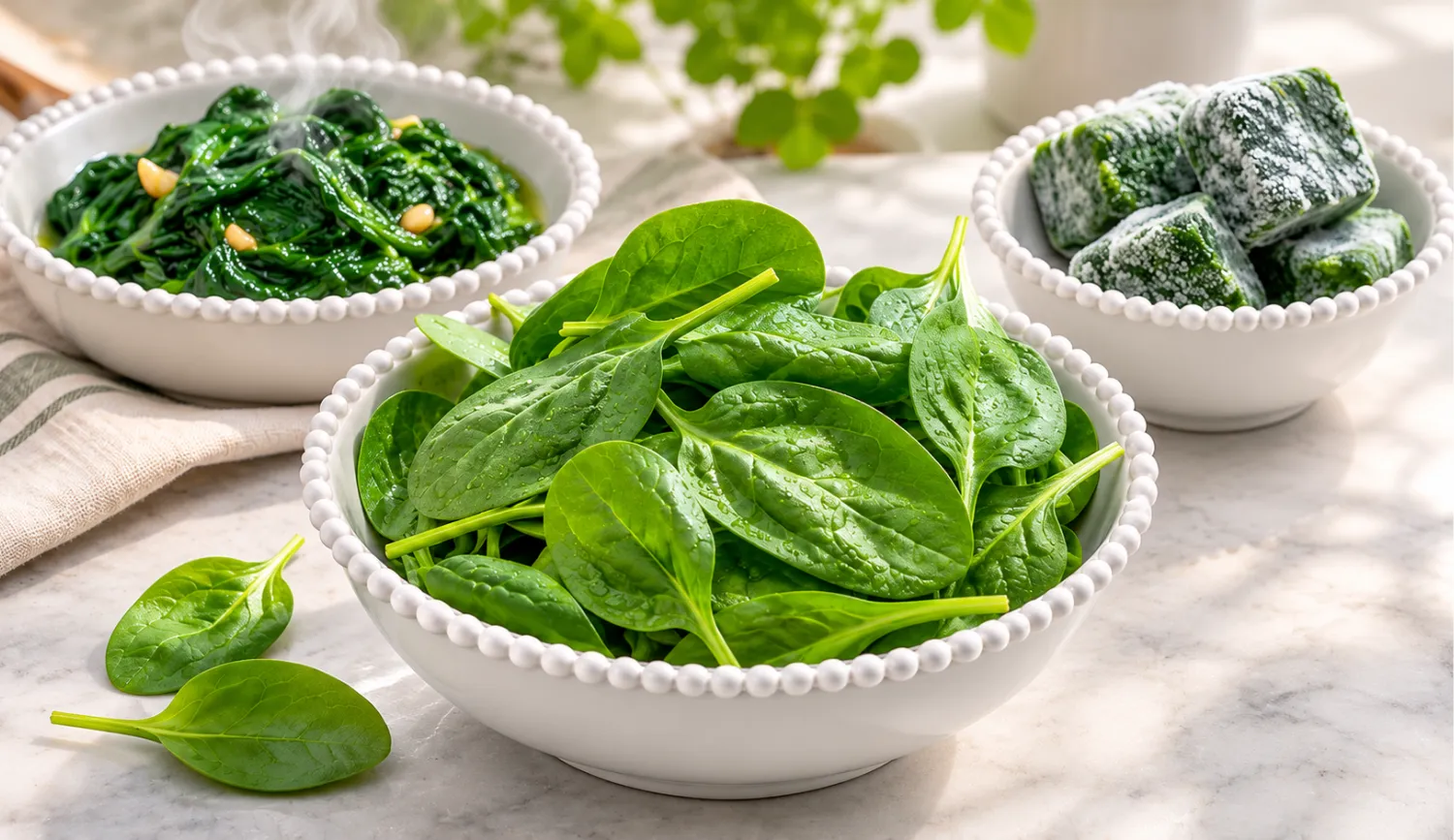
Yes, researchers have measured histamine in spinach, including fresh and frozen samples, so spinach is not reliably histamine-free. The amounts vary from sample to sample. Cooking studies also disagree: some boiling methods lowered histamine in the cooked leaves, probably by moving it into the water, while a brief blanching test showed no clear change.
No lab measurement tells you your own symptom threshold.
This guide explains what was measured, what cooking and freezing can and cannot do, and how to make a sensible food decision without a universal ban.
Is spinach high in histamine?
Spinach is a documented source of dietary histamine: researchers have detected it in fresh and frozen samples. That does not establish a universal clinical cutoff between “high” and “low,” or prove that eating spinach will cause symptoms.
Finding histamine in a food is also different from knowing it will cause symptoms. The amount that matters for any one person depends on factors these studies did not test, and a measurement in a lab does not set a personal limit.
How much histamine is in spinach?
The available numbers come from a few small studies, summarized below. They use the same unit, milligrams of histamine per kilogram of spinach as sampled.
| Study | Spinach samples | Measured histamine | Main limitation |
|---|---|---|---|
| 2007 market survey | 18 market samples | 9.5 to 69.7 mg/kg | Wide range; handling and age of samples varied |
| 2022 Greek food analysis | 1 fresh, 2 frozen | Fresh 30.2 mg/kg; frozen 33.7 and 17.9 mg/kg | Only three samples, not matched products |
The spread in the 2007 samples shows that “how much histamine is in spinach” has no single answer. The studies do not establish one typical concentration across all spinach sold or prepared in different ways.
A separate cooking study reported a raw spinach value of 142 mg/kg, but that figure is per kilogram of dry matter, with the water removed. It cannot be compared with the numbers above, so it is kept out of the table.
Is fresh or frozen spinach lower in histamine?
There is no reliable head-to-head answer. The 2022 samples show that frozen spinach can contain histamine, but with only one fresh and two frozen samples, they do not show that frozen is higher, lower or the same as fresh.
Freezing may slow further histamine formation while the food stays frozen, but it does not remove histamine that is already there.
Storage conditions in the lab, including one experiment at 6°C where histamine generally rose over time, were experimental settings and not advice for your refrigerator. Follow normal food-safety guidance and do not keep produce past its safe window.
Does cooking spinach reduce histamine?
The answer depends on how the spinach is cooked, and the studies disagree. In one experiment, boiling spinach for 15 minutes lowered histamine in the cooked leaves by nearly 60%, and grilling lowered it by about 25%. Those are study-specific results, not a demonstrated improvement in how well anyone tolerates the food.
A review also summarizes an older experiment that reported a larger drop of 83% after boiling, along with histamine moving into the cooking water.
Histamine is heat-stable, so heat itself is not the likely reason. A reasonable explanation, supported by earlier reviewed work but not a universal rule, is that histamine moves into the cooking water.
In a different study, spinach blanched for 30 seconds at 90°C showed no distinct change in histamine. The two studies used different food preparation, protocols and assays, so their results cannot simply be lined up.
In practice, a long boil in water you then discard may lower the amount in the leaves, while brief blanching may not. Cooking can change a measurement, but it cannot guarantee you will tolerate the food.
What about raw spinach, baby spinach, salads and smoothies?
Raw and cooked spinach differ in water content and portion size, which changes how much you actually eat. A big smoothie may contain far more spinach than a side salad. That is a fact about portion, and it is not evidence that a smoothie causes a sudden overload of the enzyme diamine oxidase (DAO).
No verified measurements compare baby spinach, spinach powder or canned spinach in this evidence, so there is no rating to give. It is better to name that gap than to guess.
Is spinach a histamine liberator?
Spinach contains real, measurable histamine, which is a separate question from whether it prompts the body to release its own. The “liberator” idea is a hypothesis, and reviews of low-histamine diets find no convincing human clinical studies establishing it for foods in general.
That does not mean liberators are impossible, and it does not rule out a true IgE-mediated food allergy to spinach. It means labels on food lists should not be read as proven mechanisms. Our high histamine foods guide covers why these lists contradict each other.
Can you eat spinach with suspected histamine intolerance?
It depends on your situation, and the evidence cannot give a universal rule. Histamine intolerance is hard to diagnose, symptoms after a meal have many possible explanations, and clinical evidence for low-histamine diets and their cutoffs remains limited.
If a clinician suggests a short dietary trial, the aim is to protect nutrition and avoid piling on more restrictions. These studies do not establish a validated personal serving threshold or a self-testing protocol for spinach, and clinicians can tailor any diet trial to medical and nutritional needs.
Spinach is not toxic or something to avoid for life. For DAO and diet context, see our page on the DAO deficiency diet, keeping in mind that diet alone cannot diagnose anything.
To tell a recurring pattern from a one-off event, note what and how much you ate, the other ingredients in the meal, how long after eating symptoms began, and whether they repeat on separate occasions. Add the wider context, such as other possible triggers, medicines or illness. A single reaction after one meal rarely identifies a cause, and cutting out more foods than you need can narrow your diet without answering the question.
If you have ever had a sudden, severe reaction after eating spinach, do not test it again yourself. Get it assessed first.
What can replace spinach in meals?
If you want to try something else, ordinary options include romaine, bok choy, kale and arugula. Romaine and arugula suit salads, bok choy works in sautés, and kale holds up in cooked dishes and smoothies.
These are culinary substitutes. They are not certified histamine-free, and this evidence does not measure them, so none can be called universally safe. Our low histamine grocery list and low histamine food list offer starting points for building a broader plan.
When should symptoms be assessed by a professional?
See a clinician if reactions keep recurring, if you are unsure whether a food is the cause, or if you are thinking about cutting out whole food groups.
Hives, wheezing, digestive upset and headaches can come from food allergy and many other conditions, so a food reaction alone does not diagnose histamine intolerance or mast cell activation syndrome (MCAS).
Get urgent emergency help for throat swelling, trouble breathing or fainting. A severe reaction is a reason to call for help and not to run an elimination or rechallenge experiment at home.
Bottom line
Spinach contains measurable histamine that varies widely, freezing does not remove it, and cooking studies disagree. None of that tells you what spinach will do for you. If you suspect a pattern, track it and discuss it with a clinician before restricting more than you need to.
References
- Lavizzari T, Veciana-Nogués MT, Weingart O, et al. Occurrence of biogenic amines and polyamines in spinach and changes during storage under refrigeration. J Agric Food Chem. 2007;55(23):9514–9519. doi:10.1021/jf071307l.
- Tsiasioti A, Tzanavaras PD. Simple and reliable determination of the histamine content of selected Greek vegetables and related products in the frame of “low histamine diet”. Foods. 2022;11(20):3234. doi:10.3390/foods11203234.
- Muñoz-Esparza NC, Costa-Catala J, Comas-Basté O, Toro-Funes N, Latorre-Moratalla ML, Veciana-Nogués MT, et al. Occurrence of polyamines in foods and the influence of cooking processes. Foods. 2021;10(8):1752. doi:10.3390/foods10081752.
- Chung BY, Park SY, Byun YS, Son JH, Choi YW, Cho YS, et al. Effect of different cooking methods on histamine levels in selected foods. Ann Dermatol. 2017;29(6):706–714. doi:10.5021/ad.2017.29.6.706. PMID:29200758.
- Hrubisko M, Danis R, et al. Histamine intolerance: the more we know the less we know. A review. Nutrients. 2021;13(7):2228. doi:10.3390/nu13072228.
- Sánchez-Pérez S, et al. Low-histamine diets: is the exclusion of foods justified by their histamine content? Nutrients. 2021;13(5):1395. doi:10.3390/nu13051395.
- Sánchez-Pérez S, et al. Biogenic amines in plant-origin foods: are they frequently underestimated in low-histamine diets? Foods. 2018;7(12):205. doi:10.3390/foods7120205.
- Jackson K, Busse W, Gálvez-Martín P, Terradillos A, Martínez-Puig D. Evidence for dietary management of histamine intolerance. Int J Mol Sci. 2025;26(18):9198. doi:10.3390/ijms26189198.