

Bone broth powder looks like the convenient middle ground. It promises the comfort of broth without a pot simmering on the stove, and the protein appeal of collagen without choosing between two separate routines. Scoop, stir, done.
But for histamine-sensitive people, the fact that both products come as a dry powder can be misleading. The bone broth powder vs collagen powder question really comes down to simplicity, not just which one sounds healthier on the label.
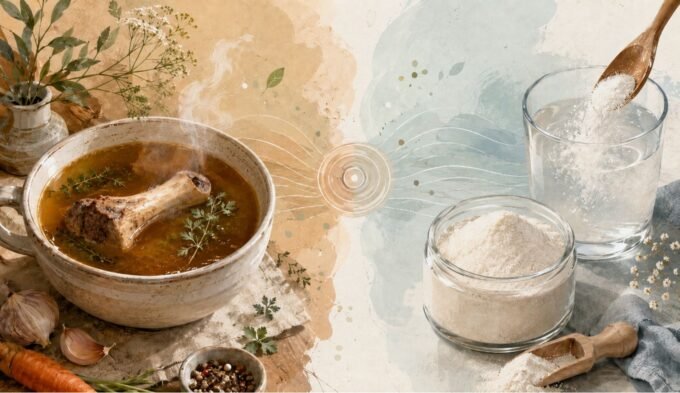
Collagen powder, in its plain form, is usually one ingredient. Bone broth powder is something else entirely: a dehydrated version of a broader food, carrying whatever was in that broth before the water got removed.
This article compares the two dry formats specifically; if you’re weighing liquid bone broth against collagen powder instead, Bone Broth vs Collagen Powder covers that decision directly.
The practical difference is not just broth vs protein
It’s tempting to think of these as two versions of the same thing. They aren’t, and the distinction matters more than it looks.
Collagen powder is generally isolated, hydrolyzed collagen peptides, a protein pulled out and processed on its own.
On the other hand, bone broth powder is a dehydrated broth or broth concentrate, meaning it started as a broader liquid food before moisture was removed. Both can technically contain collagen. Only one of them is built to be just that.
For someone managing histamine intolerance, that difference shapes how easy or hard a reaction is to interpret. A single-ingredient product gives you fewer things to evaluate, since histamine-type symptoms depend on total load and how well the body clears it, not any single food viewed in isolation [2][3].
A dehydrated broth matrix can carry several things at once.
What collagen powder usually contains
Plain collagen powder tends to be short and boring on the label, which is exactly the point. If it’s unflavored, it’s often just hydrolyzed collagen peptides, made by breaking down the larger collagen protein into smaller, water-soluble fragments [1].
That simplicity keeps formula complexity low, which is genuinely useful for testing tolerance. It doesn’t make the product guaranteed low histamine. Source quality, processing conditions, and dose still shape the real risk for any specific product, a question Is Collagen High in Histamine? addresses more broadly across collagen sources.
Collagen Peptides and Histamine covers the peptide side of the picture in more depth than this comparison needs to.
What bone broth powder usually contains
Bone broth powder’s ingredient list tells a longer story. At its core, it’s dehydrated broth solids, which can include collagen and other proteins, minerals and electrolytes pulled from the bones and connective tissue, sodium, and residual fat.
From there, commercial products vary widely. Some stay close to plain dehydrated broth. Others add natural flavors, spice blends, garlic or onion powder, yeast extract, gums for texture, or anti-caking agents to keep the powder from clumping.
Not every bone broth powder contains all of this, and reading the actual ingredient panel matters more than assuming based on the category.
Why “powder” does not mean low histamine
Here’s a detail worth sitting with: dehydration removes water, not necessarily the biogenic amines that formed before drying.
If histamine or other biogenic amines formed before dehydration, drying the liquid down does not reliably remove them [4].
In some cases, removing water can even concentrate what’s left per scoop, since you’re now getting a compressed version of the original broth rather than a diluted one.
That doesn’t mean every bone broth powder is high histamine. The powder format alone just isn’t proof either way. The manufacturing history behind that specific batch is what actually determines the outcome, and that history rarely makes it onto the label.
For a deeper look at slow-cooked broth itself, see Bone Broth and Histamine.
Bone broth powder vs collagen powder for histamine-sensitive people
| Factor | Plain collagen powder | Bone broth powder | Histamine-sensitive takeaway |
|---|---|---|---|
| Main ingredient type | Isolated hydrolyzed collagen peptides | Dehydrated broth matrix | Different starting materials entirely |
| Ingredient count | Often one, if unflavored | Frequently several, even in “plain” versions | Fewer ingredients generally means fewer things to test |
| Flavor/additive exposure | Low in unflavored versions | Common: spices, garlic/onion, natural flavors | Additives can react independent of histamine |
| Sodium/mineral load | Minimal | Can be significant, since it’s concentrated broth | Sodium load is a separate consideration from histamine |
| Histamine uncertainty | Present, but tied mainly to source and processing | Present, tied to the original broth’s cooking and storage history | Dry format alone does not prove low histamine |
| Ease of testing | Generally easier to isolate as one variable | Harder, since several ingredients move at once | Simpler formulas make pattern-tracking more reliable |
| Best use case | Testing collagen tolerance specifically | Convenience or flavor when broth is already well tolerated | Match the product to what you’re actually trying to learn |
| Higher caution situations | Flavored or fortified blends | Multi-ingredient formulas with yeast extract, spices, or gums | Read the full panel before assuming either is simple |
The table shows why this comparison is less about “broth versus collagen” and more about how many variables each product brings into the picture. For histamine-sensitive people, the simpler product is usually easier to test, but simpler does not mean risk-free.
The label matters more than the front of the tub
A tub that says “clean” or “gut healthy” on the front doesn’t tell you what’s actually inside. The ingredient panel does.
A few things worth reading for, without assuming any of them are automatically a problem: yeast extract or autolyzed yeast, hydrolyzed vegetable protein, natural or “savory” flavors, garlic powder, onion powder, spice blends, gums or thickeners, added sweeteners, probiotics, citric or other acids, and any “proprietary blend” that hides individual amounts.
High sodium per serving is also worth noting, separate from any histamine question entirely.
Some of these ingredients contain free glutamate naturally, including yeast extract and hydrolyzed vegetable protein, and a small number of people report symptoms like headache or flushing after glutamate-rich foods, even though research on that link remains mixed and it isn’t classified as a true allergic reaction [5].
The point isn’t that any single ingredient here is dangerous. It’s that a longer list gives a reaction more places to hide.
This is the same underlying problem multi-ingredient collagen formulas run into. Collagen Beauty Blends and Histamine covers that side of the equation in more depth, where sweeteners, probiotics, and botanical extracts create similar troubleshooting difficulty in a collagen product rather than a broth one.
Can collagen powder replace bone broth powder?
For collagen peptide intake, often yes. A scoop of plain collagen peptides delivers a concentrated dose of the same amino acids bone broth is known for, without the surrounding matrix.
Nutritionally, the swap isn’t exact. Bone broth powder carries minerals, sodium, and whatever else made it into that particular broth, none of which a plain collagen powder replicates. For histamine-sensitive testing specifically, plain collagen is usually the easier starting point, simply because there’s less riding along with it.
Why bone broth powder may cause side effects
Digestive upset after bone broth powder doesn’t always point to histamine. Dose size, sodium load, spice content, added gums, garlic or onion, glutamate-containing ingredients, or simply a concentrated serving of protein can each play a role on their own.
Flushing or headache could be histamine-related, or could trace back to an additive in the specific formula. Reactions that look allergic, hives, swelling, wheezing, or throat symptoms, call for stopping the product and getting medical input rather than more testing.
Collagen Powder Side Effects and Bone Broth and Histamine both go deeper into these patterns than a comparison article needs to.
When bone broth powder is not the right experiment
A handful of situations make bone broth powder a poor first test:
- You’re in an active flare or currently unstable
- You’ve reacted strongly to broth before, in any form
- You have a known meat, fish, shellfish, gelatin, or alpha-gal allergy relevant to the source
- The product lists yeast extract, spice blends, garlic or onion powder, gums, or a multi-ingredient flavor system
- You’ve had recent hives, swelling, wheezing, or chest tightness from any supplement
- You’re pregnant, breastfeeding, or managing a complex medical condition without a clinician’s input
A safety note before testing either product
Stop the product and speak with a healthcare professional if symptoms are severe, repeated, worsening, or allergy-like. A reaction to bone broth powder or collagen powder doesn’t prove histamine intolerance, MCAS, allergy, or DAO deficiency on its own.
Seek urgent medical care for throat swelling, trouble breathing, wheezing, facial, lip, or tongue swelling, fainting, severe chest tightness, rapidly spreading hives, or signs of anaphylaxis.
Don’t attempt a home re-challenge after a serious allergic reaction. If you have a known meat, fish, shellfish, poultry, pork, alpha-gal, or gelatin allergy, discuss animal-derived powders with a clinician before trying either product. The same caution applies during pregnancy or breastfeeding, or if you have kidney disease, liver disease, gout, take prescription medications, follow a protein-restricted diet, or manage a complex chronic illness. Neither product is a treatment for histamine intolerance, MCAS, DAO deficiency, leaky gut, allergy, or chronic illness [6].
The bottom line
Both products solve the same convenience problem: no simmering, no straining, no pot on the stove. That’s where the similarity ends.
Bone broth powder is usually the more complex of the two, since it’s a dehydrated version of a broader food rather than a single isolated ingredient. Plain collagen powder tends to be simpler to evaluate, though simpler doesn’t mean risk-free on its own.
For histamine-sensitive readers, the ingredient panel deserves more attention than the product category. If both formats keep causing trouble, Low Histamine Collagen Alternatives covers other ways to support the same goal.
Frequently asked questions
These common questions can help you compare bone broth powder and collagen powder more clearly, especially if you are histamine-sensitive or trying to reduce reaction variables.
Is bone broth powder the same as collagen powder?
No. Collagen powder is usually isolated hydrolyzed collagen peptides, while bone broth powder is a dehydrated version of whole broth, which can include minerals, sodium, and other ingredients beyond collagen.
Is bone broth powder high in histamine?
Not automatically, but not guaranteed low either. It depends on how the original broth was made, cooled, and stored before it was dehydrated, none of which the dry format tells you on its own.
Is collagen powder better than bone broth powder for histamine intolerance?
For testing purposes, plain collagen powder is often easier to evaluate since it usually has fewer ingredients. That doesn’t make it automatically safer, just simpler to interpret.
Can collagen powder replace bone broth powder?
For collagen and general protein support, often yes. Nutritionally, it isn’t an exact substitute, since bone broth powder carries minerals, sodium, and other components a plain collagen product doesn’t.
Does dehydration remove histamine from bone broth?
No. Dehydration removes water, not biogenic amines that already formed. If histamine built up before drying, the dry powder can still carry it, sometimes at a more concentrated level per scoop.
Why does instant bone broth powder make me react?
It could be the histamine or biogenic amine content from the original broth, or it could be sodium, spices, garlic or onion, glutamate-containing ingredients, or the concentrated protein dose. Multiple explanations are possible, and they aren’t mutually exclusive.
Is bone broth protein powder just collagen?
Not usually. It typically includes broader broth components like minerals and sodium alongside the protein, rather than being an isolated collagen product.
What ingredients should histamine-sensitive people watch for in bone broth powder?
Yeast extract, hydrolyzed vegetable protein, natural or savory flavors, garlic or onion powder, spice blends, gums, sweeteners, and high sodium content are the main items to scan the label for.
Is plain collagen powder safer than flavored bone broth powder?
It’s usually easier to evaluate because it has fewer ingredients, which is a meaningful advantage for testing. That’s a different claim from being universally safer for every person.
When should I avoid bone broth powder?
During an active flare, after a previous strong reaction to broth, with a relevant meat or fish allergy, or when the product contains multiple additives like yeast extract, spices, or gums that make troubleshooting harder.
References
- León-López A, Morales-Peñaloza A, Martínez-Juárez VM, Vargas-Torres A, Zeugolis DI, Aguirre-Álvarez G. Hydrolyzed Collagen—Sources and Applications. Molecules. 2019;24(22):4031. https://doi.org/10.3390/molecules24224031
- Maintz L, Novak N. Histamine and histamine intolerance. American Journal of Clinical Nutrition. 2007;85(5):1185–1196. https://doi.org/10.1093/ajcn/85.5.1185
- Comas-Basté O, Sánchez-Pérez S, Veciana-Nogués MT, Latorre-Moratalla M, Vidal-Carou MC. Histamine Intolerance: The Current State of the Art. Biomolecules. 2020;10(8):1181. https://pmc.ncbi.nlm.nih.gov/articles/PMC7464760/
- Gardini F, Özogul Y, Suzzi G, Tabanelli G, Özogul F. Technological Factors Affecting Biogenic Amine Content in Foods: A Review. Frontiers in Microbiology. 2016;7:1218. https://pmc.ncbi.nlm.nih.gov/articles/PMC4982241/
- Questions and Answers on Monosodium Glutamate (MSG). U.S. Food and Drug Administration. https://www.fda.gov/food/food-additives-petitions/questions-and-answers-monosodium-glutamate-msg
- Dietary Supplements. U.S. Food and Drug Administration. https://www.fda.gov/food/dietary-supplements