
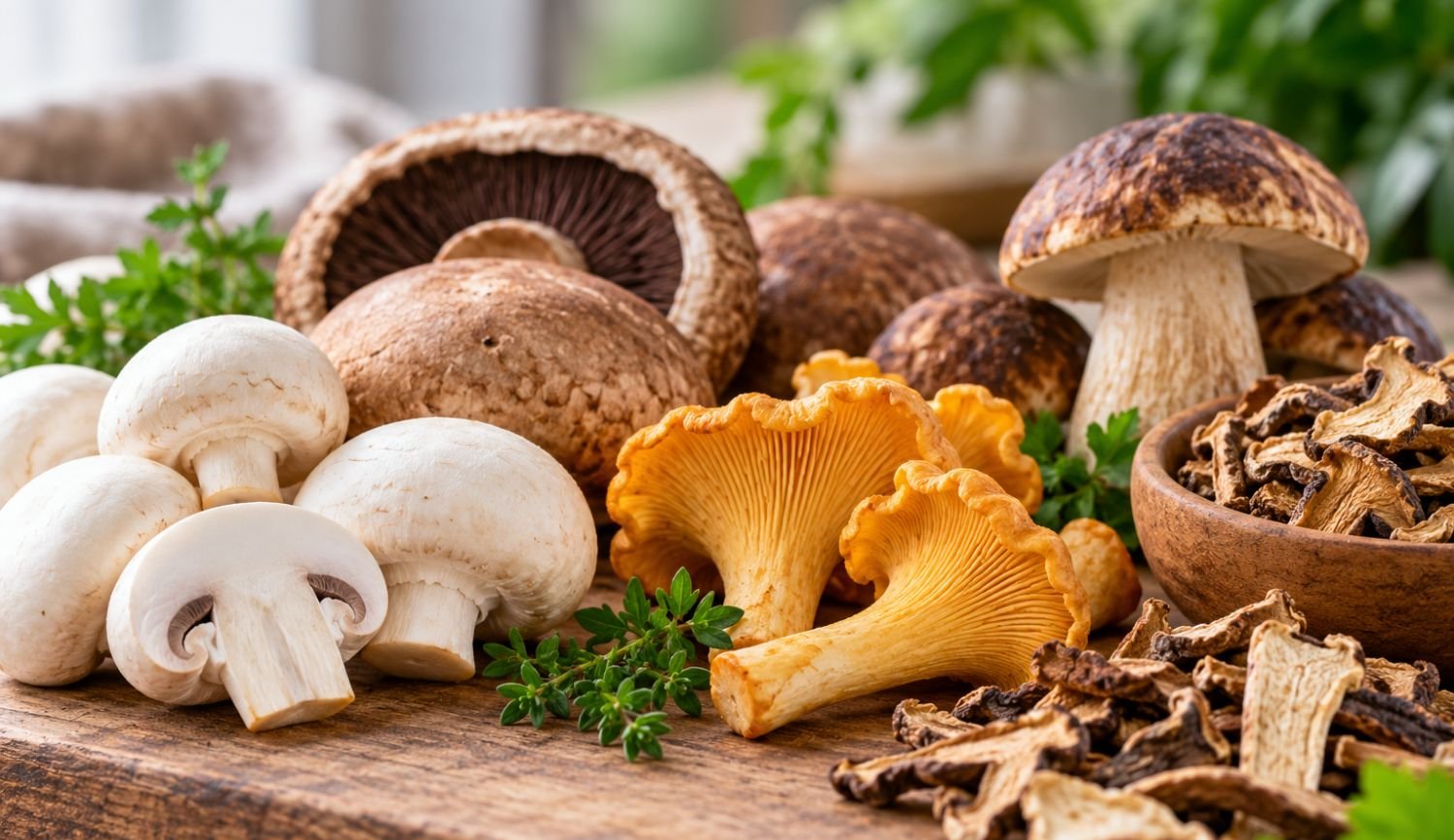
Mushrooms aren’t consistently high or low in histamine as one uniform category. Several tested fresh cultivated mushrooms had no detectable histamine, while fresh wild-market porcini and chanterelle have produced measurable and sometimes substantial values, and dried forest-mushroom products can be higher still.
A laboratory number also doesn’t predict how you will react. The sections below look at what the measurements show by type and form, so mushroom advice can be read with more precision.
Why mushroom histamine lists disagree
Most online advice gives mushrooms a single label, often moderate or low, and many food lists place them in one category. A list has to give one answer for a group of foods that includes button mushrooms from a supermarket, wild porcini from a market and dried mushrooms from a packet.
Laboratory studies measure something different: how much histamine was in particular samples. When the samples differ in species, origin and form, the results differ too, and a single label hides that. For broader category context, see the low histamine food list.
What laboratory studies found
The table sets out the main direct measurements. Wild-market values are expressed per kilogram of fresh matter, which means the mushroom as sold, not dried.
| Mushroom/product form | Evidence context | Histamine finding | What it means |
|---|---|---|---|
| Fresh cultivated commercial mushrooms | 2020 analysis of fresh commercial species, including Agaricus bisporus, Pleurotus species and shiitake-related samples | Histamine was below the study’s detection limit in several tested samples | Several fresh cultivated mushrooms had no detectable histamine, but this doesn’t prove every product is free of it |
| Fresh wild-market chanterelle | 2023 Austrian market study | Not detected to 95.7 mg/kg fresh matter | Large differences between samples, from none detected to a substantial value |
| Fresh wild-market porcini | Same 2023 study | Not detected to 407.0 mg/kg fresh matter | Even wider spread, and not every sample was high |
| Dried forest-mushroom products | 2020 analysis of 53 processed and unprocessed products on the Polish market | Histamine was particularly detected in dried forest-mushroom samples, with high variability between products | Product form matters, but not every dried mushroom is high |
Are mushrooms low histamine?
Not as one universal category. Several tested fresh cultivated mushrooms had histamine below the study’s detection limit, which supports a lower-histamine interpretation for those specific tested products. But fresh wild-market porcini and chanterelle showed much wider values, and dried forest-mushroom products formed a different evidence category.
So if you are asking whether mushrooms contain histamine, the most accurate answer is that some samples do and some tested samples did not. The useful question is which mushroom, in what form, and from what handling context rather than whether every mushroom belongs on one low-histamine list.
Do cultivated and wild mushrooms behave differently?
In these datasets, yes. In the 2020 analysis of fresh commercial species, histamine was below the study’s detection limit in several tested samples, including Agaricus bisporus products such as button/champignon and portobello mushrooms, Pleurotus (oyster-type) mushrooms and shiitake-related samples.
The 2023 Austrian market study of fresh chanterelle and porcini found something different. Values ranged from not detected to 95.7 mg/kg in chanterelle and to 407.0 mg/kg in porcini, so fresh wild mushrooms can’t simply inherit the cultivated-mushroom result.
That is not the same as saying every porcini or chanterelle is high in histamine. Some samples had none detected. What the data show is that the variability is real, and it is wider in the wild-market samples than in the cultivated ones.
What about dried and processed mushrooms?
A 2020 market study analyzed 53 processed and unprocessed mushroom products from Poland. Histamine was particularly detected in dried forest-mushroom samples, and it varied a lot from one product to the next.
This is a product-form distinction, not proof that drying creates histamine, and not proof that every dried mushroom is high. Possible contributors include the history of the raw material, microbial quality, processing, storage and concentration effects. The evidence doesn’t separate these into one universal cause.
It also doesn’t show that soaking or rehydrating removes histamine from a product that contains it. Product quality and microbial history can matter in some market samples, but storage does not produce a predictable histamine rise in every mushroom. In a 1997 experiment, four mushroom species stored at 6°C or 20°C had no detectable histamine, and the researchers found no unambiguous effect of storage temperature on measured amine levels. That makes a simple rule such as ‘older mushrooms automatically become high histamine’ too strong.
Do mushrooms contain other amines, and does that matter?
Mushrooms can contain several biogenic amines even when histamine isn’t detected. A 2020 study of eight fresh commercial species found spermidine in all of them, with tyramine, tryptamine and phenylethylamine in some species. Cadaverine and putrescine were present at low levels.
Those compounds are not histamine, and their presence doesn’t make mushrooms a high-histamine food. It is also sometimes claimed that mushroom putrescine or cadaverine blocks DAO enough to cause histamine intolerance symptoms. That mushroom-specific mechanism hasn’t been established in people.
Are mushrooms histamine liberators?
Not as a proven fact. Some food lists label mushrooms as histamine liberators, but a label on a list is not analytical proof, and no mushroom-specific histamine-release mechanism has been demonstrated.
The 2021 multi-society guideline on suspected adverse reactions to ingested histamine doesn’t support broad food avoidance based on poorly established liberator mechanisms. A reaction you have noticed can still be real. It just doesn’t show that the mushroom released histamine.
Is shiitake high in histamine?
The fresh commercial evidence doesn’t justify a blanket claim that shiitake is high in histamine. Shiitake-related samples were part of the fresh cultivated group in which histamine was below the detection limit.
Shiitake can cause a different problem. Raw or undercooked shiitake is associated with shiitake dermatitis, an itchy flagellate (whip-like streaked) rash thought to involve a compound called lentinan. It is a separate condition and doesn’t indicate excess histamine or histamine intolerance.
Is mushroom coffee high in histamine?
Mushroom coffee is a formulated beverage, not plain mushrooms, so plain-mushroom data can’t classify it. What matters is the mushroom species or extract used, how much of it, the coffee content, the other ingredients and the processing.
Without product-specific testing, the honest answer is that it can’t be assigned a histamine category from the evidence above.
How to use this on your own plate
Species and product form matter more than the word mushroom. Fresh cultivated button or oyster-type mushrooms cannot automatically be treated the same as wild-market porcini or dried forest-mushroom products. Your own tolerance still can’t be predicted from a laboratory number.
If mushrooms seem to bother you, a structured approach of noting what you ate and how you felt, with clinician or dietitian input where appropriate, can tell you more than permanent avoidance. For categories with a stronger measured-histamine rationale, see high histamine foods.
References
- Reis GCL, et al. Investigation of biologically active amines in some selected edible mushrooms. J Food Compos Anal. 2020;86:103375.
- Bak A, et al. Nutritional properties, microbial and sensory quality, and formation of biogenic amines in wild-grown mushrooms (Cantharellus cibarius & Boletus edulis) from Austrian local markets. Food Chem Adv. 2023;2:100193.
- Jabłońska-Ryś E, et al. Determination of biogenic amines in processed and unprocessed mushrooms from the Polish market. J Food Compos Anal. 2020;92:103492.
- Kalač P, Křížek M. Formation of biogenic amines in four edible mushroom species stored under different conditions00170-7). Food Chem. 1997;58(3):233-236.
- Reese I, et al. Guideline on management of suspected adverse reactions to ingested histamine. Allergol Select. 2021;5:305-314.
- Stephany MP, et al. Shiitake Mushroom Dermatitis: A Review. Am J Clin Dermatol. 2016;17(5):485-489.