
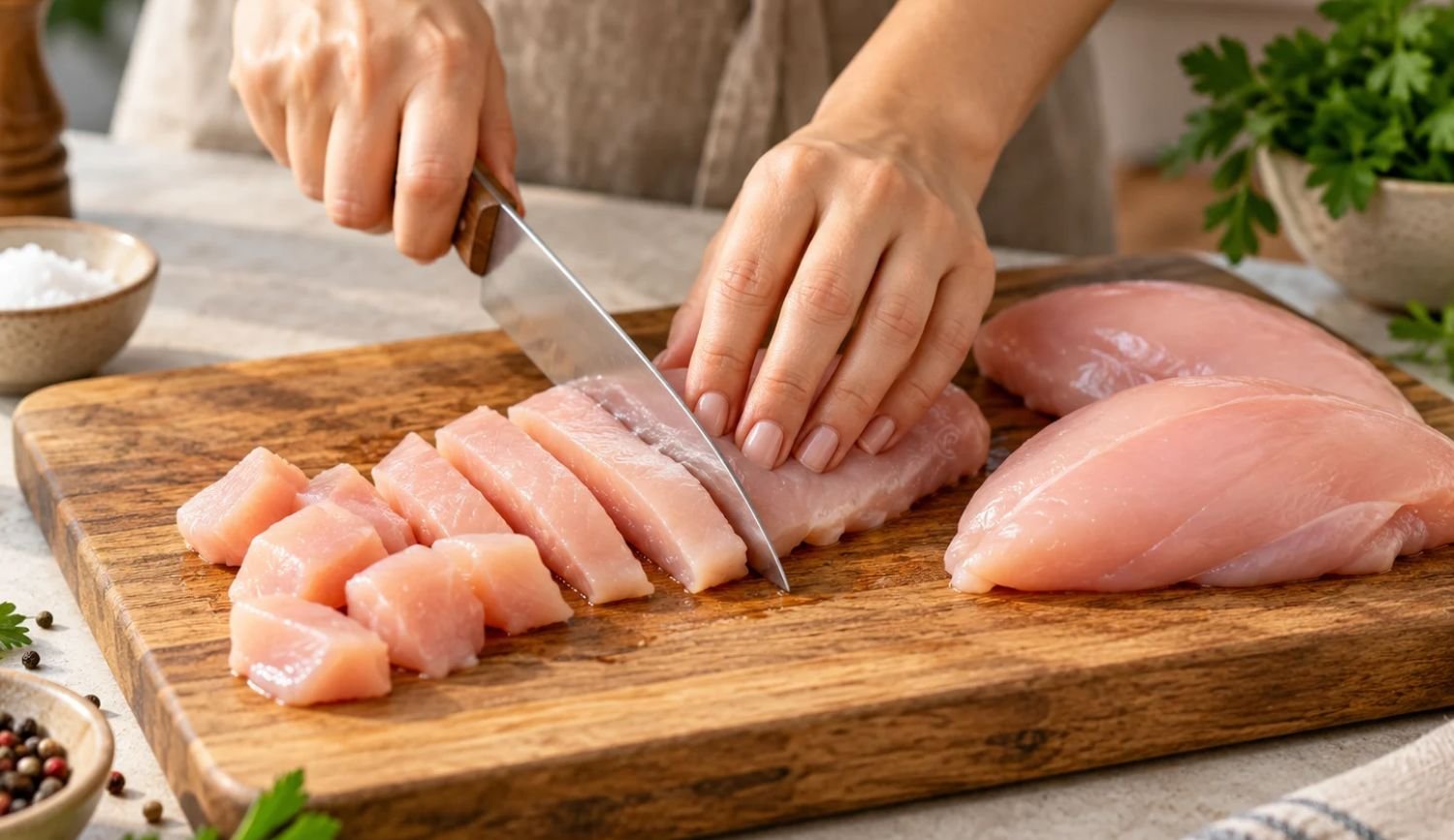
Fresh, well-handled chicken is generally low in measured histamine, so it is not best described as an inherently high-histamine food. But chicken is not histamine-free, and its histamine level can change with storage and microbial activity.
Controlled studies have reported low or low-single-digit amounts in fresh or early-storage chicken, with different patterns over time. For a low-histamine approach, freshness and storage history matter more than choosing breast over thigh or following a rigid leftover-hour rule.
Is chicken high in histamine?
Based on the controlled studies reviewed for this page, fresh chicken is generally low in measured histamine. That supports calling it a reasonable protein in a low-histamine approach. It does not support calling it histamine-free.
Different studies report different baseline values and different changes over time. No single milligram-per-kilogram number describes every piece of chicken, because supply-chain history varies. Analytical food values should not be treated as universal symptom thresholds; the 2021 guideline by Reese and colleagues emphasizes the diagnostic uncertainty around suspected adverse reactions to ingested histamine.
Broader food lists disagree on many items. Sánchez-Pérez and colleagues (2021) found no consensus on what counts as a “low histamine” content and noted uncertainty around other biogenic amines.
What studies actually measured in chicken
Four studies give the most useful direct data. They used different chicken, storage conditions and methods, so they are best read side by side rather than merged into one number.
| Study | Chicken tested | Storage condition | Histamine finding | What it means |
|---|---|---|---|---|
| Triki et al. 2018 | Chicken breast | Chilled at 2°C | 0.53 mg/kg on day 0, 1.23 on day 3, 1.73 on day 6, 2.11 on day 10 | Low values in fresh and early-storage breast, rising gradually in this study |
| Balamatsia et al. 2006 | Chicken breast fillets | Aerobic or modified atmosphere packaging at 4°C, up to 17 days | Histamine formation observed only after day 11 | Formation tracked microbial growth (Enterobacteriaceae around 107 CFU/g), not a daily rate |
| Wojnowski et al. 2019 | Ground chicken breast (example batch) | Stored at 4°C | About 1.48, 1.43, 4.29, 4.09 and 3.84 mg/kg on days 1 to 5 | Low-single-digit values; the trajectory was not a steady climb |
| Silva & Glória 2002 | Breast and thigh, plus chicken-based products | 4 ± 1°C after slaughter | Low histamine in thigh right after slaughter; breast higher than thigh by day 15 | No fixed breast-thigh hierarchy; processed products varied |
These values are study-specific. The Triki numbers, for example, are not “the” histamine value of chicken. They do not tell you how long to keep chicken, and they are not symptom thresholds.
A small 2021 study by Saewa and colleagues, which examined breast and thigh under refrigeration and freezing, reported generally low values with variation by condition and time. Its sample set was small, so it adds context but not a ranking.
Why freshness and storage matter more than a fixed number
Histamine forms when histamine-producing microorganisms have suitable time and conditions. That is why storage history matters. The cold chain, temperature, packaging and starting microbial load all play a part, as Naila and colleagues (2010) describe in their review of biogenic amine control.
The studies above show that the pattern is not uniform. In Triki’s work, histamine climbed gradually over ten days. In Balamatsia’s, it appeared only after day 11, when bacterial counts had grown. In Wojnowski’s ground-breast batch, it jumped on day 3 and then eased slightly.
There is no universal hourly increase, and histamine does not necessarily rise smoothly every day. Treat these studies as laboratory observations, not as a guide to how long to keep raw chicken. Normal food-safety storage guidance applies.
Other amines matter here too, but they are not histamine. Balamatsia’s group found putrescine and cadaverine rose with storage well before histamine appeared. Wojnowski and colleagues found that an overall biogenic-amine index rose sharply after day 2, largely because of cadaverine. An index is not a histamine measurement, and these amines do not prove anything clinical about DAO.
Is chicken breast lower in histamine than thigh?
There is no stable, evidence-based hierarchy. Silva and Glória (2002) detected low histamine in thigh immediately after slaughter. After prolonged storage at 4°C, by day 15, the breast had higher histamine and total amines than the thigh.
Other studies analyzed breast only, so they cannot settle the comparison. A rule that breast is always lower, or that thigh is inherently high, goes beyond the data. Storage and handling history is the more defensible variable.
What about ground and processed chicken?
Processed and ground forms are where uncertainty grows, because the product history is less visible. The evidence here is thinner, so the honest answer is often “it depends.”
Ground chicken
Grinding increases exposed surface and handling, so ground chicken is more sensitive to how it is handled. That does not make it automatically high in histamine. Wojnowski’s ground-breast samples were in the low single digits across the five days studied, though this was one batch and does not represent all ground chicken.
Rotisserie and canned chicken
We did not verify a direct dataset on supermarket rotisserie chicken. It has less transparent holding time, storage and ingredient history than chicken you cook at home. That uncertainty is the evidence-based point, and it does not make rotisserie chicken high in histamine.
For canned chicken, we also did not find a dataset sufficient for a universal rating. Shelf-stable processing means it should not inherit the fresh-breast evidence automatically. The available evidence is not sufficient to assign canned chicken a universal high- or low-histamine rating.
Sausage, nuggets and other processed forms
Silva and Glória analyzed several chicken-based products. Chicken sausage had higher total biogenic amines than the other products tested, but total amines are not the same as histamine, so that cannot be turned into a histamine number. Nuggets had an amine profile most similar to fresh chicken among the tested products.
That does not prove every nugget product is low in histamine. Ingredients and storage still vary from product to product.
Chicken liver
We did not verify direct chicken-liver evidence sufficient for a universal classification. Generic food lists often group organ meats together, but that does not establish the histamine content of chicken liver.
Does cooking or freezing change histamine?
Cooking can kill microorganisms, but it does not reliably destroy histamine that has already formed. Histamine is heat stable, as Naila and colleagues note. Boiling, poaching, grilling and frying should not be ranked as low-to-high histamine methods, because moisture loss or transfer can change concentration without the food creating or destroying histamine.
Freezing is a preventive storage tool, not a way to remove histamine. It can slow or prevent additional microbial histamine formation while the chicken remains frozen. It cannot undo histamine that accumulated beforehand, and the history of a frozen product before it was frozen may be unknown.
Moreira and colleagues (2008) illustrate how sensitive handling can be. In their 8-hour aging experiment, histamine formation was associated with aging temperatures above 4.9°C, and histamine was detected after long frozen storage in that design. Those experimental conditions do not establish a household histamine-intolerance cutoff.
What about leftover chicken?
No validated universal 24-hour or 48-hour cutoff for histamine intolerance was identified. Chicken does not become “high histamine” at an exact hour, and reheating does not remove histamine that has formed.
A few bounded habits are reasonable if dietary histamine is a concern:
- minimize unnecessary storage time
- follow standard food-safety storage guidance
- cool and store cooked chicken appropriately
- freeze portions promptly when that is useful
Tolerance also varies between individuals. Refrigeration slows formation but does not stop it entirely.
Is chicken a histamine liberator?
Reliable human evidence does not establish ordinary chicken as a clinically proven histamine liberator. The broader “histamine liberator” mechanism has not been established in reliable human evidence, as Reese and colleagues and Sánchez-Pérez and colleagues discuss. Our guide to histamine liberator foods covers the broader theory.
Why might chicken still cause symptoms?
A reaction to chicken does not establish histamine intolerance. Several explanations are possible:
- a true poultry allergy
- ingredients in marinades, breading, sauces, brines or seasonings
- product-specific storage or processing
- another food eaten in the same meal
- nonspecific symptoms or another medical cause
- individual tolerance variation
True poultry-meat allergy is uncommon but real, and it is a different mechanism. Hemmer and colleagues (2016) describe genuine primary poultry allergy and the separate bird-egg syndrome, with symptoms that can include oral and gastrointestinal symptoms, hives and swelling. Severe anaphylaxis is uncommon but possible, and chicken and turkey can cross-react.
Immediate hives, swelling, breathing difficulty, faintness or other systemic symptoms need appropriate medical or emergency evaluation rather than deliberate home rechallenge. Our comparison of histamine intolerance and food allergies explains how the two differ.
Practical ways to keep chicken handling simple
This is a way to keep handling simple, not a guaranteed low-histamine protocol. Buy chicken you plan to use soon. Keep it cold, cook it promptly and freeze portions promptly when you do not plan to eat them soon.
Check ingredient lists on marinated, breaded or seasoned products. For broader context on what else to eat, see our low histamine food list.
If you want a simple recipe, the low histamine chicken rice bowl is one route. If you are looking for chicken broth, that is covered separately in bone broth and histamine.
Frequently asked questions
These answers are short, since the sections above give the detail.
Is chicken low histamine?
Fresh, well-handled chicken is generally low in measured histamine, but it is not histamine-free.
Is chicken breast lower histamine than thigh?
Not reliably. Current evidence does not support a stable hierarchy.
Is ground chicken low histamine?
It is more handling-sensitive, but not automatically high. Freshness and storage matter.
Is rotisserie chicken high in histamine?
We did not verify direct data. Its holding and storage history is less transparent, so uncertainty is the main point.
Are chicken nuggets high in histamine?
In one study, nuggets had an amine profile closest to fresh chicken among the tested products. That does not apply to every product.
Is chicken liver high in histamine?
We did not verify direct evidence for a universal classification.
Does freezing chicken reduce histamine?
No. Freezing limits further formation while frozen, but it does not remove histamine that has already formed.
Does reheating chicken remove histamine?
No. Heat does not reliably destroy histamine that has formed.
The bottom line
Fresh, well-handled chicken is generally low in measured histamine, but “histamine-free” is too absolute. How the chicken was stored and handled tells you more than whether it is breast or thigh.
There is no validated leftover cutoff, and freezing and cooking do not remove histamine that has formed. If a reaction follows chicken, treat it as information to investigate rather than proof of histamine intolerance, and seek prompt evaluation for anything severe.
References
- Triki M, Herrero AM, Jiménez-Colmenero F, Ruiz-Capillas C. Quality Assessment of Fresh Meat from Several Species Based on Free Amino Acid and Biogenic Amine Contents during Chilled Storage. Foods. 2018;7(9):132. doi:10.3390/foods7090132. PMID:30149617.
- Balamatsia CC, Paleologos EK, Kontominas MG, Savvaidis IN. Correlation between microbial flora, sensory changes and biogenic amines formation in fresh chicken meat stored aerobically or under modified atmosphere packaging at 4°C: possible role of biogenic amines as spoilage indicators. Antonie Van Leeuwenhoek. 2006;89(1):9–17. doi:10.1007/s10482-005-9003-4. PMID:16528580.
- Silva CMG, Glória MBA. Bioactive amines in chicken breast and thigh after slaughter and during storage at 4±1°C and in chicken-based meat products. Food Chem. 2002;78(2):241–248. doi:10.1016/S0308-8146(01)00404-6.
- Wojnowski W, Kalinowska K, Majchrzak T, Płotka-Wasylka J, Namieśnik J. Prediction of the Biogenic Amines Index of Poultry Meat Using an Electronic Nose. Sensors (Basel). 2019;19(7):1580. doi:10.3390/s19071580. PMID:30939836.
- Moreira APS, Giombelli A, Labanca RA, Nelson DL, Glória MBA. Effect of Aging on Bioactive Amines, Microbial Flora, Physico-Chemical Characteristics, and Tenderness of Broiler Breast Meat. Poult Sci. 2008;87(9):1868–1873. doi:10.3382/ps.2007-00370. PMID:18753456.
- Naila A, Flint S, Fletcher GC, Bremer PJ, Meerdink G. Control of Biogenic Amines in Food: Existing and Emerging Approaches. J Food Sci. 2010;75(7):R139–R150. doi:10.1111/j.1750-3841.2010.01774.x. PMID:21535566.
- Sánchez-Pérez S, Comas-Basté O, Veciana-Nogués MT, Latorre-Moratalla ML, Vidal-Carou MC. Low-Histamine Diets: Is the Exclusion of Foods Justified by Their Histamine Content?. Nutrients. 2021;13(5):1395. doi:10.3390/nu13051395. PMID:33919293.
- Reese I, Ballmer-Weber B, Beyer K, et al. Guideline on management of suspected adverse reactions to ingested histamine. Allergol Select. 2021;5:305–314. doi:10.5414/ALX02269E. PMID:34651098.
- Hemmer W, Klug C, Swoboda I. Update on the bird-egg syndrome and genuine poultry meat allergy. Allergo J Int. 2016;25:68–75. doi:10.1007/s40629-016-0108-2. PMID:27340614.
- Saewa S, Khidhir Z, Al Bayati M. The impact of storage duration and conditions on the formation of biogenic amines and microbial content in poultry meat. Iraqi J Vet Sci. 2021;35(1):183–188. doi:10.33899/ijvs.2020.126584.1346.